

There is no government salary figure for Pilates studio owners. What an owner makes is the studio’s profit plus any wage the owner pays themself, so it swings with class fill. The best public data point is the Club Pilates franchise disclosure document: its 849 US studios open all of 2024 averaged $984,270 in gross revenue, with a median of $969,022, per Item 19 of the Club Pilates FDD (February 2026 amendment). The FDD does not disclose costs or profit, so the owner-pay numbers on this page are my own labeled calculations.
Short answer: On my model, an independent 10-reformer studio pays its owner about $13,000 a year at 35% class fill, $66,000 at 50% and $137,000 at 70%, before income tax. A Club Pilates franchisee with average revenue ($984,270 in 2024, FDD) could keep roughly $280,000 a year after debt service if costs match my stated assumptions; a bottom-quartile studio about $146,000. Employed instructors earn a median $47,160 (BLS, May 2025).
Below: what each primary source actually measures, the Club Pilates revenue and membership data by quartile, Census numbers for every fitness business with a payroll, two worked P&Ls (independent and franchise) with every assumption shown, a startup cost worksheet priced from the manufacturer and the FDD, and a pass/fail check to run before you sign a lease.
How much does a Pilates studio owner make? What each source measures
No dataset counts Pilates studio owners’ pay directly. These are the closest primary numbers, and each one measures something different.
| Source and period | What it measures | Figure | Notes |
|---|---|---|---|
| Club Pilates FDD Item 19, calendar 2024 | Average gross revenue per franchised studio open all year | $984,270 (median $969,022) | 849 “Qualified Studios”; range $356,528 to $2,325,810. Revenue only, no costs |
| Club Pilates 2026 FDD, fiscal 2025, as reported by 1851 Franchise | Same measure, next year | $987,800 (median $978,300) | 1,005 studios; reported, not read in the FDD itself |
| Xponential Fitness 10-K, 2025 | Average unit volume across all five brands (Club Pilates, Pure Barre, YogaSix, StretchLab, BFT), North America | $695,000 (LTM) | Club Pilates is not broken out. Same store sales growth was 0% in 2025 |
| Census SUSB, 2022, NAICS 713940 | Revenue per location, all fitness and recreational sports centers with employees | $928,640 | $37.88B ÷ 40,786 locations (my calculation). Pilates studios are not counted separately |
| Census Nonemployer Statistics, 2022, NAICS 7139 | Revenue per one-person business, other amusement and recreation (includes solo fitness and instruction businesses) | $45,661 | $6.41B ÷ 140,432 businesses (my calculation) |
| IRS SOI Table 1, tax year 2023 | Net profit of sole proprietors that made money, amusement, gambling and recreation industries | $19,986 average; 23.7% margin | $2.38B ÷ 119,272 returns (my calculation). Broad category, many side businesses |
| BLS Occupational Outlook Handbook, May 2025 | Median wage, employed fitness trainers and instructors | $47,160 ($22.67 an hour) | Excludes the self-employed. Your opportunity cost if you teach for someone else |
Read it this way: a mature franchised reformer studio grosses close to $1 million, a typical fitness business is far smaller, and the owner’s share depends on how much of that revenue survives payroll, rent and debt. Revenue is not salary. A studio grossing $984,270 can still pay its owner less than an instructor’s wage if fill is low and the lease is heavy.
Owner pay is salary plus profit
If you own an LLC taxed as a sole proprietorship, there is no salary: you take draws, and your pay is the studio’s net profit. If you elected S corporation status, you pay yourself a wage through payroll and take the remaining profit as distributions. Either way, the number to compare with a job offer is owner earnings: profit before any owner pay, plus the owner wage if you run one through payroll. That is the figure in my P&L tables below.
How much do Pilates studios earn? Club Pilates revenue and members by quartile
Club Pilates is the only Pilates brand whose studio-level revenue I could verify from a disclosure document. Item 19 ranks the 849 qualified studios by 2024 gross revenue and by average monthly active members.
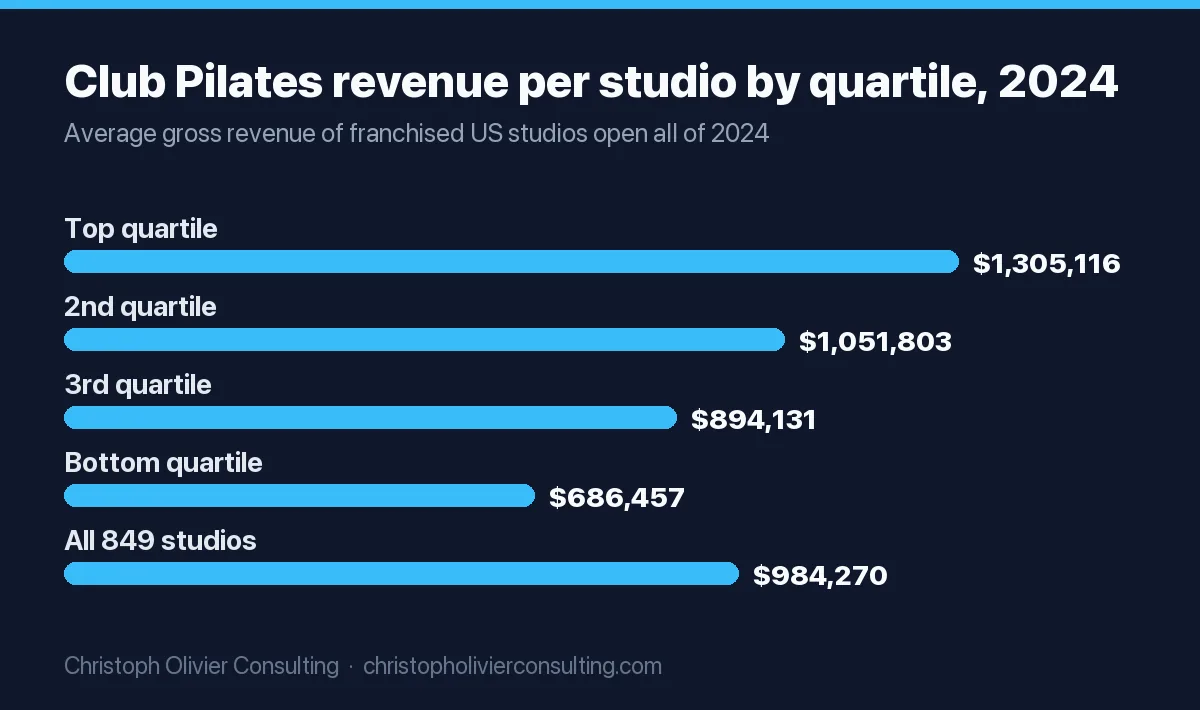
| Quartile (2024) | Studios | Average gross revenue | Revenue range | Average monthly active members | Revenue per member per month |
|---|---|---|---|---|---|
| Top quartile | 212 | $1,305,116 | $1,142,347 to $2,325,810 | 568 | $191 |
| 2nd quartile | 212 | $1,051,803 | $969,985 to $1,141,717 | 469 | $187 |
| 3rd quartile | 213 | $894,131 | $811,438 to $969,022 | 407 | $183 |
| Bottom quartile | 212 | $686,457 | $356,528 to $811,436 | 318 | $180 |
| All qualified studios | 849 | $984,270 | $356,528 to $2,325,810 | 440 | $186 |
| Expanded studios (more than 12 reformers) | 11 | $1,477,615 | $736,077 to $2,350,170 | 619 | $199 |
Source: Club Pilates FDD (February 2026 amendment), Item 19, Parts A-1 and A-2. Revenue and member quartiles are ranked separately, so the revenue per member column is my calculation (average revenue ÷ average members ÷ 12) and is approximate.
Three things in Item 19 matter for owner income:
- Membership is the business. Recurring memberships were 87% of average gross revenue, services such as privates and class packs 8%, retail 3% and fees 1% (Part C). Your income lives or dies on monthly members, not drop-ins.
- Every studio adds members constantly. The average qualified studio signed 42 new memberships a month in 2024; the bottom quartile signed 29 (Part A-3). With roughly 440 active members, that churn replacement is the marketing job.
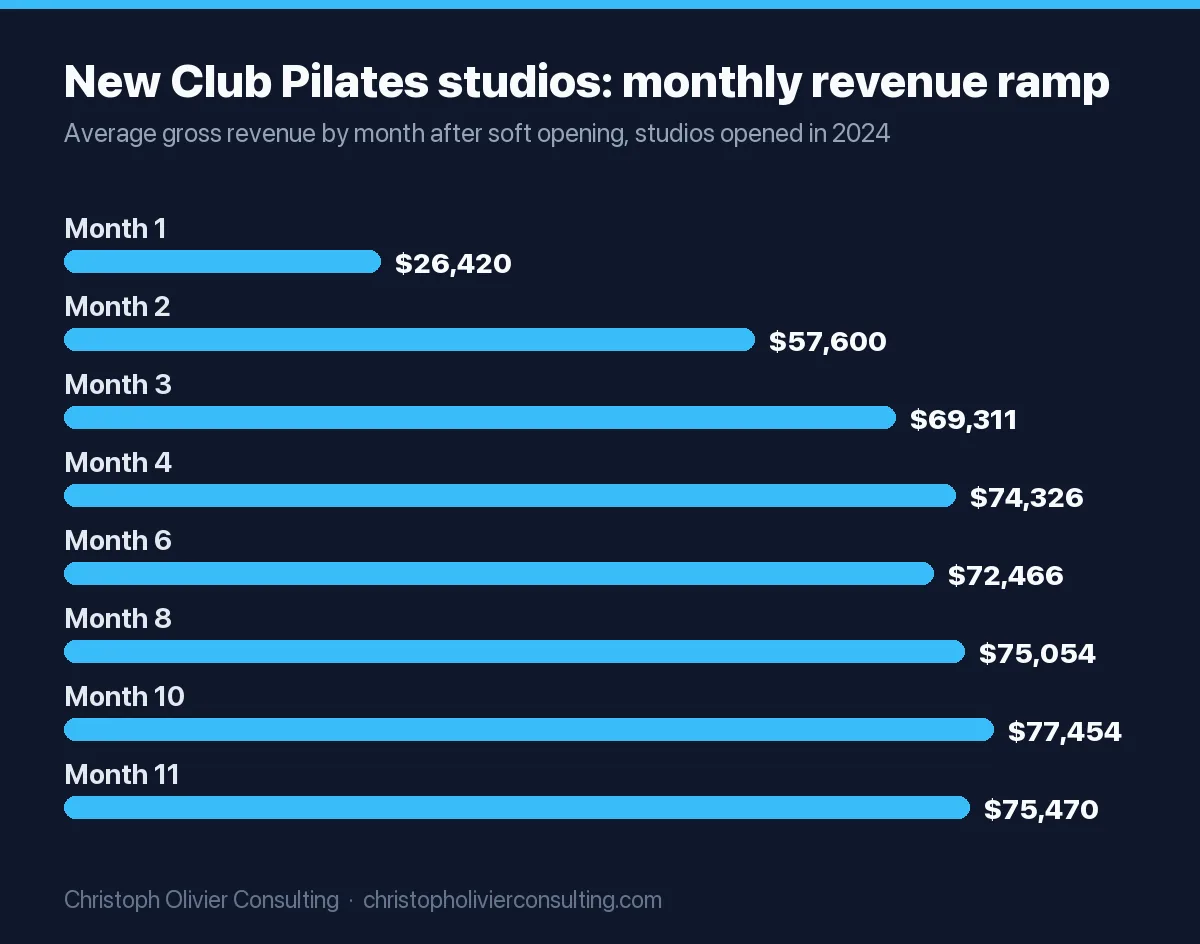
- The ramp is fast when pre-sales work. New studios that soft-opened in 2024 averaged 285 active members and $26,420 in revenue in month one, $69,311 by month three, and between about $75,000 and $82,000 a month from month eight onward (Part B). That is the franchise pre-sale machine; an independent opening without one should model a slower ramp.
For context on the wider brand system: Xponential reported 1,414 operating Club Pilates studios globally at the end of 2025, and across all its brands 92 North American studios stopped operating during 2025, against 2,446 open at the start of the year, per its 2025 10-K. The same filing says about 30% of its global license obligations were more than 12 months behind their development schedule.
What a typical small fitness studio brings in
Census does not publish Pilates studios on their own; studios with employees are counted with gyms and other fitness centers under NAICS 713940. The distribution still tells you where an independent sits. I calculated the shares, averages and payroll ratios from the SUSB 2022 file.
| Company annual revenue | Companies | Share | Cumulative | Average revenue | Payroll as % of revenue |
|---|---|---|---|---|---|
| Under $100,000 | 7,160 | 21.5% | 21.5% | $46,890 | 35.9% |
| $100,000 to $499,999 | 15,292 | 46.0% | 67.6% | $258,248 | 31.9% |
| $500,000 to $999,999 | 5,198 | 15.6% | 83.2% | $691,542 | 33.0% |
| $1M to $2.49M | 3,557 | 10.7% | 93.9% | $1,507,794 | 31.0% |
| $2.5M to $4.99M | 1,036 | 3.1% | 97.0% | $3,236,946 | 34.4% |
Source: U.S. Census Bureau, Statistics of U.S. Businesses 2022, NAICS 713940, employer firms only. Companies above $5 million are omitted. Shares, averages and ratios are my calculations.
The median fitness company with a payroll takes in between $100,000 and $499,999 a year, and payroll eats about 31% to 33% of revenue in every band where a studio is likely to sit. An average Club Pilates studio would rank in the top fifth of all US fitness companies by revenue. I use the 32% payroll ratio in both P&Ls below.
Pilates studio profit margin: what is disclosed and what is not
“Profit margin” gets quoted loosely. Here is what the primary data does and does not say:
- Club Pilates does not disclose studio costs or profit. Item 19 is revenue, members and revenue mix only. Anyone quoting a Club Pilates “profit margin” is estimating.
- IRS: sole proprietors in amusement, gambling and recreation (a broad group that includes fitness centers) kept 6.2% of receipts as net profit across all returns and 23.7% among returns with a profit in tax year 2023, per IRS Statistics of Income (my calculation).
- Studio survey: The BFS Network’s 2024 State of the Industry report drew 369 studio submissions, of which 214 were profitable and 17% ran margins above 20%, as reported by Athletech News. The report says Pilates studios consistently report higher margins than other studio types and that 65% of Pilates studios charge $200 or more a month. It is a self-selected survey, not a census.
So a realistic answer to “is a Pilates studio profitable” is: about 58% of surveyed boutique studios were (214 of 369, my calculation), and a 20%+ margin puts you in the top fifth. My models below land between 5% and 29% for an independent, depending almost entirely on class fill. If you want the cross-industry context, my profit margin by industry breakdown shows where fitness sits against other service businesses.
Worked P&L: a 10-reformer independent studio at three fill rates
This is my own calculation, not reported data. Every input is labeled so you can swap in your lease, your prices and your schedule.
Assumptions (mine):
- 50 reformer classes a week, 10 reformers, so 500 spots a week. The 6-reformer column runs 30 classes and the owner teaches 24 of them.
- Each member visits 1.6 times a week. Anchor: Xponential reported 59.2 million visits in 2025 and about 704,000 actively paying members, roughly 84 visits per member a year (my calculation from the 10-K; includes livestream visits).
- $186 revenue per member per month, the Club Pilates 2024 average from the quartile table above.
- Payroll (instructors, front desk, a part-time manager, payroll taxes) at 32% of revenue, the Census ratio for fitness companies. In the 6-reformer column, payroll is 6 hired classes a week at $40 a class plus 10% taxes.
- Rent at $40 per square foot per year all in: 1,800 square feet for 10 reformers, 1,200 for 6. Xponential says its studios run 1,500 to 2,500 square feet. Replace this with your quote; it is the input that varies most by market.
- Marketing 5%, card processing and software 4%, other operating costs (utilities, insurance, cleaning, repairs, music licensing, supplies) 8% of revenue.
- Build-out and equipment loan: $200,000 over 7 years at 9% ($39,738 a year); $100,000 for the 6-reformer studio ($19,869 a year).
- The owner draws no wage inside these costs, so the bottom line is owner earnings before income tax.
| Annual line (own calculation) | 6 reformers, owner teaches, 65% fill | 10 reformers, 35% fill | 10 reformers, 50% fill | 10 reformers, 70% fill |
|---|---|---|---|---|
| Visits per week | 117 | 175 | 250 | 350 |
| Members (visits ÷ 1.6) | 73 | 109 | 156 | 219 |
| Revenue (members × $186 × 12) | $163,215 | $244,125 | $348,750 | $488,250 |
| Payroll | $13,728 | $78,120 | $111,600 | $156,240 |
| Rent | $48,000 | $72,000 | $72,000 | $72,000 |
| Marketing (5%) | $8,161 | $12,206 | $17,438 | $24,412 |
| Processing and software (4%) | $6,529 | $9,765 | $13,950 | $19,530 |
| Other operating (8%) | $13,057 | $19,530 | $27,900 | $39,060 |
| Loan payments | $19,869 | $39,738 | $39,738 | $39,738 |
| Owner earnings before income tax | $53,871 | $12,766 | $66,124 | $137,269 |
| Margin | 33.0% | 5.2% | 19.0% | 28.1% |
What the model says:
- Break-even is about 100 members (32% fill) for the 10-reformer studio under these assumptions. Below that, the owner is paying to work.
- Each point of fill is worth about $3,600 a year. Moving from 50% to 70% fill adds $71,145 to owner earnings because rent and the loan do not grow with members.
- The small studio is a job, not a business. $53,871 for teaching 24 classes a week is close to the BLS instructor median of $47,160, plus the risk of a lease and a loan. That is fine if you want it, but price it as a job.
- Price matters as much as fill. At $160 per member instead of $186, the 50%-fill studio earns about $25,000 less (my calculation: 156 members × $26 × 12 = $48,672 of revenue, less the 49% of it that variable costs would have taken). My pricing strategy guide covers how to test a price increase without losing members.
How much does a Club Pilates franchise owner make?
Club Pilates lists a $65,000 initial franchise fee, an 8% royalty and a 2% marketing fund contribution on its franchise FAQ, and Xponential’s 10-K says royalty rates across its brands typically run 7% to 8% of gross sales. Franchise Direct reports the 2026 FDD also requires local advertising of the greater of $1,500 or 2% of the prior month’s gross sales and a $550 monthly technology fee (reported by Franchise Direct).
The P&L below applies those fees to the three Item 19 revenue levels. Payroll (32%), rent (2,000 square feet at $40) and other operating costs (12%, higher than the independent to cover the franchise’s software, retail and staffing standards) are my assumptions, because the FDD does not disclose costs. Debt service assumes $400,000 borrowed over 10 years at 10%, about 72% of Xponential’s $554,000 weighted average initial franchisee investment in 2025.
| Annual line (own calculation) | Bottom quartile average | All-studio average | Top quartile average |
|---|---|---|---|
| Gross revenue (FDD Item 19, 2024) | $686,457 | $984,270 | $1,305,116 |
| Royalty (8%) | $54,917 | $78,742 | $104,409 |
| Brand fund (2%) | $13,729 | $19,685 | $26,102 |
| Local advertising (greater of $18,000 or 2%) | $18,000 | $19,685 | $26,102 |
| Technology fee ($550 a month) | $6,600 | $6,600 | $6,600 |
| Payroll (32%, assumption) | $219,666 | $314,966 | $417,637 |
| Rent (assumption) | $80,000 | $80,000 | $80,000 |
| Other operating (12%, assumption) | $82,375 | $118,112 | $156,614 |
| Studio cash flow before debt | $211,170 (30.8%) | $346,479 (35.2%) | $487,651 (37.4%) |
| Debt service (assumption) | $65,098 | $65,098 | $65,098 |
| Owner earnings before income tax | $146,072 | $281,381 | $422,553 |
Treat these as an upper-middle case, not a promise. Each 5 points of payroll above my 32% removes about $49,000 from the average studio, and a $70-per-foot lease instead of $40 removes $60,000. The lowest-revenue qualified studio in 2024 grossed $356,528, which on the same costs would roughly break even before paying its owner anything. Same store sales across Xponential’s brands were flat (0%) in 2025, so 2024 revenue is not a floor. Before you buy, ask existing franchisees for their actual P&Ls; Item 19 says written substantiation is available on reasonable request.
Pilates studio startup costs
The only itemized, disclosed startup budget for a reformer studio is the Club Pilates Item 7. Use it as a benchmark for an independent build, and replace each line with your own quotes. Reformer prices are Balanced Body’s US list prices on pilates.com in November 2026, before shipping and tax.
| Line | Club Pilates 2026 FDD Item 7 (reported) | Independent 10-reformer reference | Your quote |
|---|---|---|---|
| Reformers | Inside the equipment package below | 10 × $4,460 to $4,940 (Studio Reformer) = $44,600 to $49,400; Allegro 2 lists from $4,050 to $4,490 (pilates.com) | |
| Fitness equipment and FF&E package | $128,986 to $170,034 | Reformers plus props, towers, furniture: get a package quote | |
| Leasehold improvements | $123,056 to $519,381 | Same order of magnitude; flooring, HVAC, showers drive it | |
| Real estate, lease and professional fees | $19,000 to $63,600 | Deposit, legal, architect | |
| Signage | $6,000 to $26,500 | Landlord rules set the floor | |
| Insurance | $3,823 to $21,172 | General and professional liability | |
| Computer, A/V and related | $5,500 to $19,000 | Sound system, front desk, booking software | |
| Grand opening marketing | $33,300 to $46,600 | The pre-sale budget; do not cut it first | |
| Initial franchise fee | $65,000 | Not applicable | |
| Additional funds, 3 months | $7,000 to $44,000 | Hold at least 3 months of rent plus payroll | |
| Total | $403,289 or $431,289 to $1,029,811 | Add your lines | |
Item 7 lines as reported by Franchise Direct and 1851 Franchise; the two report different low-end totals ($431,289 and $403,289), and 1851 lists insurance up to $27,172. Check the current FDD before relying on any line. Xponential’s 10-K puts the weighted average initial investment across its brands at about $554,000 in 2025.
Can you make $100k as a Pilates instructor?
As an employee, rarely: the top 10% of fitness trainers and instructors earned more than $83,100 in May 2025, and the median was $47,160, per the BLS. Instructors working in fitness centers earned a median $48,140. BLS also counts 15% of the 388,400 trainer and instructor jobs as self-employed, and its wage data excludes them. The path to six figures is volume times rate, which this grid shows (my calculation, 48 teaching weeks a year):
| Sessions per week | $35 per session | $45 per session | $60 per session | Rate needed for $100,000 |
|---|---|---|---|---|
| 15 | $25,200 | $32,400 | $43,200 | $139 |
| 20 | $33,600 | $43,200 | $57,600 | $104 |
| 25 | $42,000 | $54,000 | $72,000 | $83 |
The per-session rates are illustrative inputs, not survey data. The math shows why most instructors who clear $100,000 either sell privates at private rates or own the studio, where the margin on other instructors’ classes becomes part of their pay.
Before you sign a lease: a pass/fail check
These are my rules of thumb, built from the model above. If two or more fail, the studio is likely to pay you less than a teaching job.
| Test | Pass | Fail | How to measure |
|---|---|---|---|
| Break-even members as a share of capacity | Under 40% | Over 50% | (rent plus loan payments ÷ (revenue per member per year × 0.51)) ÷ capacity members; 0.51 is what is left after the 49% of revenue my model treats as variable |
| Rent at 50% fill | Under 20% of revenue | Over 25% | Annual all-in rent ÷ 50%-fill revenue |
| Revenue per member per month | $180 or more | Under $150 | Membership price after discounts, plus add-ons; Club Pilates averaged about $186 in 2024 |
| Founding members signed before opening | Enough to cover 3 months of fixed costs | Fewer than 50 | Club Pilates new studios averaged 285 active members in month one (FDD Part B) |
| Payroll share | 32% or less | Over 40% | All staff and instructor pay plus taxes ÷ revenue; Census average about 32% |
| Debt service | Under 10% of 50%-fill revenue | Over 15% | Annual loan payments ÷ revenue |
| New members needed per month | Your marketing plan names the channel for each | “Word of mouth” | Club Pilates studios averaged 42 new memberships a month in 2024 |
The last test is where most independents fail. Replacing 30 to 40 members a month is a marketing system, not a launch event. The channels that fill fitness studios are covered in my gym marketing guide, and it is worth knowing your cost per new member against what a member is worth before you spend: see customer acquisition cost benchmarks and the customer lifetime value guide.
What is the best Pilates franchise to own?
I will not rank franchises, because the answer depends on territory, the operator and terms that change every year. What I would do is compare them on the documents. Ask each brand for its current FDD and check: does Item 19 disclose revenue for all open units or a filtered subset (Club Pilates excludes studios open part of the year and non-traditional sites); what share of units fall below the median; how many units closed, transferred or were terminated in Item 20; and what the total of royalty, brand fund, local advertising and technology fees comes to at your projected revenue. At Club Pilates that total is roughly 12.7% of revenue for an average studio on my table above. If you are weighing franchise versus independent from a marketing angle, my franchise marketing page covers how brand funds and local spend split the work.
For the same analysis across all gym types, including big-box clubs, see how much gym owners make. If you want a second pair of eyes on your studio’s member math and marketing plan, you can book a consultation.
Ready to scale your revenue?
Book a free 30-min consultation. We’ll diagnose your growth bottleneck and map out the 3 highest-leverage moves for your business.
Frequently asked questions
How much does a Pilates studio owner make?
There is no official salary figure. Owner pay is studio profit plus any wage you take. On my labeled model, an independent 10-reformer studio pays its owner about $13,000 a year at 35% class fill, $66,000 at 50% and $137,000 at 70%. A Club Pilates franchisee at the 2024 average revenue of $984,270 could keep roughly $280,000 after debt service if costs match my assumptions.
Is a Pilates studio profitable?
Often, but not reliably. In the BFS Network 2024 studio survey, 214 of 369 boutique studios were profitable and 17% ran margins above 20%, as reported by Athletech News, and the report says Pilates studios post higher margins than other studio types. On my model a 10-reformer studio breaks even near 100 members, about 32% class fill.
What is a typical Pilates studio profit margin?
Club Pilates does not disclose costs or profit, so any franchise margin is an estimate. IRS data for tax year 2023 show profitable sole proprietors in the broad recreation category kept 23.7% of receipts. My independent studio model ranges from 5% at 35% fill to 28% at 70% fill, after rent, payroll and loan payments but before owner pay and income tax.
How much do Pilates studios earn in revenue?
The 849 Club Pilates studios open all of 2024 averaged $984,270 in gross revenue, with a median of $969,022 and a range of $356,528 to $2,325,810, per the franchise's FDD Item 19. Census data for all US fitness businesses with employees show the median company takes in $100,000 to $499,999 a year, so most independents are far smaller.
What are Pilates studio startup costs?
The Club Pilates 2026 FDD reportedly estimates $403,289 or $431,289 up to $1,029,811, including a $65,000 franchise fee, $123,056 to $519,381 of leasehold improvements and $128,986 to $170,034 for equipment. For an independent, ten Balanced Body Studio Reformers list at $44,600 to $49,400 before shipping. Build-out and rent drive the rest.
Can you make $100k as a Pilates instructor?
As an employee it is rare. BLS reports a May 2025 median of $47,160 for fitness trainers and instructors, and the top 10% earned more than $83,100. Teaching 25 sessions a week for 48 weeks, you need about $83 a session to reach $100,000, which usually means private clients or owning the studio.
Practice economics benchmarks