
A bakery owner in the US typically makes somewhere between $20,000 and $135,000 a year in salary and profit combined, and where you land depends almost entirely on sales volume. The typical retail bakery with employees takes in $100,000 to $499,999 a year (Census SUSB, 2022). The typical home bakery takes in less than $10,000 (Census Nonemployer Statistics, 2022). For comparison, employed bakers earned a median of $37,160 in May 2025 (BLS OEWS).
Short answer: No government survey reports bakery owner income directly. In my worked P&L built from Census, BLS and 10-K data, an owner keeps about $28,000 a year at $300,000 in sales, $78,000 at $600,000 and $133,000 at $1 million, before income tax. A cottage food baker selling $40,000 a year keeps about $24,000 before self-employment tax. Unincorporated food manufacturers that made a profit averaged $22,596 in net profit in 2023 (IRS).
Below are the numbers that actually exist: Census revenue for every US retail bakery, IRS tax returns, BLS wages, the audited cost lines in Krispy Kreme’s 2025 10-K, a franchise disclosure, ingredient prices and state cottage food sales caps. Where a figure is my own calculation, it is labeled. The worked P&L and a pass/fail owner pay worksheet are in the second half.
How much does a bakery owner make a year? Six sources compared
Salary sites quote one “bakery owner salary,” but they are built from job ads and self-reports, not from bakery books. Each source below measures something different, so read the middle column before you compare yourself to any figure.
| Source and year | What it measures | Figure |
|---|---|---|
| IRS Statistics of Income, Table 1, tax year 2023 | Net profit per sole proprietor in food manufacturing (Schedule C), returns with a profit. Bakeries are not broken out; home bakers who file under a baking code are inside this group. | $22,596 (my calculation: $878.3 million ÷ 38,869 returns) |
| Same table | Net profit as a share of receipts for those profitable returns | 13.4% on average receipts of $168,924 (my calculation) |
| Census SUSB 2022, NAICS 311811 Retail Bakeries | Annual receipts of the typical retail bakery firm with employees (median band) | $100,000 to $499,999; firms in that band averaged $268,595 |
| Census Nonemployer Statistics 2022, NAICS 3118 | Receipts of bakeries with no paid employees, mostly home and side businesses | $29,180 average; median band $5,000 to $9,999 |
| BLS OEWS, May 2025 | Median pay of employed food service managers. This is what it costs to hire someone to run the shop for you. | $69,390 a year |
| BLS OEWS, May 2025 | Median pay of employed bakers (236,200 jobs) | $17.86 an hour, $37,160 a year |
Three things stand out. First, the IRS profit figure is lower than the wage of an employed baker, and 47.6% of food manufacturing sole proprietors reported no net profit at all in 2023 (35,285 of 74,154 returns, my calculation). Taken together, the group lost $117.8 million. Second, the median employer bakery is a small business: 59.2% of retail bakery firms took in under $500,000. Third, the hired manager benchmark ($69,390) is higher than what most small owners take home, which tells you many owners are paid less than the person they would hire to replace themselves.
Owner pay is salary plus profit, not a salary
When people ask what a bakery owner makes, they usually mean owner earnings: whatever the owner pays themselves plus the profit left over. How it splits depends on the legal form:
- Sole proprietor or single-member LLC: there is no salary. You keep the Schedule C net profit and pay self-employment tax on it. 93.7% of bakery nonemployers in the Census count are sole proprietors (27,494 of 29,353, my calculation).
- S corporation: you take a W-2 salary through payroll, and the rest of the profit passes through to your personal return.
- Either way, loan principal on ovens and build-out is paid out of profit, so the cash you can spend is lower than the profit on paper.
That is why the P&L further down shows one number, owner earnings before income tax, instead of a “salary.”
How much do bakeries make? Revenue by size from Census data
The Census Bureau counts retail bakeries under NAICS 311811: the industry code for bakeries that bake on the premises and sell at retail. Shops that mainly serve food and drinks to eat on site, such as bakery cafes, may be counted under food service codes instead, so treat this as the closest available proxy. In 2022, 8,628 retail bakery firms with employees ran 8,979 locations and reported $11.73 billion in receipts (SUSB 2022, released April 10, 2025).
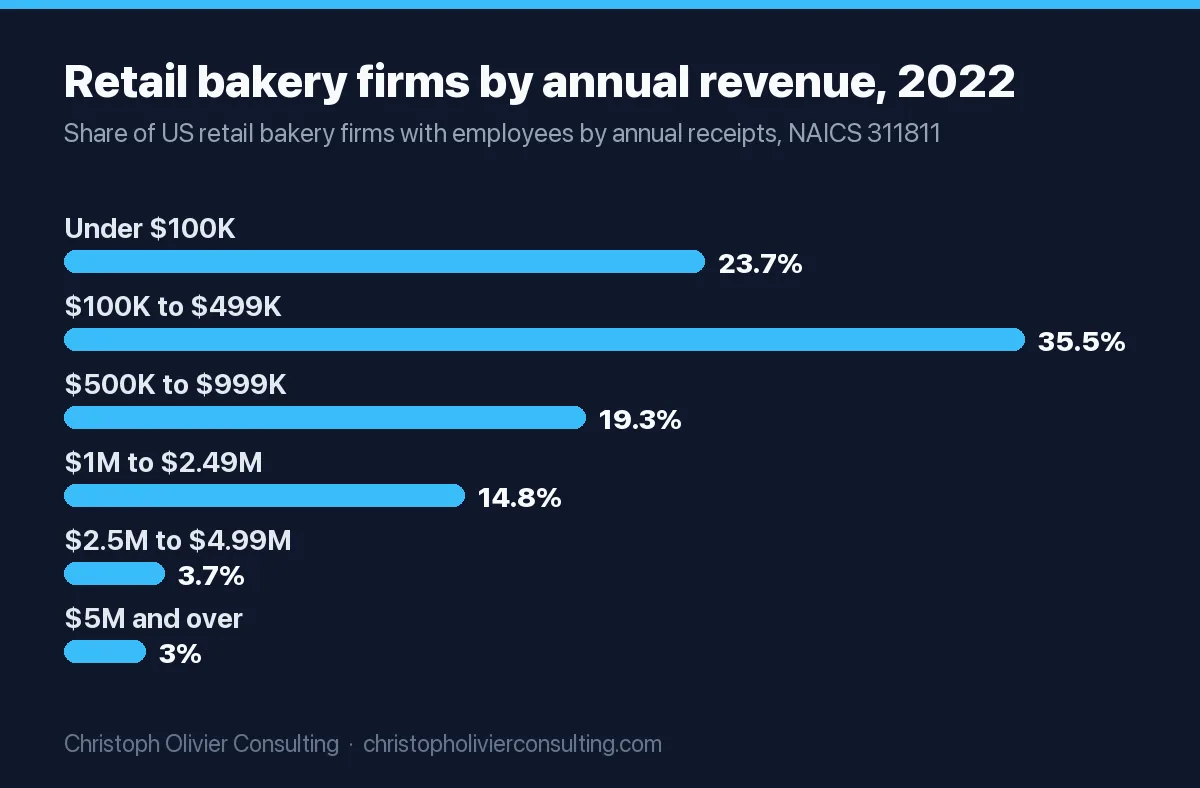
Ignore the overall average of $1.31 million per location. 32 firms with 500 or more employees operated just 59 locations here but reported $4.18 billion, 35.6% of all receipts, so they are likely large companies with a few production-scale sites coded as retail bakeries. Among firms under 500 employees, the average was $846,126 per location (my calculation). The revenue bands show what a normal bakery looks like:
| Annual receipts of the firm | Firms | Share of firms | Cumulative share | Average receipts per firm | Employees per firm | Payroll as % of receipts |
|---|---|---|---|---|---|---|
| Under $100,000 | 2,049 | 23.7% | 23.7% | $50,759 | 1.4 | 34.1% |
| $100,000 to $499,999 | 3,059 | 35.5% | 59.2% | $268,595 | 4.3 | 32.9% |
| $500,000 to $999,999 | 1,668 | 19.3% | 78.5% | $695,165 | 10.0 | 33.7% |
| $1 million to $2.49 million | 1,273 | 14.8% | 93.3% | $1,474,608 | 18.8 | 32.7% |
| $2.5 million to $4.99 million | 317 | 3.7% | 97.0% | $3,134,274 | 32.8 | 31.5% |
| $5 million and over | 259 | 3.0% | 100% | $25,948,907 | 101.6 | n/a |
Source: U.S. Census Bureau, SUSB 2022, U.S. 6-digit NAICS by enterprise receipts size, NAICS 311811. Employer firms only. The $5 million and over row combines the published bands above $5 million. Shares, averages and payroll percentages are my calculations. Employee counts exclude unincorporated owners, who are not on payroll.
What this tells you:
- The median retail bakery firm sits in the $100,000 to $499,999 band, averaging $268,595 with about four employees. Only 21.5% of firms reach $1 million.
- Payroll eats about a third of sales at every size up to $5 million, 31.5% to 34.1%. That is wages only, before payroll taxes and benefits. Baking is labor-heavy because the product is made by hand, early, every day.
- By employee count, bakeries with fewer than 5 employees averaged $248,103 per location, 5 to 9 employees $554,013, and 10 to 19 employees $950,788 (SUSB 2022 employment-size file, my calculation).
Bakery revenue by state
To keep the giant firms out, this table uses only bakeries owned by firms with fewer than 20 employees, which is 7,524 of the 8,979 locations. Average revenue per location roughly doubles from the lowest states to the highest:
| State | Small-firm bakery locations (2022) | Average receipts per location | Payroll as % of receipts |
|---|---|---|---|
| Massachusetts (highest) | 268 | $645,381 | 27.3% |
| Colorado | 129 | $567,016 | 26.3% |
| California | 1,066 | $543,914 | 27.8% |
| New York | 758 | $493,814 | 30.4% |
| Florida | 366 | $483,579 | 27.8% |
| Illinois | 349 | $476,736 | 28.8% |
| New Jersey | 376 | $448,787 | 27.7% |
| Washington | 251 | $413,418 | 33.7% |
| Texas | 549 | $406,149 | 28.2% |
| Pennsylvania | 295 | $338,475 | 30.4% |
| North Carolina | 253 | $330,968 | 30.8% |
| Oklahoma | 94 | $265,415 | 30.0% |
Source: Census SUSB 2022 state file, NAICS 311811, enterprises with fewer than 20 employees. Averages and payroll shares are my calculations. States with fewer than 40 locations are left out because a few shops swing the average.
How much does a home bakery make?
Most home bakeries make very little, and a few make a real income. Census counts businesses with no paid employees separately. In 2022 there were 29,353 bakery businesses with no payroll (NAICS 3118, which also includes tortilla makers), with $856.5 million in combined receipts, or $29,180 each (Nonemployer Statistics 2022, my calculation). The spread is wide:
| Annual receipts | Bakery nonemployers | Share | Cumulative share |
|---|---|---|---|
| Under $5,000 | 9,198 | 31.3% | 31.3% |
| $5,000 to $9,999 | 5,672 | 19.3% | 50.7% |
| $10,000 to $24,999 | 7,737 | 26.4% | 77.0% |
| $25,000 to $49,999 | 3,109 | 10.6% | 87.6% |
| $50,000 to $99,999 | 1,757 | 6.0% | 93.6% |
| $100,000 to $249,999 | 1,308 | 4.5% | 98.1% |
| $250,000 to $499,999 | 428 | 1.5% | 99.5% |
| $500,000 to $999,999 | 144 | 0.5% | 100% |
Source: U.S. Census Bureau, Nonemployer Statistics 2022, NAICS 3118 (bakeries and tortilla manufacturing), U.S. totals by receipts size class. Shares are my calculations. Receipts are sales, not profit. Home bakers who never file under a bakery code, or who report hobby income, are not counted.
Half of these businesses sell less than $10,000 a year. Only about one in eight (12.4%) passes $50,000. If you are selling $25,000 or more from home, you are already in the top quarter.
Cottage food sales caps limit how big a home bakery can get
Many states let you sell shelf-stable baked goods from a home kitchen under a cottage food law, but several cap your sales. Three of the largest states:
| State | Annual sales cap for home food sales | Primary source |
|---|---|---|
| Florida | $250,000 in annual gross sales of cottage food products, counted across all locations and products. Internet and mail order sales are allowed; wholesale is not. | Florida Statutes s. 500.80 (2025) |
| Texas | $150,000 in annual gross income, adjusted for inflation each year (raised from $50,000 by SB 541, effective September 1, 2025) | Texas SB 541, enrolled text |
| California | Class A (direct sales only): $88,878. Class B (direct and indirect sales): $177,756. Limits effective January 1, 2026, adjusted yearly by California CPI. | California Department of Public Health, 2026 limits |
California’s statute also limits a cottage food operation to one full-time equivalent employee outside the family. Once you outgrow a cap, you need a licensed commercial kitchen, which brings rent, equipment and inspection costs into your P&L.
What can I sell as a home baker?
Cottage food laws generally cover foods that do not need refrigeration to stay safe, which is why breads, cookies and many cakes and pastries qualify. The Texas statute, for example, limits cottage sales to food that is not “time and temperature control for safety food.” Under that kind of rule, items that must be refrigerated to stay safe, such as cream or custard fillings, generally need a licensed kitchen. Florida also requires every product to carry a label with your name, address, ingredients, net weight, allergens and a statement that it was made in a cottage food operation. Check your own state’s statute before you take orders; rules differ by state and sometimes by county.
Bakery profit margin: what the disclosed numbers show
Margin claims online run from 3% to 60% because writers mix the margin on a single cake with the margin of the whole business. Here are the audited and tax-return figures, each defined:
| Measure | Figure | Source |
|---|---|---|
| Krispy Kreme U.S. segment, product and distribution costs, % of revenue | 24.4% | Krispy Kreme 10-K, fiscal 2025 (year ended December 28, 2025). U.S. segment revenue $913.1 million. Percentages are my calculations from the segment table. |
| Krispy Kreme U.S. segment, operating expenses (shop and delivery labor, occupancy, logistics) | 57.5% | |
| Krispy Kreme U.S. segment, SG&A plus marketing | 10.7% | |
| Krispy Kreme U.S. segment, depreciation | 7.0% | |
| Krispy Kreme U.S. segment, Adjusted EBIT margin | 1.8% ($16.1 million) | |
| Food manufacturing sole proprietors with a profit, net profit as % of receipts | 13.4% | IRS SOI, tax year 2023, my calculation |
| All food manufacturing sole proprietors, net income less deficit | Loss of $117.8 million on $9.97 billion receipts (about minus 1.2%) | Same |
| Retail bakery payroll, wages only, % of receipts, firms under 500 employees | 29.9% | Census SUSB 2022, my calculation |
A realistic reading: a well-run independent bakery keeps roughly 10% to 15% of sales for the owner before income tax, and that number includes the owner’s own pay for baking. The IRS 13.4% is the average for owners who made money; nearly half did not. Krispy Kreme’s U.S. stores, which carry a corporate cost structure and a fresh delivery network, kept just 1.8% at the segment level in 2025, down from 4.9% in 2024 ($52.4 million on $1.06 billion, my calculation).
Is a 50% profit margin too much?
Not on a single item, but it is not a business margin. If ingredients and packaging cost 25% to 30% of the price, as at Krispy Kreme (24.4%), your gross margin on each item is 70% to 75%. A 50% “profit” usually means the baker counted only ingredients and left out their own hours, rent, fees and equipment. After labor and occupancy, no disclosed source above shows a bakery business keeping anything close to 50%. Price from the full cost of each product, including your labor at a wage you would accept, and check the result against the worksheet below. The pricing strategy guide covers how to set and test those prices.
Why are bakeries struggling? Ingredient costs, labor and traffic
Three pressures show up in primary data for 2025 and 2026:
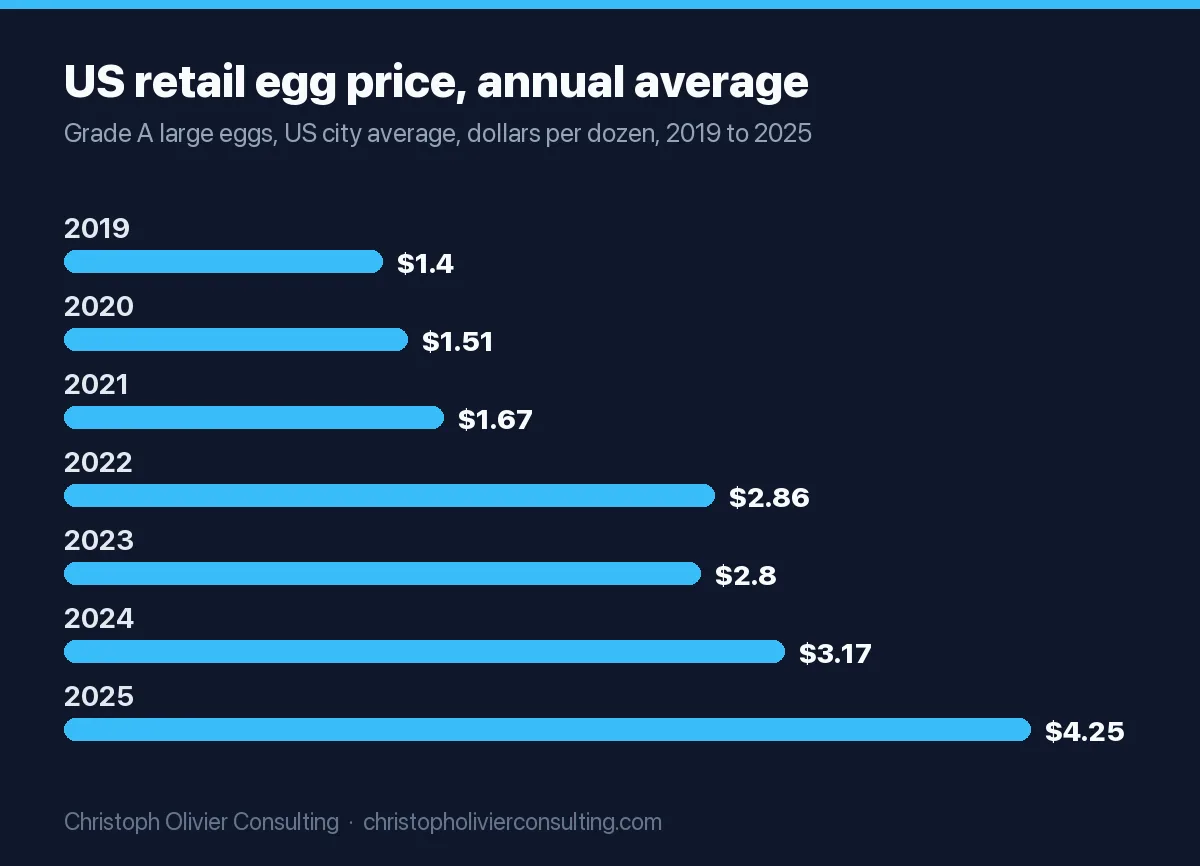
- Eggs. The BLS average retail price for a dozen grade A large eggs averaged $4.25 in 2025, three times the 2019 average of $1.40, and peaked at $6.23 in March 2025. By October 2026 it was back to $2.32 (BLS via FRED).
- Labor. Krispy Kreme’s operating expenses rose 390 basis points as a share of revenue in fiscal 2025, which the company attributed mainly to “higher shop and delivery labor expenses.” Its U.S. organic revenue fell 3.5%, “primarily driven by lower Doughnut Shop transaction volume.”
- Softer sales at the big brands. Crumbl, which is privately held, disclosed in its newly released franchise disclosure document that average unit volume fell 16% to $1.14 million in 2025 from nearly $1.4 million, and it stopped publishing profitability figures, as Restaurant Business reported on April 10, 2026.
The other baking staples rose less but stayed up:
| Ingredient (US city average retail price) | 2019 average | 2025 average | October 2026 |
|---|---|---|---|
| Eggs, grade A large, per dozen | $1.40 | $4.25 | $2.32 |
| Butter, stick, per pound | $3.98 | $4.76 | $3.98 |
| Sugar, white, per pound | $0.59 | $1.03 | $1.00 |
| Flour, white all purpose, per pound | $0.44 | $0.56 | $0.54 |
Source: BLS Consumer Price Index average price data, retrieved from FRED, November 2026. Annual averages of monthly prices are my calculation. These are retail shelf prices; wholesale prices from your distributor will be lower but tend to move in the same direction.
Sugar is up 74% since 2019 and has not come back down. If your menu prices were set before 2023, recost every recipe.
Worked P&L: what a bakery owner keeps at four sizes
This is my own model, not reported data. Every percentage is an assumption tied to a benchmark above, and you can swap in your own numbers. The bottom line is owner earnings before income tax: what is left for the owner’s salary and profit combined. The $300,000, $600,000 and $1 million sizes match the Census averages for bakeries with under 5, 5 to 9 and 10 to 19 employees.
| Line (assumption) | Home bakery, $40,000 | Small shop, $300,000 | Busy shop, $600,000 | High-volume, $1,000,000 |
|---|---|---|---|---|
| Ingredients and packaging (30% home, retail-bought; 28% / 28% / 27% for shops, near Krispy Kreme’s 24.4%) | $12,000 | $84,000 | $168,000 | $270,000 |
| Staff payroll, owner excluded (none at home; 25% / 28% / 33%, from Census payroll shares for under 5, 5 to 9 and 10 to 19 employee firms) | $0 | $75,000 | $168,000 | $330,000 |
| Payroll taxes and workers’ comp (assumed 9% of payroll; employer FICA alone is 7.65%) | $0 | $6,750 | $15,120 | $29,700 |
| Rent (none at home; assumed $4,000 / $5,500 / $7,000 a month) | $0 | $48,000 | $66,000 | $84,000 |
| Card and platform fees (assumed 3% home, 2.5% shops) | $1,200 | $7,500 | $15,000 | $25,000 |
| Utilities, insurance, repairs, supplies, software, marketing, accounting (assumed $3,000 home; 9% / 9% / 8% of sales) | $3,000 | $27,000 | $54,000 | $80,000 |
| Oven, equipment and build-out loan payments (none at home; assumed $2,000 / $3,000 / $4,000 a month) | $0 | $24,000 | $36,000 | $48,000 |
| Total costs | $16,200 | $272,250 | $522,120 | $866,700 |
| Owner earnings before income tax | $23,800 (59.5%) | $27,750 (9.3%) | $77,880 (13.0%) | $133,300 (13.3%) |
| Per month | $1,983 | $2,313 | $6,490 | $11,108 |
| Per owner hour (assumed 1,250 hours at home; 2,750 hours, 55 a week for 50 weeks, in a shop) | $19.04 | $10.09 | $28.32 | $48.47 |
Own calculation, November 2026. All percentages and dollar costs in the first column are assumptions; benchmark sources are linked in the sections above. Excludes income tax and self-employment tax (about $3,363 on the home bakery’s $23,800, at 15.3% on 92.35% of net earnings).
What the model shows:
- The $300,000 shop pays the owner less than an employee baker. $10.09 an hour is well under the BLS median for bakers of $17.86. That matches the IRS picture: average profit of $22,596 for profitable food manufacturing owners, and nearly half with none.
- A good home bakery can out-earn a small storefront. With no rent, staff or loan payments, $40,000 in sales leaves $23,800, close to the small shop’s $27,750 for far fewer hours. The trade-off is the cottage food cap and limits on what you can sell.
- Fixed costs are why volume matters. Rent and loan payments are 24% of sales at $300,000 but 13.2% at $1 million. Between $300,000 and $600,000 in sales, each extra $100,000 adds about $16,700 to owner earnings in this model.
- One point of ingredient cost is real money. A 1 percentage point change in ingredients and packaging moves owner earnings by $3,000 at $300,000 in sales and $10,000 at $1 million. At the March 2025 egg peak, that kind of swing was common.
To turn a sales goal into a daily target, divide by days open. A $600,000 bakery open 310 days (six days a week, closed some holidays) needs about $1,935 a day. At an assumed $15 average ticket, that is about 129 sales a day. Use your own average ticket from your point-of-sale reports.
Bakery owner pay worksheet: pass/fail benchmarks
Fill in the “Your bakery” column from your last 12 months of books, as a share of sales. Any line that fails is where your owner pay is going. The thresholds come from the disclosed figures above; a narrow fail is a warning, not a crisis.
| Line | Your bakery | Pass | Fail | Benchmark source |
|---|---|---|---|---|
| Ingredients and packaging, % of sales | ____% | 30% or less | Over 35% | Krispy Kreme U.S. 24.4% (fiscal 2025) |
| Staff payroll (wages only, owner excluded), % of sales | ____% | At or below the Census share for your size (25% to 33%) | Over 36% | Census SUSB 2022: 24.7% under 5 employees, 28.3% at 5 to 9, 33.0% at 10 to 19 |
| Rent plus loan payments, % of sales | ____% | 15% or less | Over 22% | My P&L model: 24% at $300,000, 13.2% at $1 million |
| Sales per location vs. peers your size | $______ | At or above the Census average for your employee size | Below it | $248,103 under 5 employees; $554,013 at 5 to 9; $950,788 at 10 to 19 (2022) |
| Owner earnings (salary plus profit), % of sales | ____% | 10% or more | Under 5% | IRS 13.4% for profitable food manufacturing owners (2023) |
| Owner earnings per owner hour worked | $____/hr | Above $33.36/hr | Below $17.86/hr | BLS food service manager median $69,390 ÷ 2,080 hours; BLS baker median $17.86 (May 2025) |
The last line is the one most owners skip. If you earn less per hour than an employed baker, the bakery is buying you a job, not building an asset. That can be a fine choice, but make it knowingly. The same pattern shows up in other food businesses: the coffee shop owner salary data shows owners of small shops earning about what they pay their staff.
Bakery startup costs: what is actually disclosed
No government survey measures what it costs to open an independent bakery, and figures you see online are estimates. The disclosed reference points are narrow:
- Krispy Kreme states in its 2025 10-K that the average capital investment is $2 million to $5 million for a Hot Light Theater Shop, which bakes on site, and $0.1 million to $1 million for a Fresh Shop that sells doughnuts delivered from a production hub.
- Home bakeries under a cottage food law skip the lease, build-out and commercial ovens, in exchange for the sales caps above.
An independent storefront usually lands between those extremes, but the honest answer is that it depends on your space. Get written quotes for these lines before you sign a lease: build-out (ventilation, plumbing, electrical and permits are where budgets break), deck or convection ovens, mixers, proofers, sheeters, refrigeration, display cases, point of sale, opening inventory and at least three to six months of operating cash.
A common lower-risk path is to start as a cottage food operation, build a customer list through direct sales, and move into a storefront once your home sales approach your state’s cap. The food truck owner salary numbers show a similar step-up path in mobile food.
Does owning a bakery make good money?
On the numbers, a single small bakery is a modest living with early mornings. The owners who earn six figures share a few traits in the data:
- They pass $600,000 in sales. Below that, my model leaves the owner under the BLS food service manager median of $69,390. 78.5% of retail bakery firms are below $1 million.
- They control ingredient cost. Recipe costing and price reviews after every big input swing, such as the 2025 egg spike, protect the 10% to 15% that is left.
- They add higher-ticket sales. Custom cakes, catering trays and corporate orders raise the average ticket without adding morning foot traffic. The catering business marketing playbook applies directly to bakery catering orders.
- They market to a steady local base. Repeat customers and pre-orders smooth out daily production waste. The tactics in restaurant marketing carry over well to bakeries.
Is a baker a high paying job?
No. Employed bakers earned a median of $17.86 an hour ($37,160 a year) and a mean of $38,480 in May 2025, across 236,200 jobs (BLS OEWS). Bakers working in bakeries and tortilla manufacturing earned a similar median of $37,180. For comparison, food service managers earned a median of $69,390. Owning the bakery is the main route to higher pay, but only at volume.
How much do bakery owners make per month?
In the worked model above, about $2,000 a month for a $40,000 home bakery, $2,300 for a $300,000 shop, $6,500 for a $600,000 shop and $11,100 for a $1 million shop, all before income tax.
If you run a bakery and want a second opinion on pricing, the menu or local marketing, you can book a consultation and bring your last 12 months of numbers.
Ready to scale your revenue?
Book a free 30-min consultation. We’ll diagnose your growth bottleneck and map out the 3 highest-leverage moves for your business.
Frequently asked questions
How much does a bakery owner make a year?
No government survey reports bakery owner income directly. In a worked model built from Census, BLS and 10-K data, an owner keeps about $28,000 a year at $300,000 in sales, $78,000 at $600,000 and $133,000 at $1 million, before income tax. Food manufacturing sole proprietors who made a profit averaged $22,596 in net profit in tax year 2023, and nearly half reported no profit.
What is a typical bakery profit margin?
Owner-operated food manufacturers that made a profit kept 13.4% of receipts as net profit in tax year 2023 (IRS). Krispy Kreme's U.S. segment kept just 1.8% at the Adjusted EBIT level in fiscal 2025, with ingredients and distribution at 24.4% of revenue. A well-run independent bakery keeps roughly 10% to 15% of sales for the owner, including the owner's own pay.
How much does a home bakery make?
Most make little. Census counted 29,353 bakery businesses with no employees in 2022, averaging $29,180 in sales. Half sold under $10,000 a year and only 12.4% passed $50,000. Because a home bakery has no rent or staff, a baker selling $40,000 a year could keep about $23,800 before self-employment tax, based on assumed ingredient and fee costs.
How much does it cost to start a bakery?
No government survey measures independent bakery startup costs. Krispy Kreme's 2025 10-K puts its average capital investment at $2 million to $5 million for a shop that bakes on site and $0.1 million to $1 million for a smaller shop supplied by a hub. A home bakery under a cottage food law avoids lease and build-out costs but faces state sales caps.
Does owning a bakery make good money?
Only at volume. In the worked model, a $300,000 bakery pays its owner about $10 an hour for a 55 hour week, below the $17.86 BLS median for employed bakers. Owner pay passes the $69,390 food service manager median only somewhere above $600,000 in sales. About 78.5% of retail bakery firms take in under $1 million.
How much can a home bakery sell under cottage food laws?
It depends on the state. Florida allows up to $250,000 in annual gross sales of cottage food products. Texas raised its cap from $50,000 to $150,000, adjusted for inflation, effective September 1, 2025. California's 2026 limits are $88,878 for Class A direct sales and $177,756 for Class B operations that also sell through stores or restaurants.
Is a baker a high paying job?
No. Employed bakers earned a median of $17.86 an hour, or $37,160 a year, in May 2025 across 236,200 jobs, according to BLS. Food service managers earned a median of $69,390. Owning a bakery is the main path to higher pay, but owner earnings only clear the manager benchmark at high sales volume.
Small business owner income