
Most outpatient psychiatrists see about 8 to 16 patients a day, and 12 is the middle of the best published range. When the American Association of Community Psychiatrists asked members about full-time clinic jobs between 2015 and 2018, the daily volumes they reported ran from 6 to 25 patient contacts a day (McQuistion and Zinns, Psychiatric Services, 2019). The median of the 15 answers that gave a daily number is 12 (our calculation). Visit length decides almost everything. A psychiatrist booking 30-minute follow-ups fits about 14 visits into 7 hours of patient time. One booking 15-minute medication checks can fit 28.
Short answer: About 12 patients a day is typical for a full-time outpatient psychiatrist doing medication management, with a reported range of 6 to 25 (AACP members, 2015 to 2018). That works out to roughly 50 to 70 visits a week over five clinic days. A first appointment usually lasts 50 to 60 minutes and a follow-up usually lasts about 30. In Medicare’s 2024 claims, the most common psychiatrist office visit was code 99214, which carries a 30-minute total-time threshold.
How many patients do psychiatrists see a day? Every published number
No federal agency publishes a “patients per psychiatrist per day” statistic. What exists is a small set of member surveys, Medicare claims and workforce data. The table below collects every usable figure and says exactly what each one measures.
| Measure | Figure | Who and when | Source |
|---|---|---|---|
| Patients seen per day, full-time public-sector clinic psychiatrist | 6 to 25 (median 12, our calculation from 15 answers) | AACP member responses, October 2015 to May 2018 | McQuistion and Zinns, Psychiatric Services, 2019, Table 1 |
| Caseload of a full-time clinic psychiatrist | 40 to “unlimited” (median about 290, our calculation from 26 numeric answers) | Same AACP sample, 28 responses | McQuistion and Zinns, 2019 |
| Unduplicated patients seen per week | 35.4 | 970 APA members, 1996 National Survey of Psychiatric Practice | Zarin et al., American Journal of Psychiatry, 1998 |
| Hours worked per week | 46.4 | Same 1996 survey | Zarin et al., 1998 |
| Hours per week and share in direct patient care | 48 hours, two-thirds direct care; caseload over 60 with about half seen each week | 19,431 psychiatrists, 1988 to 1989 mail survey | Dorwart et al., American Journal of Psychiatry, 1992 |
| Share of psychiatrist office visits that include psychotherapy | 44.4% (1996 to 1997) down to 21.6% (2015 to 2016) | 29,673 NAMCS psychiatrist visits | Tadmon and Olfson, American Journal of Psychiatry, 2022 |
| Psychiatrists providing no psychotherapy at all | About 53% | 2010 to 2016 | Tadmon and Olfson, 2022 |
| Medicare fee-for-service patients per psychiatrist, median | 46 beneficiaries, 219 services, $21,046 allowed (our calculation) | 19,778 psychiatrists billing Medicare Part B, 2024 | CMS Medicare Physician and Other Practitioners, by Provider, 2024 |
| Employed psychiatrists and pay | 27,980 employed; mean $269,940, median $281,870 | Wage and salary workers, May 2025 (self-employed excluded) | BLS OEWS, Psychiatrists 29-1223 |
| Federal shortage marker | 1 psychiatrist per 30,000 residents or worse (20,000 in high-need areas) | Mental health HPSA criteria | 42 CFR Part 5, Appendix C |
The surveys measure different things, so read them carefully. The AACP figures count contacts per day in public-sector clinics, where most visits are 30-minute follow-ups. The 1996 APA survey counts unduplicated patients per week, so a patient seen twice counts once. The Medicare medians look tiny because Medicare fee-for-service is only one payer in most psychiatric practices, and the public file has no rows with fewer than 11 beneficiaries, so very small Medicare practices drop out. Use those Medicare medians to see the payer mix, not total workload.
The AACP sample is small and informal. The authors call it “illustrative,” and it covers public-sector clinics, not cash-pay private offices. It is still the only published source that pairs a named setting with a daily count. The spread tells you something: one New York state hospital clinic reported 6 a day, and a West Virginia respondent reported 20 to 25 a day across a 10-hour workday.
How many patients does a psychiatrist see a week?
Multiply the daily number by clinic days. At the AACP median of 12 a day, a five-day clinician sees about 60 visits a week. The full 6 to 25 range gives 30 to 125. The last national APA practice survey, from 1996, found psychiatrists saw 35.4 unduplicated patients in a typical week while working 46.4 hours. That figure is old and counts each person once. Back then psychotherapy was in 44.4% of psychiatrist visits, against 21.6% by 2015 to 2016 (Tadmon and Olfson). With fewer long therapy sessions, more visits fit in a week, so treat 35 as a floor for a medication-management practice today.
A therapy-heavy psychiatrist sees far fewer people. Seven 60-minute sessions a day is 35 a week, which lines up with what full-time therapists carry. Our breakdown of how many clients a therapist sees per week covers that side of the market.
How long is a psychiatrist appointment?
A first visit usually takes 50 to 60 minutes and follow-ups usually take about 30. Washington University’s adult psychiatry service tells new patients that “the initial appointment will last 50 minutes to 1 hour and the follow up appointments will generally last 30 minutes.” Several AACP respondents described the same template: a 60-minute intake and 30-minute follow-ups. Billing codes set the real boundaries, because many psychiatry codes are time-based. Here is each common visit type, the minutes that apply to it, and what Medicare pays in 2026.
| Visit type | Code(s) | Time rule | 2026 Medicare national rate, office (our calculation) |
|---|---|---|---|
| First visit: diagnostic evaluation with medical services | 90792 | Not time-based; usually booked for 50 to 60 minutes | $202.08 |
| First visit: diagnostic evaluation without medical services | 90791 | Not time-based | $173.35 |
| Medication follow-up, low complexity | 99213 | Low complexity, or 20 minutes (code descriptor) | $95.19 |
| Medication follow-up, moderate complexity | 99214 | Moderate complexity, or 30 minutes | $135.61 |
| Medication follow-up, high complexity | 99215 | High complexity, or 40 minutes | $192.39 |
| Follow-up plus short psychotherapy | 99214 + 90833 | Psychotherapy 16 to 37 minutes, on top of the E/M work | $217.11 ($135.61 + $81.50) |
| Follow-up plus longer psychotherapy | 99214 + 90836 | Psychotherapy 38 to 52 minutes | $238.82 ($135.61 + $103.21) |
| Psychotherapy only, 45 minutes | 90834 | 38 to 52 minutes | $113.90 |
| Psychotherapy only, 60 minutes | 90837 | 53 minutes or more | $167.00 |
Sources and method: psychotherapy time ranges from CMS billing article A57520, which also says “Do not report psychotherapy of less than 16 minutes duration” and that psychotherapy time “does not include the E/M time.” E/M minutes are from the code descriptors in the CMS 2026 fee schedule file. Rates are our calculation: non-facility total RVUs times the $33.4009 conversion factor in the CMS RVU26D file (October 2026 release). They are national amounts before geographic adjustment, and they include the 20% patient coinsurance.
The “15-minute med check” exists, but it is not the norm in Medicare data. The AACP authors write that the field moved from the weekly “50-minute hour” to “30 minutes monthly,” and that most psychiatrists consider routine 15-minute checks every 2 to 6 months unacceptable.
What psychiatrists actually bill: Medicare 2024 visit mix
Medicare claims show what a psychiatrist’s day looks like in practice. We added up every 2024 line billed by providers whose CMS specialty is Psychiatry in the Medicare Physician and Other Practitioners by Provider and Service file: 57,115 provider and code rows from 17,995 psychiatrists. No search result we checked offers this breakdown.
| Code | What it is | 2024 Medicare services by psychiatrists | Psychiatrists billing it | Share of established office visits |
|---|---|---|---|---|
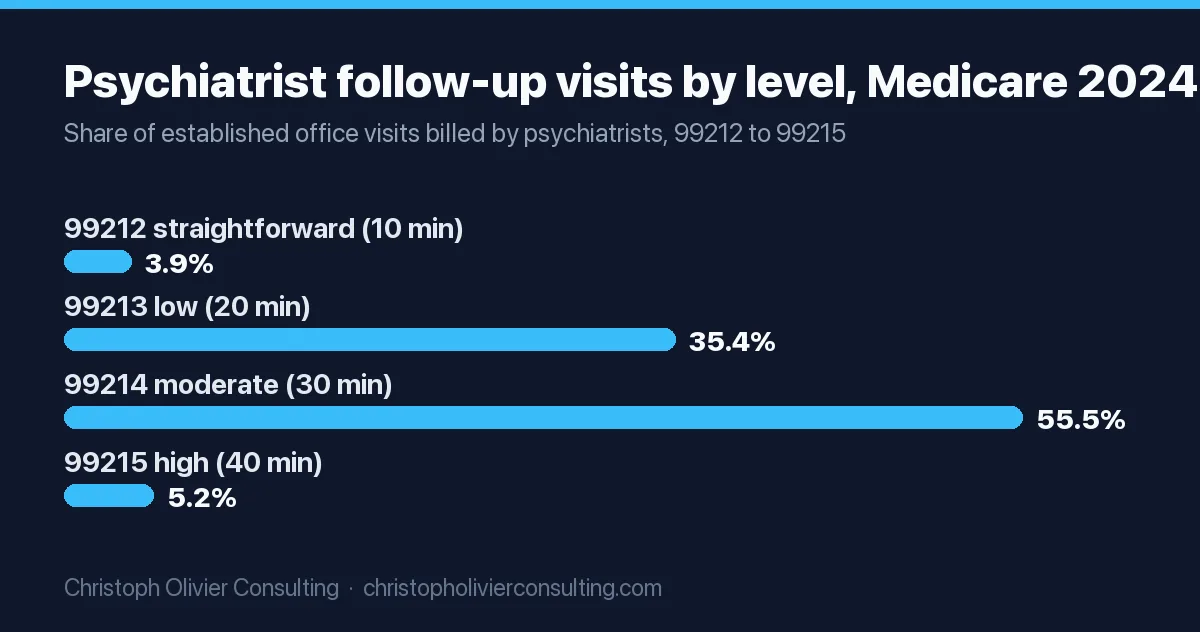
| 99212 | Established visit, straightforward (10 min) | 107,945 | 765 | 3.9% |
| 99213 | Established visit, low (20 min) | 976,218 | 5,426 | 35.4% |
| 99214 | Established visit, moderate (30 min) | 1,529,541 | 9,097 | 55.5% |
| 99215 | Established visit, high (40 min) | 144,201 | 1,959 | 5.2% |
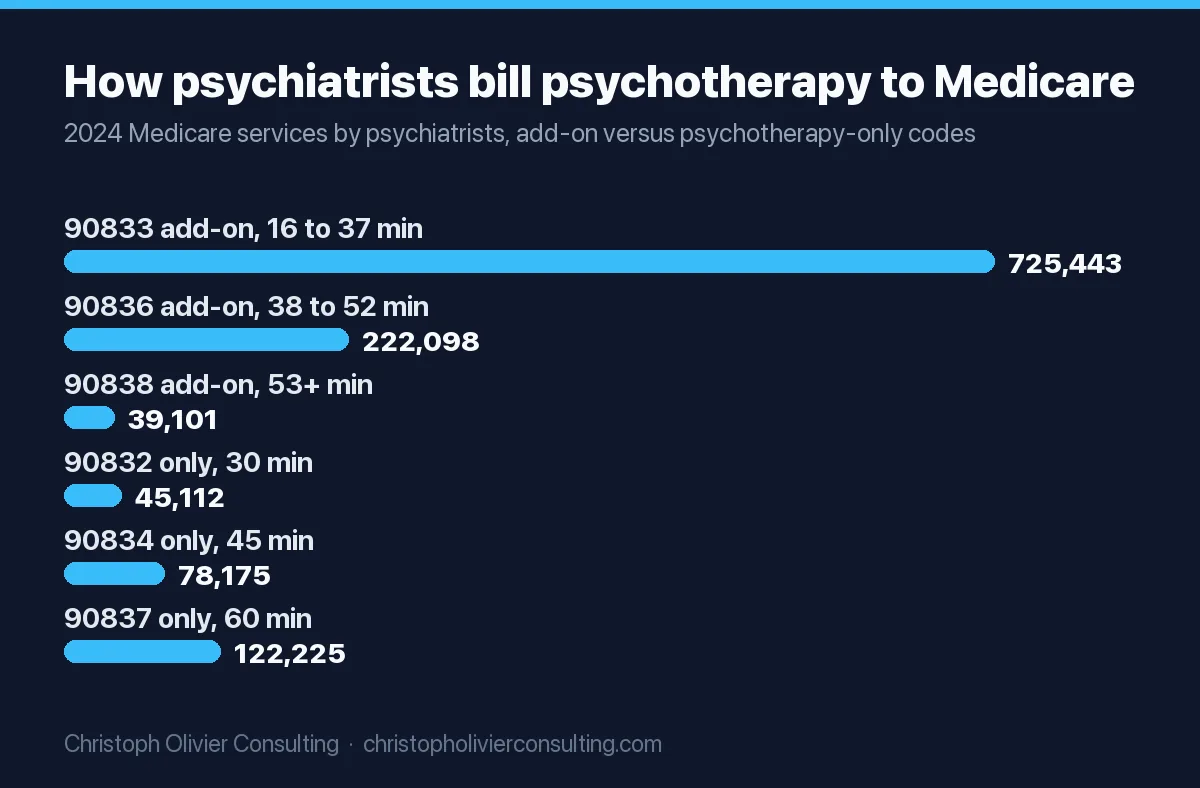
| 90833 | Add-on psychotherapy, 16 to 37 min | 725,443 | 3,931 | n/a |
| 90836 | Add-on psychotherapy, 38 to 52 min | 222,098 | 1,232 | n/a |
| 90838 | Add-on psychotherapy, 53+ min | 39,101 | 267 | n/a |
| 90832 / 90834 / 90837 | Psychotherapy only (30 / 45 / 60 min) | 45,112 / 78,175 / 122,225 | 278 / 386 / 492 | n/a |
| 90792 | Diagnostic evaluation with medical services | 193,212 | 4,141 | n/a |
Our calculation from CMS 2024 data. Medicare fee-for-service only. The public file contains no provider and code pair with fewer than 11 beneficiaries, so totals run low. Nurse practitioners and physician assistants are listed under their own CMS specialties and are not counted here.
Three things stand out. First, 99214 is the workhorse code, at 55.5% of established office visits, so the typical Medicare follow-up is a moderate-complexity visit with a 30-minute time threshold. Second, about 80% of psychotherapy units psychiatrists billed were add-ons to a medical visit (986,642 add-on units against 245,512 psychotherapy-only units). The “medication visit with some therapy” model is now the standard psychiatrist session. Third, only 492 psychiatrists billed 90837 to Medicare at all. The hour-long therapy session is a niche for psychiatrists.
Patients per day calculator: schedule to visits to revenue
This is the table to use if you are planning a schedule or checking a job offer. It converts slot length into patients a day, visits a year and gross revenue at 2026 Medicare rates. Swap in your own payer rates to rerun it.
| Schedule template | Patients per day | Rate per visit (2026 Medicare) | Gross per day | Visits per year | Gross per year | Gross per year at 17% no-shows |
|---|---|---|---|---|---|---|
| 15-minute med checks (99213) | 28 | $95.19 | $2,665 | 6,440 | $613,024 | $508,810 |
| 20-minute follow-ups (99214) | 21 | $135.61 | $2,848 | 4,830 | $654,996 | $543,647 |
| 30-minute follow-ups (99214 + 90833) | 14 | $217.11 | $3,040 | 3,220 | $699,094 | $580,248 |
| Mixed day: 1 new evaluation (60 min, 90792) + 12 thirty-minute follow-ups | 13 | $215.95 average | $2,807 | 2,990 | $645,702 | $535,933 |
| 45-minute follow-ups (99214 + 90836) | 9 | $238.82 | $2,149 | 2,070 | $494,357 | $410,317 |
| 60-minute therapy sessions (90837) | 7 | $167.00 | $1,169 | 1,610 | $268,870 | $223,162 |
Our calculation. Assumptions: 7 hours (420 minutes) of booked patient time a day; 230 clinic days a year; 2026 Medicare national non-facility rates from the CMS RVU26D file (conversion factor $33.4009, before geographic adjustment); every slot filled. The 17% no-show column uses the rate one AACP respondent reported for a California clinic. It is an example, not a national average. Gross means billed allowed amounts before overhead, staff, billing costs and collection losses. Commercial and cash rates differ.
The table shows why 30-minute visits with an add-on dominate. They earn more per day than 15-minute checks, even though the psychiatrist sees half as many people. Pushing volume up does not pay unless the visit codes stay the same. Hour-long therapy-only days earn the least at Medicare rates, which fits the long drop in psychiatrist psychotherapy. Mojtabai and Olfson (2008) linked the early decline to changes in reimbursement, managed care and medication prescribing, and Tadmon and Olfson (2022) found it continued through 2016.
How many patients does a psychiatrist have? Caseload math
A caseload, or panel, is the number of active patients. It is far bigger than the daily count because most patients come back monthly or quarterly. AACP respondents reported caseloads from 40 to “unlimited.” The median numeric answer was about 290, the most common single answer was 300, and one New York respondent said that “over 400 patients yield poorer care.” Older studies the paper reviews put clinic caseloads at 165 to 438.
The panel a schedule can support follows one formula: panel = patients per day × clinic days per year ÷ visits per patient per year.
| Patients per day | Visits per week (5 days) | Visits per year (230 days) | Panel if seen monthly (12/yr) | Every 6 weeks (8/yr) | Every 2 months (6/yr) | Quarterly (4/yr) |
|---|---|---|---|---|---|---|
| 8 | 40 | 1,840 | 153 | 230 | 307 | 460 |
| 10 | 50 | 2,300 | 192 | 288 | 383 | 575 |
| 12 | 60 | 2,760 | 230 | 345 | 460 | 690 |
| 14 | 70 | 3,220 | 268 | 402 | 537 | 805 |
| 16 | 80 | 3,680 | 307 | 460 | 613 | 920 |
| 20 | 100 | 4,600 | 383 | 575 | 767 | 1,150 |
Our calculation. Assumes every visit is a follow-up. In practice, take new-evaluation slots out first. A psychiatrist adding one new patient a day loses one follow-up a day and grows the panel until turnover matches intake.
Worked example. You see 14 patients a day, 4 days a week, 46 weeks a year (184 days). That is 2,576 visits. If your average patient comes every 6 weeks (about 8.7 visits a year), your sustainable panel is about 296. That sits right in the 250 to 300 band most AACP respondents reported. If you carry 450 at that schedule, the only way the math works is to stretch visits to about every 9 weeks (5.7 visits a year). That is how waitlists and 3-month gaps happen.
Is 20 patients a day too much for a psychiatrist?
For outpatient psychiatry, usually yes, unless visits are short and stable by design. Twenty patients in 7 hours leaves 21 minutes each, with no time between visits. Only one AACP respondent reported a 20-plus daily load, and that was over a 10-hour day. The middle of that sample was 12. Use this check against any schedule or job offer:
| Patients per day (7 booked hours) | Minutes per patient | What it usually means | Pass or flag |
|---|---|---|---|
| 6 to 9 | 47 to 70 | Therapy-heavy or 45-minute visits, complex or inpatient-adjacent caseload | Pass if the payer mix supports it |
| 10 to 14 | 30 to 42 | 30-minute follow-ups plus a new evaluation; the AACP middle | Pass |
| 15 to 18 | 23 to 28 | 20 to 25 minute follow-ups, stable patients, some nursing support | Check documentation time and support staff |
| 19 to 25 | 17 to 22 | Short medication checks; reported mainly with long days or team documentation | Flag: ask how notes, refills and messages get done |
| 26+ | 16 or less | 15-minute checks; no room for a psychotherapy add-on, which needs at least 16 minutes on top of the medical visit | Flag |
Our decision table, built from the AACP ranges, the CMS 16-minute psychotherapy minimum, and the E/M time thresholds above. Support staff change the math. The Maine respondent who saw 9 to 10 a day noted a “team of registered nurses doing documentation.”
Why it is getting harder to get an appointment
Demand is growing faster than supply, which pushes both daily volume and caseloads up. A 2026 Psychiatric Services study projects that the supply of psychiatrists serving adults will fall 12.3% from 2024 to 2037 while demand rises 43.7%, so workforce adequacy drops from 70.2% to 42.8% under the status quo scenario. Federal rules already treat an area with one psychiatrist per 30,000 residents (one per 20,000 in high-need areas) as a mental health shortage area.
For practice owners, the takeaway is that patient demand is not the bottleneck for most psychiatrists. Capacity is. Growth comes from adding prescribers, nurses and therapists rather than from more marketing to a full schedule. If that is where you are, our guide to compliant mental health marketing covers how to fill new clinician capacity. Our breakdown of private practice therapist income shows the therapy side of a combined practice.
First visits, diagnosis and referrals
Do psychiatrists diagnose on the first visit?
The first visit is built for it. It is billed as a psychiatric diagnostic evaluation (90791, or 90792 when it includes medical services such as a medication review), and CMS billing guidance says that when a mental health diagnosis is established, that is the diagnosis to bill. The diagnosis can be revised at later visits as more history comes in. In Medicare’s 2024 data, psychiatrists billed 193,212 of the 90792 evaluations.
Can I just go straight to a psychiatrist?
Often, yes. With Original Medicare, “in most cases you don’t need a referral to see a specialist”; with a Medicare Advantage plan “you may need to get a referral.” Medicare Part B covers psychiatric evaluation, medication management and psychotherapy, and you pay 20% of the approved amount after the deductible. Private plans set their own referral rules, so check your plan documents. The harder part is often the wait for a first slot: each 60-minute evaluation takes the place of two 30-minute follow-ups, so a full schedule has few new-patient openings.
A note on the “3 month rule” you may see: it comes from section 58 of England’s Mental Health Act 1983 (consent or a second opinion for medication after three months of detention) and does not apply in the US.
How to use these numbers
- Pick your visit template first. Patients per day falls out of slot length: 420 booked minutes divided by the slot.
- Price the template, not the headcount. At 2026 Medicare rates, 14 thirty-minute visits with an add-on gross more per day than 28 fifteen-minute checks.
- Set the panel cap from the formula. Patients per day × clinic days ÷ visits per patient per year. Close intake when you hit it.
- Protect new-evaluation slots. Each 60-minute intake replaces two follow-ups. Decide how many a week you can afford.
- Benchmark against the sources, not forums. 12 a day (AACP median), 250 to 300 caseload, 30-minute follow-ups. If you are well above all three, expect access or burnout problems.
The same capacity logic applies across healthcare. See how it plays out in primary care in how many patients a doctor sees a day. If you run a psychiatric or behavioral health practice and want help matching growth to clinician capacity, you can book a consultation.
Ready to scale your revenue?
Book a free 30-min consultation. We’ll diagnose your growth bottleneck and map out the 3 highest-leverage moves for your business.
Frequently asked questions
How many patients do psychiatrists see a day?
About 12 is typical for a full-time outpatient psychiatrist. Community psychiatrists surveyed by the AACP between 2015 and 2018 reported 6 to 25 patient contacts a day, with a median of 12 across 15 answers. Visit length drives the number: 30-minute follow-ups allow about 14 a day in 7 booked hours, 15-minute checks about 28.
How many patients does a psychiatrist see a week?
Roughly 50 to 70 visits a week for a full-time medication-management psychiatrist working five clinic days at 10 to 14 a day. The last national APA practice survey (1996) found 35.4 unduplicated patients a week over 46.4 hours, but psychotherapy was far more common then, so that is a floor for today's shorter visits.
How long is a psychiatrist appointment?
A first appointment usually lasts 50 to 60 minutes and follow-ups about 30 minutes, per Washington University's adult psychiatry service. Billing codes set the edges: add-on psychotherapy needs at least 16 minutes, 99214 follow-ups carry a 30-minute threshold, and 60-minute therapy (90837) requires 53 minutes or more.
How many patients does a psychiatrist have on their caseload?
Usually a few hundred. AACP members reported caseloads from 40 to unlimited, with a median near 290 and 300 the most common answer. The math: patients per day times clinic days divided by visits per patient per year. At 14 a day, 184 days and visits every six weeks, the sustainable panel is about 296.
Is 20 patients a day too much for a psychiatrist?
Usually, for outpatient work. Twenty patients in 7 booked hours leaves 21 minutes each with no buffer, and the only AACP respondent reporting 20 or more worked 10-hour days. The survey middle was 12. Volumes above about 18 a day generally need short stable follow-ups plus nursing or documentation support.
Do psychiatrists diagnose on the first visit?
The first visit is designed to. It is billed as a psychiatric diagnostic evaluation (CPT 90791, or 90792 when it includes medical services such as medication review), and CMS guidance says the established mental health diagnosis is what gets billed. The diagnosis can be revised at later visits as more history comes in.
How many clients: caseload research