
A fractional CMO for manufacturing is a part-time chief marketing officer who owns a manufacturer’s marketing plan, budget and pipeline number for roughly 5 to 20 hours a week, while your staff, reps, distributors and agencies do the execution. In 2026 the published asking rate for fractional CMOs with manufacturing experience averages $163 an hour, which works out to about $6,000 to $7,600 a month at 10 hours a week. Generalist rate cards run from $3,000 a month for strategy only to $12,000 or more with team oversight. A full-time marketing manager in US manufacturing costs about $220,550 in year one once benefits are added, before any search fee.
Short answer: Expect $3,000 to $15,000 a month for a fractional CMO, with manufacturing specialists asking $138 to $175 an hour (middle half of GoFractional’s 35 observed profiles, August to November 2026). It usually fits a manufacturer between about $5 million and $20 million in revenue that has a sales team, reps or distributors and some marketing spend, but no senior person who owns it. Below that, a one-off consultant project is usually enough. Above that, a full-time hire usually pays.
What a fractional CMO actually owns at a manufacturer
At a manufacturer the CMO’s decisions are rarely about brand campaigns. They are about which product lines and end markets get the money, how leads reach a quote, how distributors and reps are supported, and whether the next trade show is worth it. The fractional CMO decides and holds the number. Your team and vendors do the work.
| Area | The fractional CMO owns | Your team, reps or vendors do | What you should see in writing |
|---|---|---|---|
| Markets and product lines | Which end markets, applications and product families to push, and which to stop marketing | Sales and product management supply margin and win-rate data | A ranked list of 3 to 5 target segments with gross margin and current win rate for each |
| Path to a quote | The route from first visit to RFQ or request for quote: forms, routing, response time, follow-up | Inside sales and estimating answer RFQs; CRM admin builds the routing | An RFQ process map with a response-time target and an owner per step |
| Channel partners | What marketing gives distributors and manufacturer’s reps: product data, co-op rules, leads, training content | Channel manager runs the partner relationships day to day | A partner marketing kit list and a rule for which leads go direct and which go to a partner |
| Product information online | Priorities for specs, CAD files, selection and comparison tools on the website | Engineers supply data; web team or agency builds pages | A product-data backlog ranked by revenue at stake |
| Trade shows and events | Which shows to keep, cut or test, with a cost-per-qualified-conversation target | Event coordinator handles booth, shipping and staffing | A show-by-show scorecard from the last 12 to 24 months |
| Budget and measurement | Total spend, the split by channel, and definitions of a qualified lead and an opportunity | Agencies and staff run campaigns inside approved caps | A dashboard reconciled to booked orders in your ERP, not just web leads |
For the general definition, see what a fractional CMO is and what it costs. If most of what you need is someone to build pages, run Google Ads or write case studies, you need a specialist or a marketing director rather than a fractional CMO, and you should pay that rate. The channel-by-channel playbook for industrial companies sits in our manufacturing marketing guide; this page is about the leadership seat and what it costs.
Why manufacturing marketing is a different job: the numbers
A CMO who has only sold software or consumer products will misread industrial buyers. These facts should shape the plan.
| Fact | Figure | Source | What it means for the CMO’s plan |
|---|---|---|---|
| Most manufacturers are small | 239,265 US manufacturing firms in 2022; all but 4,177 have fewer than 500 employees; about three-quarters have fewer than 20 | NAM, citing Census Statistics of US Businesses (updated May 2025) | Most buyers of this service have no marketing department at all. The CMO often directs one coordinator plus vendors. |
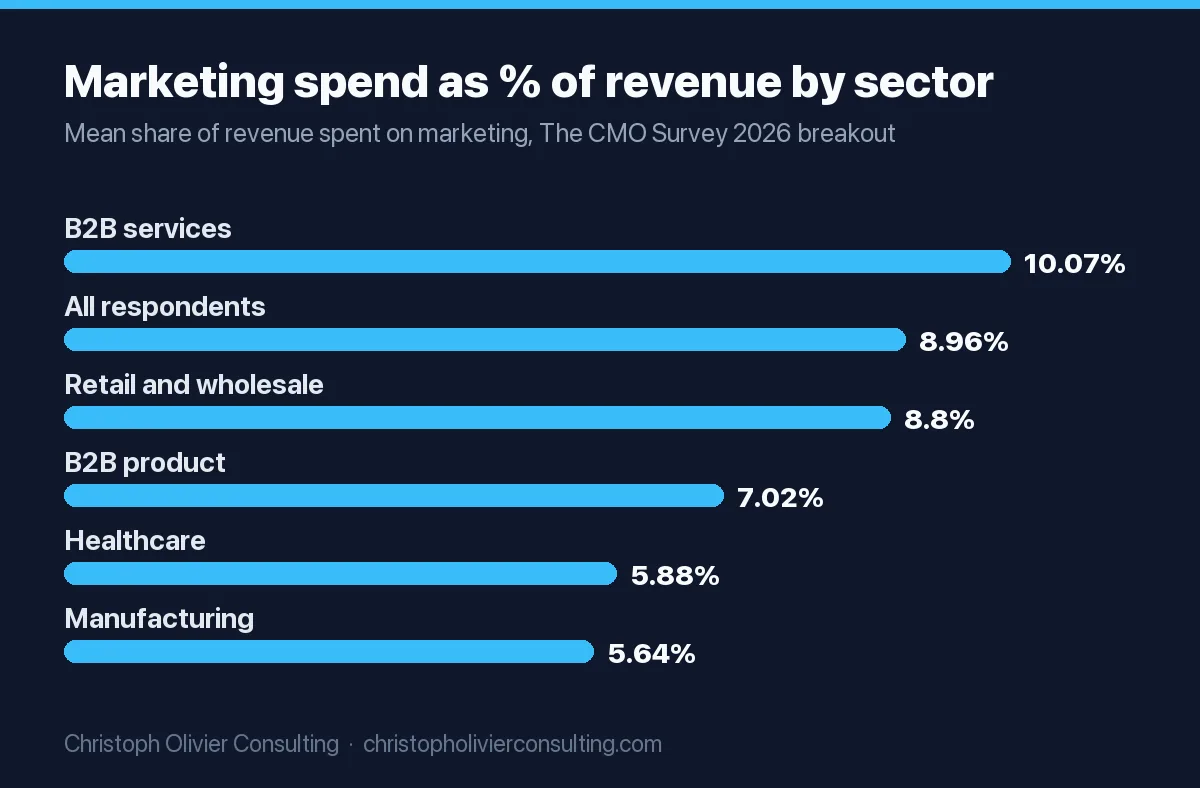
| Marketing budgets are thin | Marketing spend averaged 5.64% of revenue at manufacturing companies (13 responses) and 7.02% at B2B product companies (61 responses), against 8.96% for all 154 respondents | The CMO Survey Firm and Industry Breakout Report 2026, pp. 125 to 126 | Leadership cost has to be justified against a small pool of money. Small samples, so treat these as a starting point. |
| Research happens before contact | Technical buyers spend on average 60% of the buying process online before talking to a supplier; 72% spend at least half | 2025 State of Marketing to Engineers, GlobalSpec and TREW Marketing (n = 792) | The website and product data do most of the early selling. Sales sees the buyer late. |
| Why buyers finally call | 47% first contacted sales because of technical complexity, 40% for pricing or inventory questions; only 6% prefer never to talk to a salesperson | Same report (n = 791) | Fast, competent answers to technical and price questions are a marketing asset. Response time belongs on the scorecard. |
| Where they look | 73% routinely use supplier websites and 73% online trade publications; 29% conferences and trade shows; 10% generative AI tools | Same report (n = 1,002) | Website and trade media come before social. Trade shows still matter but are not the main research source. |
| Which online tools they value | 66% product selection or parametric search, 59% product comparison, 44% configurators; 22% quote generators, 9% chatbots | Same report (n = 1,009) | Budget for selection and comparison tools before chat widgets. |
| Trade shows | 75% planned to attend at least one in-person industry event in 2025, 55% at least two; buyers rated an informative website 4.0 out of 5 as a credibility signal versus 2.8 for prominent trade-show sponsorship | Same report (n = 794) | Keep the shows that produce conversations; question the sponsorship packages. |
So the job is part marketing, part sales operations: RFQ routing, quote follow-up and partner leads decide more revenue than ad creative, and the CMO must work well with engineers who supply product data and distributors who own the customer. If your channel runs through distributors, the partner program design in our channel sales strategy guide is the foundation the CMO builds on.
What a fractional CMO for manufacturing costs in 2026
Every figure below is published by a seller of fractional talent or marketing services, not an independent survey. Treat them as asking prices and always ask for the hours behind a monthly quote.
| Engagement | Published rate | Hours | Source and date |
|---|---|---|---|
| Fractional CMO with manufacturing experience, talent asking rate | $163 an hour average; middle half $138 to $175 | Not observed for this industry | GoFractional manufacturing benchmark, 35 profiles, Aug 30 to Nov 28, 2026 |
| Fractional CMO, all industries | $168 an hour average; middle half $125 to $200; $8,500 to $13,600 a month | About 17 a week | GoFractional CMO benchmark, November 2026 |
| Fractional CMO, strategy only | $3,000 to $6,000 a month | 5 to 10 a week | MarketerHire, April 2026 |
| Fractional CMO, strategy plus execution oversight | $7,000 to $12,000 a month | 15 to 20 a week | MarketerHire, April 2026 |
| Executives-as-a-service firm, retainer | $1,500 to over $30,000 a month, about $300 to $500 an hour equivalent | Not stated | Chief Outsiders, updated Oct 26, 2026 |
| Independent marketing consultant | $100 to $200 an hour, some $450 and up | Not stated | Chief Outsiders, Oct 2026 |
| Industrial marketing agency, ongoing program | $5,500 to $15,000 a month, six months minimum recommended; $7,500 one-time strategy diagnostic | Not stated | Windmill Strategy pricing page, viewed Nov 2026 |
| Manufacturing clients of a fractional marketing team | $3,000 to $30,000 a month in marketing services; talent at $75 to $250 an hour | Not stated | Prose manufacturing FAQ, undated |
MarketerHire also lists $150 to $350 an hour for hourly work and adds that fractional CMOs with deep vertical expertise charge roughly 20 to 30% more than generalists. The manufacturing asking rate in GoFractional’s data ($163) actually sits slightly below its all-industry average ($168), so do not accept “industrial specialist” as a reason for a premium on its own. Ask what the specialism is: distributor programs, an end market, or engineered-to-order quoting.
To compare quotes, convert each to an hourly rate: monthly fee divided by (weekly hours x 52 / 12). Our calculation: at GoFractional’s manufacturing figures, 10 hours a week is 43.3 hours a month, so $138 to $175 an hour is $5,980 to $7,583 a month, and the $163 average is $7,063. At 17 hours a week, the average is $12,008 a month. If you already have a proposal on the table and want someone to check its hours, scope and rate against this table, you can book a free consultation and go through it line by line. The full tier-by-tier breakdown across industries is in our fractional CMO cost guide.
Fractional CMO vs full-time hire vs manufacturing agency: year-one cost
Salary is not the cost of a hire. The manufacturing-specific baseline uses two federal sources.
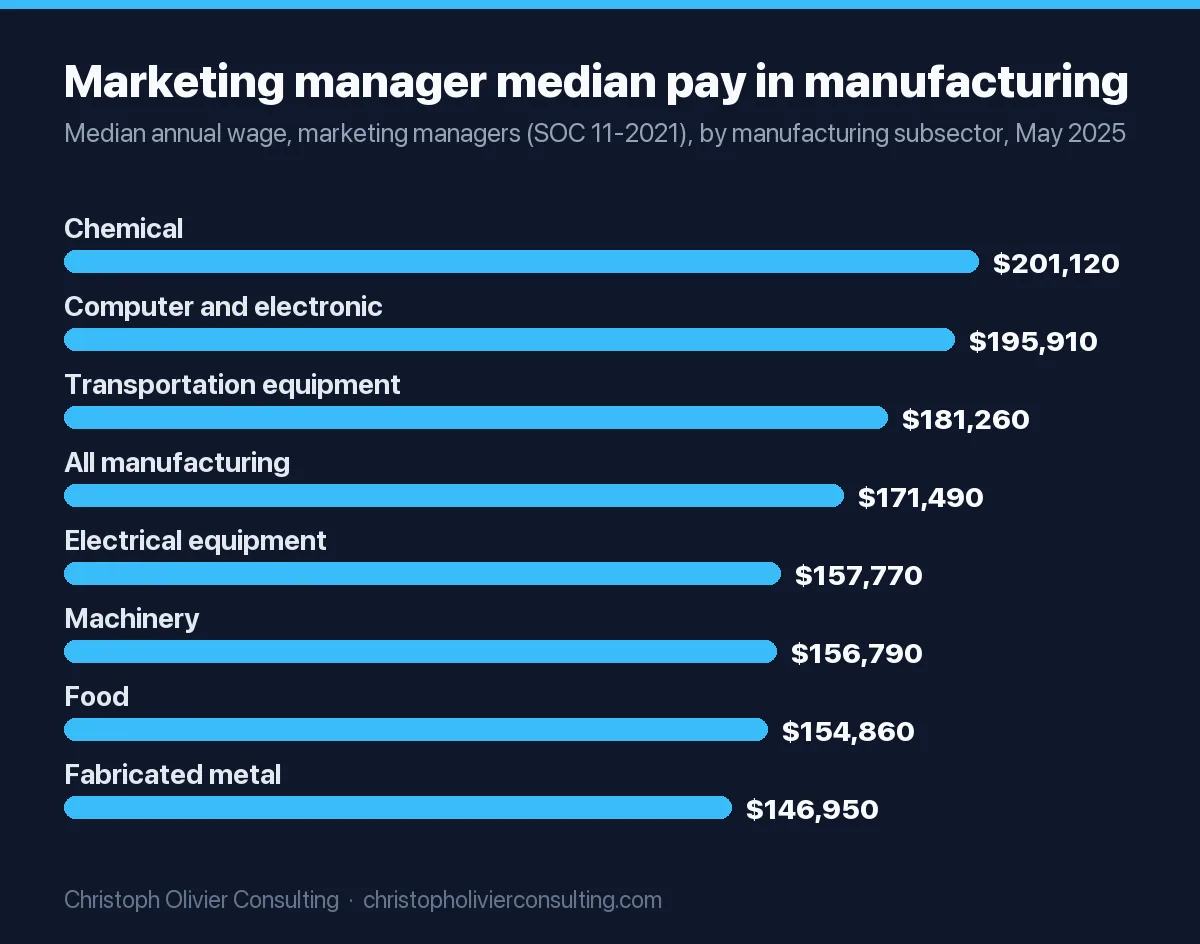
- Salary. In the BLS OEWS national industry estimates for May 2025, marketing managers in manufacturing (NAICS 31 to 33, 31,460 jobs) had a median wage of $171,490, a 75th percentile of $216,240 and a 90th percentile of $280,000. Across all industries the BLS median for marketing managers is $166,790. BLS does not track “CMO” separately; we use the 90th percentile as a CMO floor.
- Benefits. In BLS Employer Costs for Employee Compensation, June 2026, Table 4, management, business and financial jobs in manufacturing cost $90.18 an hour: $61.69 in wages, $8.43 in paid leave and $28.49 in total benefits. Salary already includes paid leave, so the load on top of salary is (28.49 minus 8.43) / (61.69 + 8.43) = 28.6%.
- Search fee. Korn Ferry’s fiscal 2026 annual report says executive search fees are “generally one-third of the estimated first-year cash compensation of the placed candidate.” MarketerHire puts recruiter fees for a full-time CMO at $50,000 to $100,000, or 25 to 30% of salary.
Our cost model, using those inputs (search fee applied to salary only; bonus excluded):
| Option | Math | Year-one cost | What you get |
|---|---|---|---|
| Fractional CMO, strategy only | $3,000 to $6,000 x 12 | $36,000 to $72,000 | Plan, budget, scorecard; 5 to 10 hours a week |
| Fractional CMO at manufacturing asking rates, 10 hours a week | $138 to $175 x 43.3 hours x 12 | $71,760 to $91,000 | Same, at a rate sourced to manufacturing profiles |
| Fractional CMO, strategy plus oversight | $7,000 to $12,000 x 12 | $84,000 to $144,000 | Weekly leadership of staff and agencies; 15 to 20 hours |
| Industrial marketing agency, ongoing program | $5,500 to $15,000 x 12, plus $7,500 diagnostic | $73,500 to $187,500 | Execution capacity across channels; strategy owned by you unless contracted |
| Full-time marketing manager, manufacturing median, own network | $171,490 x 1.286 | $220,550 | 2,080 paid hours, one person |
| Same, retained search | $220,550 + one-third of $171,490 | $277,713 | Same |
| Full-time CMO, manufacturing 90th percentile, retained search | $280,000 x 1.286 + one-third of $280,000 | $453,436 | Senior executive; bonus and equity extra |
A fractional CMO costs less because you buy fewer hours, not cheaper ones: $220,550 over 2,080 paid hours is about $106 an hour, below most fractional rates. The break-even is $220,550 / 12 = $18,379 a month. A fractional engagement billing more than that for a full year costs more than a median full-time hire in manufacturing. MarketerHire puts its own tipping point lower, at fees consistently above $12,000 to $15,000 a month for six months or more.
Pay also varies by what you make. Median marketing manager pay in the same BLS file ranges from $146,950 in fabricated metal products to $201,120 in chemicals, so use your own subsector when you budget a permanent hire. Our CMO salary guide covers bonus and total compensation by company size.
Marketing consultant, agency or fractional CMO: who does what
A marketing consultant sells advice by the hour or project: an audit, a positioning study, a trade-show review. Chief Outsiders’ published range for independents is $100 to $200 an hour. A manufacturing marketing agency sells execution: website, SEO, paid search, content, often on a retainer such as Windmill Strategy’s $5,500 to $15,000 a month. A fractional CMO sells ownership: they set the plan and budget, direct the agency and your staff, and answer for the pipeline number. A fractional CMO directing one agency is a normal structure; the risk is an agency setting its own targets with nobody checking them against booked orders.
Does your company need one? Fit by revenue
Revenue decides fit because it decides how much marketing money the CMO is supposed to direct. The table applies The CMO Survey’s 2026 averages (5.64% of revenue for manufacturing, 7.02% for B2B product companies) to typical manufacturer sizes. The 30% cap is my rule of thumb, not a survey finding: keep marketing leadership under about 30% of the total marketing budget so most of the money still reaches buyers.
| Annual revenue | Marketing budget at 5.64% to 7.02% | Leadership cap at 30% | What usually fits |
|---|---|---|---|
| $2 million | $112,800 to $140,400 | $33,840 to $42,120 | Owner-led marketing plus a one-off consultant project, or strategy-only fractional at the low end |
| $5 million | $282,000 to $351,000 | $84,600 to $105,300 | Fractional CMO, strategy only or about 10 hours a week ($36,000 to $91,000) |
| $10 million | $564,000 to $702,000 | $169,200 to $210,600 | Fractional CMO with oversight ($84,000 to $144,000); a full-time manager at $220,550 would take 31% to 39% of the budget |
| $20 million | $1,128,000 to $1,404,000 | $338,400 to $421,200 | Full-time marketing leader ($220,550 loaded = 16% to 20% of budget); fractional as bridge or advisor |
| $50 million | $2,820,000 to $3,510,000 | $846,000 to $1,053,000 | Full-time CMO or VP marketing with a team; fractional only to cover a gap or run a search |
Then run a payback test: year-one cost divided by gross margin is the added revenue the engagement must produce. Illustrative example: a $90,000 year at a 30% gross margin needs $300,000 of added revenue, which is 6% growth for a $5 million manufacturer. If you cannot name where that $300,000 would come from (a segment, a distributor, a product launch), the scope is not ready.
When hiring help makes sense, and when it does not
A fractional CMO is the wrong answer for plenty of manufacturers.
| Your situation | Better answer | Why |
|---|---|---|
| Under about $2 million, owner sells, one or two key customers | Do it yourself, plus a 20 to 40 hour consultant audit ($2,000 to $8,000 at $100 to $200 an hour) | The 30% cap leaves under $42,000 a year for leadership; spend the rest on a usable website and customer visits |
| Build-to-print job shop that wins work through a few OEM buyers and RFQ portals | Sales hire or estimator capacity, not a CMO | Revenue depends on quote speed and capacity, not demand creation |
| You already have a capable marketing manager who needs direction, not a boss | Strategy-only fractional or advisory, a few hours a week | Paying for oversight hours duplicates your manager |
| Plan is clear, you just need pages, ads or content built | A specialist or an industrial agency on a defined scope | You are buying hands, not leadership |
| Marketing team past about 10 people, or fees above $12,000 to $15,000 a month for six months | Full-time CMO or VP marketing | MarketerHire’s published tipping points; the fractional break-even here is $18,379 a month |
| $5 million to $20 million, sales team or reps and distributors, spend with no owner, owner approves every campaign | Fractional CMO | Enough budget that misallocation is expensive, not enough to justify $220,550 or more for one hire |
| New product line or new end market launching within 6 to 12 months | Fractional CMO or a fixed project with a fractional lead | Positioning, pricing support and channel launch need senior time for a defined period |
More readiness signals are in our guide on when to hire a fractional CMO.
Not sure which row your plant is in?
Bring your revenue, current marketing spend and any agency or fractional proposals. In a free consultation we will work out which row of the table you are actually in, including whether a cheaper option or doing it in-house is the better call.
The first 90 days of a fractional CMO at a manufacturer
Hold the engagement to output, not hours. This is a working template, not a published standard.
| Days | Work | Deliverable | Pass if |
|---|---|---|---|
| 1 to 15 | Data access (CRM, ERP orders, analytics, ad accounts); interviews with sales, 3 partners and 5 recent customers | A baseline: last 12 months of leads, RFQs, quotes and orders by source and product line | Baseline ties marketing-sourced RFQs to booked orders, even if the match is manual |
| 16 to 30 | Segment and product-line ranking by margin and win rate; trade-show and agency review | Written diagnosis with 3 priorities and a budget by channel | Each priority has a number, an owner and a stop rule |
| 31 to 60 | Fix the RFQ path and partner lead rules; first product-data pages | RFQ process map live; 2 or 3 tests running with kill rules | Median RFQ response time is measured weekly |
| 61 to 75 | Rewrite agency and vendor scopes; decide next trade-show season | New scopes signed; show list with a cost-per-conversation target | Every vendor is measured on opportunities or orders, not traffic |
| 76 to 90 | Review against baseline with the owner and sales lead | Day-90 call: continue, rescope, start a full-time search, or end with a handover | The decision is made with numbers on the table, not impressions |
Put the milestones and the exit clause into the agreement itself. Our fractional CMO contract template has clauses for scope, hours, data access and termination that you can copy.
Questions to ask a fractional CMO before you sign
Copy these into your interview notes. Strong candidates answer with specifics, weak ones with frameworks.
- “Walk me through how you would connect a web lead to a booked order in our ERP.” Pass: they ask what CRM and ERP you run and describe a match on account or quote number. Fail: they talk only about form fills and cost per lead.
- “How have you supported distributors or manufacturer’s reps without creating channel conflict?” Pass: they name a lead-routing rule and a partner kit. Fail: they plan to sell around your distributors.
- “How many hours a week, and what do I get each week for that?” Pass: a number and a recurring deliverable. Fail: “as needed.”
- “What will you not do?” Pass: a clear list, such as writing every spec page or running daily bids. Fail: “whatever you need.”
- “What happens at day 90 if the numbers have not moved?” Pass: a rescope or exit path they volunteer. Fail: a request for more time without a test plan.
Where CO Consulting fits for manufacturers
To be plain: CO Consulting’s published industry focus is professional-service firms and 7-figure service businesses, plus HVAC contractors, and our case studies come from those fields, not from industrial manufacturing. What we can offer a manufacturer is the fractional CMO seat as described on our fractional CMO services page: one senior owner of the plan, budget, vendors and weekly scorecard, an audit first, then a prioritized 90-day plan, with the team and agencies you already have doing the execution. We are not a trade-show exhibit house or a rep firm, and we do not replace the engineer who writes your specs. If you fall in one of the “better answer” rows above, we will say so. Either way, book a consultation and bring your numbers and any quotes you have.
Ready to scale your revenue?
Book a free 30-min consultation. We’ll diagnose your growth bottleneck and map out the 3 highest-leverage moves for your business.
Frequently asked questions
How much does a fractional CMO for manufacturing cost?
Published 2026 rates run $3,000 to $6,000 a month for strategy only and $7,000 to $12,000 with team oversight (MarketerHire). GoFractional's benchmark for fractional CMOs with manufacturing experience shows a $163 average asking rate, $138 to $175 for the middle half, about $6,000 to $7,600 a month at 10 hours a week. All are seller-published figures.
How much does a fractional CMO charge per hour?
MarketerHire lists $150 to $350 an hour. GoFractional's live November 2026 data averages $168 an hour across all industries, with the middle half between $125 and $200, and $163 for profiles with manufacturing experience. Executives-as-a-service firms such as Chief Outsiders equate their retainers to about $300 to $500 an hour.
What is a CMO for manufacturing?
A chief marketing officer at a manufacturer owns which product lines and end markets get marketing money, the path from website visit to RFQ and quote, support for distributors and reps, trade-show decisions and the marketing budget, measured against booked orders. A fractional CMO does the same part-time, typically 5 to 20 hours a week, directing staff and agencies.
How much should I pay a marketing consultant for a manufacturing company?
Independent marketing consultants typically charge $100 to $200 an hour, some $450 and up, per Chief Outsiders' October 2026 guide. Prose lists talent at $75 to $250 an hour. A 20 to 40 hour audit at $100 to $200 an hour costs $2,000 to $8,000, often the right first step for manufacturers under about $2 million in revenue.
How much does it cost to hire a manufacturing marketing agency?
Windmill Strategy, an industrial agency, publishes $5,500 to $15,000 a month for ongoing digital marketing with a six-month minimum recommended, plus a $7,500 strategy diagnostic and websites from about $45,000. Prose says its manufacturing clients invest $3,000 to $30,000 a month. An agency executes; it does not own your strategy unless you contract for that.
Is a fractional CMO cheaper than a full-time marketing manager in manufacturing?
Usually, because you buy fewer hours. BLS puts the May 2025 median for marketing managers in manufacturing at $171,490. With the 28.6% benefits load from BLS ECEC data for manufacturing management jobs, year one costs about $220,550, or $277,713 with a one-third search fee. Fractional fees above $18,379 a month for a year cost more.
What does a fractional CMO do in the first 90 days at a manufacturer?
Days 1 to 15: data access and a baseline tying leads and RFQs to booked orders. Days 16 to 30: a written diagnosis with three priorities and a channel budget. Days 31 to 60: fix RFQ routing and partner lead rules, start two or three tests. Days 61 to 90: rewrite vendor scopes, then a continue, rescope or exit decision.
Fractional CMO: cost, fit and industries