

Google says AI Overviews reach more than 2.5 billion people a month, and OpenAI’s CEO says 1.2 billion people use ChatGPT every week. When an AI summary appears, Google users click a regular result on 8% of visits, against 15% without one. Even so, AI chatbots sent only 0.40% of tracked referral visits in September 2026, while search engines sent 91.01%. Those four numbers frame AI search in 2026: huge exposure, fewer clicks per search, and still a sliver of measured traffic.
Every figure below names its publisher, its date and what kind of number it is: company-stated (not audited), measured (panel or log data), survey (self-reported) or forecast. Where a newer number replaced an older one, both are shown so you can see the trend and avoid citing a stale figure.
AI search stats 2026: the 5 numbers people ask for most
| # | Statistic | Date | Source | Type |
|---|---|---|---|---|
| 1 | AI Overviews: over 2.5 billion monthly active users | May 19, 2026 | Sundar Pichai, Google I/O 2026 keynote | Company-stated |
| 2 | ChatGPT: 1.2 billion weekly users (last official written figure: more than 900 million, Feb 27, 2026) | Sept 29, 2026 | Sam Altman at OpenAI DevDay, as reported live by Engadget; earlier figure in OpenAI’s own post | Company-stated |
| 3 | Google users clicked a traditional result on 8% of visits with an AI summary, 15% without | Data March 2025, published July 22, 2025 | Pew Research Center | Measured (900 US adults) |
| 4 | 49% of US adults use AI chatbots; 42% use them to search for information | Survey Feb 17 to 23, 2026, published June 17, 2026 | Pew Research Center | Survey (5,119 US adults) |
| 5 | AI chatbots sent 0.40% of referral visits; search engines 91.01%; social 8.60% | September 2026 | StatCounter Global Stats | Measured (site tag network) |
If you only need one sentence: AI answers now sit in front of billions of people, but measured clicks from AI tools are still under 1% of what search sends. Both halves are true at the same time, and good reporting quotes both.
AI search statistics by year, 2023 to 2026
Most stats pages mix years without saying so. The tables below put each company-stated user count on its own date, so you can see growth and cite the latest one correctly.
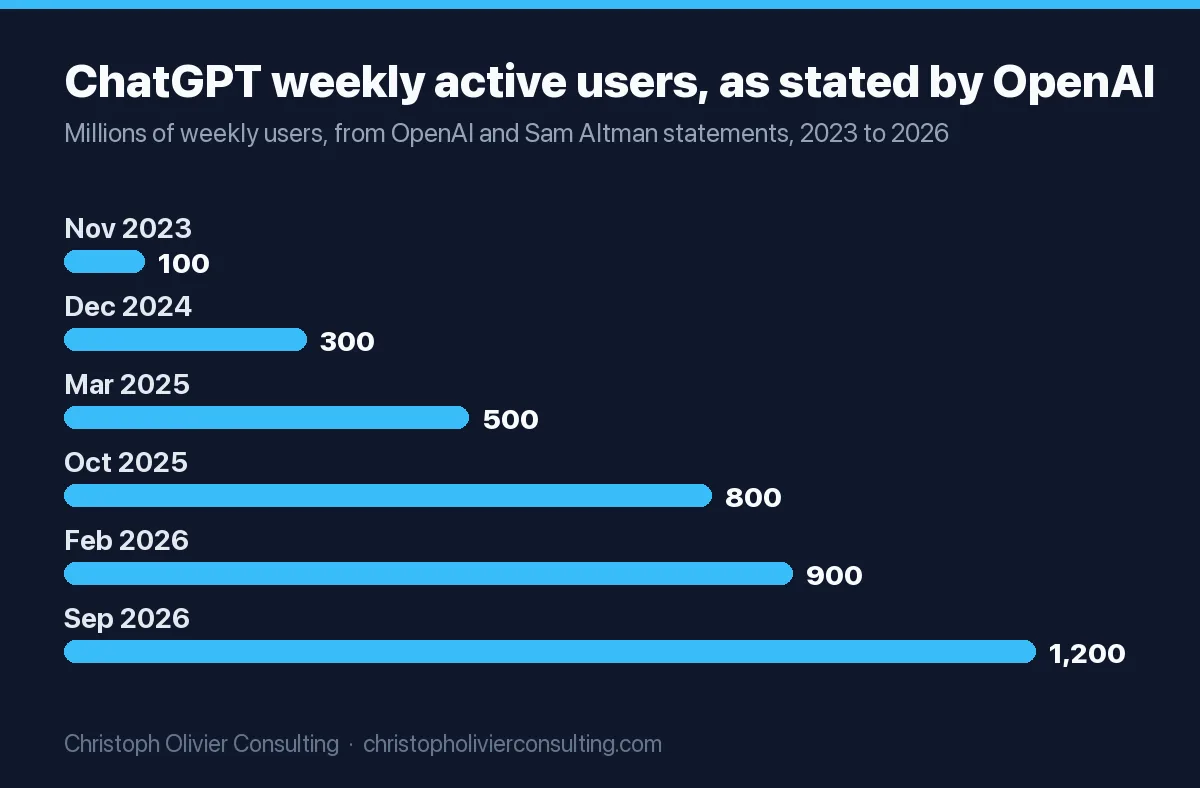
Company-stated user counts by year
| Product | 2023 | 2024 | 2025 | 2026 (latest) |
|---|---|---|---|---|
| ChatGPT weekly active users | 100M (Nov 6, 2023, Altman at DevDay) | 300M (Dec 2024, Altman at DealBook) | 500M (end of March); 800M (Oct 6, 2025, Altman at DevDay) | 900M+ (Feb 27, OpenAI post); 1.2B (Sept 29, DevDay) |
| Google AI Overviews monthly users | Not launched | Not stated | 2B+ (July 23, 2025, Q2 2025 call) | 2.5B+ (May 19, I/O) |
| Google AI Mode | Not launched | Not launched | 100M+ monthly users in the US and India (July 2025); 75M+ daily users (Oct 29, 2025, Q3 2025 call) | 1B+ monthly users (May 19, I/O; repeated on the July 22 Q2 2026 call) |
| Gemini app | Not stated | Not stated | 450M+ monthly (July 2025); 650M+ monthly (Oct 2025) | 900M+ (May); 950M monthly (July); 1B users (Oct 28, Q3 2026 release) |
| Microsoft Copilot and Bing | Not stated | Not stated | Family of Copilots 150M+ monthly users (Oct 29, 2025, FY26 Q1 call) | Bing 1B monthly users for the first time (Apr 29, FY26 Q3 call); 30M+ paid Microsoft 365 Copilot seats (July 29, FY26 Q4 call) |
| Perplexity queries | Not stated | Not stated | 780M queries in May 2025, 20%+ monthly growth (Srinivas at Bloomberg Tech) | No newer company-wide figure found |
Two cautions. First, these products define a “user” differently: weekly for ChatGPT, monthly for Google, and Google’s October 2026 Gemini release says “users” without a period. Do not add or rank them as if they were the same metric. Second, the 1.2 billion ChatGPT figure was said on stage and shown on a slide. The latest number OpenAI put in writing that I could fetch is the 900 million from February.
Measured behavior by year
| Metric | Earlier reading | Latest reading | Source |
|---|---|---|---|
| Share of tracked queries showing an AI Overview | 6.49% (Jan 2025) | 24.61% peak (July 2025), 15.69% (Nov 2025) | Semrush, 10M+ keywords |
| Position 1 CTR on AI Overview keywords | 0.073 (Mar 2024) to 0.026 (Mar 2025): 34.5% lower than expected | 0.016 (Dec 2025): 58% lower than expected | Ahrefs, 300,000 keywords |
| US Google searches ending without a click | 58.5% (2024 data) | SparkToro with Datos | |
| AI referral visits to the top 1,000 websites | 1.13B in June 2025, up 357% from June 2024 | Similarweb | |
| AI chatbots’ share of search, social and AI referrals | 0.29% (June 2025) | 0.40% (Sept 2026) | StatCounter |
| AI referral traffic to US retail sites, holiday season | Up 693.4% year over year (Nov 1 to Dec 31, 2025) | Adobe Analytics | |
Survey adoption by year (US adults who have used ChatGPT)
| 2023 | 2024 | 2025 | 2026 | Source |
|---|---|---|---|---|
| 18% | 23% | 34% | 44% | Pew Research Center, Americans and AI 2026 |
AI search adoption statistics 2026: who actually uses it
The best 2026 adoption data comes from Pew’s Americans and AI 2026 report, a survey of 5,119 US adults fielded February 17 to 23, 2026 and published June 17, 2026.
- 49% of US adults use AI chatbots, up from 33% in 2024. Pew notes the 2024 question was asked only of people who had heard of chatbots, so the comparison is not exact.
- 24% use a chatbot daily: 8% about once a day, 12% several times a day, 4% almost constantly.
- 42% use chatbots to search for information, the most common use Pew listed.
- 60% say they read the AI summaries at the top of search results; 30% say they do not; 10% are not sure.
- Chatbot reach: ChatGPT 44%, Gemini 24%, Copilot 17%, Meta AI 14%, Grok 8%, Claude 6%, Character.ai 3%. Perplexity was not in Pew’s list.
The “60% read AI summaries” figure pairs well with Pew’s 2025 click study below: most people see the summaries, and fewer of them click.
Pew Research 2025: Google AI summaries, 8% vs 15% clicks
This is the most cited AI search study, and most pages quote it without its method. Here is what Pew actually measured in “Google users are less likely to click on links when an AI summary appears in the results” (Athena Chapekis and Anna Lieb, July 22, 2025).
- Panel: real browsing by 900 US adults in Pew’s KnowledgePanel Digital, March 1 to 31, 2025. Results pages were re-collected April 7 to 17, 2025.
- Volume: 68,879 unique Google searches, 12,593 of which showed an AI summary (18% of all searches).
- Reach: 58% of panelists ran at least one search that produced an AI summary that month.
| Behavior on the results page | With AI summary | Without AI summary |
|---|---|---|
| Clicked a traditional search result | 8% of visits | 15% of visits |
| Clicked a link inside the AI summary | 1% of visits | Not applicable |
| Ended the browsing session | 26% of pages | 16% of pages |
The math people get wrong: 8% versus 15% is a 47% relative drop in clicks (7 divided by 15), not a 7% drop. Say “nearly half as often,” which is Pew’s own framing, or give both raw numbers.
Other findings from the same study that rarely get quoted:
- 88% of AI summaries cited three or more sources; 1% cited just one. The median summary was 67 words.
- Only 8% of one or two word searches produced a summary, against 53% of searches with 10 or more words. 60% of searches starting with who, what, when or why produced one.
- Wikipedia, YouTube and Reddit together were 15% of sources in AI summaries and 17% in standard results. Government sites were 6% of AI summary sources versus 2% of standard results.
Limits: one month, US only, desktop and mobile browsing of a 900-person panel. I found no 2026 rerun of the click study; Pew’s 2026 AI work is the survey above.
Click-through studies after Pew: Ahrefs, Semrush and SparkToro
Three vendor datasets measure clicks differently. They agree on direction and disagree on size, so cite each with its own definition.
| Study | What it measures | Finding | Method |
|---|---|---|---|
| Ahrefs, Feb 4, 2026 | Desktop CTR of the position 1 result | 0.073 (Dec 2023) to 0.016 (Dec 2025) on AI Overview keywords. Expected without AI Overviews: 0.037. Result: 58% lower. | Aggregated Search Console data, 150,000 AI Overview keywords vs 150,000 informational keywords without one |
| Ahrefs, Apr 17, 2025 | Same metric, one year | 0.073 (Mar 2024) to 0.026 (Mar 2025): 34.5% lower | Same design |
| Semrush, Dec 15, 2025 | Zero-click rate for the same keywords before and after an AI Overview appeared | 33.75% before, 31.53% after | Datos clickstream, 200,000+ keywords, Jan to Oct 2025 |
| SparkToro and Datos, 2024 | All Google searches ending with no click | 58.5% in the US, 59.7% in the EU | Datos clickstream panel, 2024 data |
Why Semrush and Ahrefs seem to disagree: Ahrefs measures how much the top organic result loses. Semrush measures whether the searcher clicks anything at all. A searcher can skip result 1 and still click an ad, a lower result or a link inside the overview. If your question is “what happens to my number one ranking,” Ahrefs is the closer fit. If it is “do people stop clicking entirely,” use Semrush or Pew.
Worked example with the Ahrefs ratio: a page at position 1 on a keyword with 10,000 monthly desktop impressions would expect about 370 clicks at a 0.037 CTR, and about 160 at 0.016. That is an estimate from averages, not a forecast for any one keyword. If you want to see where your own clicks are going, our guide to optimizing for Google AI Overviews walks through the page-level fixes.
How often AI Overviews appear, and what percentage of searches are answered by AI in 2026
There is no single measured 2026 figure for the share of all Google searches answered by AI. Google does not publish one. The two best measured readings are both from 2025: AI summaries appeared on 18% of real searches in Pew’s March 2025 panel, and on 15.69% of Semrush’s 10 million tracked keywords in November 2025, after a July peak of 24.61%.
What changed inside that year matters as much as the rate. Semrush found informational queries fell from 91.3% of AI Overview triggers in January 2025 to 57.1% in October, while navigational triggers rose from 0.74% to 10.33%. Ads appeared at the bottom of about 25% of AI Overview results pages by late 2025, up from under 1% in March.
The 2026 data points to more commercial coverage. Semrush’s July 2, 2026 commercial search study tracked more than 600,000 US desktop keywords across 10 industries from November 2025 to April 2026. The average share of commercial intent results pages with an AI Overview grew 71%, finance grew 231.25%, and transactional pages declined 5% on average. Similarweb’s July 29, 2026 stats page cites a US AI Overview appearance rate of 43% or more but does not publish the method behind it, so treat that one as a vendor claim.
Google adds a usage signal of its own. On the October 28, 2026 call, Pichai said AI Mode queries are on average 3x longer than traditional searches and 1 in 5 AI Mode searches use voice, images or documents.
AI search engine market share statistics, 2025 and 2026
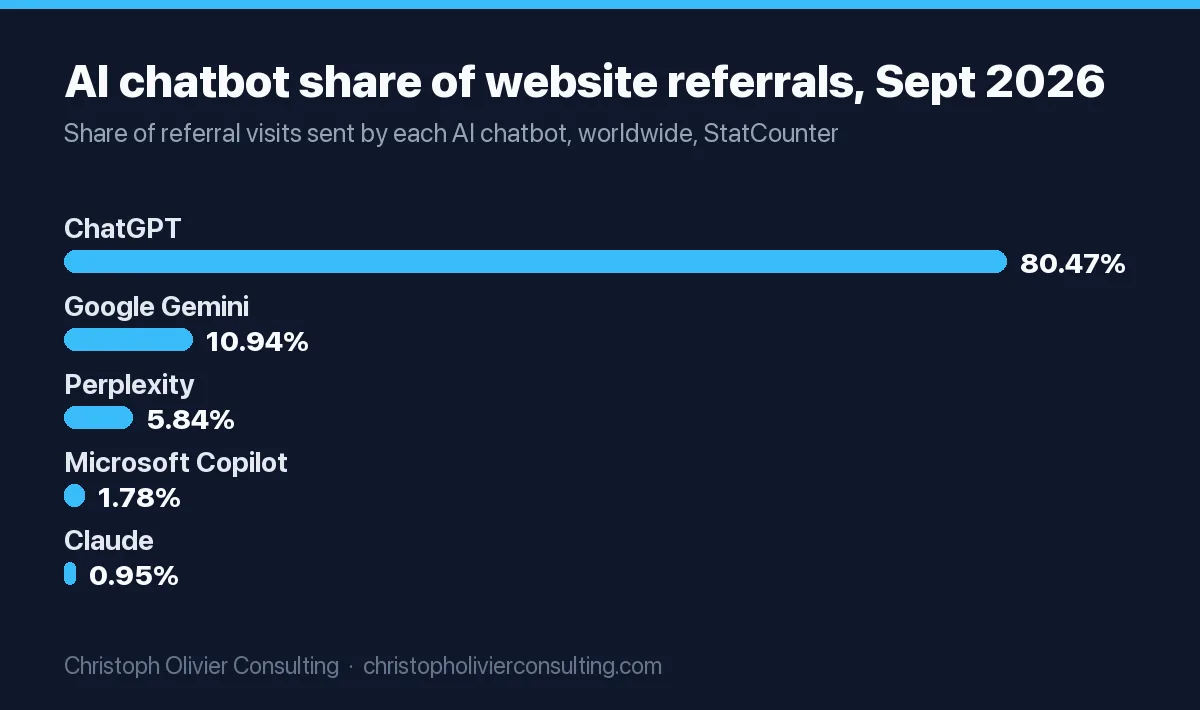
“Market share” for AI search is measured three ways, and the leader’s share swings from about 50% to about 80% depending on which one you pick.
| Measure | ChatGPT | Gemini | Others | Source and date |
|---|---|---|---|---|
| Share of referral visits sent by AI chatbots to websites | 80.47% | 10.94% | Perplexity 5.84%, Copilot 1.78%, Claude 0.95% | StatCounter, Sept 2026 |
| Share of visits to generative AI websites | About 53% (from about 76% in June 2025) | About 27 to 28% (from under 9%) | Claude about 9% (from about 2%) | Similarweb, May 2026 |
| Share of US adults who use each chatbot | 44% | 24% | Copilot 17%, Meta AI 14%, Claude 6% | Pew, Feb 2026 |
StatCounter measures referrals across more than 1 million websites and 3 billion monthly page views, according to its May 7, 2026 release. Grok is excluded because it does not pass referral data. One warning: StatCounter’s partial October 2026 reading shows ChatGPT at about 51% and Gemini near 29%, a break from every prior month. Wait for the full month before quoting it.
For the “similarweb chatgpt traffic growth yoy february 2026” question: Similarweb posted on March 8, 2026 that Gemini was the fastest growing gen AI tool by year-over-year website visits in February 2026. The chart in that post, as reported by OfficeChai, shows Gemini up 643.58% and ChatGPT up 37.04% year over year. Across the full June 2025 to May 2026 window, Similarweb puts average monthly gen AI web visits at 9.5 billion, up 70%, with 655 million unique visitors.
Classic search share has barely moved. StatCounter has Google at 89.94% of worldwide search in September 2026 and Bing at 5.29%, against 91.47% for Google in January 2024. Our search engine market share statistics page tracks that series in more detail.
Generative AI referral behavior: traffic, landing pages and retail growth
AI referrals grow fast from a small base. Similarweb counted 1.13 billion AI referral visits to the top 1,000 websites in June 2025, up 357% from June 2024, with ChatGPT sending more than 80%. In the same panel, Google search sent 191 billion. Divide one by the other: AI referrals were about 0.6% of Google’s volume. StatCounter’s broader September 2026 reading, 0.40% for AI chatbots against 91.01% for search, tells the same story.
Three 2026 behavior shifts are worth knowing:
- More homepage landings. After a May 2026 ChatGPT change, the share of AI referral traffic landing on homepages rose from roughly 26 to 29% to about 62 to 63% by late May, per Similarweb’s weekly referral data. Expect more AI visits on your homepage and fewer on the article that was cited.
- More answers with links. The share of US ChatGPT prompts whose answers included a citation rose from about 1.6% in June 2025 to about 6.8% in May 2026 (Similarweb). Professional services sat under 4%, against about 23% for travel and hospitality.
- Retail growth is slowing from a huge base. Adobe measured AI referral traffic to US retail sites up 693.4% in the 2025 holiday season, across more than 1 trillion visits. For the 2026 season it forecasts growth of 130%, with July 2026 at 62% year over year, per Digital Commerce 360’s report on Adobe’s forecast.
To see these patterns in your own analytics, set up a separate AI referral channel. Our walkthrough on tracking AI search traffic in GA4 and Search Console has the setup.
Which sources AI engines cite
Profound analyzed 680 million citations from August 2024 to June 2025 (published June 5, 2025, updated August 2025). Each engine leans on a different source.
| Engine | Top source | Share of that engine’s top 10 cited sources |
|---|---|---|
| ChatGPT | Wikipedia | 47.9% |
| Perplexity | 46.7% | |
| Google AI Overviews | Reddit, then YouTube | 21.0%, 18.8% |
Top 10 share is not total citation volume, and this data predates 2026 model changes. It is still the largest public citation dataset.
First-party data on the supply side: our AI Search Readiness Study 2026 crawled 487 US small-business and professional-services websites in July 2026, of which 419 were live. Sites came from public best-of lists and local directories across six verticals and ten cities. We fetched robots.txt, llms.txt, the homepage and one interior page per site, without running JavaScript, and scored each on a 0 to 100 index. Results: 22.4% of live sites had no schema markup, no llms.txt and no FAQ content; the mean score was 59.7; only 4.3% used FAQPage schema; 19.6% had an llms.txt file; 91.2% did not mention GPTBot in robots.txt. Limits: two pages per site, one snapshot, and JavaScript-injected schema is missed. If you want the playbook that follows from this, the answer engine optimization guide covers it.
Gartner’s 25% search volume drop prediction, traced
The claim: on February 19, 2024, Gartner predicted that “by 2026, traditional search engine volume will drop 25%, with search marketing losing market share to AI chatbots and other virtual agents.” The analyst quoted was Alan Antin, VP Analyst. The supporting research, “Predicts 2024: How GenAI Will Reshape Tech Marketing,” is behind Gartner’s client paywall, so the public release does not define “traditional search” or name a baseline.
The record so far, with two months of 2026 left:
| Evidence | What it says | Source |
|---|---|---|
| Google query growth | “Our year-over-year query growth rate is the highest it’s been in the last five years” (Oct 28, 2026) | Alphabet Q3 2026 earnings release |
| Google Search revenue | $63.35B in Q3 2026, up from $56.57B in Q3 2025 | Same release |
| Google search share | 89.94% worldwide (Sept 2026) vs 91.47% (Jan 2024) | StatCounter |
| Referral share | Search 91.01%, AI chatbots 0.40% (Sept 2026) | StatCounter |
Verdict: on the public evidence, a 25% drop in search volume has not happened. The fair caveat is that Google counts AI Mode and AI Overviews queries as Search, and Alphabet does not publish absolute query counts. If “traditional” means ten blue links only, nobody outside Google can measure it. Cite the Gartner line as a 2024 forecast that the 2026 data does not support, not as a fact.
Search Console’s Generative AI performance report: your own AI search stats
Industry stats tell you the trend. Your own numbers now come from Google. On June 3, 2026, Google introduced Search Generative AI performance reports in Search Console for a subset of sites, and added a note that as of August 31, 2026 they had rolled out to all websites worldwide. The reports cover AI Overviews and AI Mode, plus a separate report for generative AI features in Discover.
What the report gives you, per the Search Console help page: impressions only (how often links to your site were shown in a generative AI feature), broken down by page, country, device and date. A search type filter separates text searches from multimodal ones such as Google Lens. It does not report clicks, CTR or position. The newest data is preliminary, the table caps at 1,000 rows, and Search Labs experiments are excluded.
A 10-minute monthly pull:
- Open the report at search.google.com/search-console/performance/search-analytics/ai and select your property.
- Set the date range to the last full month and note total generative AI impressions.
- Open the standard Performance report for the same range and note total impressions. Divide the first by the second: that is your AI impression share.
- Switch to the Pages dimension. Export the top 25 pages by AI impressions and compare their organic clicks month over month in the standard report.
- Switch to Countries and record the top five countries by AI impressions.
- Log the five numbers in one sheet every month. After three months you have your own AI search statistics, which beat any industry average for your decisions.
How do I prioritize which markets to track for AI visibility first?
Use the Countries dimension above. My rule of thumb: start with the countries that already produce your revenue, then add any country where your AI impressions are high but your organic clicks are low, because that gap is where AI answers may be replacing visits. Ignore countries with only a handful of impressions until they grow; small counts swing too much month to month.
Which AI search number to cite
Pick the row that matches the sentence you are writing. The last column lists numbers that are stale or mislabeled.
| You want to say | Cite this | Phrase it as | Avoid |
|---|---|---|---|
| How many people see AI search | Google I/O, May 19, 2026 | “Google says AI Overviews have over 2.5 billion monthly users” | “2 billion” (July 2025, superseded) |
| How big ChatGPT is | OpenAI, Feb 27, 2026, or DevDay, Sept 29, 2026 | “OpenAI reported more than 900 million weekly users in February 2026; Altman cited 1.2 billion in September” | “ChatGPT has 1.2 billion monthly users” (the figure is weekly) |
| AI summaries reduce clicks | Pew, July 22, 2025 | “Users clicked a result on 8% of visits with an AI summary vs 15% without (Pew, March 2025 data)” | “AI cut clicks by 7%” |
| Top rankings lose clicks | Ahrefs, Feb 4, 2026 | “Position 1 CTR was 58% lower on AI Overview keywords (Ahrefs, Dec 2025 data)” | “34.5%” as current (that was the 2025 study) |
| How often AI Overviews show | Semrush, Dec 15, 2025, with month | “15.69% of tracked keywords in November 2025, after a 24.61% July peak” | Any rate with no month attached |
| How much traffic AI sends | StatCounter, Sept 2026 | “AI chatbots sent 0.40% of referral visits vs 91.01% for search” | Growth rates alone (357%, 693%) with no base |
| AI chatbot market share | Name the metric | “ChatGPT sent 80.47% of AI chatbot referrals (StatCounter)” or “about 53% of gen AI site visits (Similarweb)” | Mixing referral share with visit share |
| US adoption | Pew, June 17, 2026 | “49% of US adults use AI chatbots; 42% use them to search for information” | Vendor surveys with no sample size |
| Search will shrink | Gartner, Feb 19, 2024 | “Gartner forecast a 25% drop by 2026; Google reported its fastest query growth in five years in Q3 2026” | Stating the forecast as a measured result |
Before you move budget toward AI visibility, put your own Search Console numbers next to these averages. If you want a second opinion on what they mean for your firm, you can book a consultation. For the content side, start with the 11 signals that get pages cited by AI.
Frequently asked questions
What are the most important AI search stats for 2026?
Five numbers cover most needs. Google says AI Overviews have over 2.5 billion monthly users (May 2026). Sam Altman cited 1.2 billion weekly ChatGPT users (September 2026). Pew measured 8% clicks with an AI summary versus 15% without (March 2025 data). Pew found 49% of US adults use AI chatbots (February 2026). StatCounter shows AI chatbots sent 0.40% of referral visits in September 2026.
What percentage of searches are answered by AI in 2026?
Google does not publish a share for all searches. The best measured readings are from 2025: AI summaries appeared on 18% of real Google searches in Pew's March 2025 panel, and on 15.69% of Semrush's 10 million tracked keywords in November 2025, after a 24.61% peak in July. Semrush's 2026 data shows coverage rising on commercial queries, up 71% on average from November 2025 to April 2026.
What did the Pew Research 2025 study find about Google AI summaries and clicks?
Pew tracked 900 US adults in March 2025 across 68,879 Google searches. Users clicked a traditional result on 8% of visits when an AI summary appeared, against 15% without one. They clicked a link inside the summary on just 1% of visits, and ended their session on 26% of pages with a summary versus 16% without. Pew published the study on July 22, 2025.
How many people use ChatGPT in 2026?
OpenAI wrote on February 27, 2026 that ChatGPT has more than 900 million weekly active users and over 50 million consumer subscribers. At DevDay on September 29, 2026, Sam Altman cited 1.2 billion weekly users, as reported live by Engadget. In the US, Pew's February 2026 survey found 44% of adults have used ChatGPT, up from 18% in 2023.
What is the AI search engine market share in 2026?
It depends on the metric. By referrals sent to websites, StatCounter puts ChatGPT at 80.47%, Gemini at 10.94% and Perplexity at 5.84% in September 2026. By visits to AI websites, Similarweb puts ChatGPT near 53% and Gemini near 27 to 28% in May 2026. Classic search is unchanged: Google held 89.94% of worldwide search in September 2026.
Did Gartner's prediction of a 25% drop in search volume by 2026 come true?
Not on the public evidence. Gartner forecast on February 19, 2024 that traditional search engine volume would drop 25% by 2026. In October 2026 Alphabet said its year-over-year query growth was the highest in five years, and Google still held about 90% of search share. Gartner's paywalled report does not publicly define traditional search, so cite it as an unconfirmed forecast.
Does Search Console show AI Overviews and AI Mode data?
Yes. Google launched Search Generative AI performance reports on June 3, 2026 and rolled them out to all websites worldwide by August 31, 2026. They show impressions from AI Overviews and AI Mode by page, country, device and date, plus a separate Discover report. They do not show clicks, CTR or average position, so pair them with the standard Performance report.
More CO Consulting marketing research
- 37 Page Speed and Core Web Vitals Statistics for 2026
- FTC Advertising and Endorsement Enforcement: 12 Compliance Statistics for 2026
- Marketing Cost & CAC Benchmark by Industry 2026: The True Cost Per Acquired Client
- The AI Search Readiness Study 2026: 15 Data Points on How Small-Business Websites Score for AI Citation
- US Digital Advertising Spend: 42 Statistics, Trends, and Data Points for 2026
- Social Media Marketing Statistics 2026: Adoption, Demographics, Time Spent, and Ad Spend
- CMO and Marketing Budget Statistics 2026: Verified Benchmarks From Gartner and The CMO Survey
More Marketing Research guides