

Tree service lead costs in 2026 depend on who sells the lead. Networx publishes $42 to $51 for a shared tree services lead and $88 to $97 for an exclusive one, and the closest Google search ads benchmark (Home and Home Improvement) is a $90.92 median cost per lead. Angi, HomeAdvisor, Thumbtack and Google Local Services Ads do not publish a tree service price, so you only learn it inside the account.
The lead price is half the story. Divide it by the share of leads you actually book and compare the result with what the job pays. On HomeGuide’s 2026 price ranges and our example inputs, a $90 lead pays off on an extra-large removal or a storm call and loses money on a single trim or stump. The tables below give you every published price we could verify, the math to test them against your own tickets, and the organic channels that book tree work without a per-lead fee.
Want a specialist to build this for your business? See how CO Consulting’s marketing services work, starting with a diagnostic and audit.
Tree service lead costs by channel (published prices only)
Every figure in this table comes from the vendor’s own page or a primary benchmark report. Where a vendor does not publish a price, the table says so instead of guessing.
| Channel | Published tree service price | How you pay | Shared or exclusive |
|---|---|---|---|
| Networx Pay Per Lead | Tree Services $42 to $51; Stump Removal and Grinding $24 to $29 | Per lead; you set how many leads per day, week or month | Shared (number of pros per lead not stated) |
| Networx Exclusive | Tree Services $88 to $97; Stump Removal and Grinding $50 to $55 | Prepaid credit; each lead is deducted from your budget | Exclusive; some leads arrive as live transferred calls during business hours |
| Google search ads (WordStream 2026 benchmarks, Home and Home Improvement) | $90.92 median cost per lead; $8.33 cost per click; 8.05% conversion rate | Per click | Exclusive (your own ad and landing page) |
| Service Direct | About $58 national average; about $68 in California; $71 in Los Angeles (post dated September 22, 2023) | Per lead; partners set their own cost per lead | Not stated |
| Inquirly | Form leads $10 to $50; call leads $25 to $100; “winning” lead around $25 on average (post dated September 4, 2024) | Pay per lead; no minimums or monthly fees | Exclusive, per its page |
| Google Local Services Ads | Not published for tree services | Per lead (calls and messages) | The customer contacts you directly from your ad |
| Angi | Not published; fees vary with task, location and demand | Charged when you and the homeowner both show interest, “whether or not you open or respond” | Shared with no more than five pros |
| HomeAdvisor (Angi Inc.) | Not published | Fees per consumer match “regardless of whether the Pro ultimately provides the requested service,” per Angi’s FY2025 10-K | Not stated in the filing |
| Thumbtack | Not published | Per lead; pros adjust “max lead price settings” | Not stated |
| Google Business Profile, website SEO, Nextdoor posts | No per-lead fee | Your time, or an agency retainer | Exclusive |
Three things to know before you compare rows. First, WordStream’s Home and Home Improvement category mixes every home trade, so tree work in your market can sit well above or below $90.92. It is still the only large public search benchmark that covers tree companies: 13,474 US campaigns from April 1, 2025 to March 31, 2026, reported as medians, and the same category we use on our Google Ads CPC by industry page. The all-industry median is $66.69 per lead and $5.42 per click, so home services pay a premium.
Second, the Service Direct and Inquirly figures are older posts on the vendors’ own blogs. Treat them as the price the vendor chose to advertise, not an audit. Third, Angi Inc.’s 10-K lists four ways pros bought in 2025: “full-priced leads within a monthly budget, access to discounted leads in a subscription package, double opt-in leads on an a-la-carte basis and pre-priced offerings.” The same marketplaces price other trades the same way, as our general contractor lead cost breakdown shows.
Cost per lead for tree service vs cost per booked job
The number that decides whether a channel works is cost per booked job: cost per lead divided by the share of those leads that turn into a paid job. Track it per channel in your CRM or a spreadsheet for at least 30 days of leads before you judge a source.
The worked examples below use two labeled assumptions, not benchmarks: a 20% booking rate on shared leads (one in five, if Angi-style matching sends the job to up to five pros and you win an even share) and 40% on exclusive leads. Replace both with your own numbers.
| Source | Published cost per lead | Booking rate (assumption) | Cost per booked job |
|---|---|---|---|
| Networx shared, Tree Services | $42 to $51 | 20% | $210 to $255 |
| Networx exclusive, Tree Services | $88 to $97 | 40% | $220 to $242.50 |
| Google search ads, Home and Home Improvement median | $90.92 | 40% | $227.30 |
| Service Direct national average (2023) | $58 | 40% | $145 |
| Inquirly average winning lead (2024) | $25 | 40% | $62.50 |
Notice what happens to the shared row. The Networx shared lead costs about half as much as the exclusive one, yet ends up at roughly the same cost per booked job, because you split it with other crews. Our moving lead price comparison runs the same shared versus exclusive math with a different trade’s vendors.
What lead cost your tree jobs can carry
Turn it around: the most you can pay per lead is job value times the share of revenue you allow for marketing times your booking rate. The table uses HomeGuide’s 2026 tree removal costs, its tree trimming costs and its stump grinding costs as job values, a 10% marketing allowance and a 40% booking rate. The 10% and 40% are example inputs, not benchmarks.
| Job type (HomeGuide price) | Marketing budget per job at 10% | Maximum cost per lead at 40% booking | Does a $90.92 search lead fit? |
|---|---|---|---|
| Trim one tree ($650 national average) | $65 | $26 | No |
| Stump grinding, one stump ($120 to $400) | $12 to $40 | $4.80 to $16 | No |
| Remove a small tree, under 30 ft ($200 to $500) | $20 to $50 | $8 to $20 | No |
| Remove a medium tree, 30 to 60 ft ($500 to $1,500) | $50 to $150 | $20 to $60 | No |
| Remove a large tree, 60 to 80 ft ($850 to $2,000) | $85 to $200 | $34 to $80 | No |
| Remove an extra-large tree, over 80 ft ($1,200 to $2,500+) | $120 to $250+ | $48 to $100+ | Only for jobs above about $2,273 |
| Same-day removal of a medium tree (HomeGuide: 2 to 3 times the standard rate, so $1,000 to $4,500) | $100 to $450 | $40 to $180 | Yes, for jobs above about $2,273 |
The pattern is the useful part. With a 10% allowance and 40% booking, the most you can pay per lead is 4% of the job, so a $90.92 lead only pays when the job is worth about $2,273 or more: extra-large removals, multi-tree jobs and emergency work. Trimming and stump grinding rarely carry a paid lead on their own, so those services need organic demand, repeat customers or an add-on sale on a removal visit. If your average ticket is higher because you sell multi-tree or commercial work, rerun the table with your own numbers: the formula does not change.
Google Guaranteed for tree services: what changed and what LSA leads cost
“Tree services” is an eligible category on Google’s US Local Services Ads getting started page, so tree companies can still run the ads that used to carry the Google Guaranteed badge. The badge itself is gone. Search Engine Roundtable reported that effective October 20, 2025, Google replaced the Google Guaranteed, Google Screened and License Verified by Google badges with a single Google Verified badge.
The money-back promise went with it. Google’s help page on the badge change says it is “discontinuing the Money Back Guarantee associated with the Google Guarantee badge,” with reimbursement requests still allowed for Local Services Ads bookings made before December 7, 2025, within 30 days of the service date. If your truck wraps, website or estimates still say “Google Guaranteed,” update them.
What to expect when you apply, from Google’s screening and verification page:
- Accelerated verification can put the Google Verified badge on your ad quickly, but you then have 14 days to finish the remaining verification steps or the ad stops serving.
- If a background check is denied, you wait 30 days before you can reapply.
- You pay per lead (calls and messages from the ad), not per click. Google does not publish a tree service lead price, so the only way to see yours is to set a small budget and watch the first month of charged leads.
The product is also moving. Google is migrating Local Services Ads into Google Ads as Performance Max campaigns with pay-per-lead goals. The first phase started in August 2026 for select US home and storefront advertisers; service-area businesses without storefronts, which describes most tree companies, follow in late 2026. Your historical weekly budget is divided by 7 into a daily average, monthly spend is capped at that average times 30.4, and manual bidding is retired. Export your lead history by job type before you migrate. Our plumber marketing cost guide walks through the same migration for a trade that moved in the first wave.
Tree service organic lead services: Google Business Profile, service pages, reviews, Nextdoor
Organic leads cost time instead of a per-lead fee. They are the only channel in the tables above that can profitably book a $650 trim, which is why they belong at the base of a tree company’s plan. Our local SEO statistics page collects the sourced data on how people choose local businesses from map results.
Google Business Profile settings for a tree company
Google says local results are based mainly on relevance, distance and prominence, and that “there’s no way to request or pay for a better local ranking,” per its local ranking help page. Prominence includes how many websites link to you and how many reviews and how high a rating you have. What that means in the profile:
- Primary category “Tree service,” with “Arborist service” as a secondary category if you employ arborists. GMB Everywhere (a third-party tool, since Google publishes no category list) shows this as the typical setup.
- Add each service you actually sell as its own service: tree removal, tree trimming, stump grinding, emergency tree service, cabling and bracing.
- Upload real job photos: before and after, the crane or bucket truck on site, the cleaned-up yard.
- Reply to every review. Google lists responding to reviews as one of its own recommendations.
One page per service, built for the search behind it
| Page | What the searcher wants | What the page must show |
|---|---|---|
| Tree removal | A price range and proof you can drop a big tree near a house safely | Your price range by tree height, crane or rigging photos, insurance and license numbers, whether stump grinding and haul-away are included |
| Tree trimming and pruning | Someone who will not top or butcher the tree | A line that pruning follows ANSI A300 practices (if it does), the ISA Certified Arborist on staff, your best trimming season for local species |
| Stump grinding | A quick price | Price per inch or per stump, multi-stump pricing, how deep you grind, what happens to the chips |
| Emergency storm work | Someone who answers now | A phone number that a person answers, response hours, how insurance claims typically work, photos of storm jobs |
| Each city or county you serve | A local crew | Jobs completed in that area, local permit or license notes, reviews from customers there |
Reviews without breaking Google’s rules
Google’s Maps content policy bans offering “payment, discounts, free goods and/or services” in exchange for a review, bans selectively asking only happy customers, and bans asking reviewers to include specific content. So send the same review link by text to every finished job, keep any referral reward separate from reviews, and never script keywords like “tree removal” into the request. Our guide on how to get more Google reviews has compliant request templates.
Nextdoor
Nextdoor’s small business page offers a free Business Page, free Business Posts and customer recommendations, with paid ads on top, and says 1 in 3 US households are on the platform (Nextdoor’s own claim). For a tree company, the free version is enough to start: post finished jobs by neighborhood and ask satisfied customers to recommend you there.
What organic lead services cost if you hire them out
Few tree service SEO agencies publish prices. 1Digital Agency states that tree service SEO programs “typically range from $1,500-$4,000/month,” with Local Services Ads as a separate pay-per-lead budget. Hook Agency publishes no tree price but says it is “usually the best fit for growth-mode contractors over 2M+.” Before you sign with any organic lead service, score it against this checklist:
| Question | Pass | Fail |
|---|---|---|
| Who owns the website, domain and Google Business Profile? | You, in writing | The agency, or “we’ll transfer it if you stay 12 months” |
| Are the leads yours alone? | Yes, they come from your own profile and site | Leads come from an agency-owned site and may be resold |
| What do they report monthly? | Calls and forms by service page, plus booked jobs if you share them | Rankings and traffic only |
| Contract term | Month to month, or a short term with a clear exit | 12 months or more with no performance exit |
| Will they build one page per service and city you name? | Yes, with your prices, photos and credentials | Template pages with the city name swapped |
Trust signals homeowners check before they call
Tree work is dangerous and expensive to get wrong, so credentials do real selling work on your profile and estimates. Put the ones you hold where customers can verify them in one click.
| Credential | Who issues it | What it requires (per the issuer) | How a customer checks it |
|---|---|---|---|
| ISA Certified Arborist | International Society of Arboriculture | A credential held by individual professionals; ISA says certification holders are held to a Code of Ethics and promotes hiring companies with ISA certified professionals on staff | ISA’s Find an Arborist directory. Listing is voluntary and some holders hide their location, so make sure your arborists’ profiles are public |
| TCIA Accreditation | Tree Care Industry Association | Voluntary company audit; in effect three years with yearly check-ups that confirm the required number of arborists on staff, proper insurance, and a good safety and consumer satisfaction rating (TCIA) | The accredited company search on TCIA’s site, per its Accreditation FAQ |
| Louisiana Arborist License | Louisiana Department of Agriculture and Forestry | Required to recommend or perform tree removal, pruning, trimming, cabling, fertilization and cavity work for a fee; exam passed at 70% or higher; $125 a year; proof of general liability and, if applicable, workers’ compensation insurance; annual continuing education; a written contract with the property owner (LDAF) | LDAF’s list of licensed arborists (as of July 2026) on the same page |
| Maryland Licensed Tree Expert | Maryland DNR Forest Service | “All tree care professionals practicing in Maryland must obtain a license. Without a license, they may not practice or advertise tree care services in the state” (Maryland DNR) | DNR’s online search by company, county or last name |
| Connecticut Arborist License | Connecticut DEEP | Required for anyone “advertising, soliciting or contracting to do arboriculture,” defined as work for hire such as feeding, pruning, trimming, bracing or treating trees; arborist businesses must also register with DEEP (since October 1, 2013) (CT DEEP) | Ask for the license number and confirm with DEEP |
| California C-49 Tree and Palm Contractor | Contractors State License Board | Since January 1, 2024, new tree service specialists apply for the C-49, which requires a trade exam; C-61/D-49 Tree Service applications received after December 31, 2023 are processed as C-49, and existing D-49 holders may keep working under it (CSLB bulletin 23-07) | CSLB’s online license check |
If you still advertise a “D-49 license” in California, that is accurate for an existing license, but the C-49 is what the CSLB calls the new industry standard. In Maryland and Connecticut the rules reach advertising itself, so an unlicensed company running ads there has a legal problem, not just a marketing one.
Two standards are worth naming in estimates, used the way their publishers describe them. ANSI A300 gives “standard practices and specification writing guidelines” for tree care; TCIA is the secretariat and the standards are reviewed and revised if necessary every five years (TCIA). ANSI Z133 sets safety and health requirements for arboricultural operations, and ISA announced the Z133-2026 edition as available from May 27, 2026. OSHA’s tree care standards page lists both as voluntary consensus standards, not OSHA regulations, so describe them as the practices you follow, not as a legal certification.
Storm season: what NOAA data shows about tree damage reports
Storm demand is the highest-value tree work, and you do not have to guess when it happens in your area. NOAA’s Storm Events Database logs each severe weather event with its county, date, event type and a written narrative, and NOAA posts the full yearly files for bulk download. We downloaded the 2025 file (72,360 unique events) and counted the events whose narrative mentions a tree or trees: 16,208, or 22%.
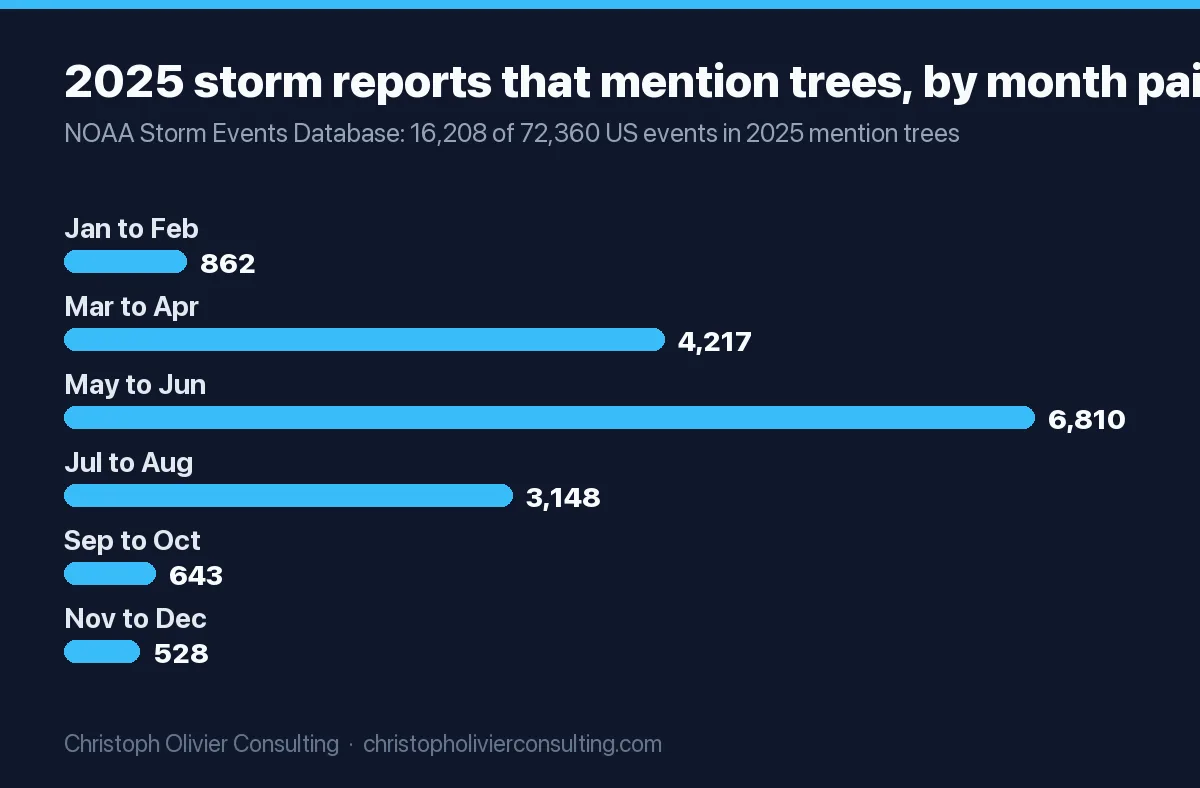
Of those 16,208 reports, 14,067 (87%) were Thunderstorm Wind events and 1,120 were tornadoes. The months from March through July held 13,400 of them, 83% of the year. October through January together held 850. The busiest states by count were Alabama (1,472), Virginia (1,097), Georgia (988), Pennsylvania (878), Mississippi (741) and Illinois (702).
| 2025 month | Storm events that mention trees | 2025 month | Storm events that mention trees |
|---|---|---|---|
| January | 153 | July | 2,373 |
| February | 709 | August | 775 |
| March | 1,965 | September | 474 |
| April | 2,252 | October | 169 |
| May | 3,078 | November | 149 |
| June | 3,732 | December | 379 |
This is one year of national data, so it shows a pattern, not a forecast for your county, and a narrative that mentions trees is not always a report of damage. The 2026 file NOAA posted on October 26, 2026 runs through July 2026 and shows the same shape so far: 3,693 tree-mention events in June and 4,028 in July. To see your own storm calendar:
- Download the last three to five yearly “StormEvents_details” files from NOAA’s bulk CSV folder.
- Filter the STATE column to your state and the CZ_NAME column to your counties, and count each EVENT_ID once (the bulk files can repeat rows).
- Keep the EVENT_TYPE values Thunderstorm Wind, High Wind, Strong Wind, Tornado and Ice Storm, then count events by BEGIN_YEARMONTH. Search EVENT_NARRATIVE for “tree” if you want the tree-specific count.
- Raise Local Services Ads and search budgets ahead of your busiest months and make sure someone answers the phone after hours.
A 90-day plan built on cost per booked job
- Days 1 to 10: set up tracking. Give every channel its own phone number or form tag, and log every lead with its source, job type, quote and whether it booked.
- Days 1 to 30: fix the free base. Correct the Google Business Profile category and services, publish or rebuild the removal, trimming, stump and emergency pages, add your license and credential numbers, and start a review text after every job.
- Days 15 to 45: apply for Local Services Ads with a small weekly budget, and confirm your license and insurance documents for your state. Note when your account is scheduled to migrate to Google Ads.
- Days 30 to 60: if you buy marketplace leads, buy exclusive ones in tree categories only, and cap the spend. Compare each vendor’s cost per booked job against the maximum lead cost table above.
- Days 45 to 75: pull your county’s storm history from NOAA and set budget increases for the months that matter.
- Days 75 to 90: rank every channel by cost per booked job and by job type. Cut the worst one and move its budget to the best.
If you are setting a total marketing budget at the same time, our small business lead generation budget plan shows how to split it across channels. If you want a second set of eyes on your numbers, you can book a consultation and bring your last 90 days of leads.
Work with CO Consulting
Want this done for your business?
- A diagnostic call and an audit of your current marketing and numbers
- A prioritized 90-day plan built for your market
- Execution across SEO and AI search, paid ads, content, funnels and automation
- Weekly check-ins and monthly reporting, led by a fractional CMO
Frequently asked questions
How much do tree service leads cost?
Published prices in 2026: Networx lists $42 to $51 for a shared tree services lead and $88 to $97 for an exclusive one. WordStream's 2026 Google search benchmark for Home and Home Improvement is a $90.92 median cost per lead. Service Direct advertised about $58 on average in 2023. Angi, HomeAdvisor, Thumbtack and Google Local Services Ads do not publish tree service prices.
What is a good cost per lead for a tree service?
It depends on the job. Multiply the job value by the share of revenue you allow for marketing and by your booking rate. At 10% and 40%, a $650 trim supports about $26 per lead, while a $2,500 removal supports $100. Under those inputs, a $90.92 search lead only pays when the job is worth about $2,273 or more.
Is Google Guaranteed still available for tree services?
No. Tree services remain an eligible Local Services Ads category in the US, but effective October 20, 2025 Google replaced the Google Guaranteed, Google Screened and License Verified badges with one Google Verified badge. Google also discontinued the money-back guarantee, keeping reimbursement only for bookings made before December 7, 2025. Update any marketing that still says Google Guaranteed.
What are tree service organic lead services and what do they cost?
They are agencies that build leads from your own Google Business Profile, website service pages and reviews instead of selling you leads. Few publish prices: 1Digital Agency states tree service SEO programs typically run $1,500 to $4,000 a month, with Local Services Ads budgeted separately. Make sure you own the site and profile and that the leads are yours alone.
Are shared tree service leads worth buying?
Only if the math works. Angi sends each request to no more than five pros. If you book one in five shared leads, a $42 to $51 Networx shared lead costs $210 to $255 per booked job, about the same as an exclusive $88 to $97 lead booked at 40%. That suits large removals and storm jobs, not single trims or stumps.
Do tree service companies need a license to advertise?
In some states, yes. Maryland says tree care professionals may not practice or advertise without a Licensed Tree Expert license. Connecticut requires an arborist license to advertise, solicit or contract arboriculture. Louisiana requires an LDAF Arborist License for removal, pruning and trimming for a fee, and California tree specialists now apply for the CSLB C-49 Tree and Palm classification.
When do tree service storm leads peak?
In NOAA's 2025 Storm Events data, 16,208 events mentioned trees in the narrative, and March through July held 83% of them, with June the single busiest month at 3,732. October through January held only 850. That is national data for one year, so pull your own county's history from NOAA's bulk files before you set seasonal budgets.
More Growth, Strategy & Sales guides
- Barbershop Marketing: The 2026 Playbook to Fill Every Chair
- Google Ads Budget for Small Business: How Much to Spend and How to Split It
- Handyman Marketing: The Channel Plan That Books More Jobs
- How Much Does Digital Marketing Cost?
- How Much Does SEO Cost in 2026?
- Junk Removal Marketing: A Channel-by-Channel Booking System
- All Growth, Strategy & Sales guides →