
Locksmith marketing works differently from every other trade because Google treats locksmiths as a fraud-prone category: in the US and Canada you cannot run locksmith ads at all until you pass Google’s Advanced Verification, and Local Services Ads add background checks on the owner and every technician. So the winning order is verification first, then a clean Google Business Profile, then Local Services Ads and exact-intent search ads, then service pages and reviews that fake listings cannot copy. Below are the exact rules, compliant ad copy you can paste, the lead-buying options compared, budget math on the LocaliQ 2026 search benchmarks, and a 90-day plan.
Locksmith advertising on Google: the rules that apply only to you
Google’s local services policy says it plainly: “Ads for locksmith services and garage door repair services are restricted” in the United States, and locksmith ads are also restricted in Canada. In Spain, the Netherlands, Germany, Sweden and Belgium locksmith ads cannot run at all, according to the same policy page. Garage door companies face the same US gate, which is why our garage door company marketing guide covers a near-identical checklist.
There are three separate Google systems, and each has its own bar:
| System | What Google requires from a locksmith | What trips people up |
|---|---|---|
| Google Ads (search, call ads, Performance Max) | Advanced Verification: true legal name or registered DBA, honest license disclosures, a recorded video interview, cooperation with audits | Google may ask you to re-verify “once every 12 months” or after a move or new website. You must report changed circumstances. |
| Local Services Ads | Per the US screening table: business and owner background checks, state business license where local law applies, owner license, general liability insurance, plus “service professional background checks” and Advanced Verification | Every technician who serves customers needs a check, including contractors. A failed check means a 30-day wait; a second denial means 180 days (Google). |
| Google Business Profile | Guidelines: real name, no virtual office, hide your address if you are service-area only, local phone number “under the direct control of the business” | Lead-gen agents “aren’t eligible for a Business Profile.” Keywords in the business name are not allowed. |
Three Advanced Verification rules shape your ad copy, quoted from Google’s policy:
- “Service call fees and minimum or starting prices must not be included in any text ads.” No “$19 service call.”
- “Discounts and coupons must not be included in text ads that promote emergency or repair services.” No “20% off lockouts.”
- “Claims of rapid response times that are unlikely to always be true and cannot be guaranteed must not be included in text ads.” No “15-minute arrival.”
Several popular locksmith marketing guides still recommend discount offers and fast-arrival promises. On Google, those lines can cost you your verification.
Local Services Ads are moving into Google Ads
Google is migrating Local Services Ads into the Google Ads interface as a pay-per-lead campaign. Per Google’s help article, phase one started in August 2026 for select US home and storefront advertisers, service-area businesses without storefronts follow in late 2026, and “all remaining business categories” move in 2027. Locksmith is not named in phase one. Manual bidding such as a maximum cost per lead is no longer supported, weekly budgets become daily budgets (weekly average divided by 7), and your LSA performance reports do not transfer. Lead history, messages and call recordings do carry over. Action for you: export or screenshot your LSA reports now, before Google emails you the 14-day notice that Search Engine Roundtable reported.
Locksmith ad copy that passes Google’s rules (copy and edit)
Responsive search ads allow up to 15 headlines of 30 characters and 4 descriptions of 90 characters (Google Ads Help). Every line below fits those limits. Use only the claims that are true for your shop: background checks, a real storefront, a license number.
| Headline (30 max) | Chars | Use it for |
|---|---|---|
| Locked Out? Call a Local Pro | 28 | Home and car lockout ad groups |
| Licensed Locksmith Near You | 27 | Generic “locksmith near me” terms |
| Upfront Quote Before We Start | 29 | Trust line that replaces a price |
| Car Keys and Fobs Made Onsite | 29 | Automotive ad group |
| Rekey Your Home After a Move | 28 | Rekey ad group |
| Background-Checked Techs | 24 | Only if every tech passed LSA screening |
| Real Shop on Main Street | 24 | Swap in your street; storefronts only |
| Master Keys for Businesses | 26 | Commercial ad group |
Descriptions (90 max):
- “Licensed, insured locksmiths based in [City]. We give you the full price before any work.” (89 characters with “Austin”)
- “Home, car and business lockouts, rekeys and new locks. Call now to talk to a local tech.” (88)
| Do not write | Why it fails | Write instead |
|---|---|---|
| $19 Service Call | Service call fees and starting prices banned in text ads | Upfront Quote Before We Start |
| 20% Off Emergency Lockouts | Discounts banned in emergency or repair ads | Licensed Locksmith Near You |
| Here in 15 Minutes, Guaranteed | Rapid response claims that cannot be guaranteed | Local Techs Across [Area] |
| Google Verified Locksmith | Google logo and brand elements need permission | Licensed and Insured |
Broad match terms can pull “how to pick a lock” searches and people looking for locksmith jobs, and both burn budget. Our list of common Google Ads mistakes has the negative keyword and match type fixes.
State locksmith licenses and license numbers in your ads
Licensing is set by states, not Google, and a few states write rules straight into your advertising. Google’s LSA screening checks state licenses “to the extent possible” against government databases, and you must confirm city and county licenses yourself (Google).
| State | Regulator | Advertising rule |
|---|---|---|
| California | Bureau of Security and Investigative Services (BSIS) | B&P Code 6980.64: every ad must show your business name, address or phone, and license number as BSIS records them. “Advertisement” includes business cards, flyers, paid ads in any media and directory listings. Fines: $500 first violation, $1,000 each after. BSIS also requires your license and current renewal to be “conspicuously displayed at all times in each mobile services vehicle” (BSIS notice). |
| Texas | Texas DPS Private Security Program | Occupations Code 1702.131: company ads must contain the company name and address as stated in DPS records. Under 1702.1056, advertising with the word “locksmith” or using it in your name makes you a locksmith company, so even a lead-gen site that advertises “locksmith” services is treated as a locksmith company under the chapter. |
| Maryland | Maryland Department of Labor | Owner or designee needs state and federal fingerprint background checks, every employee who does locksmith work must be checked, and a certificate of liability insurance is required. Licenses run two years (Maryland Labor). |
Even where a state does not require the number, put it in your Google Business Profile description, website footer, truck wrap and invoices. In my view it is the cheapest trust signal you have, because a customer can look it up in a minute and a fake listing has nothing to show.
Add association credentials where you hold them. ALOA’s certification ladder runs from CRL (mandatory exam plus two electives) to CPL (CRL plus 12 more electives) to CML (CPL plus nine more electives), with separate CAL for automotive and CPS for safes. A line like “CRL certified, ALOA member” on your service pages is a specific, checkable claim. “Certified experts” is not.
The fake-listing problem and how legit locksmiths compete
This is not a vague worry. A Google and UC San Diego study found that roughly 2 out of 5 fake Maps listings posed as locksmiths, plumbers, electricians and other contractors, and that Google had cut fake listings 70% from their June 2015 peak (Google Research, 2017). In March 2025 Google sued a network behind more than 10,000 fake listings; the case started when a Texas business reported an unlicensed locksmith impersonating it on Maps, and Google said it removed or blocked about 12 million fake business profiles in 2023 (CBS News).
You win against these operators on proof, because proof is the thing they cannot fake at scale:
- Report fakes the right way. In Maps, open the listing, choose Suggest an edit, then “Place is closed or not here,” then “Offensive, harmful, or misleading.” For fraud patterns, use the Business Redressal Complaint form, which accepts 10 or more profiles or a spreadsheet of URLs at once (Google Maps Help). Keep a sheet of fake pins in your area and refile monthly.
- Show a real person. Owner photo, technician photos, branded vehicle, shop interior. Fake profiles run on stock images.
- Show a checkable license number on every page, ad and invoice.
- Write prices on your site. Ads cannot show starting prices, but your landing page can show a typical range, which is exactly what scam operators avoid.
- Earn reviews that name the job. “Rekeyed our rental in 40 minutes” beats ten “great service” reviews. Our guide to getting more Google reviews covers request timing and what Google forbids.
Google Business Profile setup for a locksmith
Google ranks local results on relevance, distance and prominence, and “There’s no way to request or pay for a better local ranking on Google” (Google). Prominence includes links and review count. For a locksmith that means:
- Mobile only? Set a service area and hide your address. Google’s guidelines say a rented mailbox or unstaffed virtual office “isn’t eligible for a Business Profile” (guidelines).
- Storefront? Show the address and keep permanent signage with your name at it, which the guidelines expect.
- Name: your real-world name only. “Smith Lock and Key” is fine; “Smith Lock and Key 24/7 Emergency Locksmith Austin” violates the rule against unnecessary information.
- Phone: a local number you control, not a call center line or a lead broker’s number.
- Categories and services: primary category Locksmith, then add each service by name: house lockout, car lockout, rekeying, car key replacement, key fob programming, safe opening, access control.
Sample GBP posts for locksmiths
Google “may remove posts with unverified contact information,” so leave phone numbers out of the text and use the Call now button, which dials your verified number (Google).
- New-home rekey: “Just moved in? You don’t know who has copies of your keys. We rekey existing locks so old keys stop working, usually without replacing hardware. Licensed [State] locksmith, license #[number]. Tap Call now for a quote.”
- Car key season: “Lost the only key to your [popular local make]? We cut and program transponder keys and fobs at your car, so you can skip the tow to the dealer. Photo: today’s job in [Neighborhood].”
- Property managers: “Tenant turnover this month? We rekey units the same week, keep a key log per property and invoice monthly. Ask about master key systems for multi-unit buildings.”
Post weekly with a real job photo. A post that names a neighborhood and a job type adds relevance a stock-photo profile cannot match.
Locksmith leads: free, bought, pay-per-call and exclusive compared
Searchers asking where to “get locksmith leads” are choosing between owning demand and renting it. Here is the trade-off:
| Lead source | You pay | Who owns the customer | Verdict |
|---|---|---|---|
| Google Business Profile (free leads) | Nothing but time | You | Do first. Highest-intent free leads in the category. |
| Apple Maps place card via Apple Business | Time to claim and maintain | You | Claim it so Apple Maps shows your real logo, hours and photos. |
| Local Services Ads | Per lead | You | Strong if you pass screening. Dispute bad leads. |
| Google search ads | Per click | You | Exact-intent terms only. Needs call tracking. |
| Pay-per-call networks | Per qualified call | The network owns the number and the brand | Fill gaps only. If you stop paying, calls stop. |
| Shared leads for sale | Per lead | Nobody: sold to several shops | Lowest close rates. Avoid for lockouts, where the first caller back wins. |
| “Exclusive” bought leads | Per lead, higher | You, once | Ask how they generate them and whether they run Google ads under a generic “locksmith” name. |
One rule to know before you buy: Google requires lead generation networks that advertise restricted locksmith services to display the legal business address on the website and explain pricing in the top 20% of the homepage and landing pages (Advanced Verification policy). A broker whose site hides who they are is a risk to your brand, and in Texas, advertising with the word “locksmith” makes a company a locksmith company under the state’s private security law.
Locksmith PPC budget math on 2026 benchmarks
LocaliQ’s 2026 Search Advertising Benchmarks (updated June 1, 2026) do not break out locksmiths, so use the two categories you straddle. Home and Home Improvement: $8.33 cost per click, 6.47% click-through rate, 8.05% conversion rate, $90.92 cost per lead. Automotive Repair, Service and Parts: $29.96 cost per lead. The all-industry average is $66.69. For a deeper cross-industry view, see our average cost per lead by industry breakdown.
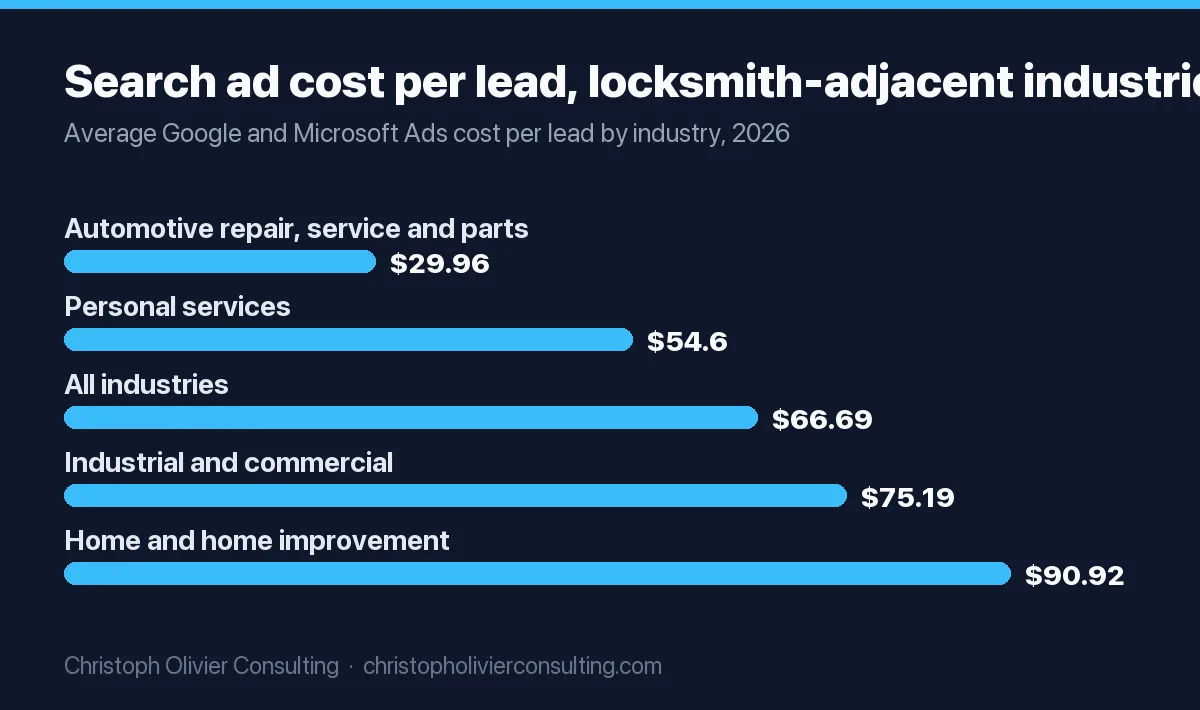
A lead is not a job. Divide cost per lead by your booking rate (booked jobs divided by leads) to get cost per booked job:
| Cost per lead (LocaliQ 2026) | Book 40% of leads | Book 60% | Book 80% |
|---|---|---|---|
| $29.96 (Automotive repair) | $74.90 | $49.93 | $37.45 |
| $54.60 (Personal services) | $136.50 | $91.00 | $68.25 |
| $90.92 (Home and home improvement) | $227.30 | $151.53 | $113.65 |
Worked example. Plug in your own numbers; these inputs are illustrative. Say your average residential ticket is $180 and you are willing to spend 30% of a ticket to win it. You book 60% of leads. Your maximum affordable cost per lead is $180 × 0.30 × 0.60 = $32.40. At the home-improvement benchmark of $90.92 you would lose money on every residential lockout; at the automotive benchmark of $29.96 you clear it. A $3,000 monthly search budget at $90.92 buys about 33 leads and, at 60%, about 20 jobs at roughly $152 each.
What that means in practice:
- Split campaigns by job value: car keys and commercial work can carry a much higher cost per lead than a $180 house lockout.
- Bid hard on exact emergency terms (“locksmith open now,” “car locked out [city]”) and cut research terms.
- Raise your booking rate before raising budget. Moving from 40% to 80% halves cost per job at any lead price.
Our Google Ads budget guide for small businesses shows how to set the starting daily budget from these numbers.
Call tracking: know which ad booked the job
Most locksmith leads arrive by phone, so you need two layers:
- Google Ads call conversions. Turn on call reporting, then count only calls that last longer than “a minimum duration you set” (Google Ads Help). I set it near 60 seconds for locksmiths, since a real lockout call includes an address and a vehicle or door type. With call recording on, Google’s AI can grade lead quality.
- A tracking number per source. CallRail lists Lead Tracking at $50 a month with 5 local numbers, 250 minutes and 25 texts, extra local numbers at $3, and Lead Conversion at $150 a month with AI transcription and call analysis. Five numbers covers GBP, search ads, website organic, truck wrap and direct mail. Local Services Ads use Google’s own lead tracking.
Then log one field your tracking tool cannot see: did the call become a paid job, and for how much. Cost per booked job by source, reviewed weekly, is the only number that should move budget. Our call tracking and attribution guide walks through the setup for another phone-led trade.
Service-area pages that book jobs
Each service needs its own page, because “car key replacement” and “commercial access control” are different buyers with different urgency. Build these first:
| Page | Searcher’s words | Must be on the page | Primary action |
|---|---|---|---|
| Emergency lockout | “locked out of house,” “locksmith open now” | Hours you actually answer, area served, typical price range, license number, ID check policy | Click to call, above the fold |
| Rekey | “rekey locks near me,” “rekey vs replace” | Per-lock and first-lock pricing, when rekeying is enough, landlord turnover offer | Call or book a time |
| Automotive | “car key replacement,” “key fob programming [make]” | Makes and model years you program, what the owner must bring (ID, registration), on-site vs shop | Call with year, make, model |
| Commercial access control | “commercial locksmith,” “access control installer” | Systems you install and service, master key systems, past project photos, insurance limits | Request a site survey |
Write one city page only where you have a real presence: a shop, a staffed branch, or jobs and reviews you can show from that town. Ten near-identical city pages with swapped names are what spam networks publish. For page structure that converts, see our guide to lead generation landing pages.
Content marketing for locksmiths that brings calls
Content works in this category when it answers the question a customer asks before the emergency, or during a planned job. Five topics with a clear buyer behind them:
- “Rekey or replace locks after moving?” Explain the difference, show your per-lock pricing, link to the rekey page.
- “How to tell a real locksmith from a scam listing.” License lookup link for your state, ID check policy, what a real quote looks like. This page earns links and trust because it helps the customer even if they never call you.
- “[Make] key fob replacement cost: dealer vs locksmith.” One page per popular local make, with your real price ranges.
- “Landlord checklist for tenant turnover.” Rekey, key log, smart lock code reset. Feeds the commercial pipeline.
- “What to do if you’re locked out of your car with kids or pets inside.” Practical safety steps first, then your number. Be accurate and humble here.
On social, short job videos (a fob programmed, a master key chart explained) do more than promotions. Facebook ads rarely beat search for lockouts, because nobody scrolls a feed while locked out, but they can work for retargeting and for reaching property managers with a turnover rekey offer.
Commercial accounts: the recurring revenue track
Residential lockouts are one-off. Property managers, realtors, schools and offices buy rekeys, master key systems and access control repeatedly, and they buy on relationship, not on a 2 a.m. search. Build a list of 30 property management firms in your service area, offer a lock audit of one building, and follow up every quarter. Track these as accounts with a yearly value, not as leads, so you know how much you can spend to win each one.
A 90-day locksmith marketing plan
| Weeks | Work | Done when |
|---|---|---|
| 1 to 2 | Apply for Advanced Verification; start LSA screening for owner and every tech; gather license, insurance certificate (valid at least 14 days after submission, insured name matching your ad name), DBA proof | Applications submitted, documents filed in one folder |
| 1 to 2 | Fix GBP: real name, service area or storefront, local phone, all services listed, 20 real photos; claim Apple Maps | Profile passes the guideline checks above |
| 3 to 4 | Set up CallRail numbers per source and Google Ads call conversions; build a booked-job log | Every call has a source and an outcome field |
| 3 to 6 | Publish the four service pages with license number, price ranges and click-to-call | Pages live and linked from GBP |
| 5 to 8 | Launch search ads on exact emergency and car key terms with the compliant copy above; turn on LSA once approved | Ads approved, first 30 days of cost per lead recorded |
| 5 to 12 | Review request by text after every job; weekly GBP post; report fake pins monthly | Steady weekly review flow |
| 9 to 12 | Compute cost per booked job by source; cut the worst source by half; start property manager outreach | Budget moved on booked jobs, not leads |
Hiring a locksmith marketing agency or PPC manager: pass/fail questions
If you hire help for locksmith PPC management or SEO, ask these before you sign. Any “no” on the first four is a fail.
- Will the Google Ads account, GBP and tracking numbers be owned by my business, with you as a manager? (Pass: yes, in writing.)
- Do you also sell leads or run ads for other locksmiths in my service area? (Pass: no, or fully disclosed.)
- Will you write ads that follow Advanced Verification rules on prices, discounts and response times? (Pass: they name the rules without prompting.)
- Will you report cost per booked job by source, not just clicks and calls? (Pass: they ask for your job log.)
- How will you handle the LSA move into Google Ads? (Pass: they mention exporting reports and setting a campaign-level target CPA.)
If you want a second opinion on an agency proposal or your current numbers, you can book a consultation and bring your last 90 days of call data.
Frequently asked questions
How much does locksmith advertising cost?
On LocaliQ's 2026 search benchmarks there is no locksmith category, so use the two you straddle: Home and Home Improvement leads average $90.92 and Automotive Repair leads $29.96, with clicks around $8.33 in home services. Divide cost per lead by your booking rate to get cost per booked job, and size the budget so that number stays below the share of your average ticket you can afford to spend.
Do locksmiths need advanced verification to run Google Ads?
Yes. Google restricts locksmith ads in the United States and Canada, and you must apply for Advanced Verification before ads can run. Expect to confirm your legal name or DBA, disclose licenses honestly and take part in a recorded video interview. Google may ask you to re-verify every 12 months or after a move or a new website. Local Services Ads add background checks on owners and technicians.
What is the best way to get free locksmith leads?
Your Google Business Profile is the best source of free locksmith leads. Use your real business name, a local phone number you control, a service area or a staffed storefront, every service listed by name and weekly posts with real job photos. Add your license number to the description, claim your Apple Maps place card and ask every satisfied customer for a review that names the job.
Should I buy locksmith leads or use pay-per-call?
Use bought or pay-per-call leads only to fill gaps. Shared leads are sold to several shops, so for lockouts the first caller back wins, and pay-per-call networks own the phone number and brand, so calls stop when you stop paying. If you buy, ask how leads are generated and check that the broker shows its legal address and pricing as Google requires of lead generation networks.
What should locksmith PPC management include?
Good locksmith PPC management includes separate campaigns by job value, exact-match emergency and car key terms, negative keywords for lock-picking and job searches, ad copy that follows Google's ban on service-call prices, discounts and guaranteed response times, call conversions with a minimum call length, and a weekly cost per booked job report. You should own the Google Ads account, with the manager given access.
Do Facebook ads work for locksmiths?
Facebook ads rarely beat search for emergency lockouts, because people who are locked out search rather than scroll. They can work for planned jobs: retargeting past website visitors, promoting rekeys to new homeowners and reaching property managers with a tenant turnover offer. Short job videos, such as a key fob being programmed, tend to make better creative than discount offers.
More Growth, Strategy & Sales guides
- Logo Design Cost in 2026: What You Pay by Source
- Water Damage Restoration Marketing: The 2026 Playbook for More Booked Jobs
- Weight Loss Clinic Marketing: A Compliant Playbook for GLP-1 Growth
- Average Cost Per Lead by Industry (2026 Benchmarks)
- Cosmetic Dentist Marketing: A Cost-Per-Case Playbook for 2026
- Foundation Repair Marketing: The Cost-Per-Booked-Job Playbook
- All Growth, Strategy & Sales guides →