
Last reviewed: October 2026

Outsourced marketing means hiring outside specialists, such as an agency, freelancers, a fractional CMO or a full outsourced marketing department, to plan or run some or all of your marketing instead of building a full in-house team. It usually fits companies that need senior skills or channel depth they cannot keep busy full time. The right model depends on your stage, budget and how much control you need to keep.
This guide compares the five outsourced marketing models side by side, shows what to keep in-house, prices an in-house team from US government wage data against market ranges for outsourcing, and gives you a buying checklist, the questions to ask, the contract terms that protect you and the red flags that should end a sales call.
Need senior marketing leadership without a full-time hire? See CO Consulting’s fractional CMO services.
What is outsourced marketing?
Outsourced marketing is any arrangement where people outside your payroll do marketing work for you under contract. It ranges from one freelancer writing blog posts to a full outsourced marketing department that owns strategy, execution and reporting. You still own the goals, the budget, the brand and the accounts. The outside team supplies skills and capacity.
Most firms do not outsource everything or nothing. They mix. A common pattern is an in-house owner or marketing coordinator, a part-time senior strategist, and one or two specialist vendors for channels that need deep technical skill, such as paid search or SEO.
Three terms get used loosely, so here is how this page uses them:
- Outsourced marketing services: specific jobs bought from a vendor (SEO, paid ads, content, design, email).
- Outsourced marketing department: a vendor that acts as your whole marketing team, sometimes sold as “marketing as a service” (MaaS) on a monthly subscription.
- Fractional leadership: a senior marketer, usually a fractional CMO, who sets strategy and manages vendors for part of each week.
Why companies outsource marketing in 2026
Companies outsource marketing because budgets are tight and the skill list keeps growing. Gartner’s 2025 CMO Spend Survey found marketing budgets flat at 7.7% of company revenue, with agencies taking about a fifth of spend. Outsourcing lets a firm buy senior skill and channel expertise in the exact amounts it needs, without fixed payroll.
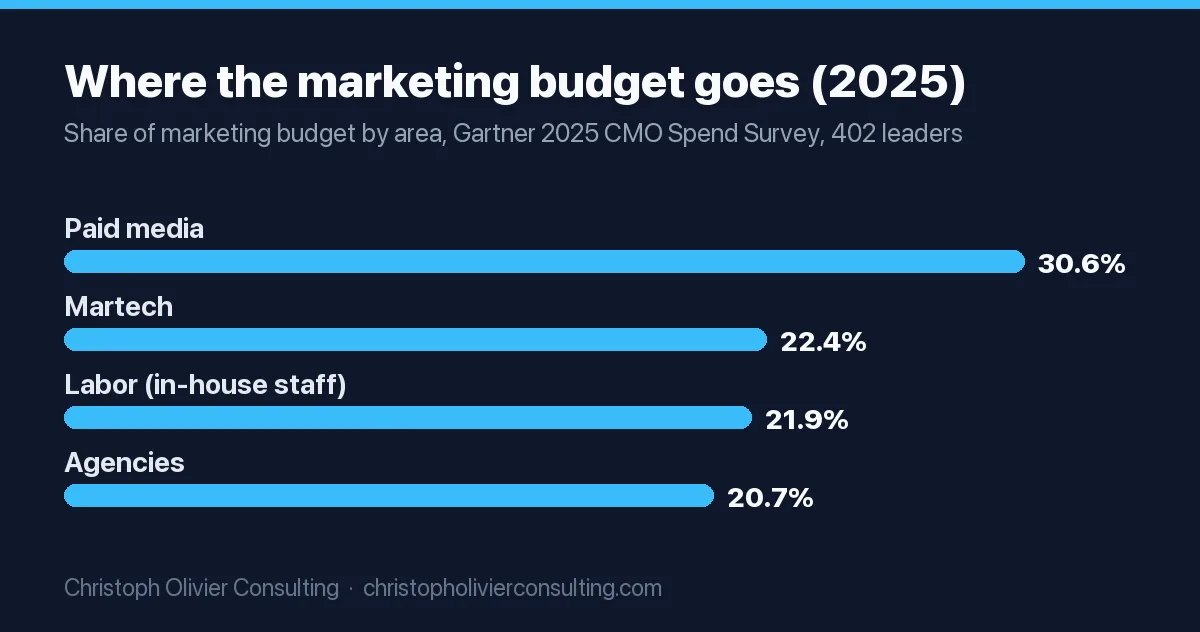
The numbers behind that pressure come from Gartner’s 2025 CMO Spend Survey of 402 marketing leaders, as reported by Chief Marketer. Budgets averaged 7.7% of revenue, down from 9.5% three years earlier. Paid media took 30.6% of the budget, martech 22.4%, labor 21.9% and agencies 20.7%. The same report says 39% of CMOs planned to cut labor costs and 39% planned to cut agency allocations.
CMOs are not abandoning outside help. They are consolidating it: fewer, better partners with clearer scopes. The content side shows the same strain. In the Content Marketing Institute’s B2B outlook for 2025, 54% of B2B marketers named lack of resources as a challenge and 45% said they lacked a scalable content creation model.
The 5 outsourced marketing models compared
There are five main outsourced marketing models: a full-service agency, specialist agencies, freelancers, a fractional CMO paired with specialists, and an outsourced marketing department sold as a subscription. They differ mainly in who owns strategy, how many vendors you manage and how fixed the monthly cost is. The table below compares them on those points.
| Model | Who owns strategy | Best for | Main strength | Main risk |
|---|---|---|---|---|
| Full-service agency | Agency account lead | Firms that want one contract covering most channels | One point of contact, broad bench | Senior people sell, junior people execute; strategy can tilt toward what the agency sells |
| Specialist agencies (SEO, PPC, creative) | You, or whoever manages the vendors | Firms with a clear plan that need channel depth | Deep skill in one channel | Nobody owns the whole picture; vendors optimize their own metric |
| Freelancers | You | Defined, repeatable tasks with an in-house manager | Lowest cost per hour of skill, flexible | Capacity limits, single point of failure, management load on you |
| Fractional CMO plus specialists | Fractional CMO | Growing firms that need senior judgment but not a full-time executive | Strategy stays independent of execution vendors | Limited hours; quality depends heavily on the individual |
| Outsourced marketing department (MaaS) | Vendor team lead | Firms with no marketing staff that want a packaged team | Predictable subscription, fast start | Packaged scope may not fit; harder to exit if the vendor holds your accounts |
Full-service agency
A full-service marketing agency covers strategy, creative, media and reporting under one roof. It works best when you want one accountable partner and have enough budget for the agency to staff your account properly. Ask who will actually do the work each week, not just who is in the pitch.
Specialist agencies and freelancers
Specialists win on depth. A paid search shop will usually know platform changes before a generalist does. A freelance digital marketer can be the most cost-efficient option for a defined job, such as running email campaigns or a monthly content calendar. For admin work like scheduling posts, pulling reports or updating the CRM, a digital marketing virtual assistant costs less again. The catch is that someone has to set direction and judge the work.
Fractional CMO plus specialists
This model separates thinking from doing. The fractional leader sets the plan, hires and manages vendors, and reports to the owners. Because they are not selling media or production hours, their advice is less likely to be skewed toward a specific channel. It is the model most often described as fractional marketing.
Outsourced marketing department
Here a single vendor supplies a whole team for a monthly fee: strategist, content, design, ads and reporting. It can get a firm from zero to a working program quickly. Read the scope closely. A package built for many clients may include deliverables you do not need and skip the one channel that matters most for you.
Outsource or keep in-house: what to keep and what to hand off
Keep in-house anything that requires deep company knowledge, fast internal decisions or ownership of customer relationships: positioning, final approval, sales alignment, account ownership and customer data. Outsource work that needs specialist skill, uneven volume or tools you would not use daily, such as paid media, technical SEO, design, video and analytics setup.
| Function | Usually keep in-house | Usually outsource | Why |
|---|---|---|---|
| Positioning, brand and offer | Yes | Get outside input, keep the decision | It depends on knowledge only owners and staff have |
| Marketing strategy and budget | Owner or marketing lead | Fractional CMO can lead it | Senior skill is needed only a few days a month in smaller firms |
| Ad, analytics and CRM account ownership | Always | Never | Losing admin access can mean losing years of data |
| Paid search and paid social | Only at high spend | Yes, in most cases | Platforms change often; specialists see patterns across accounts |
| Technical SEO and site performance | Rarely | Yes | Specialist skill, uneven volume |
| Thought leadership content | Subject matter and review | Writing, editing, production | Expertise must come from you; craft can be bought |
| Design and video | Simple, recurring assets | Campaign and brand work | Quality varies with tools and experience |
| Sales enablement and follow-up | Yes | Templates and automation setup | Close to revenue and client relationships |
For a practitioner view of the same split, the video above from the SaaS CMO Pro channel walks through which marketing functions to hire for internally and which to hand to agencies.
What outsourced marketing services cost vs an in-house team
A single in-house marketing specialist costs roughly $112,500 a year fully loaded at the national median, and a marketing manager about $238,000, based on BLS wage and benefits data. Market ranges for outsourcing run from about $2,000 a month for a freelancer to $25,000 or more for an agency. Neither number includes ad spend.
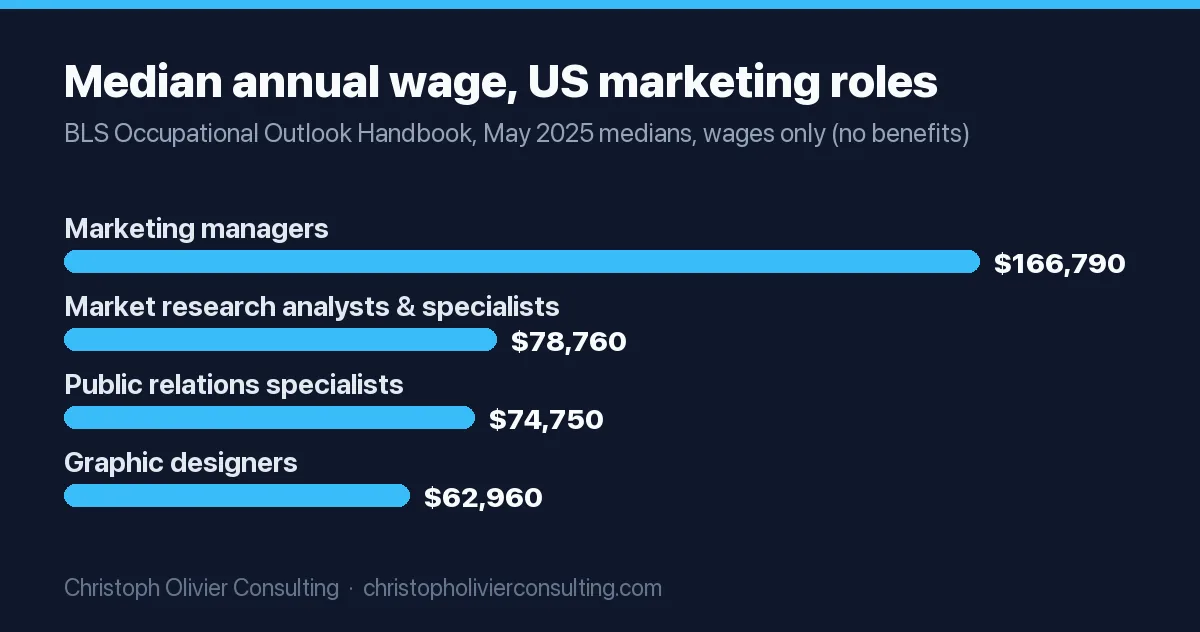
The in-house side, built from BLS data
The US Bureau of Labor Statistics publishes median wages by occupation. For May 2025, the median annual wage was $166,790 for marketing managers, $78,760 for market research analysts and marketing specialists, $74,750 for public relations specialists and $62,960 for graphic designers.
Wages are not the full cost. In the BLS Employer Costs for Employee Compensation release for June 2026, wages made up 70.0% of private industry compensation and benefits made up 30.0%. Dividing a wage by 0.70 gives a rough fully loaded cost. That is an estimate: the benefits share varies by role and company, and it leaves out recruiting, software seats, training and management time.
The outsourced side: market ranges, not quotes
There is no government price index for marketing services, so the ranges below come from industry surveys and vendor-published guides. Treat them as market ranges, not quotes. Your price depends on scope, channel count and seniority.
| Option | Typical cost | Basis | Source |
|---|---|---|---|
| In-house marketing specialist | About $112,500 a year (about $9,400 a month) | $78,760 median wage divided by 0.70 | BLS OOH May 2025, BLS ECEC June 2026 (estimate) |
| In-house marketing manager | About $238,300 a year (about $19,900 a month) | $166,790 median wage divided by 0.70 | BLS OOH May 2025, BLS ECEC June 2026 (estimate) |
| Freelance marketer | $2,000 to $8,000 a month | Vendor-published market range | MarketerHire, 2026 |
| Fractional CMO | $3,000 to $15,000 a month, or $150 to $350 an hour | Vendor-published market range | MarketerHire, 2026 |
| Marketing agency retainer | $5,000 to $25,000+ a month | Vendor-published market range | MarketerHire, 2026 |
| SEO agency retainer | Most common band $500 to $1,000 a month; 22% of North American agencies charge over $2,000 | Survey of 260 agencies | SE Ranking, 2025 pricing survey |
| Digital agency retainer minimums | About half set a minimum of $2,000 a month or less; 13.5% require over $5,000 | Agency survey (2019, dated) | Credo pricing survey |
Worked example: a three-person team vs an outsourced mix
Here is an illustration, not a quote. Say a 40-person professional-service firm is weighing a lean in-house team against an outsourced mix.
- In-house team: one marketing manager ($166,790), one marketing specialist ($78,760) and one graphic designer ($62,960) at BLS medians. Wages total $308,510. Divided by 0.70, the loaded cost is about $440,700 a year, or about $36,700 a month.
- Outsourced mix: a fractional CMO at $8,000 a month plus two specialist vendors at $4,000 a month each, all inside the market ranges above. That totals $16,000 a month, or $192,000 a year.
- Adjust for reality: add an internal coordinator if no one in the firm can own approvals, and add tools in both scenarios. Ad spend sits on top of both.
On these assumptions the outsourced mix costs less than half as much. That gap narrows as volume grows. Once you have enough steady work to keep specialists busy full time, in-house hires often become the better deal, because you are no longer paying agency margin on predictable work.
Which model fits your company stage
Your stage decides the model more than your industry does. Early firms usually need one senior person to set direction plus a few low-cost doers. Growing firms add specialist vendors under a fractional leader. Larger firms bring core roles in-house and keep outside partners for depth. Use the decision path below as a rule of thumb.
- No plan, no marketing staff, small budget: start with an audit and a 90-day plan from a senior strategist, then hire one freelancer or a virtual assistant to execute.
- Clear plan, owner still approving everything: a fractional CMO plus one or two specialists. The owner stops being the bottleneck.
- Several channels working, need for scale: keep the fractional lead, add specialist agencies per channel and hire an in-house coordinator to own approvals and assets.
- Steady, predictable volume in one channel: bring that channel in-house and keep outside help for strategy reviews and peaks.
- Need everything at once with nobody internal: an outsourced marketing department can work, if you keep account ownership and a clean exit clause.
How to choose an outsourced marketing partner: checklist and questions
Choose an outsourced marketing partner by checking four things in order: relevant results with references you can call, who will actually do the work, how success will be measured, and what happens to your accounts and data if you part ways. Price comes last. A cheap vendor with the wrong fit costs more than a fair one that delivers.
Buyer checklist template (copy and use)
- [ ] Written goals for the first 90 days and the first 12 months, with one primary metric (leads, booked consults, revenue).
- [ ] Named people on your account, their seniority and their weekly hours.
- [ ] Two references from clients in a similar business model, and you called both.
- [ ] A sample monthly report from a current client, anonymized.
- [ ] Scope list: deliverables per month, revision rounds, response times.
- [ ] Account ownership: every ad, analytics, CRM, domain and CMS account sits in your company’s name, with the vendor added as a user.
- [ ] IP clause: you own all creative, copy, data and code you paid for.
- [ ] Exit terms: notice period, handover checklist, no fees to release your assets.
- [ ] Media spend paid directly by you, or markups disclosed in writing.
- [ ] A first-30-day plan that starts with an audit, not with output.
Questions to ask before you sign
- Who exactly will work on my account, and what share of their week is that?
- What did you change in a similar client’s first 90 days, and what happened as a result?
- How will you measure success, and what results do you expect in what timeframe?
- Will I own every account, asset and dataset from day one?
- Do you take any commission or markup on media, tools or subcontractors?
- What will you need from my team each week to do good work?
- What happens on day one after I give notice?
Several of these mirror the questions Google suggests asking any SEO in its own guide, Do you need an SEO?, including asking how they measure success and whether they will share every change they make to your site.
Governance: account ownership, data access and SLAs
Good governance means your company owns every account and asset, the vendor gets the minimum access it needs, and both sides agree in writing on response times, reporting and exit steps. Set this up before work starts. Fixing ownership after a dispute is slow and sometimes impossible, especially for ad accounts with years of history.
| Area | What to put in writing | Why it matters |
|---|---|---|
| Account ownership | Ad, analytics, Search Console, CRM, domain, hosting and CMS accounts are created in your name; the vendor is a user | Your data and history stay with you if the vendor leaves |
| Access level | Least access needed; admin rights only where the job requires them; a shared list of who has what | Limits damage from mistakes and staff turnover on either side |
| Service levels | Response time for routine requests and for urgent issues; reporting date each month | Sets expectations so problems surface early |
| Reporting | One primary business metric, plus channel metrics, with raw data access | Stops vanity metrics replacing results |
| Intellectual property | You own all work product on payment | Lets you reuse creative and content with any future vendor |
| Exit and handover | Notice period, handover checklist, credential transfer, final data export | Makes switching vendors a routine task rather than a crisis |
The first 90 days of outsourced marketing
A good first 90 days runs in three phases: audit and access in month one, a short list of high-impact fixes and tests in month two, and a stable operating rhythm with reporting in month three. Expect learning and early signals in this window, not finished results. Channels such as SEO often take longer to show impact.
- Days 1 to 14, access and audit: grant user access to every account, share past reports and sales data, and let the partner audit tracking, the website, ad accounts and the sales handoff.
- Days 15 to 30, plan: agree on the primary metric, the baseline, three to five priorities and a written 90-day plan. Fix broken tracking first, since every later decision depends on it.
- Days 31 to 60, fix and test: ship the highest-impact fixes, launch one or two controlled tests and hold a short weekly check-in.
- Days 61 to 90, rhythm: move to a monthly report and review, decide what to scale, stop or change, and set the next quarter’s plan.
This is the approach I use myself. At CO Consulting the work starts audit-first with a 90-day plan, drawing on content systems I have built that have earned over 200 million organic views and on millions of dollars in managed ad spend. There are no guarantees in marketing, and anyone who offers one is a warning sign, which brings us to the last section. If you would rather have help picking the right outside team, our fractional CMO services put one senior leader in charge of the plan who also manages whoever executes it, whether that is your team, freelancers or agencies.
Red flags when buying outsourced marketing services
The biggest red flags are guaranteed results, vague scopes, vendor-owned accounts, hidden media markups and reports full of activity with no business metric. Any one of them is a reason to slow down. Two or more is usually a reason to walk away, however attractive the price looks.
- Guarantees. Google says plainly that “No one can guarantee a #1 ranking on Google” in its guide to hiring an SEO. The same logic applies to promised lead counts or revenue.
- Accounts in the vendor’s name. If they will not set up accounts under your company, assume a messy exit.
- Secrecy about methods. Google’s guide also warns you to be careful if a company “is secretive or won’t clearly explain what they intend to do.”
- The pitch team disappears. Senior people in sales, unnamed juniors on delivery.
- Long lock-in with no exit path. A minimum term is normal; no termination for cause is not.
- Undisclosed markups on media, tools or subcontracted work.
- Reports with no money metric. Impressions and posts published are fine as context, not as the headline.
Outsourced marketing works best when you treat it as a managed team, not a purchase: clear goals, your accounts, honest reporting and one person accountable for the whole plan. If you would like a second opinion on which model fits your firm, you can book a consultation and we can talk it through.
Work with CO Consulting
Senior marketing leadership, without the full-time hire
- One senior owner of strategy, budget, vendors and the weekly scorecard
- Audit first, then a prioritized 90-day plan with measurable milestones
- Weekly team leadership, monthly strategic reviews and quarterly planning
- No guarantees we cannot back up; reporting tied to pipeline
Frequently asked questions
What is outsourced marketing?
Outsourced marketing is hiring people outside your payroll, such as an agency, freelancers, a fractional CMO or a full outsourced marketing department, to plan or run some or all of your marketing. You keep ownership of goals, budget, brand and accounts. The outside team supplies skills and capacity you cannot keep busy full time, and you can scale it up or down as needs change.
How much does outsourced marketing cost?
Market ranges published by vendors run from about $2,000 to $8,000 a month for a freelance marketer, $3,000 to $15,000 a month for a fractional CMO and $5,000 to $25,000 or more for an agency retainer. Ad spend is extra. Compare that with a single in-house marketing specialist at roughly $112,500 a year fully loaded, estimated from BLS median wage and benefits data.
What is an outsourced marketing department?
An outsourced marketing department is a vendor that acts as your entire marketing team for a monthly fee, often sold as marketing as a service. It usually bundles a strategist, content, design, advertising and reporting. It can start fast for firms with no marketing staff, but check the scope closely and keep every account in your company's name so you can leave cleanly.
Is it better to outsource marketing or hire in-house?
It depends on volume and stage. Outsourcing usually wins when you need senior or specialist skill only part of the time, or need to start quickly. In-house usually wins once you have steady, predictable work that keeps a person busy full time, because you stop paying agency margin. Many firms use a mix: in-house ownership and approvals, outside specialists for channels.
What marketing should you never outsource?
Keep ownership of your positioning, final approval of messaging, customer data and every ad, analytics, CRM and domain account. You can get outside input on positioning, but the decision should stay with the people who know the business and its clients. Vendors should be added as users on your accounts rather than owning them, so your history stays with you.
How do I choose an outsourced marketing agency?
Check relevant results with references you can call, the named people who will do the work and their hours, how success will be measured, and what happens to your accounts and data at exit. Ask for a sample report and a written 90-day plan that starts with an audit. Walk away from anyone who guarantees rankings, leads or revenue.
More Fractional CMO guides
- What Is Fractional Marketing? Model, Cost, and When to Use It
- Fractional CMO Services: The Full Scope of What Gets Delivered
- CMO Salary in 2026: Base, Bonus, and Total Comp by Company Size
- What Is a CMO? Role, Responsibilities, and Pay
- When to Hire a Fractional CMO
- CMO and Marketing Budget Statistics 2026: Verified Benchmarks From Gartner and The CMO Survey
- All Fractional CMO guides →