

A beauty marketing agency is worth its fee when it can do three things a generalist shop usually can’t: write skincare and cosmetics copy that stays on the cosmetic side of the FDA’s line, run creators and reviews inside the FTC’s rules, and sell across your own site, TikTok Shop, Amazon and retail without those channels working against each other. If an agency can’t explain all three on the first call, its reel doesn’t matter much. This guide is for founders and marketing leads at indie and DTC beauty brands who are building a 2026 shortlist: which type of agency fits your stage, what the published prices look like, where the legal traps sit, and the questions that separate specialists from generalists with a beauty case study.
What the “top beauty marketing agencies” lists leave out
Search for a beauty marketing agency and page one is mostly ranked lists. Several are published by agencies that rank themselves first, which is fine as long as you read them as sales pages. The bigger problem is what they skip. Across the lists I reviewed for this piece, there was almost no pricing, nothing on contract terms, and little or nothing on FDA claim rules or FTC disclosure rules, even though creator and influencer work is the core service most of them sell. One agency roundup, for example, gave a budget figure for just one firm (a $50,000+ minimum campaign size).
Want content that brings in clients, not just traffic? See how CO Consulting runs content marketing for service businesses.
That gap matters because in beauty brand marketing the expensive mistakes are rarely weak creative. They are a product page that turns a serum into an unapproved drug, a creator video with no disclosure, a review program that breaks a federal rule, or a customer complaint about a reaction that nobody passes to the person legally responsible for the product. A specialist agency should be preventing all four as a matter of routine.
Which kind of beauty marketing agency do you actually need?
“Beauty marketing agency” covers six quite different businesses. Most brands need one or two of them, not all six, and the right pick depends on where your revenue comes from today and where you want the next dollar to come from.
| Agency type | What it should own | Best fit | The beauty-specific test |
|---|---|---|---|
| Performance / DTC growth | Paid social, paid search, landing pages, testing, attribution | Shopify brands with a proven hero product and repeat purchase | Who checks every claim in an ad before it goes live, and how many new creatives do they ship per month? |
| Creator, influencer and UGC | Seeding, gifting, paid creators, usage rights, whitelisted ads | Launches, visual categories (makeup, hair, body), new audiences | Can they show a written disclosure standard and a monitoring process that matches FTC guidance? |
| Social commerce / TikTok Shop | Shop setup, category approval, affiliate creators, LIVE selling | Demo-friendly products at impulse price points | Have they cleared Beauty and Personal Care qualification before, and do they know which of your SKUs need an NDC? |
| Marketplace / Amazon | Listings, Sponsored ads, brand store, review generation | Replenishable products people already search for by name or ingredient | How do they get reviews without paying for sentiment or using insiders? |
| PR and retail launch | Beauty editors, events, awards, retailer launch support | Brands entering Sephora, Ulta or specialty retail | Which retail launches have they supported, and what did they do for sell-through after launch day? |
| Retention: email, SMS, subscriptions | Flows, replenishment timing, sampling to full size, loyalty | Regimen brands with a natural reorder cycle | Do their flows differ by product type, for example a daily cleanser versus a once-a-week mask? |
If you only have budget for one, follow the bottleneck. A brand with strong conversion but no traffic needs creators or performance. A brand with plenty of first orders and weak reorders needs retention first; our guide to ecommerce email marketing covers the flows that usually move repeat rate before you add ad spend.
Match the agency to your revenue stage
Under $1M in sales: buy a specialist, not a full-service retainer
At this stage most of your growth comes from the founder’s story, early creators and sampling, and a full-service retainer can eat the budget you need for product and inventory. One DTC beauty agency that publishes its pricing sets its floor at $100K in annual revenue because below that, it says, fees plus channel spend “doesn’t work mathematically.” Project work (a creator seeding program, a launch, a Shopify rebuild) is usually the better buy.
This is also the stage where the federal rules feel optional. They aren’t. Under MoCRA, a brand whose average gross annual US cosmetic sales over the previous three years are under $1,000,000 (adjusted for inflation) is treated as a small business and is exempt from good manufacturing practice rules and from facility registration and product listing. The exemption does not cover products that contact the eye’s mucous membranes, injected or internal-use products, or products meant to change appearance for more than 24 hours, and it does not switch off the other duties. Serious adverse events still have to be reported to the FDA within 15 business days, and safety still has to be substantiated.
$1M to $10M: performance plus retention, with one owner of claims
This is where most brands hire their first real agency. The usual pattern is a performance partner for paid social and search, a retention partner (or the same one) for email, SMS and subscriptions, and a creator engine feeding both with UGC. The risk at this stage is fragmentation: three vendors writing copy for the same serum, each with its own idea of what “clinically proven” can mean. Name one person, inside or outside, who owns the claim library, and make every agency work from it.
It is also when TikTok Shop and Amazon usually start to matter. Ask whether the same team can report blended results across your site and the marketplaces. If paid social and Amazon sit with separate vendors, each one tends to claim the sale.
$10M and up, or heading into retail: integrated team, retail-aware reporting
Once you sell through Sephora, Ulta or other specialty retail, your marketing has to drive sell-through in doors and on retailer sites you don’t control, not just orders on yours. You need PR and launch support that knows retail calendars, and reporting that connects media to retailer sales data. For earlier-stage founders aiming at prestige retail, Sephora’s own incubator is worth knowing about: Sephora Accelerate is in its 10th year, the 2026 cohort has 12 brands, members can apply for a $100,000 Sephora Beauty Grant, and some participating brands may be chosen to be sold at Sephora. Applications for 2026 closed March 31.
What a beauty marketing agency costs in 2026
Very few beauty agencies publish prices, so treat any single number as one data point, not a market rate. Here is what is actually on the record:
- One DTC beauty and skincare agency publishes $2,000 to $10,000 a month for brands doing $100K to $25M in annual revenue, on month-to-month terms with 30 days’ notice. That fee is for management and creative; ad spend is on top.
- An influencer agency listed in one beauty agency roundup shows a minimum campaign size of $50,000+ and positions itself for enterprise brands.
Beyond those, you will see four pricing models, and each one creates a different incentive:
- Flat retainer. Predictable. Ask exactly how many creatives, flows and reports it buys each month.
- Percentage of ad spend. Common for paid media. It rewards spending more, so pair it with an efficiency target you agree on in writing.
- Per creator or per campaign. Normal for influencer work. Check whether creator fees, product, shipping and usage rights are inside the quote or extra.
- Performance or revenue share. Appealing, but only fair if both sides trust the attribution. Agree up front how retail and Amazon sales are counted.
Two contract terms matter more than the monthly number: who owns the ad accounts, pixels and customer data (you should), and who holds usage rights to creator content after the contract ends. Paid creator assets you can’t reuse after month six are worth far less than they look.
The claims line: where skincare marketing becomes drug marketing
The FDA decides whether your product is a cosmetic or a drug based on its intended use, and the evidence includes claims on labels, in advertising, online and in other promotional materials, what consumers expect it to do, and whether it contains well-known therapeutic ingredients. A product sold as a cosmetic can become a drug through its marketing alone. Some products are legally both: the FDA’s own examples include antidandruff shampoo, antiperspirant deodorant, and moisturizers or makeup with sun protection claims.
Social posts count. In a July 2024 warning letter to a chemical peel seller, the FDA cited product pages that promised to “reverse the visible signs of aging” and “stimulate collagen production,” and it also quoted the brand’s Instagram posts, including one saying peels “help skin disorders like acne and rosacea.” The agency concluded the peels were unapproved new drugs. That is exactly the kind of copy an agency writes every week, so the claim review has to cover captions, creator briefs and ad text, not just the label.
Here is a working claim ladder for skincare and body care, built from the FDA’s listed drug-claim examples. The right-hand column is lower-risk appearance language, not a legal safe harbor; it still needs substantiation, and anything borderline should go to regulatory counsel.
| Drug-style claim (avoid on a cosmetic) | Why it is a problem | Appearance-based alternative to test |
|---|---|---|
| “Boosts collagen production” / “regenerates skin cells” | Claims to affect the structure or function of the body; the FDA lists cell regeneration as a drug claim | “Skin looks firmer and smoother” |
| “Fades dark spots by reducing melanin” | Increasing or decreasing melanin production is a listed drug claim | “Brightens the look of dull, uneven skin” |
| “Treats acne” / “heals breakouts” | Acne treatment is a drug use; acne cleansers are drugs, or drugs and cosmetics | “Cleanses away oil and impurities” (or sell it as a compliant OTC acne product) |
| “Regrows thinning hair” | Restoring hair growth is a listed drug claim | “Hair looks fuller and thicker” |
| “Reduces cellulite” / “treats varicose veins” | Both are listed drug claims | “Skin looks smoother and more even” |
| “Moisturizer with SPF 30” | Any sun protection claim makes the product a drug as well as a cosmetic | No rewrite: follow sunscreen drug rules, including the Drug Facts label |
The FTC adds a second layer: even a properly cosmetic claim needs proof. Its guidance to advertisers is blunt that you shouldn’t make claims that would require proof you don’t have. If you want to see how these cases tend to play out across industries, our roundup of false advertising examples shows the pattern: the claim that got the brand in trouble was usually the one marketing liked best.
Creators, UGC and reviews: the rules your agency should run for you
Creator marketing is the center of most beauty brand marketing plans, and it is where the FTC has been most specific. From the FTC’s Endorsement Guides Q&A, updated after the 2023 revision:
- Free product counts as a material connection. Gifting without disclosure is not a loophole.
- In video, the disclosure belongs in the video itself, ideally both on screen and spoken. A disclosure only in the description or comments is easy to miss.
- “#ambassador” and “partner” are called ambiguous. “Gifted” on its own, without the brand named, is likely ambiguous too.
- Platform tools don’t shift responsibility; the FTC says it is still best to add your own disclosure.
- The brand is “ultimately responsible” for what others do on its behalf, and needs reasonable programs to train and monitor its network. For Stories and other short-lived posts, the FTC suggests requiring approval before paid posts go up.
Reviews now have a dedicated rule. The FTC’s Rule on the Use of Consumer Reviews and Testimonials, effective October 21, 2024, makes it a violation to create fake reviews, to give incentives conditioned on a review expressing a particular sentiment, to post officer or manager reviews without disclosing the relationship, to run a company-controlled “independent” review site, to suppress reviews with groundless threats, or to buy fake followers, views or other indicators of social influence.
Beauty already has the cautionary case. In 2019 the FTC published a proposed consent order against Sunday Riley Modern Skincare and its CEO over reviews that managers, including the CEO, posted on Sephora’s website using fake accounts. The order bars misrepresenting reviewers as ordinary users, requires disclosure of material connections, and requires training employees and collecting signed acknowledgments, with most terms running 20 years. If an agency proposes “seeding a few reviews from the team,” that is the end of the conversation.
For the creator side of the plan itself (tiers, briefs, whitelisting, measurement), our influencer marketing strategy guide goes deeper than we can here.
Skincare marketing strategy, platform by platform
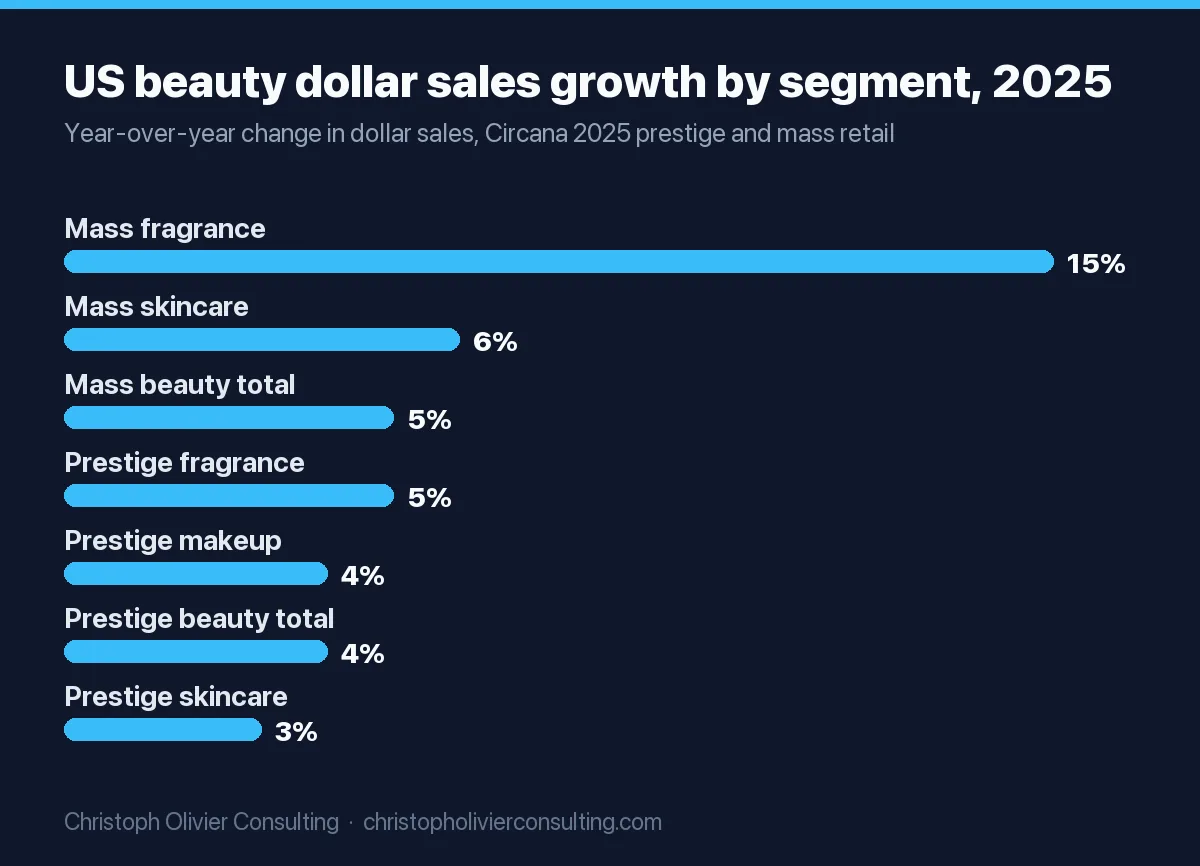
Category mix should shape channel choice. Circana’s 2025 data shows US prestige beauty at $36 billion and mass at $72.7 billion, with mass growing faster overall and mass skincare outpacing prestige skincare (full category breakdown). A drugstore-priced cleanser and a prestige serum need different channel plans, even with the same agency running both.
Meta and Instagram
Meta’s ad rules ban health and appearance ads that imply or try to create negative self-perception. A June 2026 policy breakdown reads non-permanent cosmetics as largely outside Meta’s before-and-after restriction, while weight-loss and anti-aging or wrinkle treatments face tighter limits and some categories need 18+ targeting. In practice, a “watch my skin change” UGC ad can run while “tired of looking old?” copy over the same footage gets rejected. Meta’s policy pages were reorganized during 2026, so have your agency confirm the live wording in Meta’s Transparency Center before a big launch. For creative that tends to clear review and still sell, see these social media ad examples.
TikTok Shop
Beauty and Personal Care is a restricted category on TikTok Shop: you apply through the Qualification Center in Seller Center, reviews usually take up to six days, and the most common rejection reason is incomplete or poor-quality documents. Depending on the product, TikTok may ask for a Cosmetic Product Listing Number for general cosmetics or a National Drug Code for OTC and medicated products, plus clear photos of the full label. TikTok also published binding shelf-life and expiration rules for beauty on June 5, 2026. An agency that has never cleared qualification will learn on your account.
Amazon
Amazon rewards search demand and reviews, which makes it the channel where the FTC review rule bites hardest. Listing copy is promotional material too, so the same claim ladder applies to bullets, A+ content and Sponsored Brands headlines. Keep listing claims identical to your site and your label; the inconsistent one is the one regulators and competitors find.
Sephora, Ulta and specialty retail
Retail shifts the job from “drive orders” to “drive sell-through.” Your agency’s work has to support the retailer’s launch timing, its site reviews (which retailers police, as the Sunday Riley case showed) and its in-store education. Ask for a retail case they supported past launch week.
Email, sampling and subscriptions
Regimen products live or die on the second order. Sampling works best when the sample leads to a defined next step: a deluxe sample of the serum with a full-size offer timed to when the sample runs out. Subscriptions work for daily-use products with a predictable reorder cycle, and less well for treatments people use occasionally. Build a separate replenishment flow per product type rather than one generic “time to reorder” email.
12 questions to ask a beauty marketing agency before you sign
Use these in the second meeting, after the credentials deck. The answers tell you more than the case studies.
- Who reviews claims before anything ships, and what do they check? A good answer names a person, a claim library and a point where drug-adjacent copy goes to regulatory counsel.
- Show me a skincare claim you rewrote for a client, before and after. Specialists have these ready. Generalists talk about “brand voice.”
- What is your creator disclosure standard? Listen for in-video, on-screen and spoken disclosure in plain words, not a bare “#ambassador” or “gifted.”
- How do you monitor creators after they post, including Stories? Expect a pre-approval step for paid posts and a periodic audit of live content.
- How do you generate reviews on our site, Amazon and retailer pages? Any incentive tied to positive reviews, undisclosed employee reviews or purchased followers is disqualifying.
- What happens when someone comments “this burned my skin”? Community managers see reactions first. The right answer is a same-day escalation to whoever handles MoCRA adverse event reporting for your brand.
- Which of our SKUs are cosmetics, drugs or both, and how does that change the plan? SPF, acne, antiperspirant and dandruff products change what you can say and where you can sell.
- Have you cleared TikTok Shop beauty qualification, and which documents will you need from us?
- How will you report blended results across our site, Amazon, TikTok Shop and retail? One view, one definition of a new customer.
- How many new creatives per month, and who produces them? Ask for a real monthly count and a sample month.
- What are the term and notice period, and who owns accounts, data and creator usage rights?
- What would you tell us not to do? An agency that can’t name a channel or tactic it would cut for your brand is selling hours, not judgment.
A simple way to score your shortlist
When two or three beauty marketing agencies look similar on paper, score them on the same five areas after the second meeting. The weights below are my own starting point for a DTC skincare brand; shift them toward channel fit if you sell mostly through marketplaces or retail.
| Area | Weight | What earns full marks |
|---|---|---|
| Claims and compliance | 25 | Named reviewer, claim library, disclosure standard, adverse event escalation path (questions 1 to 7) |
| Channel fit | 25 | Has run your main channel at your price point, including TikTok Shop or Amazon if those matter |
| Measurement | 20 | Blended reporting across channels, agreed definitions, no grading its own homework |
| Creative engine | 20 | Real monthly volume, creator bench in your category, usage rights included |
| Commercial terms | 10 | Clear scope, short notice period, you own accounts and data |
An agency that scores poorly on claims and compliance should not win on creative alone; that is the area where one bad month can cost more than a year of fees. If you want a neutral second read on proposals before you commit, you can book a consultation and bring the shortlist.
Work with CO Consulting
Content that earns rankings, citations and clients
- Content systems Christoph Olivier has built have generated more than 200 million organic views
- A roadmap tied to the questions your buyers ask Google and AI assistants
- Strategy, production planning and distribution in one engagement
- No guaranteed views or lead counts; reporting on leads and consultations
Frequently asked questions
What does a beauty marketing agency do?
A beauty marketing agency plans and runs the channels that sell cosmetics, skincare, hair and fragrance: paid social and search, creator and UGC programs, TikTok Shop and Amazon, PR and retail launches, and email or SMS retention. The good ones also manage beauty-specific risk, such as keeping claims cosmetic under FDA rules and making creator disclosures meet FTC guidance.
How much does a beauty marketing agency cost?
Few agencies publish prices. One DTC beauty agency lists $2,000 to $10,000 a month for brands doing $100K to $25M in revenue, with ad spend on top, while some influencer agencies set campaign minimums of $50,000 or more. Pricing models include flat retainers, a percentage of ad spend, per-campaign fees and revenue share, and each creates different incentives.
Should a small skincare brand hire an agency?
Under roughly $1M in sales, a full-service retainer often costs more than it returns. Project work usually fits better, such as a creator seeding program, a launch campaign or a site rebuild. Founder-led content, sampling and early creators do most of the work at that stage, and the budget is often better spent on product, inventory and a strong retention flow.
What skincare marketing claims can get a brand in trouble with the FDA?
Claims that a product affects the body's structure or function or treats a condition can make a cosmetic a drug. The FDA lists examples such as restoring hair growth, reducing cellulite, changing melanin production and regenerating cells, and it treats acne and sun protection claims as drug claims. Social posts and ads count as evidence of intended use, not just the label.
Do beauty influencers have to disclose free products?
Yes. The FTC treats free product as a material connection that should be disclosed clearly and conspicuously. In video, the disclosure should be in the video itself, ideally both on screen and spoken. The FTC calls terms like #ambassador ambiguous and says Gifted alone, without the brand named, is likely ambiguous. Brands are responsible for monitoring the creators they work with.
What is the best marketing for beauty brands on TikTok Shop?
Start by clearing TikTok Shop's Beauty and Personal Care qualification, which can require label photos and FDA identifiers such as a Cosmetic Product Listing Number or, for OTC products, a National Drug Code. Then build an affiliate creator program around demo-friendly hero products, with disclosure rules and claim limits written into every creator brief.
Does MoCRA apply to small beauty brands?
Partly. Brands with under $1,000,000 in average annual US cosmetic sales over three years, adjusted for inflation, are exempt from facility registration, product listing and good manufacturing practice rules, unless they make eye-area, injected, internal-use or long-wear products. Serious adverse events must still be reported to the FDA within 15 business days, and product safety must still be substantiated.
More Growth Consulting guides
- Manufacturing Marketing: A Practical Playbook for Industrial B2B Growth
- Handyman Marketing: The Channel Plan That Books More Jobs
- Outbound Marketing in 2026: Modern Plays
- Cybersecurity Marketing: How to Win Trust From Technical and Executive Buyers
- Net Promoter Score: Calculation, Benchmarks, and How to Raise It
- Marketing Operations: Skip at Your Peril
- All Growth Consulting guides →