

Private school marketing is enrollment math before it is anything else. Count the seats you need to fill next fall, subtract the families you will keep, and work backward through your own funnel to the number of inquiries that has to arrive, and by when. At the median NAIS member school, 385 inquiries produced 79 newly enrolled students in 2024-25, and the same report puts median student attrition at 8.1%. Those two numbers tell you more about where your marketing time should go than any list of tactics.
This guide is written for a head of school or a director of admission and marketing at an independent or private K-12 school, often a team of one or two people who also run tours, chase files and sit on the re-enrollment committee. It starts with the seat gap, shows how to find the stage of your funnel that is actually leaking, and covers the 2026 changes most marketing guides skip: state ESAs and the new federal scholarship tax credit.
Want a specialist to build this for your business? See how CO Consulting’s marketing services work, starting with a diagnostic and audit.
Start with the seat gap, not the marketing plan
Most schools write a marketing plan first and an enrollment target second. Reverse it. Your plan should exist to close a specific gap, by grade, in a specific window. A Grade 9 entry problem and a Pre-K problem are different campaigns with different parents, different competitors and different deadlines.
Use this worksheet with your own numbers from your student information system and admission software. The example column uses NAIS medians as stand-ins so you can see the arithmetic; your school’s numbers will differ.
| Line | How to calculate | Example (NAIS-median stand-ins) |
|---|---|---|
| A. Enrollment target for next fall | Budgeted seats, by grade | 364 students |
| B. Leaving by graduation | Your top-grade class size | Your number |
| C. Expected attrition among returning grades | (Current enrollment minus B) times your attrition rate | About 8.1% of returning students |
| D. Seat gap (new students needed) | A minus (current enrollment minus B minus C) | Say 60 new students |
| E. Acceptances needed | D divided by your yield (enrolled to accepted) | 60 / 71.4% = about 84 |
| F. Completed applications needed | E divided by your acceptance rate | 84 / 66.0% = about 127 |
| G. Inquiries needed | F divided by your inquiry-to-application rate | 127 / 46.6% = about 273 |
The conversion rates in the example are the NAIS all-member medians for 2024-25: 46.6% of inquiries became completed applications, 66.0% of applications were accepted and 71.4% of accepted students enrolled. Multiplied together, that is roughly 22 new students for every 100 inquiries. Medians from different schools do not combine perfectly, so treat this as a sanity check, not a forecast.
Run the worksheet in this order:
- Pull three years of your own funnel data by entry grade, not just school-wide totals. Entry points (Pre-K, K, 6, 9) usually carry most of the gap.
- Calculate your own stage-to-stage rates and compare them with the NAIS medians and with your regional association’s numbers.
- Circle the stage where you fall furthest below the benchmark. That is your primary marketing problem for this cycle.
- Work out when the inquiries in line G must arrive. If your application deadline is in January, most of those inquiries need to exist by late fall.
- Only then choose tactics, and give each one a job tied to a single stage.
The point of the exercise is focus. A school with healthy inquiry volume but weak yield does not need more Instagram ads. It needs a better experience between acceptance and contract.
The cheapest seat is the one you keep
Retention is marketing, and it is usually the highest-return marketing you do. A school at the NAIS median enrollment of 364 with the median 8.1% attrition rate loses about 29 students in a year, which is more than a third of the 79 new students the median school enrolls. Those families leave, then talk to the families you are trying to recruit.
The money is easy to see. NAIS reports median net tuition income of $25,669 per student. In a 364-student school, lowering attrition by two percentage points keeps about seven students, worth roughly $187,000 in net tuition a year before you count siblings. Lower attrition is achievable: the Georgia-based accreditor CESA reported a median attrition rate of 6.3% across its member schools, against 8.1% for NAIS schools.
What retention marketing looks like in practice:
- A re-enrollment campaign with the same care as admission. Current families get a “year ahead” preview of programs, teachers and trips before contracts go out, not just an invoice link.
- Exit-risk signals reviewed monthly. Late contracts, unopened school emails, a new sibling being toured elsewhere, a financial aid application that suddenly stops. Each one triggers a personal call from someone the family trusts.
- Transition-grade attention. Families often reconsider at the move from lower to middle school and from middle to upper school. Give those grades their own information evening for current families, held before outside open houses.
- Proof of progress. Parents stay when they can see what their child is getting. Short teacher updates, portfolio moments and student-led conferences do more than a glossy annual report.
What NAIS medians say about a typical funnel
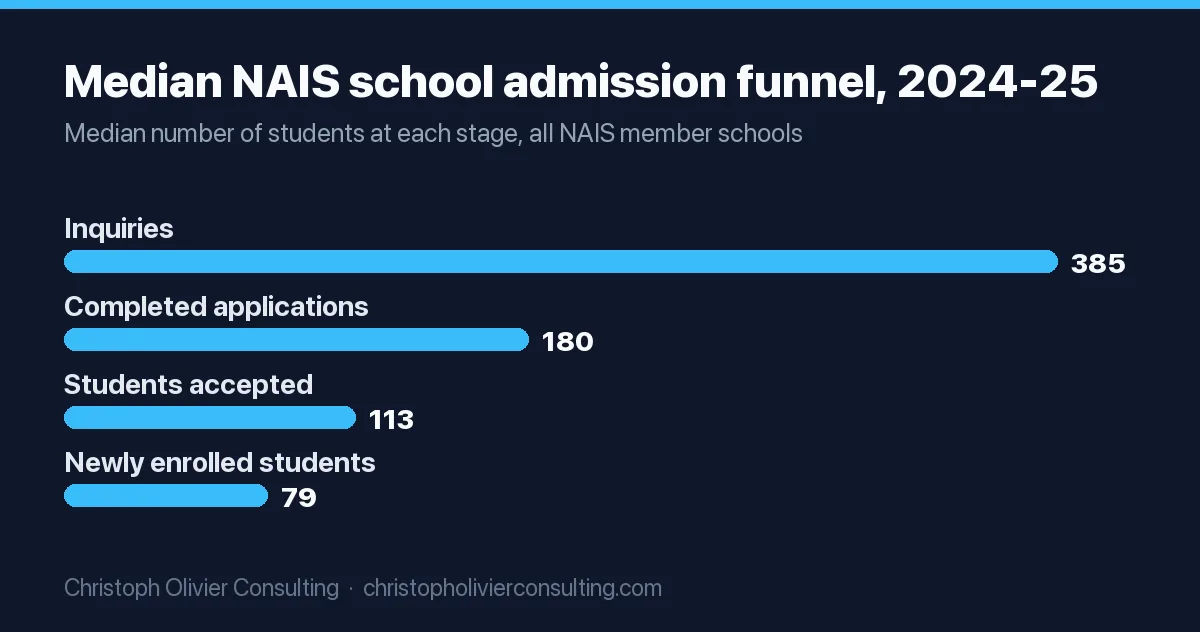
The national picture gives you a benchmark, not a target. At the median NAIS member school in 2024-25, the counts were 385 inquiries, 180 completed applications, 113 acceptances and 79 newly enrolled students.
Two cautions. First, the median school is a composite, so your numbers can sit well above or below it for good reasons, such as a waitlist in Kindergarten or a new campus. Second, inquiry volume is not holding steady everywhere. CESA’s 2025-26 benchmark found that inquiries at its largest schools fell from 972 to 751 between 2022-23 and 2025-26, a 22.7% drop, while its schools under 500 students saw inquiries rise 11.1%. The same report found that schools under 500 students had the largest shortfall against their enrollment goals. More interest does not automatically mean more enrolled students; conversion still decides the year.
Private school marketing strategies, stage by stage
Here is what to do at each stage once you know which one is leaking. Spend most of your effort on the weakest stage, and keep the others at “good enough.”
Inquiries: be the obvious answer when a parent starts looking
Parents usually start with a search such as “private schools near me,” “Montessori [town]” or “best high schools in [city],” then compare a handful of websites side by side. The basics that move inquiry volume:
- A tuition and aid page that answers the real question. Publish tuition by grade, what it includes, and how aid works. Hiding the number usually filters out families who would have qualified for aid.
- Grade-level entry pages. “Kindergarten at [School]” and “Ninth grade entry” pages rank for specific searches and speak to very different parents.
- A complete Google Business Profile with current photos, tour hours and answered questions.
- One inquiry form, short. Name, email, child’s current grade and entry year. Ask the rest later.
A budget note many schools get wrong: Google’s own rules say a school, academic institution or university is not eligible for Google for Nonprofits, though philanthropic arms of educational organizations are. Since Google Ad Grants is offered through Google for Nonprofits, do not build a plan that assumes free search ads for the school itself. If your school has a separately organized foundation, check Google’s eligibility rules carefully before applying, and expect any approved account to promote the foundation’s charitable work, not tuition-paying admission.
Content still matters here, but it should answer questions parents type, such as how your school prepares students for the transition to high school or what a day in your Grade 2 classroom looks like. Our roundup of content marketing examples shows the formats that tend to earn attention, and many of the enrollment principles in our guide to higher education digital marketing carry over, with one big difference: your buyer is the parent, and the child is the one who has to love the visit.
Visits: open houses, tours and shadow days
For most independent schools, the visit is where the decision really forms. Check it in your own data: compare the application rate of families who visited with those who only inquired. In most schools the gap is wide enough that the job of every inquiry touchpoint becomes simple: get a date on the calendar.
- Offer three visit formats. A fall open house for families who want to look without commitment, small-group or private tours for families who are serious, and a shadow day or visit day for the child.
- Run the open house like an event with a funnel. Registration, reminder sequence, a named host for each family, and a follow-up within 24 hours. Our event marketing plan lays out a timeline you can adapt.
- Put students in front. Student tour guides, a class to sit in on, and a short conversation with a teacher in the child’s subject of interest.
- Keep a virtual tour for distance and for second looks. Relocating families and the second parent who missed the visit both use it.
Applications: remove friction before you add marketing
If your inquiry-to-application rate trails the 46.6% median, the problem is often process, not persuasion. Long forms, unclear testing requirements, teacher recommendation requests that families do not understand, and a portal that fails on a phone all cost applications. Map every step a parent takes, time it, and cut what you can. Then nurture: a family that inquires in October and applies in January needs useful contact in between. Our email drip campaign examples show sequences you can rework for an admission cycle.
A sample first reply after an inquiry, written for an independent day school:
Subject: Your visit to [School], and the three questions families ask first
Hi [Parent name], thank you for asking about [Grade] at [School]. Most families start with three questions: what a day looks like, what tuition really costs after aid, and how their child would fit in. The quickest way to answer all three is a 45-minute visit with [Admission Director]. Here are the next open dates: [dates]. If you would rather talk first, reply to this email and I will call you at a time that suits you.
Aid and price: say the number, then say the help
Price is the objection most marketing avoids, and avoiding it costs you families. NAIS reports that at the median member school 26.2% of students receive financial aid, with a median grant of $21,722, against median day tuition of $37,135 in Grade 9 and $28,025 in Grade 1. That is a story worth telling plainly, as early as the first visit.
Messaging that tends to work better than “we offer need-based aid”:
About one in four families at [School] receives financial aid. Aid is based on need, applications are confidential, and the admission decision is made separately. If tuition is the question, apply anyway and let us show you the number for your family.
Only publish percentages that are true for your own school. If your share of aided families is different from the NAIS median, use yours.
Yield: the weeks between “accepted” and “enrolled”
The median yield of 71.4% means nearly three in ten accepted families go somewhere else. Many of those decisions happen in the short window after decision letters, when families compare offers and aid packages. Use it:
- A personal call from a teacher or coach within 48 hours of acceptance.
- An admitted-student event where the child meets future classmates.
- A current-parent call from a family with a similar child. Our referral marketing guide covers how to recruit, brief and thank ambassadors without turning them into salespeople.
- Aid packages explained by a person, not delivered as a PDF.
A short brief you can hand to a parent ambassador before a yield call:
You are calling as a parent, not as staff. Share one honest thing your child loves and one thing you wish you had known in the first month. Ask what the family is weighing. If they ask about tuition, aid or admissions policy, say “Let me connect you with [Name], who can give you the exact answer,” and let us know by email the same day.
ESAs, vouchers and the federal tax credit: rewrite your price story
School choice money is changing the conversation about price in a growing number of states, and many school websites still do not mention it. Two examples worth knowing in 2026:
Texas Education Freedom Accounts. The Texas Comptroller’s program sets the 2026-27 private school award at $10,474 per student, with up to $30,000 for eligible students with disabilities, and reported more than 274,000 applications and over 100,000 awards for the first year. To accept the money, a school must be in Texas, accredited by an organization recognized by the Texas Private School Accreditation Commission or the Texas Education Agency, in continuous operation for at least two school years, and must give participating students in Grades 3 through 12 a nationally norm-referenced test each year. The Comptroller had earlier reported that more than 2,200 schools had signed up ahead of the original deadline.
The Federal Scholarship Tax Credit. Starting January 1, 2027, the IRS says taxpayers can claim a credit of up to $1,700 for cash contributions to Scholarship Granting Organizations, but only in states that have elected to participate and submitted a list of SGOs. As of October 22, 2026, the IRS listed 30 participating states, including Florida, Georgia, North Carolina, Ohio, Tennessee, Texas and Virginia.
| If your school is… | Marketing move | Watch out for |
|---|---|---|
| Eligible for a state ESA or voucher | Publish a “net price with [program]” page and add the program to tour scripts and the inquiry reply | Program amounts and deadlines change each year; date-stamp the page and link to the official site |
| Not yet eligible (for example, not accredited or too new) | Tell families plainly when you expect to qualify | Never imply eligibility you do not have |
| In a state participating in the federal credit | Work with an approved SGO and brief your development office: donors may now ask about it | The credit runs through SGOs, not your school directly; confirm details with counsel or your SGO |
| In a state not participating | Watch the IRS list each year; states can still elect in | The credit only applies to contributions to SGOs in participating states |
The marketing logic is simple. A $10,474 award covers about 28% of the NAIS median Grade 9 day tuition and about 37% of the median Grade 1 figure. For some families that changes the decision from “not possible” to “worth a visit,” but only if they hear about it from you.
Three rules that catch school marketers off guard
- Free Google ads are not a school benefit. As covered above, schools are excluded from Google for Nonprofits; only philanthropic arms are eligible.
- FERPA probably is not your photo policy. The U.S. Department of Education says private and parochial elementary and secondary schools generally do not receive the funding that triggers FERPA. That does not mean anything goes. Your media release, your enrollment contract and your state’s privacy laws govern how you use student photos, names and video, so put clear, opt-out-friendly consent in the contract and keep a do-not-photograph list your marketing team can see.
- School-choice claims need a source and a date. ESA and voucher rules change every legislative session. A stale award amount on your website reads as a broken promise to the family who believed it.
Your school enrollment marketing calendar for the year
Here is a typical calendar for a day school with a winter application deadline. Rolling-admission schools compress it, and boarding schools often start earlier, so adjust the months to your deadlines and your region’s decision dates.
| When | Admission focus | Current-family focus |
|---|---|---|
| Spring and summer | Update website, tuition page, entry-grade pages and virtual tour; recruit ambassador families | Close the year with a progress story for every family |
| September and October | Fall open houses, local search push, first inquiry nurture | Welcome-back events; flag families at risk |
| November and December | Shadow days, private tours, aid workshops, application reminders | Transition-grade evenings for current families |
| January and February | Application deadline, file completion calls, aid applications | Re-enrollment preview, then contracts |
| March | Decisions, acceptance calls, admitted-student events | Follow up on unsigned contracts personally |
| April to June | Yield push, waitlist management, rolling admission for open seats | Exit interviews with every departing family |
What to report to your board
Boards ask about marketing in terms of likes and impressions only when nobody has given them better numbers. Give them the funnel instead:
- Inquiries, visits, completed applications, acceptances and enrolled students, by entry grade and by source, against the same point last year.
- Stage conversion rates against the NAIS medians and your own three-year average.
- Attrition and re-enrollment rate, with the reasons departing families gave.
- Net tuition per new student, so the board can see whether aid and choice programs are changing your mix.
- Cost per enrolled student for paid channels, where you can track it honestly. Word of mouth will always be under-counted, so ask “how did you first hear about us?” on every application.
If you want a second set of eyes on your seat-gap math or your funnel before the next cycle starts, you can book a consultation and bring your last three years of admission data. In my experience the leak is rarely where the school assumes it is, and the fix is usually smaller than a new campaign.
Work with CO Consulting
Want this done for your business?
- A diagnostic call and an audit of your current marketing and numbers
- A prioritized 90-day plan built for your market
- Execution across SEO and AI search, paid ads, content, funnels and automation
- Weekly check-ins and monthly reporting, led by a fractional CMO
Frequently asked questions
What is the best marketing strategy for private schools?
Start with your seat gap and your own funnel data, then fix the weakest stage first. For many schools that is yield or retention rather than inquiry volume. A school that already gets enough inquiries but loses accepted families to competitors needs better acceptance follow-up and clearer aid messaging, not more ads. Tactics only make sense once you know which stage is leaking.
How many inquiries does a private school need to enroll one student?
Using NAIS 2024-25 medians, 46.6% of inquiries became completed applications, 66.0% of applications were accepted and 71.4% of accepted students enrolled. Multiplied together that is roughly 22 enrolled students per 100 inquiries, or about 4.5 inquiries per new student. Your own rates may differ a lot by grade and region, so calculate them from three years of your data.
Can a private school get Google Ad Grants?
Not as a school. Google's eligibility rules for Google for Nonprofits, which provides Ad Grants, exclude schools, academic institutions and universities. Philanthropic arms of educational organizations are eligible, so a separately organized school foundation may qualify. Check Google's current rules before applying, and do not plan admission budgets around free search ads for the school itself.
How should private schools market to families using ESAs or vouchers?
If your school is eligible, say so clearly and show the net price. A dedicated page explaining the program, the award amount for the current year, your eligibility status and the official application link helps families who assume they cannot afford you. Date-stamp the page, link to the state program, and update it every year because amounts and deadlines change.
Why is retention part of private school marketing?
Every student who leaves is a seat you must refill at full marketing cost, and departing families talk to prospective ones. At NAIS median figures, a 364-student school with 8.1% attrition loses about 29 students a year. Cutting attrition by two points keeps about seven students, worth roughly $187,000 in median net tuition annually.
Does FERPA control how a private school uses student photos in marketing?
Usually not. The U.S. Department of Education says private and parochial elementary and secondary schools generally do not receive the federal funding that makes FERPA apply. Your media release, enrollment contract and state privacy laws are what govern photo and video use, so build clear consent into the contract and keep a do-not-photograph list your marketing staff can check.
More Growth Consulting guides
- What Is Growth Marketing?
- Marketing Manager Job Description Template
- Painting Company Marketing: Cost Per Booked Job by Channel
- Daycare Marketing: A Funnel That Fills Your Enrollment
- Customer Segmentation: A Practical Guide for Marketing Teams
- How to Write a Positioning Statement (Template + Examples)
- All Growth Consulting guides →