

Home care agencies get most new clients from two places: past and current clients and their families, and healthcare professionals who see people at the moment they need help, mainly hospital discharge planners, home health agencies, skilled nursing facilities and physicians. The catch is that the second group is regulated. A hospital has to give patients a choice of agencies, and you cannot pay anyone for a Medicare or Medicaid referral. This page gives you the data on which sources produce clients, a source-by-source playbook with what each one needs and what is legal to offer, the rules quoted from the regulations, and a tracking sheet and visit script you can copy.
Short answer: In the Home Care Association of America benchmark that Activated Insights cites, past and current clients and their families were the top referral source at 19.5%, followed by hospital discharge planners (8.8%) and Medicare-certified home health agencies (7.1%). On the medical side, home health was the first post-acute stop after 18.0% of Medicare hospital discharges in early 2024, per MedPAC. Earn referrals with fast response and proof of quality, never with payments.
Where home care clients actually come from: the data
There is no government survey of private-duty home care referral sources, so the best public numbers come from industry benchmarking studies. Read them as directional: they are self-reported by agency owners, and the most detailed breakdown is older. Here is everything I could verify, with the edition stated.
| Referral source | Figure | What it measures | Source |
|---|---|---|---|
| Past and current clients and their families | 19.5% | Share of top referral sources | HCAOA Private Duty Benchmarking Study, 5th edition, as cited by Activated Insights (edition year not stated) |
| Hospital discharge planners | 8.8% | Same | Same |
| Medicare-certified home health agencies | 7.1% | Same | Same |
| Skilled nursing facilities | 5.9% | Same | Same |
| State Medicaid waiver programs | 5.7% | Same | Same |
| Hospices | 5.1% | Same | Same |
| Geriatric care managers | 4.2% | Same | Same |
| Area Agency on Aging case managers | 4.0% | Same | Same |
| Assisted living facilities | 3.7% | Same | Same |
| Client referrals, revenue share | 73% | Revenue share from client referrals, among agencies naming clients a top source (872 owners surveyed) | 2020 Home Care Benchmarking Study |
| Healthcare professionals in the top 10 | 6 of 10 | Top 10 referral sources that are healthcare professionals | 2019 Benchmarking Study, Fall Edition |
| Medicare-certified home health agencies | <9% cite it; 26% of revenue | Leaders naming it a top-3 source; revenue share for those who did | 2017 Benchmarking Study |
| Median client acquisition cost | $509 to $599 | Change over five years to 2020 | 2020 Home Care Benchmarking Study |
Two patterns hold across every edition. First, clients and families are the single largest source, and the agencies that rely on them get most of their revenue that way. Second, the professional sources are many small streams, none above about 9% on its own, which is why agencies that grow fast work several of them at once. The 2017 home health finding is the useful outlier: few agencies cultivated Medicare-certified home health partners, but the ones that did got a quarter of their revenue from them.
How many hospital discharges go to home health
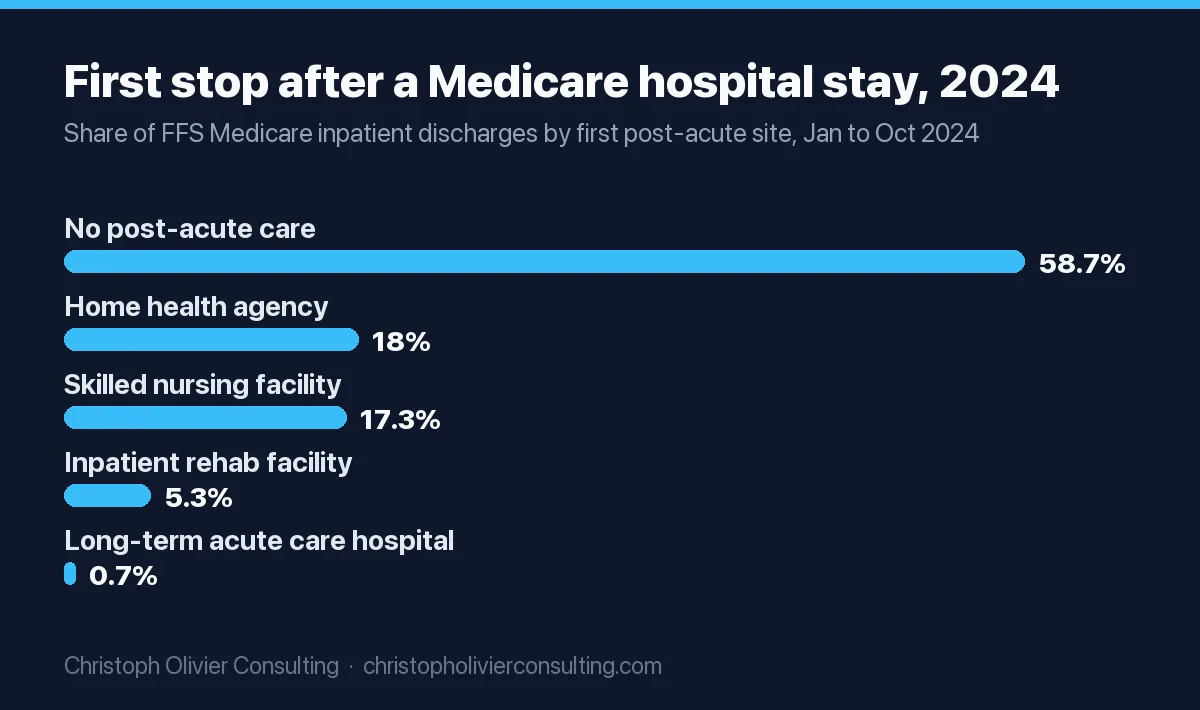
The professional channel starts with Medicare hospital discharges, and that is the one part of this market with hard federal numbers. MedPAC’s March 2026 report (Table 8-5) shows home health is now the most common first post-acute destination after an inpatient stay, ahead of skilled nursing facilities. It was the first stop after 18.0% of fee-for-service Medicare hospital discharges in the first 10 months of 2024, against 17.3% for SNFs. In 2019 the order was reversed: 18.7% SNF, 15.8% home health.
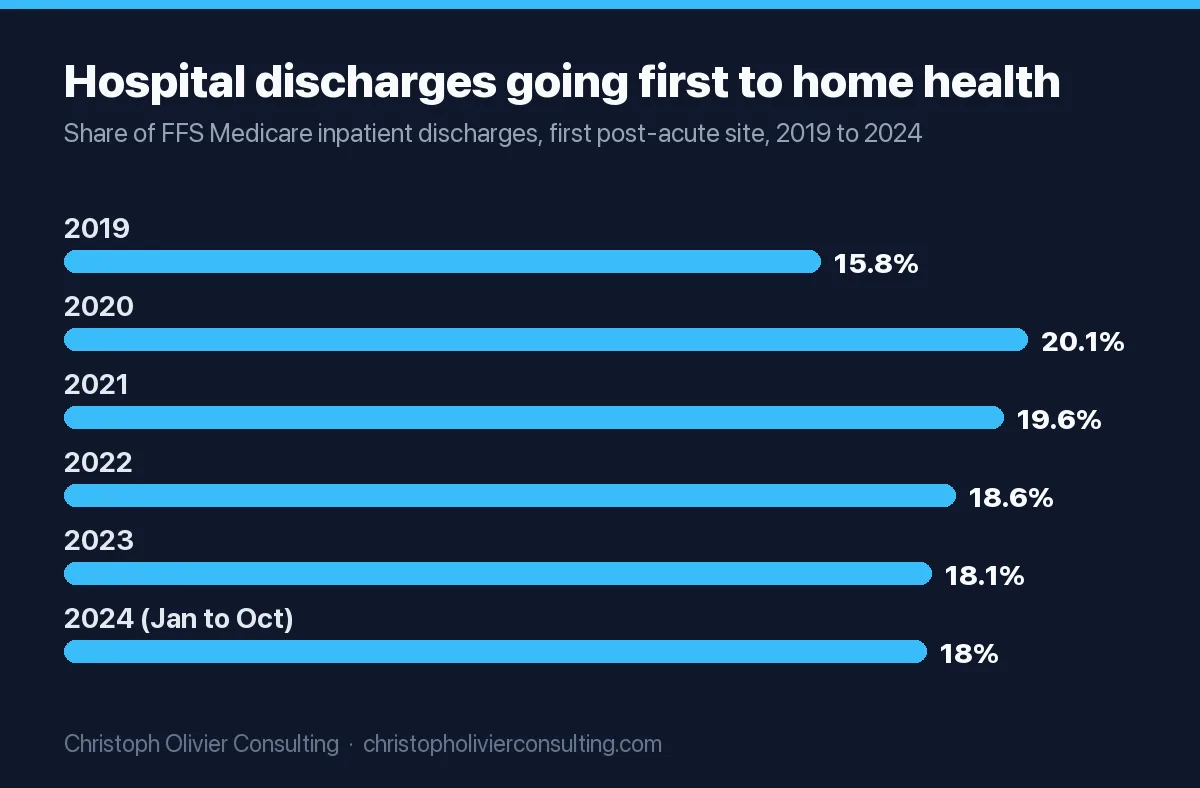
My calculation from the same table: 6.8 million inpatient discharges in 2023 times 18.1% going to home health first is about 1.23 million discharges that started with a home health referral. Each one passed through a discharge plan, and many of those patients will need non-medical help after skilled care ends.
The supply side is crowded. MedPAC counts 12,234 Medicare-participating home health agencies in 2024, and reports that 86% of fee-for-service beneficiaries live in a ZIP code served by five or more of them. Excluding California, where agency counts grew 10.2% in one year, the number of agencies fell 1.0% in 2024.
Home care vs home health referral sources: different rules, different partners
Searchers mix “home care” and “home health” referral sources, but the referral path is different, and so is the law that applies. Get this wrong and you either chase partners who cannot send you anything or offer something you cannot legally give.
| Medicare home health (skilled) | Non-medical home care (private duty) | |
|---|---|---|
| Who pays | Medicare, Medicare Advantage, Medicaid | Mostly private pay, long-term care insurance, VA, Medicaid waiver programs |
| Does a clinician have to order it? | Yes. A physician or allowed practitioner certifies eligibility after a face-to-face encounter | No, for private pay. Families can call you directly |
| Main referral sources | Hospital discharge planners, physicians, SNFs, inpatient rehab | Clients and families, home health agencies, discharge planners, senior living, care managers, elder law and financial advisers |
| Hospital choice list applies? | Yes, under 42 CFR 482.43(d) | No federal choice list, but discharge planners still steer families to agencies they trust |
| Federal Anti-Kickback Statute applies? | Yes | Yes for any Medicaid or other federal program client; not for purely private-pay referrals, but state law may apply |
What are the four types of referrals in home care?
There is no official taxonomy. The classification that holds up in practice, and the one I use to organize a referral plan, is by who is doing the referring:
- Client and family referrals. Current clients, past clients and their adult children. The largest source in every benchmark above. Driven by service quality and by asking.
- Healthcare professional referrals. Discharge planners and case managers, home health and hospice agencies, SNFs, physicians and their staff. Driven by response speed, acceptance rate and documented quality.
- Community and professional-services referrals. Area Agencies on Aging, Medicaid waiver case managers, geriatric care managers, senior living communities, elder law attorneys, financial planners, long-term care insurers, veterans organizations.
- Self-referrals through search and directories. A family member searching “home care near me” and calling you. Not a referral partner, but it often decides who gets the call after a professional gives a family three names.
Type four matters more than it looks. When a discharge planner hands a family a list, the family searches the names. Your Google reviews and profile are part of the referral.
Home care referral partners: what each source needs and what is legal to offer
This is the core playbook. For each source: who to ask for, what they actually need from you, and where the legal line sits. “Legal to offer” means items that are part of doing your job, not inducements. Anything with independent value to the referrer is the risk zone, whatever the amount.
| Source | Who to ask for | What they need from you | Fine to offer | Avoid |
|---|---|---|---|---|
| Hospital discharge planners | Case management director, discharge planners, social workers on med-surg and ortho floors | Same-day acceptance answer, start of care within 24 to 48 hours, weekend intake, clear payer and minimum-hours rules | A one-page service sheet, intake line, in-service education on your services | Meals, gift cards, paid “liaison” staff working inside the hospital, anything tied to referral counts |
| Medicare-certified home health agencies | Intake coordinator, clinical manager, agency marketer | Non-medical help for patients who need more hours than skilled visits cover, and after discharge from home health | Reciprocal education, a shared handoff process | Referral swaps (“you send me, I send you”), per-referral payments |
| Skilled nursing and rehab facilities | Social services director, discharge coordinator | Transition help in the first weeks home, the ability to staff high hours fast | Discharge-day availability, caregiver profiles matched to the patient | Paid lunches for staff, sponsorships tied to referrals |
| Physicians and practice staff | Office manager, nurse care coordinator | A reliable name for patients who are struggling at home | Brochures for the waiting room, a direct intake number | Any payment, free services to the practice, “medical director” fees above fair market value |
| Area Agency on Aging and Medicaid waiver case managers | Case manager supervisor | An enrolled, credentialed provider that accepts waiver rates and assignments | Provider enrollment, accurate capacity updates | Anything of value: these are federal program referrals |
| Senior living communities | Executive director, resident care director | Help that lets residents stay longer, short-term post-hospital support | Resident education events, transparent pricing | Per-move-in or per-client fees where any client uses federal programs |
| Elder law attorneys, financial planners, LTC insurers | Partner, care coordinator, claims staff | Documentation of care hours and care plans, LTC insurance billing support | Joint education sessions, claims paperwork help for clients | Referral fees without legal review of your state’s rules |
| Past and current clients | Primary family contact | Consistent caregivers and fast problem-solving | A thank-you note | Cash or credits for referrals of Medicaid or other federal program clients |
The source thresholds that make a partner worth visiting are worth setting before you start. An Activated Insights author suggests targeting communities around 90% occupied, home health or hospice agencies with about 100 clients, and SNFs with 40 or more discharges a month. Treat those as one practitioner’s rules of thumb, not study results.
The rules: hospital choice lists and anti-kickback limits
Hospitals must give patients a list and a choice (42 CFR 482.43)
Medicare’s hospital conditions of participation control how discharge planners hand out home health names. Under 42 CFR 482.43(d)(1), for patients “discharged home and referred for HHA services,” the hospital must “include in the discharge plan a list of HHAs” that are “participating in the Medicare program” and “serve the geographic area” where the patient lives. Under (d)(2), the hospital must “inform the patient or the patient’s representative of their freedom to choose” and “must not specify or otherwise limit the qualified providers.” Under (d)(3), it must identify any HHA “in which the hospital has a disclosable financial interest.” And (a)(8) requires hospitals to help patients pick post-acute providers using “data on quality measures and data on resource use measures.”
What this means for you: a discharge planner cannot simply “give you” Medicare patients. You win by being the agency patients pick off the list, which comes down to quality scores, coverage area, acceptance speed and reputation with the family. For private-duty agencies, the list rule does not apply, but planners still recommend the agencies that answer the phone and start care fast.
You cannot pay for Medicare or Medicaid referrals
The federal Anti-Kickback Statute, 42 U.S.C. 1320a-7b(b)(2), makes it a felony to “knowingly and willfully” offer or pay “any remuneration (including any kickback, bribe, or rebate)” in “cash or in kind” to induce someone to refer an individual for services “for which payment may be made in whole or in part under a Federal health care program.” The criminal penalty is a fine of up to $100,000, up to 10 years in prison, or both. On the civil side, 42 U.S.C. 1320a-7a(a)(7) adds a civil money penalty of “$100,000 for each such act.”
Three details trip agencies up:
- You do not need to know the law to break it. Subsection (h) says “a person need not have actual knowledge of this section or specific intent to commit a violation.”
- Tainted claims become false claims. Under subsection (g), a claim that includes services resulting from a violation “constitutes a false or fraudulent claim” under the False Claims Act.
- “Federal health care program” is broad. Under subsection (f) it covers federally funded health plans and any state health care program, which 42 U.S.C. 1320a-7(h) defines to include a state plan approved under subchapter XIX (Medicaid) and programs funded under division A of subchapter XX. A non-medical agency serving even some Medicaid waiver clients is inside the statute for those referrals.
Paying marketers: the employee and fixed-fee safe harbors
You can pay your own sales staff. The employee safe harbor at 42 CFR 1001.952(i) excludes “any amount paid by an employer to an employee, who has a bona fide employment relationship with the employer.” Independent contractors are different. Under the personal services safe harbor, 1001.952(d)(1)(iv), compensation must be “set in advance,” “consistent with fair market value in arm’s-length transactions,” and “not determined in a manner that takes into account the volume or value of any referrals.” In plain terms: a 1099 marketer paid per admitted Medicaid client is outside the safe harbor. Have a healthcare attorney review any variable pay plan.
Physicians who certify home health cannot have a financial relationship with you
Under 42 CFR 424.22(d), a physician or allowed practitioner with a financial relationship with the home health agency generally cannot certify or recertify the patient’s need for home health or perform the face-to-face encounter, unless an exception applies. Any “medical director” or consulting arrangement with a referring physician needs legal review before it starts.
Private-pay home care: where federal law stops
If a client pays entirely out of pocket or through private long-term care insurance, the federal statute’s text, which is tied to Federal health care program payment, does not reach that referral. That is not a green light. Before you pay any referral fee, even to a placement agency or a past client, check whether your state has its own anti-kickback, fee-splitting or patient-brokering statute and whether it applies to private-pay services, and have a healthcare attorney confirm it.
Can I get a referral without seeing a doctor?
For non-medical home care paid privately, yes. No referral is needed: a family can call an agency directly.
For Medicare-covered home health, no. MedPAC summarizes the rule: a physician, nurse practitioner, clinical nurse specialist or physician assistant must certify eligibility, and the beneficiary must have a face-to-face encounter related to the primary reason for home health. Under 42 CFR 424.22(a)(1)(v), that encounter must happen “no more than 90 days prior to the home health start of care date” or within 30 days after, and it can be done by telehealth. Medicare does not require a hospital stay first. That is why physician practices are a real referral source for skilled home health even with no hospitalization involved.
How to get referrals for home care: a 90-day partner plan
This is the sequence I would run for a single-location agency starting its professional referral program. It assumes one person owns referral development, either you or a full-time sales rep. Activated Insights’ 2019 benchmark found 50% of agencies do not employ a full-time sales rep.
- Weeks 1 to 2: fix intake before you market. Answer every inquiry live during business hours and call back within minutes after hours. The speed-to-lead data applies to families in crisis even more than to other buyers. Write down your acceptance rules: minimum hours, service area, payers, start-of-care time.
- Weeks 1 to 2: build your target list. List every hospital, SNF, home health agency, hospice and senior living community within your service area. Score each A, B or C by discharge or census volume and fit. Put it in the tracking sheet below.
- Weeks 3 to 6: visit A-tier partners every 2 weeks. Use the visit script below. The goal of visit one is a single test referral, not a relationship.
- Weeks 3 to 12: report back on every referral. Tell the referrer within 24 hours whether you accepted and when care started. Referrers keep sending to agencies that close the loop.
- Weeks 4 to 12: activate clients. At the 30-day and 90-day check-ins, ask satisfied families for a review and whether anyone else they know is struggling at home. Track every client referral by name. The mechanics are in this referral marketing guide.
- Week 12: cut and double down. Rank partners by admissions, not visits. Drop C-tier partners that sent nothing; move B-tier partners that sent one referral to A.
Copy-ready: referral partner tracking sheet
Paste these columns into a spreadsheet or your CRM. The “anything of value” column is a compliance log: if you cannot comfortably write an item in it, do not give it.
| Column | What to enter | Example entry |
|---|---|---|
| Partner organization | Facility or practice name | [Hospital name], 4th floor ortho |
| Source type | Hospital, SNF, HHA, hospice, physician, AAA or waiver, senior living, adviser, client | Hospital |
| Contact and role | Name, title, direct line, best time to visit | [Name], discharge planner, Tue/Thu mornings |
| Tier | A: high volume and fit, visit every 2 weeks. B: monthly. C: quarterly | A |
| Volume indicator | Discharges a month, census or client count | [number] discharges/month |
| Last touch / next action | Date, type (visit, call, in-service) and the next step with a date | [date] visit; in-service on [date] |
| Referrals this month | Count of referrals received | [number] |
| Accepted and started | Referrals you accepted, and how many started care | [number] accepted, [number] started |
| Start-of-care time | Hours from referral to first visit | [hours] |
| Payer mix of referrals | Private pay, LTC insurance, VA, Medicaid waiver | [payers] |
| Anything of value given | Date, item, dollar value, recipient (should be education materials only) | [date], service brochure, $0 |
| Feedback loop sent | Date you told the referrer the outcome | [date] |
The two numbers to review weekly are referrals per A-tier partner and referral-to-start rate. A partner sending referrals you cannot start is telling you something about your staffing or service area, not about the relationship.
Copy-ready: discharge planner visit script
Keep the first visit under five minutes. Bring a one-page service sheet, nothing else.
Opening: “Hi, I’m [name] with [agency]. I know you’re busy, so I’ll take two minutes. I’m here because I want to know what makes a discharge home go wrong for your patients.”
Listen, then ask: “When you call a home care agency, what’s the most common reason it doesn’t work out? Hours? Start time? Weekends?”
Your offer, tied to their answer: “We can usually confirm acceptance within [X] hours and start care within [X] hours, including weekends. We cover [ZIP codes or towns]. Our minimum is [X] hours a visit.”
The ask: “Next time you have a patient going home who needs help with bathing, meals or supervision, would you give the family our name as one of their options? I’ll call you back the same day to tell you what happened.”
Close: “Who else on the team handles discharges home, so I can introduce myself?”
Note what the script avoids: no food, no gifts, no promise of anything to the planner. The offer is speed, coverage and a closed loop.
What is the 80/20 rule in home care?
There is no official “80/20 rule” for home care. In referral terms it is the Pareto principle: a small share of your partners and clients will produce most of your new admissions. The benchmarks point that way: agencies that named client referrals a top source reported they produced 73% of their revenue. Use your tracking sheet to find your own concentration, then spend most of your visit time on the partners that already send clients and on the clients who already refer.
What are the best referral programs for home care?
The best programs pay off without paying anyone. That means a client referral habit built into check-ins, a professional partner cadence with a closed feedback loop, and community education that earns trust with senior living and adviser partners. Cash rewards for referrals are the risky part. They are off the table for referrals of Medicaid or other federal program clients, and they need state law review for private pay. For broader channel planning, including search and paid media, see the home care marketing guide.
Is a home care agency profitable?
For Medicare-certified home health, the federal data says yes on Medicare patients. MedPAC reports the fee-for-service Medicare margin for freestanding agencies averaged 21.2% in 2024 and projects 19% for 2026, but the all-payer margin was only 5.0% in 2024. For non-medical private-duty agencies there is no comparable public federal margin data, so treat any single profit figure you see quoted with care. What the benchmarks do show is that acquisition is getting more expensive: median client acquisition cost rose from $509 to $599 over the five years to 2020, which is another reason referral sources that cost nothing to keep matter.
How do private caregivers find clients?
Independent caregivers rely on the same first source as agencies, families who know a current or past client, plus caregiver directories and senior living staff. They usually cannot work hospital and Medicaid channels, because waiver programs enroll providers and discharge planners need a backup when a caregiver is sick. If you are moving from independent caregiving to running an agency, that backup coverage is the main thing professional referral sources are buying.
If you want a second pair of eyes on your referral plan or intake process, you can book a consultation.
Ready to scale your revenue?
Book a free 30-min consultation. We’ll diagnose your growth bottleneck and map out the 3 highest-leverage moves for your business.
Frequently asked questions
What are the best referral sources for a home care agency?
Past and current clients and their families are the largest source in industry benchmarks, cited at 19.5% of top referral sources in the Home Care Association of America study Activated Insights reports. Next come hospital discharge planners at 8.8% and Medicare-certified home health agencies at 7.1%, then skilled nursing facilities, Medicaid waiver programs and hospices. Most agencies need several professional sources at once because none is large on its own.
How do home care agencies get clients?
Mostly through word of mouth from clients and families, and through healthcare professionals such as discharge planners, home health agencies, skilled nursing facilities and physicians. Families also search online, often after a professional gives them a few names. Agencies win these referrals by answering inquiries fast, starting care quickly, covering weekends and reporting back to the referrer, not by paying for referrals.
Can a home care agency pay for referrals?
Not for anyone covered by Medicare, Medicaid or another federal health care program. The Anti-Kickback Statute makes it a felony to pay any remuneration, cash or in kind, to induce such referrals, with fines up to $100,000 and up to 10 years in prison. Paying your own employees is allowed under a safe harbor. Private-pay referral fees still need a check of your state's law.
How do I get referrals from hospital discharge planners?
Become the agency patients pick from the list. Hospitals must give home health patients a list of Medicare-participating agencies serving their area and cannot limit their choice. Win by confirming acceptance within hours, starting care within 24 to 48 hours, covering weekends, stating your service area and minimum hours clearly, and calling the planner back the same day with the outcome.
What is a home care referral partner?
A professional or organization that regularly sends families to your agency: hospitals, skilled nursing facilities, home health and hospice agencies, physician practices, Area Agencies on Aging, senior living communities, elder law attorneys and financial planners. Track each one by tier, referrals received, referrals started and time to start of care, and log anything of value you give them.
Do you need a doctor's referral for home health care?
For Medicare-covered home health, yes. A physician or allowed practitioner must certify eligibility, and the patient needs a face-to-face encounter within 90 days before or 30 days after the start of care, which can be done by telehealth. A prior hospital stay is not required. Private-pay non-medical home care needs no referral at all.
Referral fee rules by profession