

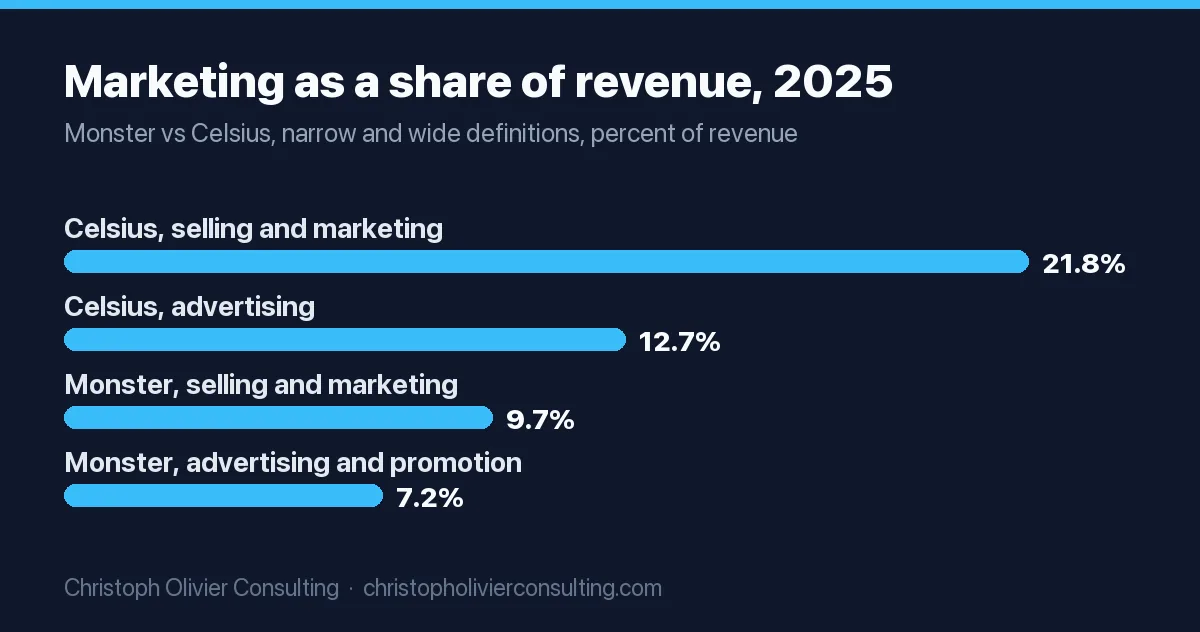
Monster Beverage spent $599.9 million on advertising and promotional expenses in 2025, 7.2% of its $8.29 billion in net sales. Celsius Holdings spent $318.9 million on advertising in 2025, 12.7% of its $2.52 billion in revenue. Both numbers come straight from each company’s 2025 annual report on SEC EDGAR. Red Bull, Liquid Death and Prime are private and publish no marketing figure, so for those three you get what is actually on the record and nothing invented.
Short answer: Monster: $599.9 million of advertising and promotion in 2025 (7.2% of net sales), or $803.5 million of segment “selling and marketing expense” (9.7%). Celsius: $318.9 million of advertising in 2025 (12.7% of revenue), or $548.3 million of selling and marketing (21.8%). Red Bull, Liquid Death and Prime do not disclose a budget.
Every figure below was read in November 2026 from the filing or article linked next to it. Percentages of revenue are our own calculation: disclosed spend divided by revenue from the same filing, times 100. We never convert euros to dollars and never fill a gap with an estimate.
Energy drink marketing budgets compared (2025 filings)
The two public companies each report marketing in two ways. The narrow line is advertising (Monster adds promotion, sponsorships and endorsements to it). The wide line is “selling and marketing expense” from the segment note, which also includes the people, sampling and field costs behind the brand. Compare like with like: narrow against narrow, wide against wide.
| Brand (owner) | Exact line item | Year | Spend | Revenue (same source) | % of revenue (calculated) | Source |
|---|---|---|---|---|---|---|
| Monster Energy (Monster Beverage) | “Advertising and promotional expenses, including, but not limited to, production costs” | 2025 | $599.9 million | $8,294.3 million net sales | 7.2% | Monster 10-K, 2025 |
| Monster Energy (Monster Beverage) | Segment “selling and marketing expense”, all four segments added | 2025 | $803.5 million | $8,294.3 million | 9.7% | Monster 10-K, 2025 |
| Celsius, Alani Nu, Rockstar (Celsius Holdings) | “Advertising expenses” | 2025 | $318.9 million | $2,515.3 million revenue | 12.7% | Celsius 10-K, 2025 |
| Celsius, Alani Nu, Rockstar (Celsius Holdings) | Segment “selling and marketing expenses” | 2025 | $548.3 million | $2,515.3 million | 21.8% | Celsius 10-K, 2025 |
| Red Bull (Red Bull GmbH, private) | No filing. Spend on sponsoring, advertising etc. per a press report of the group accounts | 2025 | About EUR 3.15 billion (press report) | EUR 12.196 billion turnover (company) | 25.8% (as reported by trend) | trend, Red Bull |
| Liquid Death (private) | Not disclosed | n/a | Not disclosed | $263 million retail sales in 2023 (company-reported) | n/a | BevNET |
| Prime (Congo Brands, private) | Not disclosed | n/a | Not disclosed | Not disclosed | n/a | BevNET |
Two reading notes. First, Celsius’s 2025 revenue includes Alani Nu from April 1, 2025 and Rockstar from August 28, 2025, so its 2025 ratios mix one full brand with two part-year brands. Second, neither company’s advertising line captures the discounts and retailer payments that are booked as a reduction of sales rather than as an expense, which we explain in the Monster section.
How much does Monster Energy spend on advertising? $599.9 million (2025)
Monster Beverage’s 2025 10-K states that “advertising and promotional expenses, including, but not limited to, production costs amounted to $599.9 million, $584.1 million and $528.9 million” for 2025, 2024 and 2023. The same note says “a significant amount” of promotional expense is payments under sponsorship and endorsement contracts, expensed straight-line over the contract term. That covers the athletes, teams, series, bands, esports, causes and events the 10-K lists as the core of its marketing.
So the answer to “what is Monster Energy’s advertising budget” is $599.9 million on the narrow definition. If you want everything Monster itself labels marketing, use the segment table in the same filing: selling and marketing expense of $714.96 million for the Monster Energy Drinks segment, $61.6 million for Strategic Brands (which includes Predator, Burn and NOS), $26.4 million for Alcohol Brands and $0.4 million for Other. Added together that is $803.5 million, or 9.7% of net sales (our calculation).
Monster Energy marketing budget by year, 2019 to 2025
| Year | Advertising and promotional expenses | Net sales | % of net sales (calculated) | Filing |
|---|---|---|---|---|
| 2025 | $599.9M | $8,294.3M | 7.2% | 10-K 2025 |
| 2024 | $584.1M | $7,492.7M | 7.8% | 10-K 2025 |
| 2023 | $528.9M | $7,140.0M | 7.4% | 10-K 2025 |
| 2022 | $460.7M | $6,311.1M | 7.3% | 10-K 2022 |
| 2021 | $417.6M | $5,541.4M | 7.5% | 10-K 2022 |
| 2020 | $345.7M | $4,598.6M | 7.5% | 10-K 2022 |
| 2019 | $391.6M | $4,200.8M | 9.3% | 10-K 2021 |
The pattern is steady. Since 2020 Monster has held advertising between 7.2% and 7.8% of net sales while the dollars rose from $345.7 million to $599.9 million. That fits the cost-management goal written into its 10-K: to decrease “sponsorships, sampling, promotional and marketing expenses, as a percentage of net sales.”
What the $599.9 million does not include
Much of Monster’s trade spending never shows up as an expense. Its 10-K lists “promotional and other allowances” that are subtracted from sales: price discounts funded for retailers, slotting and shelf-space fees, its agreed share of bottlers’ advertising and in-store marketing, and volume incentives. Monster does not publish a total for these allowances, so nobody outside the company can add them to the $599.9 million. If you see a blog quoting a single “total marketing budget” for Monster, it has either used one of the two lines above or guessed.
Monster’s committed sponsorship pipeline and 2026 so far
At December 31, 2025, Monster had $570.2 million of contractual obligations “related primarily to sponsorships and other marketing activities,” with $318.0 million falling due in 2026 (10-K, commitments note). By September 30, 2026 that figure had grown to $738.0 million (Q3 2026 10-Q).
The same 10-Q shows segment selling and marketing expense of $724.2 million for the first nine months of 2026, up $140.5 million on the same period of 2025. Against nine-month net sales of $7.45 billion, that is about 9.7% (our calculation). Monster says the third-quarter increase came from “social, digital, media and other marketing expenses, including sponsorships and endorsements, in order to reach a broader consumer audience and increase household penetration.” The 10-Q does not repeat the annual advertising-and-promotion figure, so the full-year 2026 number arrives with the next 10-K, likely in late February 2027.
How much does it cost to make Monster Energy?
Monster does not publish a cost per can. What it does publish is a 2025 gross margin of 55.8% of net sales, which means cost of sales was 44.2% of every sales dollar (our subtraction). Put differently, cost of sales took about 44 cents of every net sales dollar, and advertising and promotion about 7 cents.
Celsius marketing budget: $318.9 million in advertising (2025)
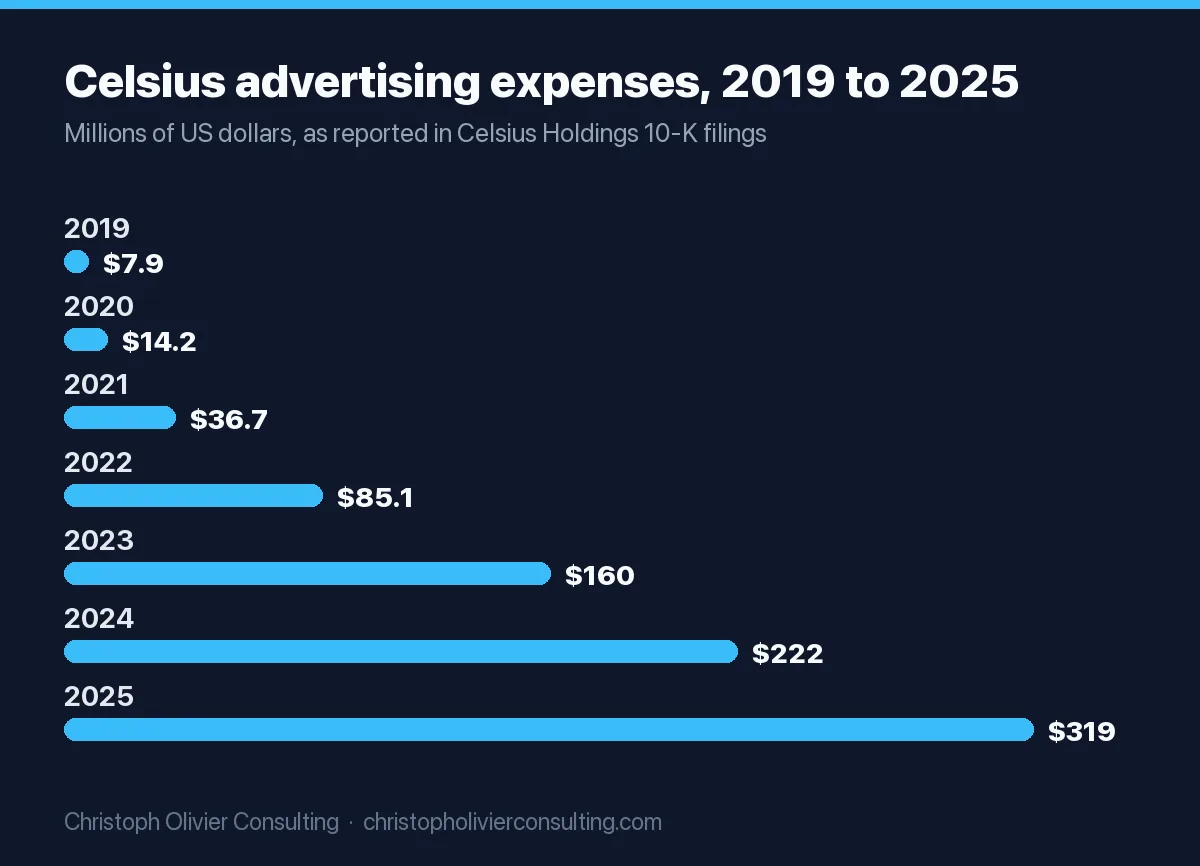
Celsius Holdings’ 2025 10-K says the company “incurred advertising expenses of approximately $318.9 million, $221.6 million and $160.0 million” in 2025, 2024 and 2023, charged to selling, general and administrative expenses. Channels named in the note: print displays, radio, digital and streaming, online and social, television, direct sponsorships, endorsements and in-store displays. The wider segment line, “selling and marketing expenses”, was $548.3 million in 2025, $350.8 million in 2024 and $264.1 million in 2023.
How much does Celsius spend on advertising each year?
This is the hyper-growth curve searchers are after: from under $8 million to almost $319 million in six years.
| Year | Advertising expenses | Revenue | % of revenue (calculated) | Filing |
|---|---|---|---|---|
| 2025 | $318.9M | $2,515.3M | 12.7% | 10-K 2025 |
| 2024 | $221.6M | $1,355.6M | 16.3% | 10-K 2025 |
| 2023 | $160.0M | $1,318.0M | 12.1% | 10-K 2025 |
| 2022 | $85.1M | $653.6M | 13.0% | 10-K 2022 |
| 2021 | $36.7M | $314.3M | 11.7% | 10-K 2022 |
| 2020 | $14.2M | $130.7M | 10.9% | 10-K 2022 |
| 2019 | $7.9M (“marketing and advertising expenses”) | $75.1M | 10.5% | 10-K 2019 |
Look at 2024. Revenue rose only 2.9% while advertising rose 38.5% (both our calculations), which is why the ratio spiked to 16.3%. Celsius kept spending through a flat year instead of cutting. In the first nine months of 2026, advertising was $272.4 million on revenue of $2,447.8 million, about 11.1% (Q3 2026 10-Q).
What the 2025 increase paid for
The 10-K breaks down the $200.6 million rise in marketing and selling expenses:
- $76.6 million more marketing expense for the “Live. Fit. Go.” campaign, which the company calls “our largest marketing initiative to date.”
- $65.0 million attributable to Alani Nu, including marketing to support that brand’s growth.
- $29.1 million of sales and marketing employee costs.
- $29.9 million of other selling costs such as storage, market analytics and customer support.
Marketing Dive reported on June 2, 2025 that “Live. Fit. Go.” was built with the agency Anomaly and runs across linear TV, connected TV, paid and organic social, out-of-home and experiential activations. Celsius has not published what the campaign’s media cost; the $76.6 million is the year-over-year increase, not the campaign total.
Do Celsius ambassadors get paid?
The campus ones do. Retail Brew reported in September 2023 that the Celsius University program puts one “paid student marketing ambassador” per campus on the payroll as a part-time employee, overseeing other unpaid student influencers who are compensated with product and merchandise. The program hired 17 paid ambassadors in 2022 and 170 in 2023. Celsius declined to say what they are paid. For the mechanics of building a program like this, see our influencer marketing strategy playbook.
Is Celsius making a profit, and what does its CEO earn?
Yes. Celsius reported 2025 net income of $108.0 million, down from $145.1 million in 2024, after $327.5 million of fees to terminate former Alani Nu distributors. Net income attributable to common stockholders, after preferred dividends, was $63.8 million (10-K 2025). Chairman and CEO John Fieldly’s 2025 total compensation was $9,607,616, of which $6,648,396 was restricted stock awards and $1,016,500 salary, per the 2026 proxy statement. The proxy puts his pay at 117 times that of the median employee.
Monster vs Celsius: why the challenger spends a bigger share
Celsius spent 53 cents on advertising for every dollar Monster spent in 2025 ($318.9 million against $599.9 million), while bringing in about 30 cents of revenue for every Monster dollar. Both calculations are ours. On the wide definition the gap is bigger still: 21.8% of revenue on selling and marketing at Celsius against 9.7% at Monster.
This is the normal shape of a category, not a quirk. The leader already owns cooler space, distribution and awareness, so it can hold marketing flat as a share and let scale do the work. The challenger is buying trial and shelf presence it does not yet have. Red Bull, the brand that invented the category’s marketing model, sits at the other extreme: about a quarter of revenue per the press report below.
The ratio test: what a challenger beverage brand can copy
Use this as a worked calculation, not a target. Take your trailing 12-month net revenue and apply each reference ratio from the filings:
| Reference point (2025) | Ratio | On $5,000,000 revenue | On $20,000,000 revenue | What it assumes |
|---|---|---|---|---|
| Monster, advertising and promotion | 7.2% | $360,000 | $1,440,000 | You already have distribution and awareness |
| Monster, selling and marketing | 9.7% | $485,000 | $1,940,000 | Includes field teams and sampling |
| Celsius, advertising | 12.7% | $635,000 | $2,540,000 | You are taking share from a leader |
| Celsius, selling and marketing | 21.8% | $1,090,000 | $4,360,000 | Full challenger mode with people costs |
Formula: marketing budget = trailing 12-month net revenue × chosen ratio. Then check it against gross margin. Monster’s 55.8% and Celsius’s 50.4% gross margins (2025 10-Ks) are what pay for these ratios. A small brand with a 30% margin cannot spend 21.8% of revenue on marketing and survive for long. For a full method beyond the beverage aisle, use our guide on how to set a marketing budget and the advertising to sales ratio by industry.
Red Bull marketing budget: not disclosed (about EUR 3.15 billion per a 2025 press report)
Red Bull GmbH is private and files no 10-K. Its own company profile discloses that it sold 13.969 billion cans in 2025 and that group turnover rose 8.6% to EUR 12.196 billion. It does not disclose marketing spend.
The Austrian business magazine trend reported, from Red Bull’s group accounts, that spending on sponsorship, advertising and similar items rose 15% to EUR 3.15 billion in 2025, 25.8% of revenue, or about 23 euro cents per can sold. Treat that as a press report, not a company statement. Our big brand marketing budgets comparison sets it beside Nike, Coca-Cola and Amazon.
Who is richer, Monster or Red Bull?
By sales, Red Bull is bigger: EUR 12.196 billion of 2025 turnover (company) against Monster’s $8.29 billion of net sales (10-K). By profit the two are closer: trend reported Red Bull group profit of EUR 2.55 billion for 2025, while Monster reported net income of $1.91 billion. The currencies differ and we have not converted them. Monster is the one you can buy shares in; Red Bull is owned privately.
Liquid Death marketing budget: not disclosed
Liquid Death is private and has never published a marketing budget. What is on the record:
- In March 2024 it closed a $67 million funding round at a $1.4 billion valuation and reported $263 million of retail sales for 2023, per BevNET. Retail sales are what shoppers paid at the register, not the company’s revenue.
- In April 2026 co-founder and CEO Mike Cessario said “we’re going to probably do close to $300 million in revenue this year and we still don’t spend more than $100,000 or $150,000 on a video,” per Chief Marketer. That revenue figure is his forecast, not a reported result.
- In the same talk he said the launch video cost $1,500 to produce and got $5,000 of paid media over four months, and that a Super Bowl spot, which the brand does buy, is “the most efficient reach media buys you can possibly make.”
So the honest answer is that Liquid Death’s marketing budget is unknown, and the company describes its model as cheap in-house production plus occasional big buys. Ad-intelligence sites that show a Liquid Death “media spend” are estimating tracked ads, not reading its books.
Prime marketing budget: not disclosed
Prime Hydration and Prime Energy are owned by Congo Brands, a private company that publishes no financial statements. The most concrete public detail on its scale comes from litigation: BevNET reported in August 2024 that bottler Refresco sued Congo for at least $67 million, alleging Congo had agreed to buy at least 18.5 million 12-pack cases of Prime Hydration a year and backed out as sales slowed. Congo disputes the claim. None of that is a marketing figure, so we do not give one.
What company has the highest marketing budget?
Among companies that disclose a number, Amazon reported $23.5 billion of “advertising and other promotional costs” in 2025 in its 10-K, far above any energy drink brand. Inside energy drinks, Red Bull (if the press report is right) outspends Monster several times over, though the figures are in different currencies and measure different things, and Monster outspends Celsius about two to one on advertising. For the wider context of where that money goes, our sports sponsorship statistics cover the market these brands buy into.
How to check any energy drink company’s ad spend yourself
- Open EDGAR full-text search or the company page on sec.gov and pick the latest 10-K (annual report, filed in February or March).
- Search the document for the exact phrase. Monster: “Advertising and promotional expenses”. Celsius: “incurred advertising expenses”. Others: “advertising costs” or “marketing expense”.
- Then search “Selling and marketing expense” to find the segment expense table, if the company reports one, and add the segment columns.
- Divide each figure by net sales or revenue from the same filing and note the fiscal year end.
- Check the revenue recognition note for “promotional allowances” or “variable consideration”: that is trade spending you will not see in the advertising line.
If you are setting a budget for your own brand and want a second pair of eyes on the ratios, you can book a consultation.
Ready to scale your revenue?
Book a free 30-min consultation. We’ll diagnose your growth bottleneck and map out the 3 highest-leverage moves for your business.
Frequently asked questions
How much does Monster spend on marketing?
Monster Beverage reported $599.9 million of advertising and promotional expenses in 2025, up from $584.1 million in 2024, according to its 2025 10-K. That is 7.2% of $8.29 billion in net sales. Its wider segment selling and marketing expense was $803.5 million, about 9.7% of net sales. Discounts and retailer allowances are deducted from sales and are not included in either figure.
How much does Celsius spend on advertising?
Celsius Holdings reported advertising expenses of about $318.9 million in 2025, $221.6 million in 2024 and $160.0 million in 2023, per its 2025 10-K. The 2025 figure is 12.7% of $2.52 billion in revenue. Its total selling and marketing expenses were $548.3 million in 2025, or 21.8% of revenue, a far higher share than Monster spends.
Who is richer, Monster or Red Bull?
Red Bull is larger by sales. It reported EUR 12.196 billion of group turnover in 2025 on its company profile, against Monster Beverage's $8.29 billion of 2025 net sales in its 10-K. On profit they are closer: a trend report put Red Bull's 2025 group profit at EUR 2.55 billion, while Monster reported $1.91 billion of net income. The currencies differ and are not converted.
What is Liquid Death's marketing budget?
Liquid Death is private and has never disclosed a marketing budget. Public facts: a $67 million funding round at a $1.4 billion valuation in March 2024 and $263 million of 2023 retail sales, per BevNET. In April 2026 its CEO said the company expects close to $300 million in revenue and still spends no more than $100,000 to $150,000 producing a video.
Do Celsius ambassadors get paid?
Celsius's campus lead ambassadors are paid. Retail Brew reported in 2023 that the Celsius University program hires one paid student marketing ambassador per campus as a part-time employee, with 17 hired in 2022 and 170 in 2023. Other student influencers they coordinate are compensated with product and merchandise. Celsius has not disclosed the pay rate.
How much does the CEO of Celsius make a year?
Celsius chairman and CEO John Fieldly received total 2025 compensation of $9,607,616, according to the company's 2026 proxy statement. That included a $1,016,500 salary, $6,648,396 in restricted stock awards and $1,899,240 of annual cash incentive. His 2024 total was $5,897,496. The proxy reports a CEO to median employee pay ratio of 117 to 1.
Is Celsius making a profit?
Yes. Celsius Holdings reported 2025 net income of $108.0 million, down from $145.1 million in 2024, according to its 2025 10-K. The drop was driven mainly by $327.5 million of fees paid to terminate former Alani Nu distributors when Pepsi took over distribution. Net income attributable to common stockholders after preferred dividends was $63.8 million.
What big companies spend on marketing