
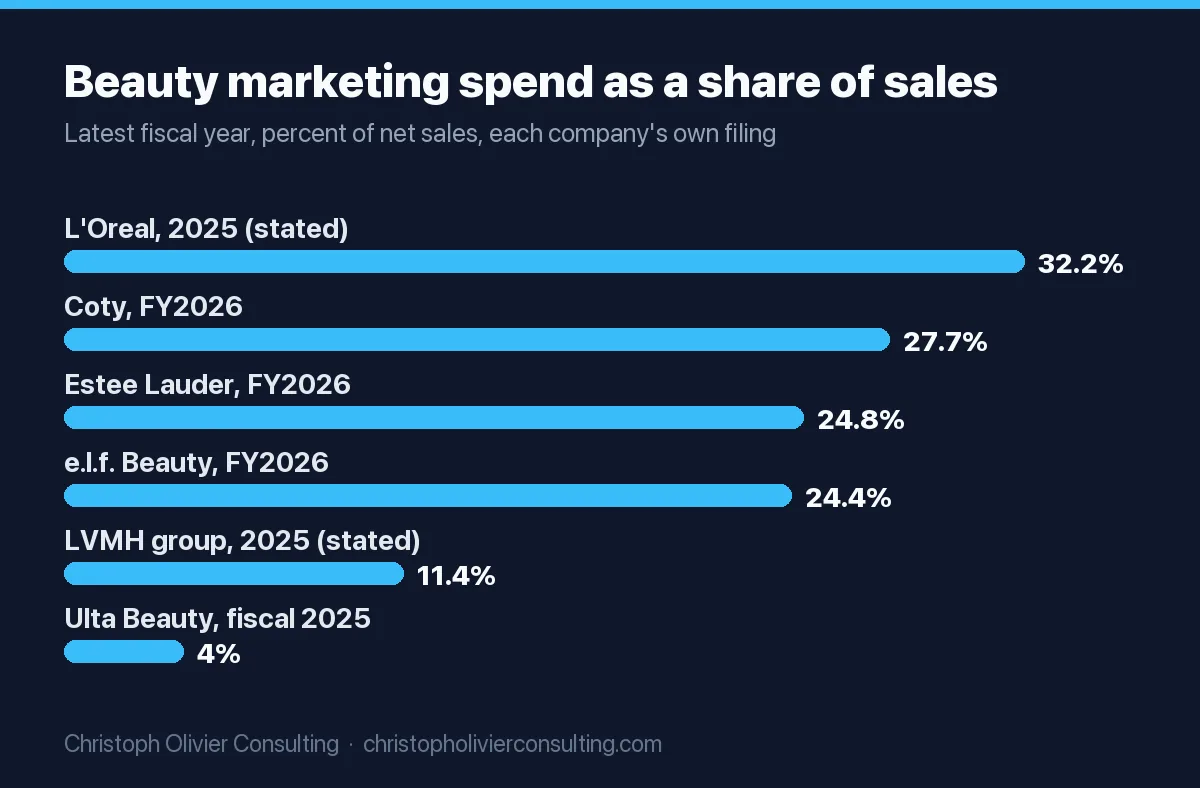
The Estée Lauder Companies spent $3,726 million on advertising, marketing, promotion and product development in the fiscal year that ended June 30, 2026, about 24.8% of its $15,049 million in net sales. e.l.f. Beauty spent $399.8 million on marketing and digital in the year to March 31, 2026, which the company puts at about 24% of net sales. Ulta Beauty spent $491.0 million on advertising in its fiscal 2025, only 4.0% of sales. Sephora does not publish a marketing budget at all.
Short answer: Estée Lauder: $3.73 billion (FY2026, 24.8% of net sales). e.l.f. Beauty: $399.8 million of marketing and digital (FY2026, about 24%), of which $361.3 million is advertising. Ulta Beauty: $491.0 million of advertising, net of vendor money (fiscal 2025, 4.0%). Coty: $1.61 billion of advertising and consumer promotion (FY2026, 27.7%). Sephora: not disclosed; parent LVMH reports only a group-wide 11.4%.
Every figure on this page comes from the company’s own annual filing, read on SEC EDGAR or the company’s investor site in November 2026. Each row names the exact line item, because “marketing budget” means something different in each filing. Percentages marked “calc.” are our own: disclosed spend divided by net sales from the same filing.
Beauty company marketing spend compared (latest fiscal year)
| Company | Fiscal year end | Exact line item in the filing | Spend (reported) | Net sales (same filing) | % of sales | Source |
|---|---|---|---|---|---|---|
| L’Oréal | Dec 31, 2025 | Advertising and promotion expenses | EUR 14,177.8 million | EUR 44,052.0 million | 32.2% (stated) | L’Oréal 2025 URD |
| Coty | Jun 30, 2026 | Advertising and consumer promotion costs | $1,607.1 million | $5,806.6 million | 27.7% (calc.) | Coty 10-K, FY2026 |
| Estée Lauder | Jun 30, 2026 | Global net advertising, marketing, promotion and product development expenses | $3,726 million | $15,049 million | 24.8% (calc.) | Estée Lauder 10-K, FY2026 |
| e.l.f. Beauty | Mar 31, 2026 | Total expenses for marketing and digital | $399.8 million | $1,636.5 million | about 24% (stated); 24.4% (calc.) | e.l.f. 10-K, FY2026 |
| LVMH (owner of Sephora) | Dec 31, 2025 | Advertising and promotion expenses, group-wide, stated only as a % of revenue | Not stated in euros | EUR 80,807 million (group) | 11.4% (stated, group) | LVMH 2025 Financial Documents |
| Ulta Beauty | Jan 31, 2026 (fiscal 2025) | Advertising expense, net (of vendor reimbursements) | $490,980 thousand | $12,392,820 thousand | 4.0% (calc.) | Ulta 10-K, fiscal 2025 |
Two reading notes. First, the euro figures are shown as filed. Where this page gives a dollar equivalent, it is our conversion at the Federal Reserve’s 2025 annual average of $1.1306 per euro (Fed G.5A), labeled each time. Second, the line items do not measure the same thing. Estée Lauder’s figure includes product development, L’Oréal’s includes beauty advisors, and Ulta’s is reduced by money its brand partners reimburse. The decoder table further down shows what sits inside each one.
How much does Estee Lauder spend on marketing? $3.73 billion (FY2026)
Estée Lauder’s fiscal 2026 10-K states that “global net advertising, marketing, promotion and product development expenses of $3,726 million, $3,643 million and $3,657 million in fiscal 2026, 2025 and 2024, respectively, are recorded in Selling, general and administrative expenses.” Net sales were $15,049 million, so the ratio was 24.8% (our calculation). That is the closest thing to a published Estee Lauder marketing budget. The company does not publish a separate media or advertising number.
Estee Lauder marketing budget by year
| Fiscal year (ends June 30) | Advertising, marketing, promotion and product development | Net sales | % of net sales (calc.) |
|---|---|---|---|
| FY2026 | $3,726 million | $15,049 million | 24.8% |
| FY2025 | $3,643 million | $14,326 million | 25.4% |
| FY2024 | $3,657 million | $15,608 million | 23.4% |
| FY2023 | $3,711 million | $15,910 million | 23.3% |
| FY2022 | $3,877 million | $17,737 million | 21.9% |
Sources: FY2024 to FY2026 from the FY2026 10-K; FY2022 and FY2023 from the FY2024 10-K, where the same line was called “advertising, merchandising, sampling, promotion and product development.” The wording changed in the FY2026 filing; the dollar series continues without a restatement.
The pattern is the useful part. Between FY2022 and FY2026 net sales fell 15.2% while this spend fell only 3.9% (our calculations), so the ratio climbed from 21.9% to 24.8%. That is deliberate. Under its “Beauty Reimagined” plan, launched in February 2025, the company says it is cutting overhead through a restructuring program targeting about $1,200 million of annual gross benefits, “a portion of which is expected to be reinvested in consumer-facing activities.”
Three things are not in the $3,726 million. Samples and testers are booked in cost of sales. Co-operative advertising paid to retailers is recorded as a reduction of revenue. And selling costs, which the 10-K groups with advertising and promotion as “consumer-facing” expenses, are reported separately. The true all-in cost of reaching an Estée Lauder customer is therefore higher than the headline line item, but the company does not publish that total. Research and development, by contrast, is disclosed separately at $278 million for FY2026.
Does Estee Lauder spend 75% of its marketing budget on influencers?
Not of the whole budget. The widely repeated “75%” comes from the August 2019 earnings call, when CEO Fabrizio Freda said “75% of our investment now is in digital social media influencers.” Tubefilter’s report makes clear the figure referred to digital marketing spend, not total marketing. Several headlines dropped the word “digital.” In February 2024 an Estée Lauder marketing executive told the eTail Palm Springs conference that about 90% of marketing spend now goes to digital channels, up from about 90% traditional a decade earlier, as Marketing Dive reported. Neither figure appears in a filing.
What is Estee Lauder’s marketing strategy?
The FY2026 10-K describes a “full-funnel” model with two halves. Broad reach media (print, television, out-of-home) builds awareness and brand equity, while performance and digital marketing, creator and influencer partnerships, search and retail media networks capture purchase intent. Hero products anchor each brand, and sampling, including gift-with-purchase, is called “a key promotional activity.” The newest element is a unified global media model with “a single global partner” buying media across markets, and explicit investment in visibility on search engines and “emerging LLMs.”
How much does e.l.f. spend on marketing? $399.8 million (FY2026)
e.l.f. Beauty’s fiscal 2026 10-K says: “Total expenses for marketing and digital in the fiscal year ended March 31, 2026 were $399.8 million, approximately 24% of our net sales.” Net sales were $1,636.5 million. A narrower line in the notes, advertising costs, was $361.3 million, or 22.1% of sales (our calculation). Use $399.8 million if you are asking about the elf marketing spend in total, and $361.3 million if you are comparing pure advertising.
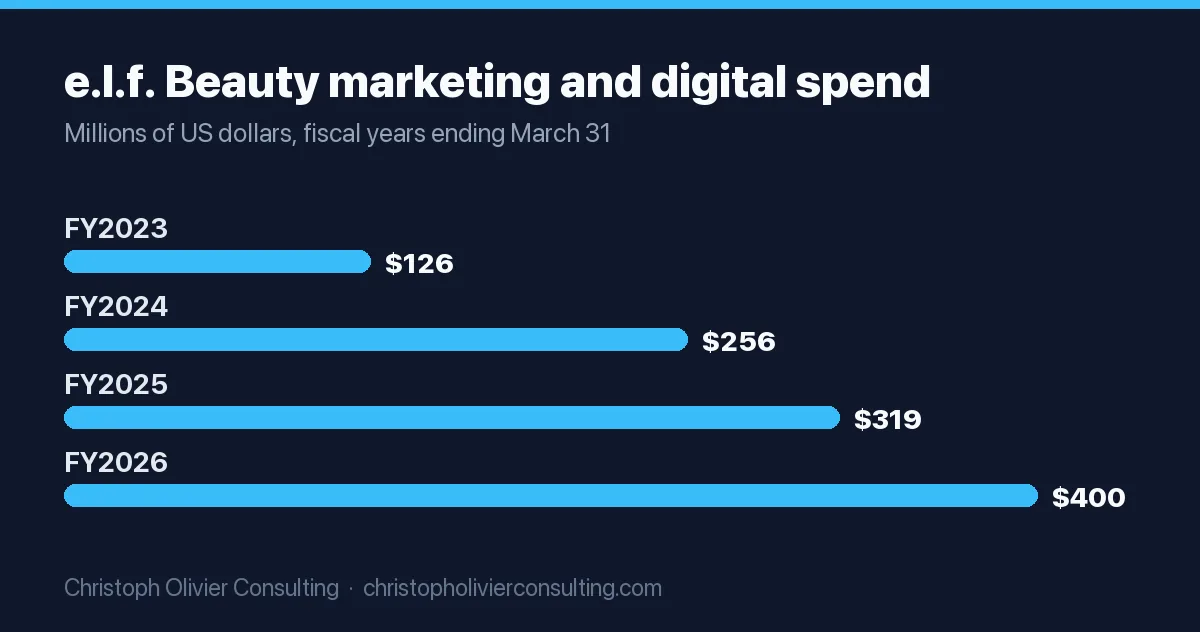
FY2026 is the first year that includes rhode, acquired on August 5, 2025. The 10-K says rhode contributed $293.5 million of the year’s sales growth and about 18% of consolidated net sales, so part of the jump in spend reflects a bigger company, not only a higher ratio.
Elf marketing spend by year
| Fiscal year (ends March 31) | Marketing and digital | Advertising costs (notes) | Net sales | Marketing and digital % of sales | Source |
|---|---|---|---|---|---|
| FY2026 | $399.8 million | $361.3 million | $1,636.5 million | about 24% (stated) | 10-K FY2026 |
| FY2025 | $318.8 million | $281.5 million | $1,313.5 million | about 24% (stated) | 10-K FY2025 |
| FY2024 | $256.0 million | $209.2 million | $1,023.9 million | about 25% (stated) | 10-K FY2024 |
| FY2023 | $126.0 million | $96.7 million | $578.8 million | about 22% (stated) | 10-K FY2023 |
| FY2022 | about $63.2 million (derived) | $41.0 million | $392.2 million | about 16% (calc.) | 10-K FY2024 |
The FY2022 marketing and digital figure is derived: the FY2024 10-K says FY2023 marketing and digital spend rose by $62.8 million, and $126.0 million minus $62.8 million is $63.2 million. Advertising costs for FY2022 and FY2023 come from e.l.f.’s tagged XBRL filing data on EDGAR; FY2024 to FY2026 appear in the FY2026 10-K text.
What is e.l.f. Cosmetics’ marketing strategy?
The 10-K calls it a “Disruptive Marketing Engine”: a “community-led and digitally-oriented approach” that reaches consumers “primarily through digital and social media, as compared to legacy beauty brands that engage consumers primarily through traditional media such as magazines, newspapers and television.” Two other details matter for anyone copying the model. e.l.f. says its flagship brand is the only top five mass cosmetics brand with its own direct-to-consumer site, and it uses that site and its Beauty Squad loyalty program to decide which products to rotate out of retail shelves each year. The marketing budget buys attention; the owned data decides the assortment.
Does elf own 100% of rhode?
Yes. The 10-K says that on completion of the merger, “rhode became a wholly owned subsidiary of e.l.f. Cosmetics, Inc.” and all of rhode’s LLC interests were cancelled and converted into the right to receive the consideration. The total purchase price was $897.5 million in cash, e.l.f. shares and a potential earnout capped at $200.0 million, payable on measurement periods ending September 30 of 2026, 2027 and 2028.
Ulta advertising budget: $491.0 million (fiscal 2025)
Ulta Beauty’s 10-K for the year ended January 31, 2026 reports “advertising expense, net” of $490,980 thousand, against net sales of $12,392,820 thousand. That is 4.0% of sales (our calculation), a sixth of the share Estée Lauder or e.l.f. spend. The 10-K defines the line as “print, digital and social media, television, and radio advertising, net of vendor income that is a reimbursement of specific, incremental, and identifiable costs.” In plain terms: when a brand pays Ulta to feature its products in an Ulta campaign, that money reduces Ulta’s reported advertising.
| Ulta fiscal year (ended) | Advertising expense, net | Net sales | % of sales (calc.) |
|---|---|---|---|
| Fiscal 2025 (Jan 31, 2026) | $491.0 million | $12,392.8 million | 4.0% |
| Fiscal 2024 (Feb 1, 2025) | $431.5 million | $11,295.7 million | 3.8% |
| Fiscal 2023 (Feb 3, 2024, 53 weeks) | $422.8 million | $11,207.3 million | 3.8% |
| Fiscal 2022 (Jan 28, 2023) | $374.7 million | $10,208.6 million | 3.7% |
Fiscal 2023 to 2025 advertising figures are in the fiscal 2025 10-K; fiscal 2022 and all net sales figures are from Ulta’s XBRL filing data on EDGAR. Fiscal 2025 sales include Space NK, the British beauty retailer whose acquisition Ulta announced on July 10, 2025.
Why so low? A retailer sells other companies’ brands, and those brands carry most of the product marketing. Ulta’s own levers are its loyalty program and its media network. The 10-K says Ulta Beauty Rewards had more than 46 million members at the end of fiscal 2025 and that about 95% of total sales came from members. Through UB Media, launched in 2022, brand partners buy advertising on Ulta’s owned channels. Ulta also says it is directing a growing share of marketing to digital, social and streaming, and runs an influencer class (UB Collective), an associate ambassador program and an affiliate program (UB Creates).
Sephora marketing budget: not disclosed
Sephora is owned by LVMH, which does not publish revenue, profit or marketing spend for Sephora alone. Sephora sits inside the Selective Retailing business group with DFS and Le Bon Marché. According to LVMH’s 2025 Financial Documents, Selective Retailing had revenue of EUR 18,348 million in 2025 (about $20.7 billion at the Fed’s 2025 average rate, our conversion) and profit from recurring operations of EUR 1,780 million, a 9.7% margin. The United States accounted for 45% of Selective Retailing revenue.
The only marketing number LVMH gives is group-wide: advertising and promotion expenses “amounted to 11.4% of revenue” across every LVMH Maison, from Louis Vuitton to its wines and spirits houses. Applying 11.4% to Selective Retailing would be a guess, not an estimate, because a retailer’s ratio behaves like Ulta’s 4%, not like a fashion house’s. So the honest answer to “what is Sephora’s marketing budget” is that nobody outside LVMH knows. What the filing does disclose about Sephora’s marketing: a community of 80 million active members, the “Sephoria” event tour (Milan, Shanghai, Paris, Dubai), the “We Belong to Something Beautiful” campaign with Haus Labs, and rhode’s launch, which LVMH calls “Sephora’s biggest-ever launch.” For the group-level picture, our breakdown of big brand marketing budgets covers LVMH alongside Nike and Coca-Cola.
Coty marketing spend: $1.61 billion (FY2026)
Coty (CoverGirl, Rimmel, Gucci and Hugo Boss fragrance licenses) reports “advertising and consumer promotion costs” of $1,607.1 million for the year to June 30, 2026, on net revenues of $5,806.6 million: 27.7% (our calculation), per its FY2026 10-K. It was $1,574.4 million (26.7%) in FY2025 and $1,625.5 million (26.6%) in FY2024. Coty is one of the few beauty companies that splits the figure by segment: Prestige spent $1,107.5 million (29.1% of its $3,805.8 million revenue) and Consumer Beauty $499.6 million (25.0% of $2,000.8 million). The total includes $111.6 million of depreciation on in-store marketing fixtures such as product displays, and the 10-K notes some licenses require minimum advertising spend.
Who is bigger, L’Oréal or Estée Lauder?
L’Oréal, by roughly three times. L’Oréal reported 2025 sales of EUR 44,052.0 million (about $49.8 billion at the Fed’s 2025 average, our conversion) against Estée Lauder’s $15,049 million for FY2026. On marketing the gap is wider: L’Oréal’s advertising and promotion was EUR 14,177.8 million (about $16.0 billion, our conversion), more than four times Estée Lauder’s $3,726 million. L’Oréal’s line includes beauty advisors, which Estée Lauder books in selling expense, so part of that gap is accounting. Our page on consumer goods advertising spend breaks L’Oréal down next to P&G and Unilever.
What company spends the most money on marketing in beauty?
Among companies that publish a figure, L’Oréal, at EUR 14.2 billion in 2025. Estée Lauder is second of the companies on this page at $3.73 billion, then Coty at $1.61 billion. By share of sales L’Oréal also leads at 32.2%, and every brand owner on this page spends between 24% and 33% of sales, against 4% for Ulta. For how beauty compares with other sectors, see the advertising to sales ratio by industry , which ranks industries by the same measure.
Challenger vs incumbent: what e.l.f. and Estee Lauder’s numbers teach
Here is the surprising result. e.l.f. and Estée Lauder now spend almost the same share of sales on marketing: 24.4% and 24.8% (our calculations). Estée Lauder spends 9.3 times as many dollars, on 9.2 times the sales. The ratio did not separate them. The trajectory and the mix did.
- Direction. From FY2023 to FY2026 e.l.f. grew its marketing and digital spend 3.2 times while net sales grew 2.8 times: spend led growth. From FY2022 to FY2026 Estée Lauder’s spend fell 3.9% while sales fell 15.2%: the ratio rose because sales shrank.
- Mix. e.l.f. says it reaches consumers primarily through digital and social. Estée Lauder’s 10-K still leads with broad reach media and calls sampling “a key promotional activity”, with marketing executives in the field working with beauty advisors and makeup artists at the counter. Those are costs a brand sold mainly online and in mass retail carries far less of.
- Ramp. e.l.f. went from about 16% of sales in FY2022 to about 25% in FY2024 in two years. That is a choice to fund awareness ahead of revenue.
In my view the lesson for a smaller brand is not “spend 24%.” It is that the ratio only works when the spend is compounding into something owned: e.l.f.’s loyalty data, Ulta’s 46 million members, Sephora’s 80 million. If you are building a beauty brand, our guide to beauty brand marketing covers the channel tactics, and the influencer marketing statistics page covers the creator side.
What each beauty marketing line item includes
Use this decoder before you compare any two rows. It is built from the definitions in each filing.
| Company | Includes | Excluded or booked elsewhere | Effect on comparison |
|---|---|---|---|
| L’Oréal | Advertising and promotion to customers and consumers, plus beauty advisors | Sales teams in SG&A | Reads high: counter staff are inside |
| Estée Lauder | Advertising, marketing, promotion and product development | Samples and testers (cost of sales); co-op advertising (reduces revenue); selling costs (separate) | Reads high on product development, low on samples and selling costs |
| Coty | Advertising and consumer promotion, incl. depreciation of displays | Trade spend with retailers (reduces revenue) | Closest to a pure “working media plus promotion” number |
| e.l.f. Beauty | Marketing and digital (advertising is $361.3m of the $399.8m) | Retail fixtures and visual merchandising (separate SG&A item) | Reads low versus brands that count displays as marketing |
| Ulta Beauty | Print, digital, social, TV and radio advertising | Vendor reimbursements subtracted; loyalty points are accounted for as deferred revenue | Reads low: brand partners fund part of it |
| LVMH / Sephora | Media, production, samples, catalogs and all brand promotion (group) | No Sephora figure at all | Not comparable at retailer level |
How to size a beauty marketing budget from these benchmarks
The filings give you three reference points, not one. Pick the one that matches your business model, then pressure-test it.
| If your business is… | Filing benchmark | Ratio | Worked example at $10M revenue |
|---|---|---|---|
| A brand in a growth push, digital-first (challenger) | e.l.f. marketing and digital, FY2024 to FY2026 | 22% to 25% | $2.2M to $2.5M |
| An established prestige brand defending share | Estée Lauder, Coty Prestige | 23% to 29% | $2.3M to $2.9M, incl. sampling and product development |
| A beauty retailer or marketplace | Ulta advertising, net | 3.7% to 4.0% | $370K to $400K, before vendor co-funding |
Copy-ready formula, the same one used for every calculated ratio on this page:
- Marketing % of sales = marketing spend ÷ net sales × 100. Example, Estée Lauder FY2026: $3,726 million ÷ $15,049 million × 100 = 24.8%.
- Budget = planned net sales × chosen ratio. Example: $10,000,000 × 24% = $2,400,000 a year, or $200,000 a month.
- Check the ceiling: gross margin minus marketing % must still leave room for overhead and profit. A brand with a 70% gross margin spending 24% keeps 46 points for everything else; a brand at 45% gross margin keeps 21.
- Define the line item before you benchmark. If your number excludes samples, gifts with purchase or retailer co-op, compare it with Coty or e.l.f., not L’Oréal.
The big companies spend from known brands and global scale. A new brand has neither, so treat the ratios as a ceiling to test, not a target. The general method for setting a figure is in our guide on how to set a marketing budget, and if you want a second opinion on your own split you can book a consultation.
Ready to scale your revenue?
Book a free 30-min consultation. We’ll diagnose your growth bottleneck and map out the 3 highest-leverage moves for your business.
Frequently asked questions
How much does Estee Lauder spend on marketing?
The Estee Lauder Companies reported global net advertising, marketing, promotion and product development expenses of $3,726 million for the fiscal year ended June 30, 2026, up from $3,643 million in fiscal 2025. On net sales of $15,049 million that is about 24.8%. Samples and testers are booked in cost of sales and co-op advertising reduces revenue, so neither is in that figure.
How much does elf spend on marketing?
e.l.f. Beauty's 10-K says total expenses for marketing and digital were $399.8 million in the fiscal year ended March 31, 2026, approximately 24% of its $1,636.5 million in net sales. Advertising costs alone were $361.3 million. The year includes rhode, acquired in August 2025. Marketing and digital spend was $126.0 million just three years earlier, in fiscal 2023.
What is Ulta's advertising budget?
Ulta Beauty reported advertising expense, net, of $491.0 million for fiscal 2025, the year ended January 31, 2026. That is about 4.0% of its $12.4 billion in net sales. The figure is net of vendor income that reimburses specific advertising costs, so brand partners fund part of Ulta's campaigns. It was $431.5 million the year before.
What is Sephora's marketing budget?
Sephora does not publish one. Its owner LVMH reports Sephora inside the Selective Retailing group, which had 2025 revenue of EUR 18,348 million, and states advertising and promotion only for the whole group: 11.4% of revenue. That group ratio is dominated by fashion and leather goods, so it should not be applied to Sephora as an estimate.
Who is bigger, L'Oreal or Estee Lauder?
L'Oreal, by roughly three times. It reported 2025 sales of EUR 44,052 million, about $49.8 billion at the Federal Reserve's 2025 average rate, against Estee Lauder's $15,049 million for fiscal 2026. L'Oreal's advertising and promotion expenses of EUR 14,178 million, 32.2% of sales, are more than four times Estee Lauder's $3,726 million.
Does elf own 100% of rhode?
Yes. e.l.f. Beauty's fiscal 2026 10-K says that when the merger closed on August 5, 2025, rhode became a wholly owned subsidiary of e.l.f. Cosmetics, Inc. The purchase price was $897.5 million in cash, e.l.f. stock and a potential earnout capped at $200 million. rhode made up about 18% of e.l.f.'s fiscal 2026 net sales.
What percentage of sales do beauty companies spend on marketing?
Brand owners spend roughly a quarter to a third of sales, based on their latest filings: L'Oreal 32.2%, Coty 27.7%, Estee Lauder 24.8% and e.l.f. about 24%. Retailers spend far less on their own advertising: Ulta's net advertising was 4.0% of sales in fiscal 2025, because brand partners fund much of the product marketing.
What big companies spend on marketing