

Adidas spent €3,079 million on marketing and point-of-sale in 2025, 12.4% of its €24,811 million in sales, the biggest disclosed marketing budget in this group after Nike. Lululemon reported $617.5 million of advertising expense in fiscal 2025, Under Armour $502.3 million of marketing and advertising in the year to March 2026, On CHF 376.5 million and Deckers’ HOKA brand $263.1 million. Puma reports a wider “marketing/retail” line of €1,607.9 million that also carries the cost of its own stores.
Short answer: Adidas: €3,079 million (2025, 12.4% of sales), and €2,513 million in the first nine months of the 2026 World Cup year. Lululemon: $617.5 million of advertising (fiscal 2025, 5.6% of revenue). Under Armour: $502.3 million (fiscal 2026, 10.1%). Puma: €1,607.9 million of marketing/retail including own-store costs (2025). Nike, for comparison, spent $4,754 million on “demand creation” and has about $15.5 billion of athlete and team endorsement obligations on its books.
Every figure below comes from the company’s own annual report, 10-K or 20-F, read on SEC EDGAR or the company’s investor site in November 2026. Currencies stay as reported, so adidas and Puma are in euros and On is in Swiss francs. I have not converted them to dollars, because the percentage of revenue is the number that compares fairly across currencies.
Athletic brand marketing budgets compared (latest fiscal year)
Spend and revenue in each row come from the same filing. The percentage column is my calculation with one formula: marketing as % of revenue = reported marketing line ÷ total revenue × 100. Worked example, Lululemon fiscal 2025: $617.5 million ÷ $11,102.6 million × 100 = 5.6%.
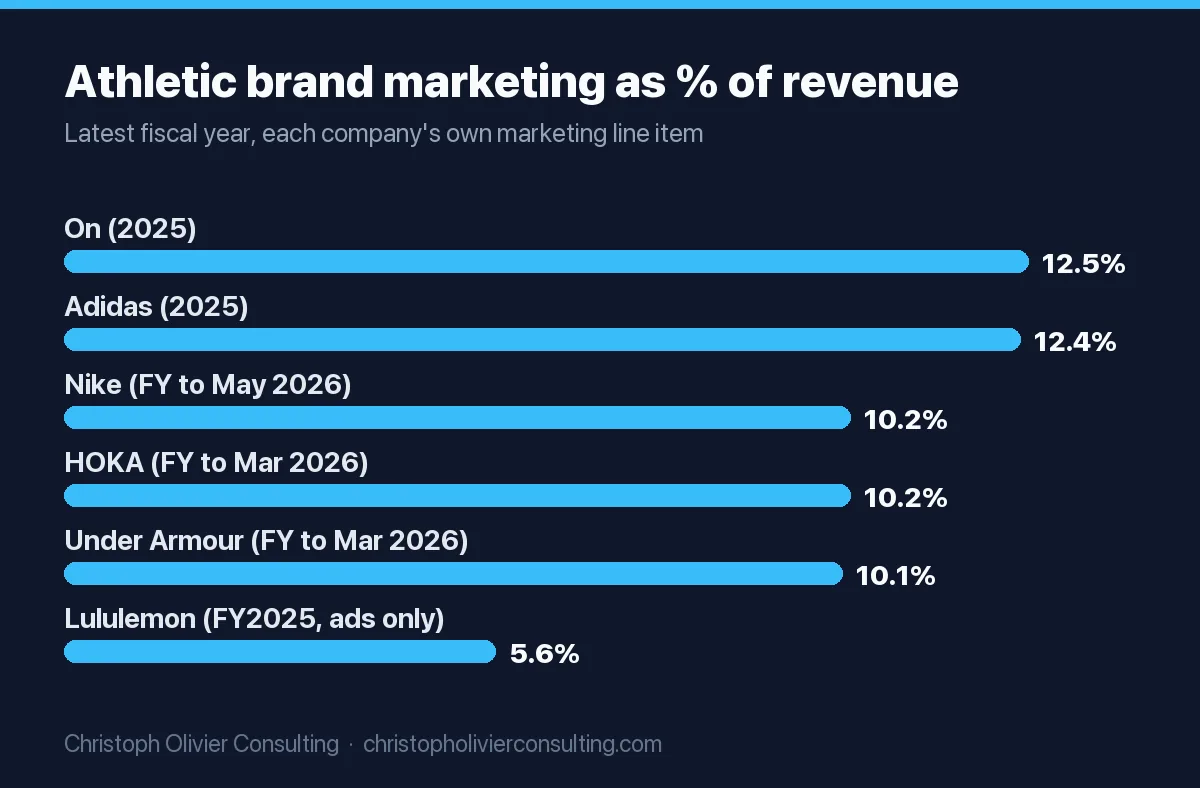
| Brand | Exact line item in the filing | Fiscal year end | Spend (reported) | Revenue (same filing) | % of revenue | Source |
|---|---|---|---|---|---|---|
| Adidas | “Marketing and point-of-sale expenses” | Dec 31, 2025 | €3,079 million | €24,811 million | 12.4% (company-stated) | adidas Annual Report 2025 |
| Puma | “Marketing/retail” (includes own retail store costs) | Dec 31, 2025 | €1,607.9 million | €7,296.2 million | 22.0% (company states 23.3% on an adjusted basis) | PUMA Annual Report 2025 |
| Lululemon | “Advertising expenses” | Feb 1, 2026 | $617.5 million | $11,102.6 million | 5.6% | Lululemon 10-K, fiscal 2025 |
| Under Armour | “Marketing and advertising costs” (includes athlete and team sponsorships) | Mar 31, 2026 | $502.3 million | $4,966.4 million | 10.1% (company-stated) | Under Armour 10-K, fiscal 2026 |
| On (On Holding) | “Marketing expenses” | Dec 31, 2025 | CHF 376.5 million | CHF 3,014.0 million | 12.5% (company-stated) | On Holding 20-F, 2025 |
| HOKA (Deckers) | “Advertising, marketing, and promotion expenses”, HOKA segment | Mar 31, 2026 | $263.1 million | $2,587.3 million (HOKA net sales) | 10.2% | Deckers 10-K, fiscal 2026 |
| Nike (reference) | “Demand creation expense” | May 31, 2026 | $4,754 million | $46,398 million | 10.2% | Nike 10-K, fiscal 2026 |
Nike’s full breakdown, including its regional demand creation split, is in our big brand marketing budgets comparison, so this page does not repeat it.
What each marketing line actually includes
“Marketing budget” means something different in every one of these filings. This is the single biggest reason third-party summaries disagree. Before you compare two brands, check what sits inside the line:
| Brand | Athlete and team deals inside? | Media and digital ads inside? | Store and point-of-sale costs inside? | What the filing says is in the line |
|---|---|---|---|---|
| Adidas | Yes | Yes | Yes, point-of-sale and store fittings | Promotion contracts, advertising, events and other communication; marketing overhead is excluded and sits in distribution and selling expenses |
| Puma | Yes | Yes | Yes, including its own retail activities | Advertising and promotional expenses plus expenses of the group’s own retail activities |
| Under Armour | Yes | Yes | Yes, displays, concept shops and fixture depreciation | Sports and brand marketing (professional, club and collegiate sponsorships, athlete and influencer agreements), media and retail presentation |
| On | Yes, sponsorship costs | Yes | Product display only | Advertising and promotions, trade shows and events, sponsorship, consultants, marketing travel, product display and overhead |
| Deckers (HOKA) | Not named | Yes | Point-of-sale materials | Media advertising (television, radio, print, social, digital), tactical advertising (signs, banners, point-of-sale materials) and other promotional costs |
| Lululemon | Not named | Yes | No | Advertising costs, including the cost to produce advertising; a separate “brand and community” cost sits in head office expenses |
| Nike | Yes, endorsement contracts | Yes | Yes, retail brand presentation | Brand marketing plus sports marketing (endorsements, complimentary product, sports events) |
The practical rule: compare adidas, Under Armour, On and Nike with each other, because all four include athlete and team deals. Treat Lululemon’s figure as a floor, since it covers advertising only. Treat Puma’s as a ceiling, since it carries store costs that the others book elsewhere.
Adidas marketing budget: €3,079 million in 2025 (12.4% of sales)
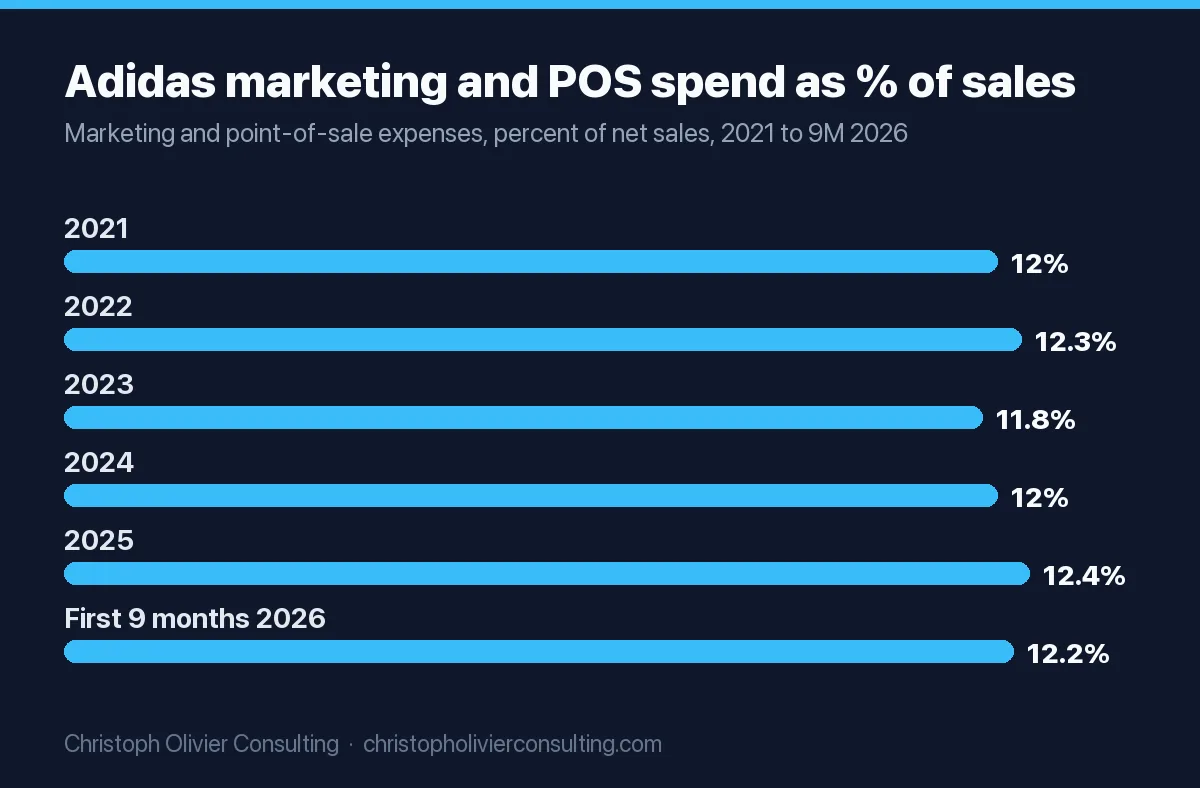
Adidas’ 2025 financial review reports that marketing and point-of-sale expenses rose 8% to €3,079 million from €2,841 million in 2024. As a share of sales the line went from 12.0% to 12.4%. The report names what the money bought: the multi-year “You Got This” brand campaign, “The Original” campaign for Originals shoes, launches such as the Evo SL, the Superstar, the FIFA World Cup 2026 home kits and the official match ball, and new or extended partnerships with the Audi F1 team, Penn State, the Argentine Football Federation and Anthony Edwards.
The notes to the income statement define the line as promotion and communication spending, “such as promotion contracts, advertising, events, and other communication activities.” Salaries of the marketing team are not in it. The glossary in the annual report adds that point-of-sale investment includes store fittings and furniture.
Over five years the ratio has stayed in a narrow band: 12.0% in 2021, 12.3% in 2022, 11.8% in 2023, 12.0% in 2024 and 12.4% in 2025, per the same financial review. That stability looks deliberate: the Q3 2026 results say the full-year 2026 ratio is planned to land below 2025’s 12.4%, even in a World Cup year.
Adidas advertising budget in the 2026 World Cup year
The World Cup quarter shows what a peak looks like. In the first-half 2026 report, second-quarter marketing and point-of-sale spend jumped 29.8% to €924 million (13.7% of sales) from €712 million (12.0%). The Q3 2026 results then show spend “normalizing as planned”: €833 million in the quarter, 11.5% of sales, down from 12.0% a year earlier.
For the first nine months of 2026, adidas has spent €2,513 million, up 11% from €2,255 million, or 12.2% of sales. The company says it plans to finish the full year below 2025’s 12.4%. That pattern (front-load around the tournament, then pull back) is the cleanest public example of event-driven marketing budgeting you will find.
Adidas sponsorship commitments: €7,897 million
Adidas also discloses what it has already signed. At the end of 2025, its financial commitments for promotion and advertising stood at €7,897 million, down 3% from €8,122 million, per the off-balance-sheet section of the 2025 financial review. Those are future payments under team, federation and athlete contracts, not a single year’s spend.
How much does Lululemon spend on marketing? $617.5 million in advertising (fiscal 2025)
Lululemon does publish a number, contrary to several pages that say it is unknown. Its 10-K for the fiscal year ended February 1, 2026 lists “Advertising expenses” inside a short table of costs included in selling, general and administrative expenses:
| Fiscal year (Lululemon label) | Year end | Advertising expenses | Net revenue | % of revenue (my calculation) |
|---|---|---|---|---|
| 2025 | Feb 1, 2026 | $617.5 million | $11,102.6 million | 5.6% |
| 2024 (53 weeks) | Feb 2, 2025 | $541.5 million | $10,588.1 million | 5.1% |
| 2023 | Jan 28, 2024 | $429.7 million | $9,619.3 million | 4.5% |
Advertising grew 44% over two years while revenue grew 15% (my calculation from the table). The 10-K explains part of the 2025 jump: “an increase in digital marketing expenses of $49.0 million” in its operating channels, plus a $7.8 million rise in “brand and community expenses” in head office costs. The strategy section describes a mix of owned and paid channels, an ambassador network, events and content, with “carefully sourced creators” on social channels.
Two cautions. First, 5.6% looks low next to adidas or On partly because Lululemon’s line covers advertising only; the 10-K reports brand and community costs separately, inside head office costs, without a total. Second, its fiscal year ends in late January or early February, so “fiscal 2025” is mostly calendar 2025.
Under Armour marketing budget: $502.3 million (fiscal 2026)
Under Armour’s 10-K for the year ended March 31, 2026 states that marketing and advertising costs, including amortization of in-store marketing fixtures and displays, were $502.3 million, down from $549.9 million in fiscal 2025 and $568.5 million in fiscal 2024. As a share of revenue the company reports 10.1%, down from 10.6%; fiscal 2024 works out to 10.0% on $5,701.9 million of revenue (my calculation). The 10-K attributes the drop to “a decrease in marketing activities during the period.”
Under Armour also splits its marketing budget by region in the segment note:
| Under Armour segment, fiscal 2026 | Marketing and advertising costs | Segment net revenues | % of segment revenue (my calculation) |
|---|---|---|---|
| North America | $212.7 million | $2,859.4 million | 7.4% |
| EMEA | $123.9 million | $1,180.5 million | 10.5% |
| Asia-Pacific | $77.0 million | $719.1 million | 10.7% |
| Latin America | $9.5 million | $234.2 million | 4.1% |
| Corporate Other | $79.2 million | n/a | n/a |
| Total | $502.3 million | $4,966.4 million | 10.1% |
The same filing shows Under Armour’s fixed sponsorship pipeline: $248.8 million of future minimum payments under sponsorship and other marketing agreements as of March 31, 2026, with $65.6 million due in fiscal 2027. That figure excludes performance bonuses and free product. Restructuring charges for the year included $69.7 million of non-cash contract termination costs, “primarily relating to the separation of the Curry Brand.”
Puma marketing budget: €1,607.9 million in marketing/retail (2025)
Puma’s ten-year overview in the 2025 annual report lists marketing/retail expenses of €1,607.9 million in 2025, down from €1,736.4 million in 2024, on consolidated sales of €7,296.2 million (down 13.1%). The income statement notes say that in addition to advertising and promotional expenses, the line “also include[s] expenses associated with the Group’s own retail activities.” So it is not a pure marketing budget.
The results of operations section gives the adjusted view: adjusted marketing/retail expenses fell €34.0 million, or 2.0%, and the adjusted ratio rose to 23.3% of sales from 20.7%, because sales fell faster than spend. Puma itself says marketing as a share of sales rose “due to the decline in sales.” The ten-year table and the adjusted text do not reconcile exactly, so quote either €1,607.9 million (table) or 23.3% (adjusted ratio) and name which one you used.
Puma’s signed commitments are in note 27: €2,731.6 million under license, promotional and advertising agreements, of which €479.7 million is due within one year, €1,371.6 million in one to five years and €880.2 million after five years. The note adds that contracts pay extra for medals and championships, amounts that cannot be predicted.
On Running marketing budget: CHF 376.5 million (2025)
On Holding, the Swiss maker of On running shoes, files a 20-F with the SEC. Its 2025 20-F reports marketing expenses of CHF 376.5 million, up 36.1% from CHF 276.6 million, on net sales of CHF 3,014.0 million. That is 12.5% of sales, up from 11.9%, the highest ratio in this group apart from Puma’s wider marketing/retail line. The filing credits “upper funnel brand building initiatives and brand partnerships” and says On intends to keep increasing marketing expenses. In the fourth quarter alone, marketing ran at 14.5% of sales.
HOKA marketing budget: $263.1 million (Deckers fiscal 2026)
Deckers Brands, which owns HOKA and UGG, reports advertising, marketing and promotion by brand. Its 10-K for the year ended March 31, 2026 shows HOKA at $263.1 million on $2,587.3 million of net sales (10.2%), up from $226.2 million on $2,233.1 million (10.1%) a year earlier. UGG spent $215.4 million on $2,738.8 million (7.9%). The company total was $495.8 million, 9.1% of $5,472.3 million in net sales (percentages are my calculations).
How much does Nike spend on athlete endorsements?
Nike does not publish an annual endorsement expense. Endorsements sit inside “sports marketing”, which is one half of the $4,754 million demand creation line in its fiscal 2026 10-K. What Nike does disclose is the size of its contracts: as of May 31, 2026, it had endorsement contract obligations, including associated marketing commitments, of about $15.5 billion, with about $1.7 billion payable within 12 months. The 10-K describes these as base compensation and minimum guaranteed royalties owed to athlete, public figure, sport team and league endorsers, and warns actual payments can be higher (performance bonuses, royalties) or lower (reduced payments if performance declines). Free product is on top. The 10-K also says demand creation rose 1% in fiscal 2026 “due to higher sports marketing expense”, partly offset by lower brand marketing.
Here is how the signed sponsorship pipelines compare. These are commitments for future years, not annual budgets:
| Brand | What is disclosed | As of | Total committed | Due within about 12 months | Source |
|---|---|---|---|---|---|
| Nike | Endorsement contract obligations incl. associated marketing commitments | May 31, 2026 | About $15.5 billion | About $1.7 billion | Nike 10-K |
| Adidas | Financial commitments for promotion and advertising | Dec 31, 2025 | €7,897 million | Not stated in the management report | adidas Annual Report 2025 |
| Puma | License, promotional and advertising agreements | Dec 31, 2025 | €2,731.6 million | €479.7 million | PUMA Annual Report 2025, note 27 |
| Under Armour | Sponsorship and other marketing agreements (minimums) | Mar 31, 2026 | $248.8 million | $65.6 million | Under Armour 10-K |
Single-athlete contract values that circulate online are press reports or estimates; none of these filings names what any individual athlete is paid. For the wider sponsorship market, see our sports sponsorship statistics.
Who spends more on marketing, Nike or Adidas?
Nike, in absolute terms. Nike’s demand creation of $4,754 million in fiscal 2026 came on $46,398 million of revenue. Adidas’ €3,079 million in 2025 came on €24,811 million. As a share of revenue, adidas spends more: 12.4% against Nike’s 10.2%. Both lines include athlete and team deals, so this is one of the few fair comparisons in the category, with the caveat that the fiscal years end five months apart and the currencies differ.
What a growing athletic or apparel brand can take from these numbers
Public brands cluster in a clear band: roughly 10% to 12.5% of revenue when athlete deals are included, and about 5.6% when the line is paid advertising only. A founder-led brand at $2 million to $20 million in revenue should not copy those ratios blindly, because a public company is defending awareness it already has. But they make a useful sanity check for a plan, alongside the cross-industry data in our marketing budget benchmarks and advertising-to-sales ratios by industry.
Copy-ready worksheet. Replace the revenue figure with your own:
- Floor (paid advertising only), Lululemon ratio: revenue × 5.6%. At $5,000,000 revenue: $5,000,000 × 0.056 = $280,000.
- Mid case (ads plus athlete or creator deals), Under Armour, HOKA and Nike ratios: revenue × 10.1% to 10.2%. At $5,000,000: $505,000 to $510,000.
- Growth push, On and adidas ratios: revenue × 12.4% to 12.5%. At $5,000,000: $620,000 to $625,000.
- Event spike, adidas World Cup quarter: plan one quarter at about 1.7 points above your normal ratio (adidas went from 12.0% to 13.7% in Q2 2026), then pull back the next quarter.
- Commitments check: add up every signed ambassador, team or creator contract for the next 12 months. Under Armour’s next-year minimums ($65.6 million) are about 13% of its annual marketing line (my calculation). If your signed deals already eat more than a third of next year’s budget, you have little room to react.
If ambassadors or creators are the lever you are weighing, our influencer marketing strategy guide covers how to structure those deals, and how to set a marketing budget walks through the full method. In my view the more useful lesson from this data is adidas’ discipline: a fixed ratio target, deliberately exceeded for one event, then paid back. If you want a second pair of eyes on your own plan, you can book a consultation.
Where to find each brand’s marketing figure yourself
Each company updates its number once a year. Search these exact phrases in the filing:
| Brand | Document | Search phrase | Next full-year update (based on 2026 filing dates) |
|---|---|---|---|
| Adidas | Annual Report, financial review (report.adidas-group.com) | “Marketing and point-of-sale expenses” | Annual report for 2026, early 2027 |
| Puma | Annual Report, ten-year overview and results of operations (annual-report.puma.com) | “Marketing/retail” | Annual report for 2026, early 2027 |
| Lululemon | Form 10-K on SEC EDGAR | “Advertising expenses” | Fiscal 2026 10-K, March 2027 |
| Under Armour | Form 10-K on SEC EDGAR | “Marketing and advertising costs” and “Sports Marketing and Other Commitments” | Fiscal 2027 10-K, May 2027 |
| On | Form 20-F on SEC EDGAR | “Marketing expenses” | 2026 20-F, early 2027 |
| Deckers (HOKA, UGG) | Form 10-K on SEC EDGAR | “Advertising, marketing, and promotion expenses” | Fiscal 2027 10-K, May 2027 |
| Nike | Form 10-K on SEC EDGAR | “Demand creation expense” and “Endorsement Contracts” | Fiscal 2027 10-K, July 2027 |
For a similar filing-by-filing breakdown of store chains, see retail advertising spend for Walmart, Target and Home Depot.
Ready to scale your revenue?
Book a free 30-min consultation. We’ll diagnose your growth bottleneck and map out the 3 highest-leverage moves for your business.
Frequently asked questions
What is the adidas marketing budget?
Adidas reported marketing and point-of-sale expenses of €3,079 million in 2025, up 8% from €2,841 million in 2024, according to its 2025 Annual Report. That was 12.4% of net sales of €24,811 million. The line covers promotion contracts with teams and athletes, advertising, events and point-of-sale investment; marketing staff costs are booked elsewhere.
What is the adidas advertising budget in the 2026 World Cup year?
In the first nine months of 2026 adidas spent €2,513 million on marketing and point-of-sale, 12.2% of sales and 11% more than a year earlier. The World Cup quarter peaked at €924 million (13.7% of sales) in Q2, then spending normalized to €833 million in Q3. Adidas plans a full-year ratio below 2025's 12.4%.
How much does Lululemon spend on marketing?
Lululemon's 10-K reports advertising expenses of $617.5 million for fiscal 2025 (year ended February 1, 2026), up from $541.5 million in fiscal 2024 and $429.7 million in fiscal 2023. On net revenue of $11,102.6 million that is about 5.6%. The figure covers advertising only; brand and community costs are reported separately within head office expenses.
What is the Under Armour marketing budget?
Under Armour spent $502.3 million on marketing and advertising in fiscal 2026, the year ended March 31, 2026, down from $549.9 million the year before. That is 10.1% of $4,966.4 million in revenue. The line includes athlete, team and collegiate sponsorships, media and in-store presentation. North America accounted for $212.7 million of it.
What is the Puma marketing budget?
Puma's 2025 Annual Report lists marketing/retail expenses of €1,607.9 million, down from €1,736.4 million, on sales of €7,296.2 million. This line also includes the cost of Puma's own retail activities, so it is wider than a pure marketing budget. On an adjusted basis Puma states the ratio at 23.3% of sales, up from 20.7% as sales fell.
How much does Nike spend on athlete endorsements?
Nike does not disclose a yearly endorsement expense; it sits inside its $4,754 million fiscal 2026 demand creation line. Its 10-K does disclose endorsement contract obligations of about $15.5 billion as of May 31, 2026, with about $1.7 billion payable within 12 months, covering base pay and minimum royalties to athletes, teams and leagues. Bonuses and free product come on top.
What percentage of revenue do athletic brands spend on marketing?
In the latest filings the range is roughly 10% to 12.5% when athlete deals are included: Under Armour 10.1%, HOKA 10.2%, Nike 10.2%, adidas 12.4% and On 12.5%. Lululemon's advertising-only line is 5.6%. Puma's marketing/retail line, which includes its own stores, is 22% to 23% of sales.
What big companies spend on marketing