

A solo private practice therapist typically nets about $66,000 to $71,000 a year before income tax. That is the 2025 median and mean net income for sole proprietors in Heard’s anonymized bookkeeping data from therapy practices in all 50 states, earned on median revenue of $91,178. Practices organized as S corporations, which include most group practices, reported a median net income of $94,307 and a mean of $115,250. Owners of larger group practices can earn more, but the federal data shows most practices stay small.
Short answer: Most private practice therapists net $66,000 to $115,000 a year before income tax, as reported by Heard for 2025 (solo median $66,084, S corp mean $115,250). In Heard’s 2025 survey of 3,229 therapists, 86% netted under $100,000. My own calculation shows a full-time solo therapist at 25 sessions a week and $122 to $157 a session netting about $113,000 to $153,000 before taxes.
Below are the primary datasets: IRS tax returns, Census Bureau business counts, BLS wages for employed therapists, 2026 Medicare rates and Heard’s practice data. Then comes a caseload-by-fee income table you can check against your own numbers, plus a worked P&L for a group practice owner. Anything I calculated is labeled “my calculation” with its assumptions.
How much does a private practice therapist make? What each data source says
The numbers you see online range from $30,000 to $250,000 because each source counts a different group. Check the “who is counted” column before you compare yourself to any one figure.
| Source and period | Who is counted | Revenue | Net income (owner’s pre-tax profit) |
|---|---|---|---|
| IRS Statistics of Income, Table 1, tax year 2023 | All 328,355 Schedule C returns for offices of mental health practitioners and social therapists, including part-time and side practices | $58,579 average (my calculation) | $29,827 average; 50.9% of receipts (my calculation) |
| Same IRS table | The 258,846 returns (78.8%) that showed a profit | $69,193 average (my calculation) | $40,191 average; 58.1% of receipts (my calculation) |
| Census Nonemployer Statistics, 2022, NAICS 62133 | 206,610 mental health practices with no paid employees | $55,064 average (my calculation) | Not reported |
| Heard customer data, 2025 | Sole proprietors and 1099 therapists using Heard’s bookkeeping | $91,178 median, $98,095 mean | $66,084 median, $70,696 mean (72.1% margin) |
| Same Heard data, 2025 | Practices taxed as S corporations (larger and group practices) | $143,646 median, $179,003 mean | $94,307 median, $115,250 mean (64.4% margin) |
| Census Statistics of U.S. Businesses, 2022, NAICS 621330 | 38,819 mental health practice firms with at least one employee | $538,125 average per firm (my calculation) | Not reported |
How to read this:
- The IRS figures are low because they include everyone. A clinician with a full-time agency job who sees four private clients on Saturdays files the same Schedule C as a full-time solo therapist. That is why average receipts are only $58,579. The IRS category also groups therapists with other “social therapists,” and it leaves out S corporations and partnerships.
- Heard’s numbers are the closest match to an established practice, but they come from the company’s own customers, people who pay for bookkeeping, not a random sample. Treat them as typical for organized, full-time practices. Heard does not say whether S corp owners’ W-2 salaries are inside or outside the “net income” figure, so compare the S corp row with care.
- Employer practices are a different business. Only 16.5% of mental health practice locations had employees in 2022, but they collected 64.7% of the receipts (my calculation from the two Census files).
How much do private practice therapists really take home?
Averages hide the spread. Heard’s 2025 Financial State of Private Practice survey asked 3,229 therapists what they netted in 2024. Nearly half (49%) reported under $50,000 and 86% reported under $100,000. Only about 3.8% netted $150,000 or more.
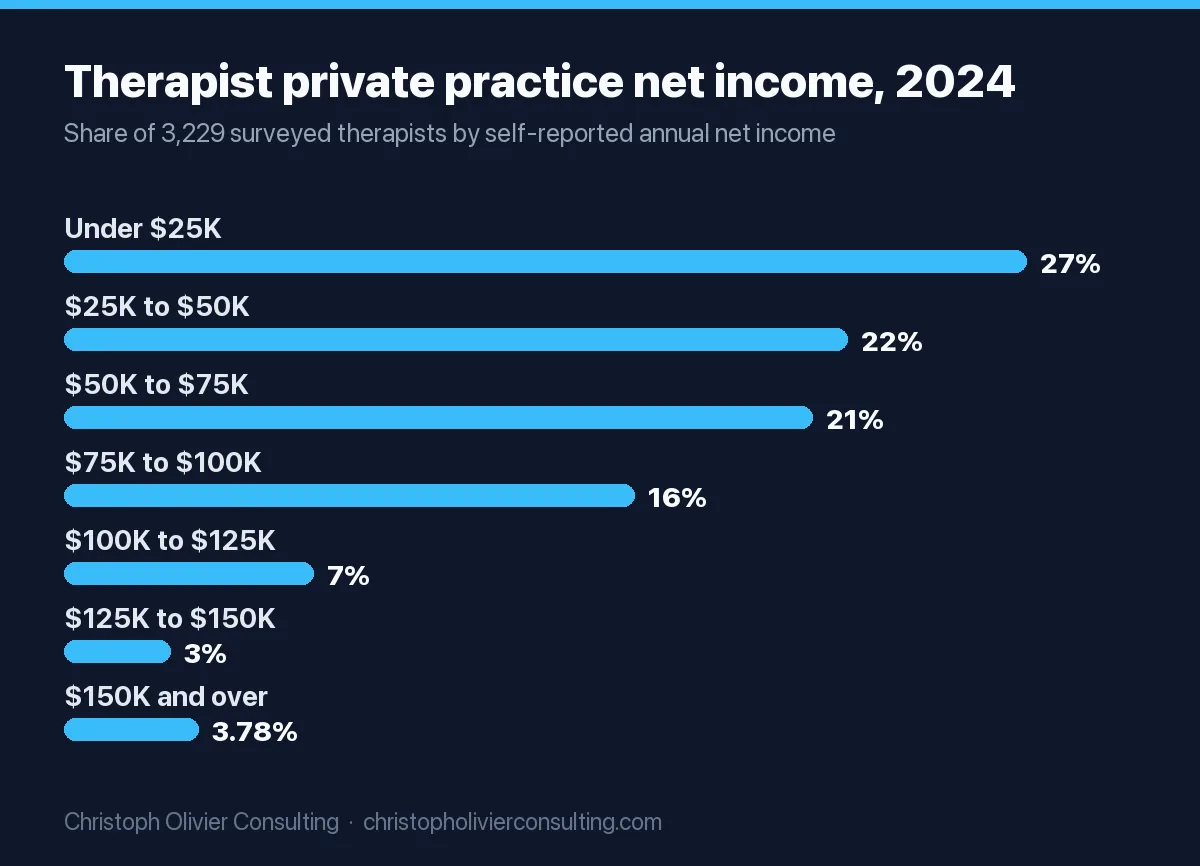
Two cautions. First, the survey includes part-time practices, which pulls the bottom bands up. Second, it is self-reported net income, so it is before income tax but after business expenses, and some respondents will have counted it differently. Read it next to the Heard customer data above, which comes from actual books.
Private practice therapist salary vs employed therapist pay
There is no “salary” for a practice owner: you keep what is left after expenses. The fair comparison is what the same license earns as an employee. The Bureau of Labor Statistics Occupational Outlook Handbook reports these May 2025 medians for employed workers only. Self-employed owners are excluded from BLS wage figures.
| License | BLS occupation | Median wage, all employers (May 2025) | Median in offices of other health practitioners | Self-employed share of jobs |
|---|---|---|---|---|
| Psychologist (PhD, PsyD) | Clinical and counseling psychologists | $100,580 | Not published (ambulatory health care: $98,590, all psychologists) | 23% of all psychologists |
| LMFT | Marriage and family therapists | $66,940 | $64,430 | 11% |
| LPC / LMHC | Substance abuse, behavioral disorder and mental health counselors | $59,350 | $58,240 | Not in the top five employers listed |
| LCSW | Mental health and substance abuse social workers | $60,280 | Not published (ambulatory health care: $63,710, all social workers) | Not in the top five employers listed |
Put next to Heard’s solo median of $66,084 net, the picture is clear: for a master’s-level clinician, a typical solo practice pays about what a staff job pays, before you subtract the self-employment tax and benefits an employer would otherwise cover. The upside is the right tail. A full-time, well-filled practice can pass $100,000. On salary, BLS puts the top 10% of employed counselors above $97,590 and the top 10% of MFTs above $123,730.
What insurance and Medicare pay per session in 2026
Your rate per session is the biggest single input. Commercial insurers do not publish their therapy fee schedules, so the public benchmark is Medicare. Here are the 2026 national amounts from the CMS physician fee schedule relative value file (RVU26D, October 2026), non-facility setting, using the $33.4009 conversion factor.
| CPT code | Service | Non-facility RVUs | Psychologist, 2026 national | LPC, LMFT, LCSW (75%) |
|---|---|---|---|---|
| 90791 | Diagnostic evaluation (intake) | 5.19 | $173.35 | $130.01 |
| 90837 | Psychotherapy, 60 minutes | 5.00 | $167.00 | $125.25 |
| 90834 | Psychotherapy, 45 minutes | 3.41 | $113.90 | $85.42 |
| 90832 | Psychotherapy, 30 minutes | 2.57 | $85.84 | $64.38 |
| 90847 | Family psychotherapy with patient, 50 minutes | 3.28 | $109.55 | $82.17 |
| 90853 | Group psychotherapy (per patient) | 0.91 | $30.39 | $22.80 |
Dollar amounts are my calculation (RVUs times conversion factor) before the geographic adjustment that raises or lowers payment by locality. The 75% column applies because CMS pays marriage and family therapists and mental health counselors 75% of the clinical psychologist amount (since January 1, 2024), and Social Security Act section 1833(a)(1)(F) sets the same 75% for clinical social workers.
For commercial and cash rates, the best available benchmark is again Heard. Its 2024 survey report put the average individual session fee in 2023 at $157 and the average insurance reimbursement at $122, and found 73% of respondents accepted some insurance. Heard also reported Aetna as the highest-paying insurer in its data at $141 an hour and Humana the lowest at $96 an hour. Notice the gap: on a 60-minute session, the Medicare 90837 amount for a psychologist ($167.00) is above the average cash fee, while the counselor rate ($125.25) sits near the commercial average.
Private practice therapist income by caseload and fee (own calculation)
This table answers the question most therapists are actually asking: if I see this many clients at this rate, what do I keep? It is my calculation, not survey data. The assumptions are listed under the table so you can swap in your own.
| Weekly sessions held | Revenue at $122 (avg insurance) | Net at $122 | Revenue at $157 (avg cash fee) | Net at $157 | Revenue at $200 (illustrative) | Net at $200 |
|---|---|---|---|---|---|---|
| 15 | $84,180 | $56,784 | $108,330 | $80,934 | $138,000 | $110,604 |
| 20 | $112,240 | $84,844 | $144,440 | $117,044 | $184,000 | $156,604 |
| 25 | $140,300 | $112,904 | $180,550 | $153,154 | $230,000 | $202,604 |
| 30 | $168,360 | $140,964 | $216,660 | $189,264 | $276,000 | $248,604 |
Assumptions (my calculation):
- 46 billed weeks a year. Six weeks are lost to vacation, holidays, sick days and late cancellations you do not bill. If you work 48 weeks, multiply revenue by 1.043.
- “Sessions held” means sessions that were paid, not sessions booked. No-shows and denied claims come off before this line.
- Rates: $122 is Heard’s 2023 average insurance reimbursement, $157 its 2023 average session fee, and $200 an illustrative premium cash rate, not a benchmark.
- Expenses: a flat $27,396, the 2025 mean expense total for Heard’s sole proprietors. A practice with a commercial lease will run higher.
- “Net” is before income tax and before self-employment tax.
Self-employment tax comes next. Per IRS Topic 554, it is 15.3% (12.4% Social Security plus 2.9% Medicare) on 92.35% of net earnings, and the Social Security part stops at the 2026 wage base of $184,500. On the middle row, that works out to about $15,953 at $122 a session (leaving $96,951) and about $21,640 at $157 (leaving $131,514). Federal and state income tax come after that. You can deduct half of the self-employment tax when figuring adjusted gross income, per the same IRS page.
Two things jump out. A clinician at 20 sessions and an average insurance rate nets about $85,000, roughly Heard’s all-practice average. And raising the fee from $122 to $157 at 20 sessions adds $32,200 a year, more than adding five sessions a week at the lower rate ($28,060).
Where a solo practice’s money goes
Heard reported these 2025 average annual expenses from its customers’ books. Staffing is the largest cost for group practices; for solo practices, rent leads.
| Expense category (Heard, 2025) | Average per year | Per month |
|---|---|---|
| Rent and lease (home office, shared or commercial space) | $10,396 | $866 |
| Software and technology (EHR, billing, telehealth) | $3,636 | $303 |
| Office expenses (supplies, furniture, equipment) | $2,813 | $234 |
| Advertising and marketing | $2,165 | $180 |
| Professional fees (legal, consultation) | $1,590 | $133 |
| Meals and entertainment (networking) | $1,269 | $106 |
| Continuing education | $1,227 | $102 |
| Credit card processing | $779 | $65 |
| Professional liability insurance | $642 | $54 |
| Internet | $365 | $30 |
The $2,165 marketing average is small next to what one unfilled slot costs. At $122 a session and 46 weeks, one empty weekly hour is $5,612 a year in lost revenue. That is why the practices that fill fastest tend to be the ones with a clear niche and a working referral system. If you are building that, start with what each therapist advertising channel costs in 2026 and the ethics rules that apply to therapist marketing.
How many clients does a private practice therapist see?
Most full-time private practice therapists hold about 20 to 25 sessions a week. The best national measure is the APA’s 2015 survey of licensed psychologists: a mean of 18.4 hours a week of direct patient care inside a 36.0-hour primary work week, with 44.8% working in private practice. Heard’s guidance for full-time self-employed therapists is 20 to 25 client hours a week, with the rest of the week going to notes, admin and marketing. For the full breakdown by setting and license, see how many clients a therapist sees per week.
How many clients do private practice therapists see a day?
Four to six, for most full-time schedules. Twenty weekly sessions over five days is four a day; 25 sessions over four clinical days is about six. Each session also carries documentation time, so six sessions is usually a full day.
Is 25 clients a lot for a therapist?
Twenty-five sessions a week is the top of the normal full-time range, not an outlier. In income terms, it is 1,150 paid sessions a year at 46 weeks, which is the 25-session row in the table above: $140,300 in revenue at the average insurance rate. Going from 25 to 30 adds $28,060 at $122, but most of the gain in that table comes from rate, not volume.
What is the typical caseload for a private practice therapist?
Caseload (active clients) runs higher than weekly sessions, because some clients come every other week. A therapist with 20 weekly clients and 10 biweekly clients has a caseload of 30 but holds 25 sessions a week. Plan your income on sessions held, not on caseload.
How much do private practice therapist owners make with a group practice?
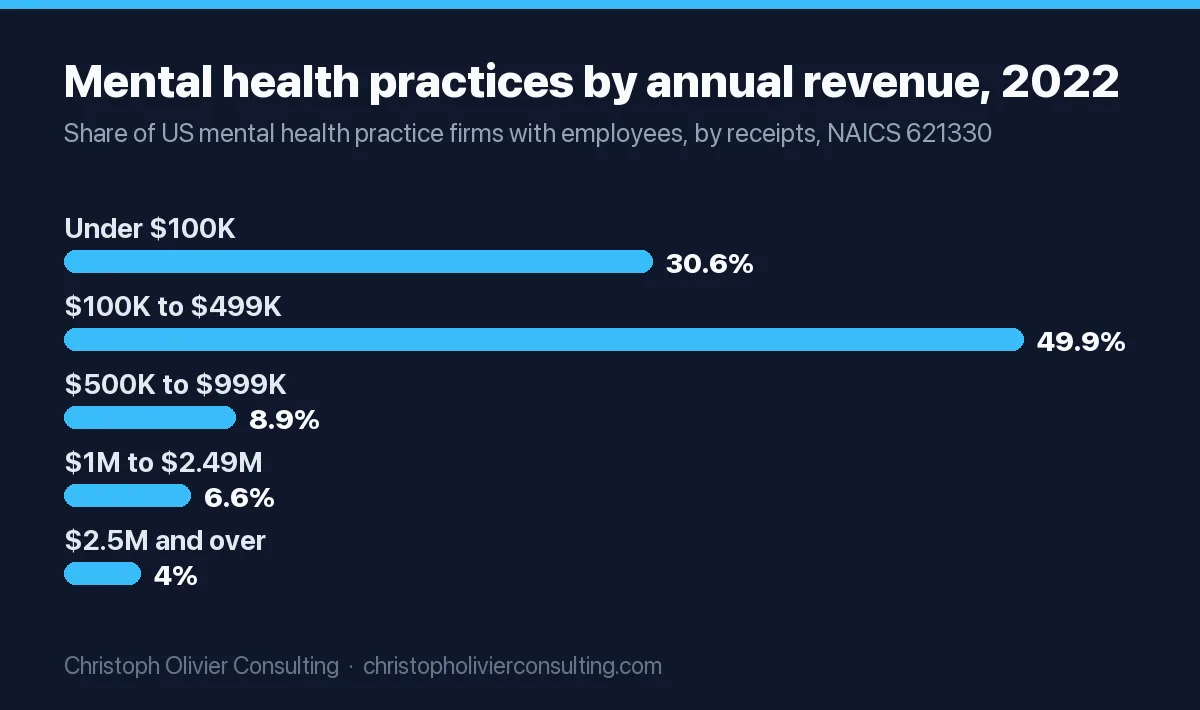
Owner income from a group practice depends on how much margin each clinician’s sessions leave after their pay. Census data shows that most practices with staff are still small. Of the 38,819 mental health practice firms with employees in 2022, 30.6% took in under $100,000 and 49.9% took in $100,000 to $499,999, according to the Census Statistics of U.S. Businesses. So the median employer practice falls in the $100,000 to $499,999 band. Just 4.0% of firms took in $2.5 million or more, but they collected 47.0% of all receipts (my calculations).
The same file gives one useful benchmark for group owners: these practices averaged 5.4 employees per location, $95,447 in receipts per employee and $43,315 in payroll per employee. Payroll equaled 45.4% of receipts (my calculation). Payroll includes part-time staff and admin, and for corporations it includes owner-officers’ wages.
Worked example: a five-clinician group practice owner’s P&L (own calculation)
| Line | Amount | How it was calculated |
|---|---|---|
| Owner’s own sessions | $84,180 | 15 sessions a week x $122 x 46 weeks |
| Four W-2 associates’ sessions | $561,200 | 4 x 25 sessions x $122 x 46 weeks ($140,300 each) |
| Total revenue | $645,380 | |
| Associate wages | ($232,960) | 4 x $58,240, the BLS May 2025 median for counselors in offices of other health practitioners |
| Employer payroll tax | ($17,821) | 7.65% (6.2% Social Security + 1.45% Medicare, per IRS Topic 751) |
| Admin, billing, rent, software, insurance, marketing | ($129,076) | Assumed 20% of revenue; not a published benchmark |
| Owner’s pre-tax profit | $265,523 | Before owner salary split, benefits and income tax |
| Profit per associate seat | $49,545 | $140,300 minus $58,240 wage, $4,455 payroll tax and $28,060 overhead share |
| Same seat at 20 sessions a week | $27,097 | $112,240 revenue, same wage and tax, $22,448 overhead |
Two takeaways. First, about three-quarters of the owner’s profit in this model comes from associates ($198,180 from four seats) and one-quarter from the owner’s own 15 sessions ($67,344 after their 20% overhead share). Second, a salaried associate’s productivity decides everything: the same seat is worth $49,545 at 25 sessions and $27,097 at 20. An associate who builds to 15 sessions in the first year, paid the same salary, would barely cover their cost. Associate wages in this example are 36.1% of revenue, below the 45.4% Census payroll average, because the model has no paid admin staff; add a front-desk hire and the owner’s profit drops accordingly. Many groups pay associates per session instead of salary for exactly this reason; the split, not the headcount, sets the owner’s margin.
Group growth runs on referrals and visibility. If you are adding clinicians faster than your phone rings, a compliant mental health marketing plan matters more than another hire. Psychologists should also read what the APA code and state boards allow in advertising.
Five levers that move a therapist’s private practice income
- Rate. In the own-calculation table, moving from $122 to $157 adds $35 a session, or $40,250 a year at 25 sessions. Heard’s 2024 report found more than half of respondents said expenses rose in 2023, but only 34% raised fees.
- Billed weeks. Every week off at 25 sessions and $122 costs $3,050. Going from 46 to 44 weeks costs $6,100.
- Payer mix. Medicare pays an LPC, LMFT or LCSW $125.25 for a national 90837 in 2026, 75% of the psychologist amount. Heard’s insurer range of $96 to $141 shows your panel choice matters as much as your license.
- Visit length coding. A 60-minute 90837 pays $167.00 to a psychologist versus $113.90 for a 45-minute 90834 (Medicare, 2026). Bill the code that matches the time you actually spent, and no more.
- Entity. Heard’s rule of thumb is that an S corp election starts to make sense once net income consistently exceeds $100,000. That is a tax planning question for your CPA, not a growth strategy.
If your caseload is the bottleneck, the channel matters. If you are weighing short-form video, check the platform and board rules first in can therapists advertise on TikTok. If you want an outside view of your fees, referral sources and growth plan, you can book a consultation.
One more rule that affects cash-pay income
If you see self-pay clients, the No Surprises Act requires a written good faith estimate. Per CMS, providers must give uninsured or self-pay patients a good faith estimate of expected charges when they request one or schedule at least 3 business days ahead. For a therapist, that means stating your session fee and expected frequency in writing at intake. Build it into your intake paperwork before you raise rates.
Ready to scale your revenue?
Book a free 30-min consultation. We’ll diagnose your growth bottleneck and map out the 3 highest-leverage moves for your business.
Frequently asked questions
How much does a private practice therapist make?
A typical solo private practice therapist nets about $66,000 to $71,000 a year before income tax: Heard reported a 2025 median of $66,084 and a mean of $70,696 for sole proprietors, on median revenue of $91,178. In Heard's 2025 survey of 3,229 therapists, 86% netted under $100,000 in 2024. Full-time therapists with strong fees can net well above $100,000.
How much do private practice therapist owners make?
Practices taxed as S corporations, which include most group practices, reported a median net income of $94,307 and a mean of $115,250 in 2025, as reported by Heard. In a worked example with four salaried associates at 25 sessions a week and $122 a session, the owner's pre-tax profit is about $265,500. Each associate seat adds roughly $27,000 to $50,000 depending on productivity.
How many clients does a private practice therapist see?
Most full-time private practice therapists hold about 20 to 25 sessions a week. The APA's 2015 survey of licensed psychologists found a mean of 18.4 hours of direct patient care a week, and 44.8% of respondents worked in private practice. Active caseload often runs higher than weekly sessions because some clients come every other week.
What is the average private practice therapist salary?
Owners do not draw a set salary; they keep net profit. For comparison, BLS reports May 2025 median wages for employed therapists of $100,580 for clinical and counseling psychologists, $66,940 for marriage and family therapists, $60,280 for mental health social workers and $59,350 for mental health counselors. Heard's solo private practice median net of $66,084 is close to the master's-level employee median.
How much does Medicare pay a therapist per session in 2026?
Using the CMS 2026 fee schedule (RVU26D) and the $33.4009 conversion factor, the national non-facility amount for a 60-minute psychotherapy session (CPT 90837) is $167.00 for a psychologist. Licensed counselors, marriage and family therapists and clinical social workers are paid 75%, or $125.25. Actual payment is adjusted up or down by locality.
Is 25 clients a week a lot for a therapist?
Twenty-five sessions a week is the top of the normal full-time range. At 46 billed weeks it equals 1,150 paid sessions a year, or $140,300 in revenue at a $122 average insurance rate and $180,550 at a $157 cash fee. Many therapists find that raising fees adds more income than adding sessions beyond 25.
Practice economics benchmarks