

A staffing agency owner’s income depends on three things: whether the agency places temps or permanent hires, how many people it has on assignment, and how much of each billed hour it keeps after paying the worker. Census data show employment services businesses with no employees took in an average of $50,117 in 2022, per the Census Bureau’s Nonemployer Statistics (my calculation). Employer agencies are much bigger: the average temporary help firm with $1 million to $2.49 million in receipts took in $1.67 million in 2022, according to Census Statistics of U.S. Businesses. On my worked models below, a solo permanent-placement recruiter clears about $112,000 to $244,000 before tax, a small temp agency owner about $154,000, a 10-person agency owner about $444,000 and a 25-person agency owner about $1.2 million. A $1 cut in the hourly bill rate wipes out half or more of each of those temp figures.
Short answer: Most staffing “agencies” with no employees are side businesses: 67.4% of them took in under $25,000 in 2022 (Census). Owners of small employer agencies usually take home roughly $100,000 to $450,000 in a normal year, depending on temps on assignment and spread (labeled model below). Public staffing companies keep 17% to 37% of revenue as gross margin but at best 1% to 4% as operating profit, and three of the six reported operating losses (2025 10-K filings). Recruiter pay and offices absorb the rest.
This page uses only primary sources: Census Bureau business counts, Bureau of Labor Statistics wage data, the 2025 annual 10-K reports of six listed staffing companies, and the Item 7 and Item 19 disclosures of the largest U.S. staffing franchise. Where I calculated a ratio the source does not print, I say so. The owner-income models are mine, and every assumption is listed so you can swap in your own numbers.
How much does a staffing agency owner make? What each primary source measures
No government survey asks staffing agency owners what they pay themselves. These six datasets get close, and each measures something different.
| Source and year | What it measures | Figure |
|---|---|---|
| Census Nonemployer Statistics, 2022 | Average receipts of employment services businesses with no employees, NAICS 5613 (42,957 businesses, 91.8% sole proprietors) | $50,117 in receipts (my calculation); only 11.4% reached $100,000 |
| Census SUSB, 2022 | Average receipts of employment placement agencies (NAICS 561311, 6,277 firms) excluding the 101 firms above $100 million | $2.19 million (my calculation) |
| Same Census file | Average receipts of temporary help firms (NAICS 561320, 15,768 firms) excluding the 518 firms above $100 million | $5.65 million (my calculation) |
| BLS OEWS industry table, May 2023 | Mean wage of chief executives employed by employment services firms (2,940 jobs) | $267,480 mean; $108.45 median hourly |
| Same BLS table | Mean wage of general and operations managers in employment services (47,700 jobs) | $132,550 mean |
| Express Employment Professionals FDD, Item 19 (filed 2026) | Franchisee’s share of gross margin, 526 units open more than 24 months, fiscal 2025, before the franchisee pays office staff and rent | $723,237 average; $563,915 median |
Two cautions. The nonemployer count includes anyone who reports recruiting or staffing fees on a Schedule C, whether they worked a weekend or a full year. And BLS wage data cover W-2 pay only: BLS excludes the self-employed, and an owner who takes profit distributions on top of a salary shows up only partly. The franchise figure is the closest public number to “owner income” for a staffed agency, but it is still a gross figure: the franchisee pays recruiters, rent and everything else out of it.
How much do recruitment agency owners make?
Permanent-placement and search firms are smaller and leaner than temp agencies, because they do not carry a payroll of workers on assignment. In the Census 2022 file, executive search firms (NAICS 561312) in the $500,000 to $4.99 million receipts bands brought in about $250,000 to $259,000 per employee, and paid their employees an average of $100,505 to $113,671 in wages. Placement agencies in the same bands (NAICS 561311) took in only $84,000 to $100,000 per employee, because many of them also run temp payrolls that count in employment.
The clearest public picture of perm economics is Robert Half’s segment note. Its permanent placement segment earned $439.5 million in 2025 with a 99.8% gross margin, then spent 77.9% of revenue on recruiter compensation and 17.0% on other costs, leaving segment income of 4.9%, down from 13.2% in 2023, per the company’s 2025 10-K (ratios are my calculation). For a solo recruiter, that 77.9% compensation line is the owner’s paycheck, which is why a one-person desk can out-earn its share of a big firm.
How much revenue does a staffing agency make by size?
Temp agencies dominate the industry’s dollars. The 518 temporary help firms above $100 million took 73.6% of the segment’s $326.3 billion in 2022 receipts. Below that, the market is a long tail of small and mid-size agencies.
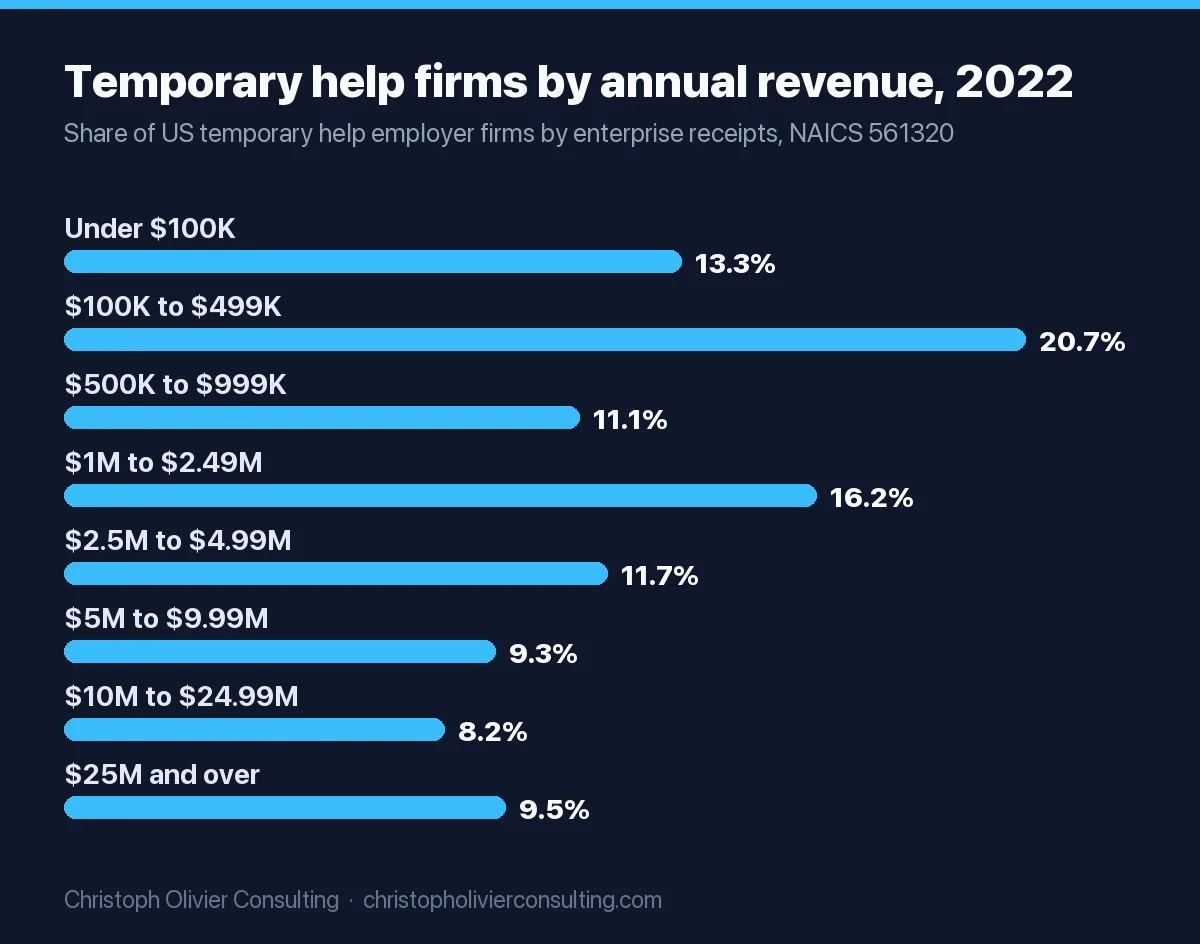
| Firm receipts band (2022) | Share of temp help firms | Cumulative | Average receipts | Employees per firm (incl. temps) | Payroll as % of receipts |
|---|---|---|---|---|---|
| Under $100K | 13.3% | 13.3% | $40,467 | 2.3 | 164.0% |
| $100K to $499K | 20.7% | 34.0% | $269,750 | 5.4 | 67.8% |
| $500K to $999K | 11.1% | 45.1% | $739,813 | 15.6 | 72.6% |
| $1M to $2.49M | 16.2% | 61.4% | $1,668,998 | 31.0 | 60.5% |
| $2.5M to $4.99M | 11.7% | 73.1% | $3,641,447 | 64.7 | 59.5% |
| $5M to $9.99M | 9.3% | 82.3% | $6,968,776 | 123.6 | 66.0% |
| $10M to $24.99M | 8.2% | 90.5% | $15,492,487 | 248.8 | 61.5% |
| $25M to $99.9M | 6.2% | 96.7% | $43,855,988 | 695.1 | 59.2% |
| $100M and over | 3.3% | 100% | $463,659,334 | 4,828.8 | 51.8% |
Source: U.S. Census Bureau, SUSB 2022, NAICS 561320, 15,768 firms. Employment is mid-March and includes temporary workers on the agency’s payroll. Payroll is wages only, before payroll taxes and workers’ compensation. Averages and ratios are my calculation. A payroll share above 100% in the smallest band means those firms paid out more in wages than they billed that year.
What this table tells an owner:
- Getting past $1 million is the first real hurdle. 45.1% of employer temp firms bill less than that.
- Payroll settles at about 59% to 66% of receipts from $1 million up to $100 million. That is temp wages plus internal staff wages. If your total payroll runs above 70% of billings, your markup is thinner than the typical small agency’s.
- Revenue per head is low because temps count as employees. Small temp firms book $47,000 to $56,000 of receipts per person on payroll. You make money on volume of hours, not on revenue per head.
Staffing agency profit margin: gross margin vs operating margin
“Profit margin” in staffing gets quoted three ways, and the numbers differ by a factor of ten. The markup is what you add to the worker’s pay rate to set the bill rate. The gross margin is what is left of revenue after the worker’s wages and the employer costs that come with them: payroll taxes, unemployment insurance and workers’ compensation. The operating margin is what is left after recruiters, sales staff, offices and software. Here is what the listed companies reported for 2025.
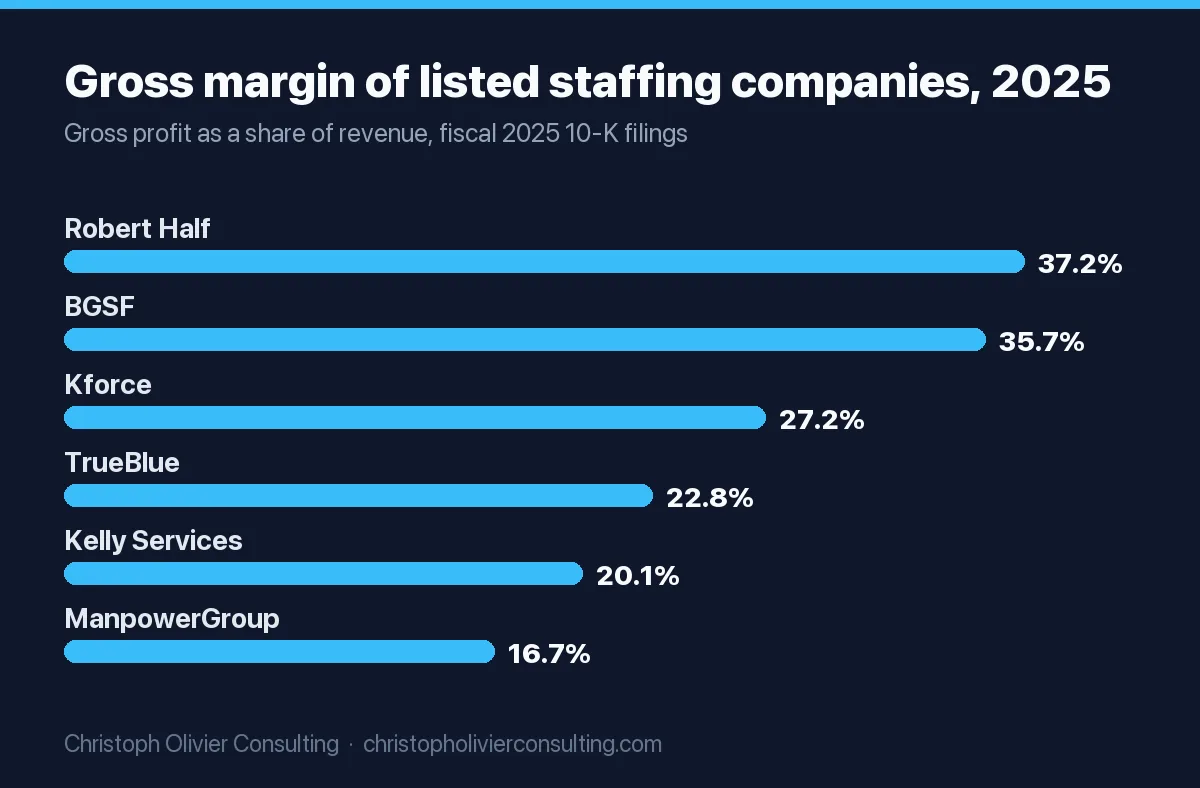
| Company (10-K, fiscal 2025) | Revenue | Gross margin | Operating margin 2025 | Operating margin 2024 | What drives it |
|---|---|---|---|---|---|
| Robert Half | $5.38B | 37.2% | 1.4% | 4.2% | Professional contract talent at 39.0% gross margin; perm placement 8.2% of revenue but 21.9% of gross profit; includes Protiviti consulting |
| Kforce | $1.33B | 27.2% | 3.8% | 5.0% | Technology bill rate about $89 an hour in Q4 2025; flex gross margin 25.8%; direct hire only $25.7M |
| TrueBlue | $1.62B | 22.8% | -2.9% | -5.9% | Industrial and on-demand labor; 2024 includes $59.7M of impairment charges |
| Kelly Services | $4.25B | 20.1% | -1.6% | -0.3% | Includes a $102.0M goodwill impairment in 2025; perm fees about 1% of revenue |
| ManpowerGroup | $17.96B | 16.7% | 0.8% | 1.7% | Global volume staffing; includes $88.7M goodwill impairment in 2025 |
| BGSF | $93.3M | 35.7% | -9.5% | -5.6% | Continuing operations after selling its professional segment (now mostly property management staffing) |
Revenue, gross profit and operating income from each company’s 2025 10-K (XBRL data on sec.gov); margins are my calculation except Kforce’s gross margin and ManpowerGroup’s operating margin, which the filings state. 2025 was a weak demand year: Robert Half’s contract hours fell 14.1% and its perm placements fell 13.6%.
What is a good profit margin for a staffing agency?
For gross margin, compare yourself with companies selling the same kind of labor. Industrial and clerical staffing runs about 17% to 23% (ManpowerGroup, Kelly, TrueBlue, and the 20.2% average gross margin of Express franchise units in fiscal 2025). Professional and IT contract staffing runs about 26% to 39% (Kforce, Robert Half). Permanent placement fees carry close to 100% gross margin because there is no worker payroll. Kelly’s 10-K says it directly: perm revenue “has a disproportionate impact on gross profit rates.”
For operating margin, the public companies show the ceiling after everyone is paid a market salary: roughly 1% to 5% in 2024 and 2025. A small owner-run agency shows a higher number only because the owner’s pay is sitting inside the profit line. Pay yourself a market wage on paper before you compare. BLS puts that wage at $132,550 for general and operations managers in employment services and $267,480 for chief executives (May 2023 means).
What is the typical gross margin for a staffing agency?
The best single small-firm benchmark is in a franchise disclosure. Across 526 Express Employment Professionals units open more than 24 months, average fiscal 2025 sales were $5,342,686 and average gross margin was $1,077,371, or 20.2% of sales (median 20.5%), per Item 19 of the company’s 2026 franchise disclosure document filed with the Minnesota Department of Commerce (percentages are my calculation). The FDD defines gross margin as billings minus worker wages, the employer share of Social Security and Medicare, unemployment taxes, workers’ compensation and similar direct payroll costs.
Worked example: what a staffing agency owner takes home at four sizes
Owner pay in a staffing agency is not a salary line. It is whatever is left of gross margin after internal staff, overhead, financing and bad debt. Whether you take it as an S corporation salary plus distributions or as sole proprietor profit changes the tax, not the total. The table below is my own calculation, with every assumption listed beneath it.
| Line (own calculation) | Solo perm recruiter | Small temp agency | 10-person temp agency | 25-person temp agency |
|---|---|---|---|---|
| Temps on assignment (average) | 0 | 40 | 150 | 400 |
| Internal staff besides owner | 0 | 2 | 9 | 24 |
| Billed hours a year (1,800 per temp) | 0 | 72,000 | 270,000 | 720,000 |
| Temp billings at $26.50 an hour | 0 | $1,908,000 | $7,155,000 | $19,080,000 |
| Direct-hire fees at $16,000 each | $198,000 (12 placements, net of fall-offs at $18,000) | $64,000 (4) | $240,000 (15) | $640,000 (40) |
| Total revenue | $198,000 | $1,972,000 | $7,395,000 | $19,720,000 |
| Temp wages at $18.00 an hour | 0 | ($1,296,000) | ($4,860,000) | ($12,960,000) |
| Employer burden at 18% of wages | 0 | ($233,280) | ($874,800) | ($2,332,800) |
| Gross margin | $198,000 (100%) | $442,720 (22.5%) | $1,660,200 (22.5%) | $4,427,200 (22.5%) |
| Internal staff at $80,000 loaded | 0 | ($160,000) | ($720,000) | ($1,920,000) |
| Overhead (rent, software, insurance, marketing, accounting) | ($20,000) | ($90,000) | ($350,000) | ($900,000) |
| Receivables financing at 1.5% of revenue | 0 | ($29,580) | ($110,925) | ($295,800) |
| Bad debt at 0.5% of temp billings | 0 | ($9,540) | ($35,775) | ($95,400) |
| Owner’s pay plus profit, pre-tax | $178,000 | $153,600 | $443,500 | $1,216,000 |
| As % of revenue | 89.9% | 7.8% | 6.0% | 6.2% |
| Stress test: bill rate $1 lower | n/a | $83,040 | $178,900 | $510,400 |
| Stress test: hours down 20%, placements down 40% | $112,000 at 8 placements | $60,272 | $93,520 | $282,720 |
Assumptions (mine, not sourced market data):
- Pay rate $18.00 an hour. Anchored to the $16.74 median hourly wage of laborers and material movers, the largest occupation in employment services, in the BLS May 2023 industry table, rounded up for wage growth since.
- Bill rate $26.50, a 47% markup. With burden, that produces a 19.8% gross margin on temp hours, close to the 20.2% Express average and the 20.1% Kelly reported.
- Burden 18% of wages. It includes the employer’s 6.2% Social Security and 1.45% Medicare tax (IRS Topic 751), federal unemployment tax of 0.6% after credit on the first $7,000 per worker (IRS Topic 759), plus state unemployment tax and workers’ compensation, which vary by state and job class. Light industrial work can carry far higher workers’ compensation rates.
- Internal staff at $80,000 loaded: base, commission, payroll tax and benefits. BLS puts the May 2025 median for human resources specialists in employment services at $60,550 (Occupational Outlook Handbook).
- Direct-hire fee $16,000, or 20% of an $80,000 salary. Robert Half’s 10-K says fees are “generally a percentage of the new employee’s annual compensation” but does not disclose the percentage, so 20% is my assumption. The solo recruiter is modeled at $90,000 salaries and $18,000 fees, with 1 in 12 placements refunded during a guarantee period (Kforce’s 10-K describes these “fallouts” over a contingency period of “typically 90 days or less”).
- Financing at 1.5% of revenue stands in for a bank line or factoring cost. It is an assumption; your rate depends on your lender.
Cross-check: my temp models put total wages (temps plus internal staff) at about 73% to 74% of revenue. Census shows 59.5% to 66.0% for firms from $1 million to $100 million. So the models are deliberately conservative on markup, and a well-priced agency should beat them. The stress-test rows matter more than the headline: in the 10-person case, a $1 drop in bill rate cuts owner income by 60%, because every dollar of lost spread comes straight out of the owner’s line.
Owner-pay worksheet: run your own numbers
- Weekly billed hours = temps on assignment x average weekly hours (1,800 a year is about 34.6 a week).
- Spread per hour = bill rate minus pay rate minus (pay rate x your burden %). Get your burden % from your workers’ compensation quote and state unemployment rate letter, not from a blog.
- Annual gross margin = weekly hours x spread x 52, plus direct-hire fees net of refunds.
- Subtract internal payroll (loaded), overhead, financing cost and a bad-debt allowance.
- Result = owner’s pay plus profit. If you run an S corporation, the IRS requires “reasonable compensation” as wages before any distribution (IRS guidance); the BLS figures above are useful comparables for your CPA.
- Pass/fail check: rerun step 5 with the bill rate $1 lower. If the result is below what you would earn as a branch manager ($132,550 mean in employment services, BLS May 2023), the agency is too thin to absorb one tough client negotiation.
Staffing agency startup costs: the franchise numbers and the payroll float
The only audited-format startup budgets in this industry are franchise disclosure documents. Express Employment Professionals’ 2026 FDD, Item 7, estimates the total investment to open at $303,500 to $598,700 for a professional-occupations franchise and $313,150 to $503,100 for a healthcare-occupations franchise, with core (light industrial and office) franchises starting at $131,000. The biggest line in every version is “additional funds” for the first nine months: $250,000 to $450,000 for professional and $280,000 to $360,000 for healthcare. The franchise fee is $40,000 per occupation line before discounts. The FDD also says the franchisor provides payroll services for franchisees’ associates and bills clients itself, which helps explain why the estimate has no line for funding temp wages.
An independent agency has to fund that payroll itself, and it is the startup cost most guides leave out. Temps are paid weekly; clients pay later. Kelly reported days sales outstanding of 61 days at the end of 2025 and ManpowerGroup 55 days, per their 10-Ks, and TrueBlue notes that it pays associates “daily and weekly” while client terms are “generally 90 days or less.”
| Payroll float (own calculation) | Small agency, 40 temps | 10-person agency, 150 temps |
|---|---|---|
| Weekly wages (34.6 hours x $18.00) | $24,923 | $93,462 |
| Weekly wages plus 18% burden | $29,409 | $110,285 |
| Weeks funded at 61 days to collect (8.7 weeks) | $256,000 | $961,000 |
| Weeks funded at 55 days (7.9 weeks) | $231,000 | $867,000 |
Rounded to the nearest $1,000. Collection periods are Kelly’s and ManpowerGroup’s year-end 2025 DSO; a small agency with slow-paying clients can be worse. A perm-only recruiting desk needs none of this float, which is why it can start from a home office.
Is a staffing agency a good business?
It can pay well, but it is one of the most cyclical service businesses you can own. U.S. temporary help employment peaked at 3,161,400 jobs in March 2022 and stood at 2,526,000 in October 2026, down 20.1%, per BLS employment data via FRED (my calculation). In the same downturn, Robert Half’s contract staffing segment income fell from 7.5% of revenue in 2023 to 1.6% in 2025, and its perm segment from 13.2% to 4.9%. Because the owner’s line is a thin slice of revenue, a 20% drop in hours, with 40% fewer placements, cuts owner income by 61% to 79% in the temp models above.
The business is good for owners who can do three things: price spread by job class instead of matching the lowest bid, keep a credit line sized to nine weeks of burdened payroll, and add direct-hire fees that carry near-100% gross margin. If you are building the client side, the same discipline that runs a marketing agency’s margins applies: track gross margin per client, not revenue. For filling the candidate pipeline, my recruitment marketing field guide covers the channels.
Are staffing franchises profitable?
The disclosed numbers show strong gross margin but do not show owner profit. Express units open more than 24 months averaged $723,237 in franchisee share of gross margin in fiscal 2025 (median $563,915), after paying an average royalty of 38.0% of gross margin, or 8.4% of sales. Out of that share, the franchisee pays internal staff, rent and other costs, and the FDD does not disclose what is left. New units are much smaller: the 22 units opened in 2023 to 2025 and open at least a year averaged $999,949 in first-year sales (median $892,374), and only 31.8% reached the average. Treat any franchise salesperson’s take-home claim that goes beyond Item 19 with caution; Item 19 itself warns: “Your individual results may differ.”.
Does a staffing agency make money on each worker?
Yes, per hour worked. In the model above, each $18.00 hour billed at $26.50 leaves $5.26 after wages and burden. A temp working 1,800 hours a year produces about $9,468 of gross margin, and an internal recruiter costing $80,000 loaded has to keep eight to nine such workers on assignment just to cover their own cost, before rent and the owner. That ratio, temps on assignment per internal employee, is the number to watch every week. Compare how other owner-run service firms stack up in consulting firm owner pay and the profit margin by industry data. If you want help pricing your services or building a client pipeline that holds up through a downturn, you can book a consultation.
Ready to scale your revenue?
Book a free 30-min consultation. We’ll diagnose your growth bottleneck and map out the 3 highest-leverage moves for your business.
Frequently asked questions
How much does a staffing agency owner make?
It depends on size and model. Employment services businesses with no employees averaged $50,117 in receipts in 2022 (Census). In my labeled model, a solo perm recruiter making 12 placements clears about $178,000 before tax, a 40-temp agency owner about $154,000, a 150-temp agency owner about $444,000 and a 400-temp agency owner about $1.2 million. A $1 lower bill rate cuts the temp figures by more than half.
How much do recruitment agency owners make?
Perm recruiters keep most of each fee because there is no worker payroll. Executive search firms with $500,000 to $4.99 million in receipts brought in about $250,000 to $259,000 per employee in 2022 (Census SUSB). In my model, a solo recruiter making 8 to 16 placements at $18,000 fees clears about $112,000 to $244,000 after refunds and $20,000 of costs. Robert Half's perm segment spent 77.9% of revenue on recruiter pay in 2025.
What is a good profit margin for a staffing agency?
Gross margin of about 17% to 23% is typical for industrial and clerical staffing (ManpowerGroup, Kelly, TrueBlue, Express franchise units in 2025), and 26% to 39% for professional and IT staffing (Kforce, Robert Half). Operating margin after everyone is paid a market salary is thin: listed staffing firms reported roughly 1% to 5% in 2024 and 2025, and three of six posted losses in 2025.
What is the typical gross margin for a staffing agency?
About 20% for general staffing. Express Employment Professionals units open more than 24 months averaged $5.34 million in sales and $1.08 million in gross margin in fiscal 2025, or 20.2%, per Item 19 of the company's 2026 FDD. Gross margin there means billings minus worker wages, employer payroll taxes, unemployment taxes and workers' compensation. Permanent placement fees carry close to 100% gross margin.
How much money do you need to start a staffing agency?
Express's 2026 FDD estimates $303,500 to $598,700 for a professional-occupations franchise and $313,150 to $503,100 for healthcare, mostly nine months of working capital. An independent temp agency must also fund payroll while clients pay: at 61 days to collect (Kelly's 2025 DSO), 40 temps at $18 an hour tie up about $256,000. A perm-only recruiting desk needs no payroll float.
Are staffing franchises profitable?
Gross margin is disclosed, owner profit is not. Express units open more than 24 months averaged $723,237 in franchisee share of gross margin in fiscal 2025 (median $563,915) after a royalty averaging 38.0% of gross margin. The franchisee pays staff, rent and other costs from that share. Units opened from 2023 to 2025 averaged $999,949 in first-year sales, and only 31.8% reached that average.
Is a staffing agency a good business?
It pays well in good years and is highly cyclical. U.S. temporary help employment fell 20.1% from its March 2022 peak to October 2026 (BLS via FRED), and Robert Half's perm segment margin fell from 13.2% in 2023 to 4.9% in 2025. It suits owners who price spread by job class, hold a credit line sized to about nine weeks of payroll and add direct-hire fees.
Practice economics benchmarks