

A busy hair stylist usually has somewhere between 60 and 150 active clients, about 100 for a typical cut and color book, and sees 2 to 6 of them a day. That range is not a survey result, because no one publishes one. It is what the data that does exist works out to: a stylist with 32 bookable hours a week, booked at the 49% to 76% utilization that salon software company Zenoti reports for North American salons in 2025, with clients returning at the intervals Americans told YouGov in 2023. Barbers run faster: about 8 to 12 haircuts a day and a book of 200 to 300 regulars.
Short answer: A full-time stylist has roughly 60 to 150 regular clients (about 85 to 130 for a mixed cut and color book) and 2 to 6 appointments a day, by our capacity model. A barber doing 30 minute cuts sees about 9 to 12 clients a day and needs 200 to 300 regulars to stay full. Census receipts per salon employee ($68,302 in 2022) divided by Zenoti’s $114 median full-service ticket works out to about 2.5 visits per employee per working day, which matches the low end of the model.
How many clients does the average hairstylist have? What the data actually says
The threads that rank for this question on Reddit, TikTok and Alignable trade single numbers (“100 is a full book,” “12 a day”) with nothing behind them. The industry itself admits the gap. At a November 2025 data roundtable held with the Professional Beauty Association, participants concluded that “even foundational metrics, such as the number of salons, active pros or independents, are unclear,” according to the Pivot Point white paper on the session. So here is every relevant figure we could verify, with exactly what it measures.
| Figure | Value | What it measures | Source |
|---|---|---|---|
| Hairdressers, hairstylists and cosmetologists | 595,000 jobs, 48% self-employed | All jobs in 2025, including self-employed | BLS Occupational Outlook Handbook |
| Barbers | 75,800 jobs, 80% self-employed | All jobs in 2025, including self-employed | BLS OOH |
| Median pay, employed stylists | $35,790 a year ($17.21 an hour) | Wage and salary workers only, tips included, May 2025 | BLS OEWS May 2025 |
| Median pay, employed barbers | $38,210 a year ($18.37 an hour) | Wage and salary workers only, tips included, May 2025 | BLS OEWS May 2025 |
| Staff utilization, full-service salons | 49% median, 63% at the 75th percentile, 76% at the 90th | Share of staff time that is booked, 2025, North America | Zenoti 2026 Benchmark Report, Salon edition |
| Average ticket, full-service salons | $114 median, $139 at the 75th, $169 at the 90th | Revenue per visit, 2025 | Zenoti 2026, Salon edition |
| Average ticket, barbershops | $34 median, $39 at the 75th, $48 at the 90th | Revenue per visit, 2025 | Zenoti 2026, barbershop data |
| Staff utilization, barbershops | 56% median, 66% at the 75th, 75% at the 90th | Share of barber time that is booked, 2025 | Zenoti 2026, barbershop data |
| Receipts per employee, beauty salons with staff | $68,302 | $26.41 billion receipts divided by 386,665 employees, 2022 (our division) | Census SUSB 2022 |
| Receipts per employee, barber shops with staff | $64,882 | $1.86 billion receipts divided by 28,674 employees, 2022 (our division) | Census SUSB 2022 |
| Clients per stylist at the largest U.S. salon chain | Not disclosed | Regis (Supercuts, 3,448 franchised and 264 company-owned salons at June 30, 2026) reports no guest counts | Regis FY2026 Form 10-K |
| National average client count per stylist | Not published | No government agency, trade association or public company reports it | None found |
The Census line is the closest thing to a hard, national client figure. If the typical salon employee generates $68,302 a year and the median full-service visit is $114, that is about 600 visits per employee per year, or 2.5 a day over 240 working days. Treat it as a floor: the employee count includes receptionists and assistants, the receipts include retail product, and the 2022 receipts are paired with a 2025 ticket price. Run the same division for barber shops ($64,882 divided by $34) and you get about 1,900 haircuts a year, or 8 a day.
How many clients should a hair stylist have? The capacity model
Your client count is not a target you pick. It falls out of three numbers you control: bookable hours, how full those hours are, and how long each appointment runs. The table below is our own calculation, not survey data. Assumptions: 4 days a week at 8 hours (32 bookable hours), 48 working weeks (1,536 hours a year), utilization at Zenoti’s 2025 median, 75th and 90th percentile for full-service salons, and the service length shown in each row.
| Book type (our assumption) | Avg appointment | Utilization | Clients per day | Visits per year | Active clients needed | Service revenue per year |
|---|---|---|---|---|---|---|
| Cut-focused, client returns 8 times a year | 1.0 hour | 49% (median) | 3.9 | 753 | 94 | $57,953 at $77 |
| 63% (75th pct) | 5.0 | 968 | 121 | $74,511 at $77 | ||
| 76% (90th pct) | 6.1 | 1,167 | 146 | $89,887 at $77 | ||
| Mixed cut and color, client returns 6 times a year | 1.5 hours | 49% | 2.6 | 502 | 84 | $57,201 at $114 |
| 63% | 3.4 | 645 | 108 | $73,544 at $114 | ||
| 76% | 4.1 | 778 | 130 | $88,719 at $114 | ||
| Color, lightening or extensions heavy, client returns 5 times a year | 2.5 hours | 49% | 1.6 | 301 | 60 | $50,878 at $169 |
| 63% | 2.0 | 387 | 77 | $65,415 at $169 | ||
| 76% | 2.4 | 467 | 93 | $78,914 at $169 |
Ticket prices are Zenoti’s 2025 percentiles ($77 is the median for its specialty “Salons” segment, $114 and $169 the median and 90th percentile for full-service salons), assigned by us to each book type. Revenue is what the chair brings in, not what the stylist takes home. On commission, your share depends on your split; as a booth or suite renter, you keep it and pay your rent and supplies out of it.
Three things jump out. First, a color specialist can be completely full with fewer than 100 clients, while a cut-focused stylist at the same utilization needs 50% more. Comparing raw client counts across those two books is meaningless. Second, the jump from median to 90th percentile utilization adds room for 33 to 52 more clients and $28,000 to $32,000 of service revenue in every row, with no price increase. Third, almost no stylist is ever at 100%: even Zenoti’s top 10% of salons book about three quarters of staff time.
How often clients come back changes the answer more than anything else
The “every 6 weeks” rule of thumb describes a minority of real clients. In YouGov’s May 2023 survey of 1,000 U.S. adults, only 23% pay for a haircut every 6 weeks or more often. A quarter go every 2 to 3 months, and 27% go every 6 months or less often.
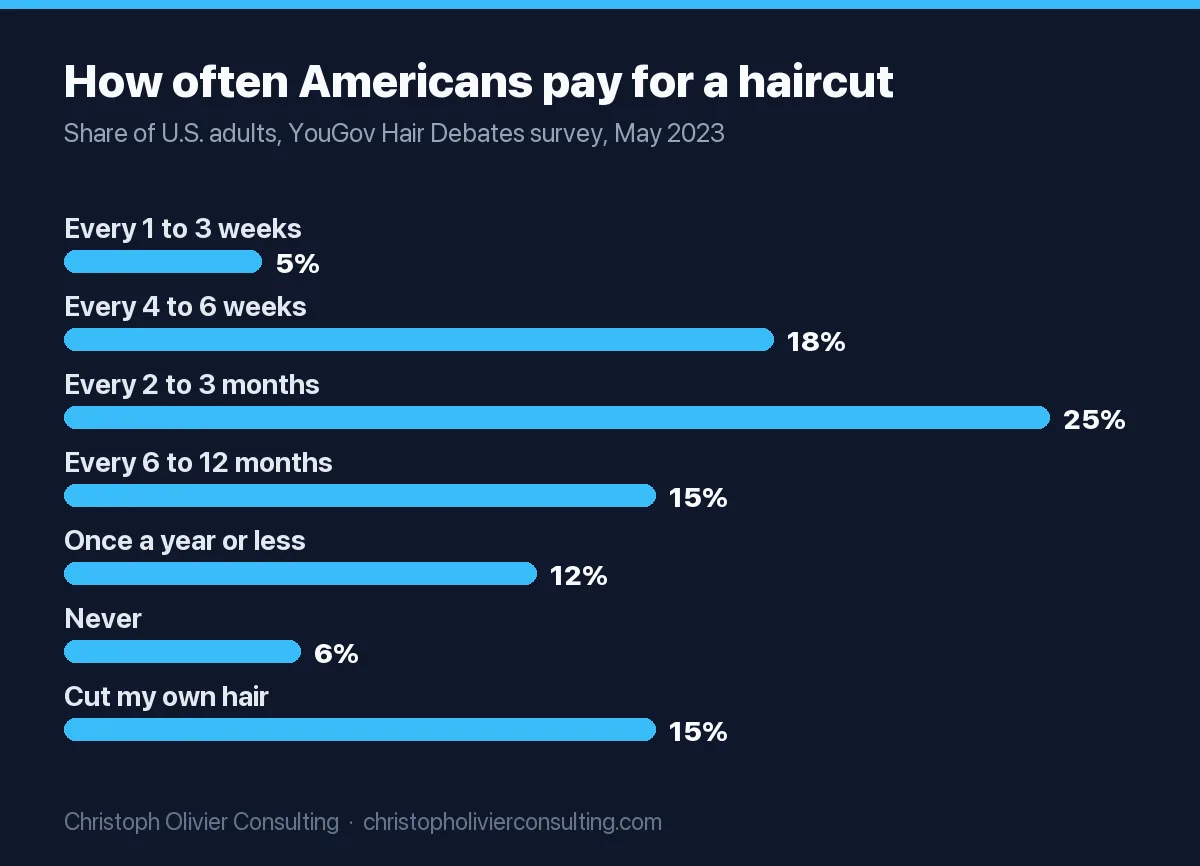
| “How often do you typically pay someone for a haircut?” | All adults | Men | Women |
|---|---|---|---|
| Every 1 to 3 weeks | 5% | 10% | 1% |
| Every 4 to 6 weeks | 18% | 24% | 13% |
| Every 2 to 3 months | 25% | 25% | 24% |
| Every 6 to 12 months | 15% | 10% | 20% |
| Once a year or less often | 12% | 6% | 18% |
| Never | 6% | 6% | 6% |
| I cut my own hair | 15% | 15% | 16% |
Source: YouGov, Hair Debates survey, May 23 to 30, 2023, 1,000 U.S. adult citizens, margin of error plus or minus 3.6 points. “Not sure” (3%) omitted.
That spread is why two stylists with identical calendars can report very different client counts. The next table, again our own calculation, holds the calendar fixed and changes only the return interval. It answers the question searchers actually mean by “how many clients does a hair stylist need”: how big does the book have to be to keep the chair full?
| Typical client returns every | Visits per client per year | Clients needed: color-heavy (387 visits) | Clients needed: mixed (645 visits) | Clients needed: cut-focused (968 visits) | Clients needed: barber (2,534 visits) |
|---|---|---|---|---|---|
| 2 weeks | 26.0 | 15 | 25 | 37 | 97 |
| 3 weeks | 17.3 | 22 | 37 | 56 | 146 |
| 4 weeks | 13.0 | 30 | 50 | 74 | 195 |
| 6 weeks | 8.7 | 45 | 74 | 112 | 292 |
| 8 weeks | 6.5 | 60 | 99 | 149 | 390 |
| 10 weeks | 5.2 | 74 | 124 | 186 | 487 |
| 13 weeks (quarterly) | 4.0 | 97 | 161 | 242 | 634 |
Visit totals come from the 75th percentile utilization rows above (63% for stylists, 66% for barbers at 30 minutes per cut, 40 hours a week). Our calculation; the frequency bands are YouGov’s.
Most real books are a blend. If half your regulars come every 6 weeks and half every 13 weeks, the average is about 6.3 visits a year, and a mixed cut and color stylist at 645 visits needs roughly 100 active clients. So “100 clients” is about right for a mixed book at decent utilization, and wrong for most color specialists and nearly every barber.
How many clients does a stylist see per day?
Divide your booked hours by your average service time. At 8 hours on the floor:
- Color, lightening or extensions: 2 to 3 guests a day is full. A single long transformation can take most of the day.
- Mixed cut and color: 3 to 5 a day, with processing time overlapped where your salon allows double-booking.
- Cuts and blowouts only: 4 to 7 a day, assuming 45 to 60 minutes each.
- Value or walk-in chains: more, because cuts are shorter. Regis says its salons serve “the value category” in strip centers and Walmart Supercenters, but discloses no guests per stylist in its FY2026 10-K.
Those ranges are our arithmetic from the capacity table, not a survey. If a source tells you the “average” stylist sees 12 clients a day, check the service mix: 12 one-hour appointments do not fit in an 8-hour shift.
How many clients does a barber have a day?
Barbering is a volume business. The median barbershop ticket in Zenoti’s 2025 North American data was $34, against $114 for a full-service salon, and barber staff utilization ran higher (56% median versus 49%). That combination means more, shorter appointments.
| Barber capacity (our calculation) | 56% booked (median) | 66% booked (75th pct) | 75% booked (90th pct) |
|---|---|---|---|
| 30 minute cuts: clients per 8-hour day | 9.0 | 10.6 | 12.0 |
| 30 minute cuts: cuts per year (40 h x 48 weeks) | 2,150 | 2,534 | 2,880 |
| 30 minute cuts: regulars needed at 10 visits a year | 215 | 253 | 288 |
| 45 minute cut and beard: clients per day | 6.0 | 7.0 | 8.0 |
| 45 minute cut and beard: regulars needed at 10 visits a year | 143 | 169 | 192 |
| Service revenue at $34 median ticket, 30 minute cuts | $73,114 | $86,170 | $97,920 |
Utilization and ticket from Zenoti’s 2025 barbershop data. Hours, cut length and the 10 visits a year (about every 5 weeks) are our assumptions.
The Census cross-check lands in the same place: $64,882 in receipts per barber shop employee in 2022 divided by a $34 ticket is about 8 cuts per working day. Demand is lopsided across the week. In Mangomint’s benchmark of more than 100 barbering businesses, Friday carried 20.47% of appointments and Thursday 18.18%, while Monday had 8.21% and Sunday 4.97%. So a barber averaging 9 a day may cut 14 on Friday and 4 on Monday. If you want to fill the slow days, that is a marketing problem, and our barbershop marketing guide covers the offers that move weekday demand.
Can a hairstylist make $100,000 a year? Can a barber make $200,000?
Both happen, but they are rare, and the government data shows how rare. Among the 823,967 one-person beauty salon businesses the Census Bureau counted for 2022 (sole stylists and renters who file their own taxes, with no employees), average gross receipts were $29,461. Only 3.9% took in $100,000 or more in receipts, and that is before rent, product and taxes. For one-person barber shops, the average was $30,504 and 3.5% reached $100,000. Just 150 of 137,372 cleared $500,000.
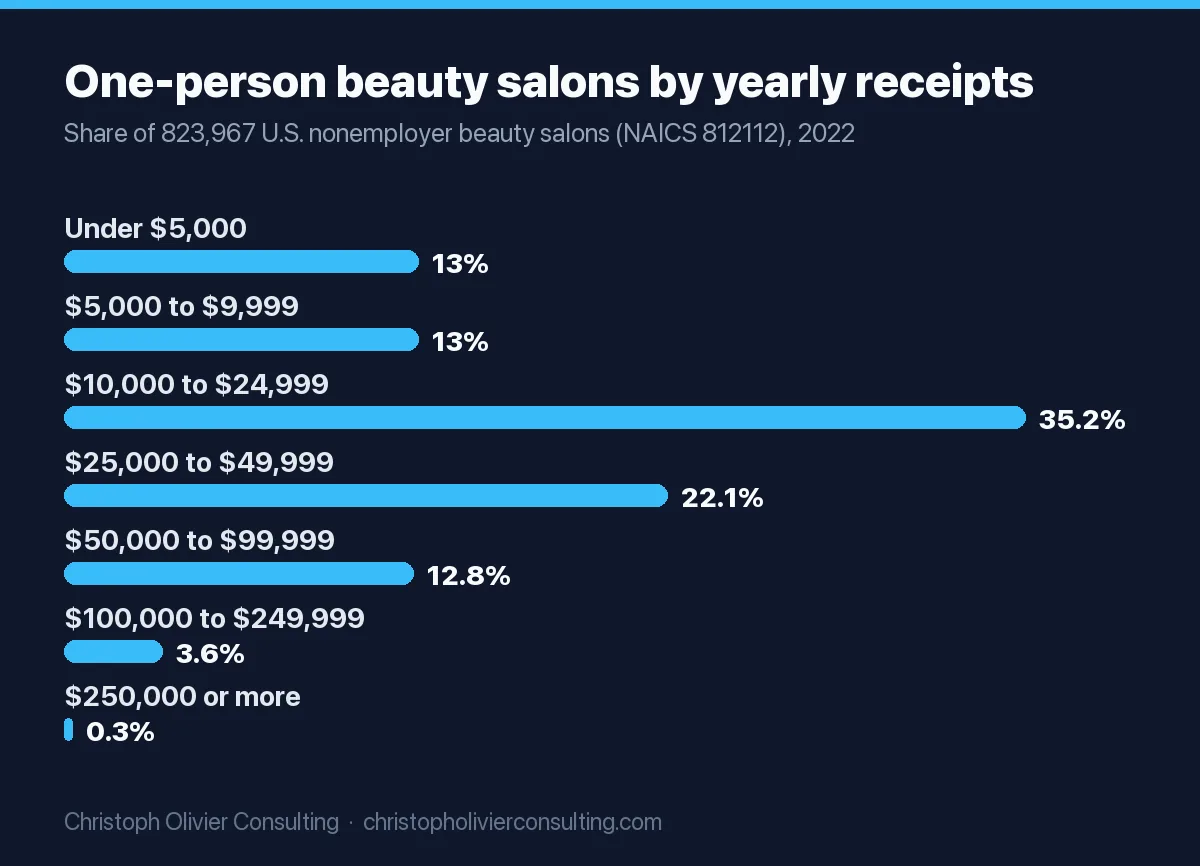
| Annual receipts, 2022 | One-person beauty salons | Share | One-person barber shops | Share |
|---|---|---|---|---|
| Under $5,000 | 106,944 | 13.0% | 17,860 | 13.0% |
| $5,000 to $9,999 | 106,864 | 13.0% | 15,803 | 11.5% |
| $10,000 to $24,999 | 290,107 | 35.2% | 46,054 | 33.5% |
| $25,000 to $49,999 | 182,402 | 22.1% | 34,458 | 25.1% |
| $50,000 to $99,999 | 105,646 | 12.8% | 18,377 | 13.4% |
| $100,000 to $249,999 | 29,493 | 3.6% | 4,159 | 3.0% |
| $250,000 or more | 2,511 | 0.3% | 661 | 0.5% |
| Total | 823,967 | 137,372 |
Source: Census Bureau Nonemployer Statistics 2022, NAICS 812112 (beauty salons) and 812111 (barber shops). Many are part-time or side businesses, which pulls the average down.
For employed stylists, the BLS 90th percentile in May 2025 was $71,190 including tips, and $76,460 for employed barbers. So $100,000 is above what 9 in 10 W-2 stylists earn.
The client math, our calculation: $100,000 in service revenue at the $114 median full-service ticket is 877 visits a year, about 3.7 a day over 240 days. At 6 visits per client that is a book of about 146 clients, and remember that is revenue, not take-home. A barber grossing $200,000 at a $34 ticket needs 5,882 cuts a year, which is 24.5 a day over 240 days. That is not realistic for one chair at 30 minutes a cut, so barbers at that level raise the ticket, add chairs or earn from renters. If you are weighing that jump, our breakdown of what hair salon owners actually make runs the owner side of the numbers.
How much do hair stylists make per client?
Per visit, the 2025 medians in Zenoti’s North American data were $114 at full-service salons, $77 at its specialty “Salons” segment and $34 at barbershops. Per client per year, multiply by how often they come back. A full-service client at $114 who returns every 10 weeks (5.2 visits) is worth about $593 a year in service revenue; the same client every 6 weeks (8.7 visits) is worth about $988. A barber client at $34 every 4 weeks is worth $442. Those per-client figures are our multiplication. They are also why retention, not new-client volume, decides most stylists’ income; our roundup of customer retention statistics shows the same pattern across service businesses.
How much do you tip a $100 hair stylist?
The median tip rate at full-service salons in Zenoti’s 2025 data was 12%, rising to 13% at the 75th percentile and 15% at the 90th. On a $100 service that is $12 to $15, with $18 at the top 10% of specialty salons. Barbershop tip rates were not published on Zenoti’s barbershop page.
Are you full? A pass/fail worksheet
Use this with 8 weeks of your own booking data. The thresholds are our rules of thumb, anchored to the published benchmarks where noted.
| Test | How to calculate | Pass | Fail means |
|---|---|---|---|
| 1. Utilization | Booked service hours divided by hours you were available | 63% or more (Zenoti 75th percentile); 75% or more is “full” | You need more clients or fewer open hours, not a price cut |
| 2. Book size vs capacity | Active clients (seen in the last 6 months) times visits per client per year, divided by your annual visit capacity | 0.9 to 1.1 | Under 0.9: you are short on clients. Over 1.1: you are turning people away and can raise prices |
| 3. Return interval | Average days between visits for clients seen at least twice | Within 2 weeks of what you recommend at checkout | Clients are stretching visits, which shrinks capacity use without anyone “leaving” |
| 4. Rebook stickiness | Share of future bookings from clients who have rebooked at least twice | Rising quarter over quarter | In Zenoti’s 2025 data, bookings from a client’s first rebook were cancelled 72% of the time, versus 4% for clients rebooked twice or more |
| 5. Revenue per hour | Service revenue divided by booked hours | At or above your target ticket divided by average service length | You are full of the wrong services; adjust the menu, not the hours |
Worked example, our numbers: a mixed cut and color stylist available 1,536 hours a year books 900 hours (59%, Test 1 fails). She has 95 active clients averaging 6 visits, so 570 visits against capacity of about 645 at 63% utilization: a ratio of 0.88 (Test 2 fails). She is about 12 clients short of full at her current return interval. Moving her average client from 6 visits a year (every 8.7 weeks) to 7 (about every 7.4 weeks) adds 95 visits, which takes her to 665 and closes the gap without a single new client.
How many clients do you need to go independent?
Going independent changes the math from “how full am I” to “how much do I clear.” The formula: clients needed = (annual rent + annual costs + target pay) divided by (average ticket x visits per client per year). As an example with placeholder inputs, not market rates: $18,000 a year in suite rent, $12,000 in product and software, and a $60,000 pay target is $90,000. At a $114 ticket and 6 visits a year, each client brings $684, so you need about 132 active clients, all of whom must follow you. Plug in your own rent quote and your own client history before you sign a lease. Building that book after you move is mostly local search and referrals, which our salon marketing guide and referral marketing guide cover step by step.
One more caution for anyone planning around a number: client counts move month to month. The PBA’s Pro Beauty Pulse, built on KIM Report data from more than 10,000 salons and solo pros, showed client counts down 2.73% in June 2026 versus May. Our rule of thumb: plan for a cushion of about 10% above your break-even book. If you run a salon and want help turning these numbers into a client acquisition plan, you can book a consultation. The same capacity logic applies to other appointment trades too, as in our breakdown of how many clients a massage therapist has.
Ready to scale your revenue?
Book a free 30-min consultation. We’ll diagnose your growth bottleneck and map out the 3 highest-leverage moves for your business.
Frequently asked questions
How many clients does the average hair stylist have?
No agency or association publishes an average. Our capacity model, using Zenoti's 2025 salon utilization of 49% to 76% and 32 bookable hours a week, puts a full-time stylist at about 60 to 150 active clients. A mixed cut and color book lands near 85 to 130; a color-heavy book can be full with under 100.
How many clients should a hair stylist have to be fully booked?
Divide your yearly visit capacity by how often clients return. A mixed cut and color stylist at 63% utilization has about 645 visits a year. With clients returning every 6 weeks that is about 74 clients; every 10 weeks, about 124. Most books blend both, so roughly 100 is a reasonable full book for that service mix.
How many clients does a barber have a day?
At 30 minute cuts and 8 hours on the floor, a barber booked at Zenoti's 2025 median utilization of 56% sees about 9 clients a day, and about 12 at the 90th percentile of 75%. Census 2022 receipts per barber shop employee divided by the $34 median ticket also work out to about 8 cuts per working day.
How many clients does a hair stylist need to go independent?
Add your yearly rent, costs and pay target, then divide by your ticket times visits per client per year. With placeholder inputs of $18,000 rent, $12,000 costs and $60,000 pay, a $114 ticket and 6 visits a year, you need about 132 active clients who follow you. Use your own rent quote and client history.
Can a hairstylist make 100k a year?
Some do, but few. BLS puts the 90th percentile for employed stylists at $71,190 in May 2025, tips included. Among one-person beauty salon businesses in Census 2022 data, only 3.9% had receipts of $100,000 or more, before rent and supplies. Reaching $100,000 in service revenue at a $114 ticket takes about 877 visits a year.
How much do hair stylists make per client?
Per visit, Zenoti's 2025 medians were $114 at full-service salons, $77 at specialty salons and $34 at barbershops. Per year, multiply by visits: a $114 client returning every 10 weeks brings about $593 in service revenue, and every 6 weeks about $988. A stylist on commission keeps only their split of that.
How many clients: caseload research