
A food truck owner who runs one truck full time typically takes home somewhere between nothing and about $100,000 a year before income tax, and the number that decides where you land is tickets sold per service day. No government survey reports food truck owner income directly. What does exist: the average U.S. mobile food business with employees took in $344,672 in 2022 (Census SUSB 2022, NAICS 722330, my calculation), and cooks in special food services earned a median of $39,650 in May 2025 (BLS OEWS). Your pay as owner sits on top of, or below, that cook’s wage.
Short answer: In my worked model built from Census, BLS and 10-K data, a part-time truck (150 days a year) pays its owner about $48,000, a full-time single truck selling 100 tickets a day at $14.50 pays about $68,000, and a two-truck operation pays about $84,000. Those figures are pre-tax and include the owner’s own labor. At 60 tickets a day the full-time owner earns roughly nothing. Most “food trucks make $250K to $500K” numbers online are sales, not owner pay.
Below: what each public dataset actually measures, how revenue is spread across real mobile food businesses, a labeled P&L at three sizes, a tickets-per-day sensitivity table, sourced permit costs for Texas and Los Angeles County, and a pass/fail worksheet you can run on your own truck.
How much money can you make as a food truck owner?
The federal statistics that touch food trucks each count a different slice. BLS wage data covers employees, not owners. Census counts receipts, not profit. The IRS publishes profit, but folds food trucks into a much bigger restaurant line. Read the “what it measures” column before you quote any of these.
| Source and year | What it measures | Figure | How it was calculated |
|---|---|---|---|
| Census SUSB 2022, NAICS 722330 Mobile Food Services | Revenue per mobile food firm with at least one paid employee | $344,672 | $3,969,239,000 receipts ÷ 11,516 firms (my calculation) |
| Census SUSB 2022, NAICS 722330, firms with fewer than 5 employees | Revenue per small employer truck business (80.5% of all mobile food employer firms) | $199,601 | $1,849,901,000 ÷ 9,268 firms (my calculation) |
| Census Nonemployer Statistics 2022, NAICS 7223 Special Food Services | Revenue per business with no paid employees (mobile food, caterers and food service contractors combined) | $26,755 | $9,940,291,000 ÷ 371,535 businesses (my calculation) |
| IRS SOI Sole Proprietorships, Table 1, tax year 2023 | Schedule C net income for restaurants and drinking places, the line food trucks are filed in | $3,995 average; $21,282 among profitable filers | $2.61 billion net income ÷ 653,372 returns; $8.01 billion ÷ 376,535 returns with net income (my calculation) |
| BLS OEWS, May 2025 | Median wage of restaurant cooks employed in special food services (NAICS 7223) | $39,650 ($19.06/hr) | Published. All restaurant cooks: $37,390 |
| BLS OEWS, May 2025 | Median wage of food service managers in special food services | $78,910 | Published. All industries: $69,390 |
Three things to take from this table:
- The IRS average is close to zero for a reason. Only 57.6% of the 653,372 Schedule C restaurant and bar filers reported net income in 2023. The rest lost money, which drags the average for the whole group down to $3,995. Net income was 3.4% of receipts for all filers and 13.6% for the profitable ones (my calculation).
- The $26,755 nonemployer average is mostly side work. 78.9% of those 371,535 special food service businesses took in under $25,000 in 2022 and only 5.7% took in $100,000 or more (my calculation). Census does not publish nonemployer figures for food trucks alone; NAICS 7223 is the finest level in the 2022 file.
- Employer trucks are small. The 11,516 employer firms averaged 3.2 employees and spent 25.9% of receipts on payroll, about $27,657 per employee (my calculation). That payroll figure can include an incorporated owner’s own wages.
How much does a food truck make a day?
Census does not count service days, so there is no official daily figure. Dividing the SUSB average of $344,672 by 240 service days gives about $1,436 a day for an employer firm (my calculation; the 240 days is an assumption). The small-firm average of $199,601 over the same 240 days is about $832 a day. Some employer firms run more than one truck, so the per-truck figure is lower than the per-firm figure.
The useful way to think about a day is tickets times average check. 100 tickets at $14.50 is $1,450. 80 tickets at $14 is $1,120. Those are the inputs I use in the model below; they are scenarios, not reported averages, so swap in your own POS numbers.
What a typical food truck business brings in: most are under $500,000
The average hides how spread out mobile food businesses are. Of the 11,516 employer firms, 82.6% took in less than $500,000 in 2022, so the median firm sits in the $100,000 to $499,999 band.
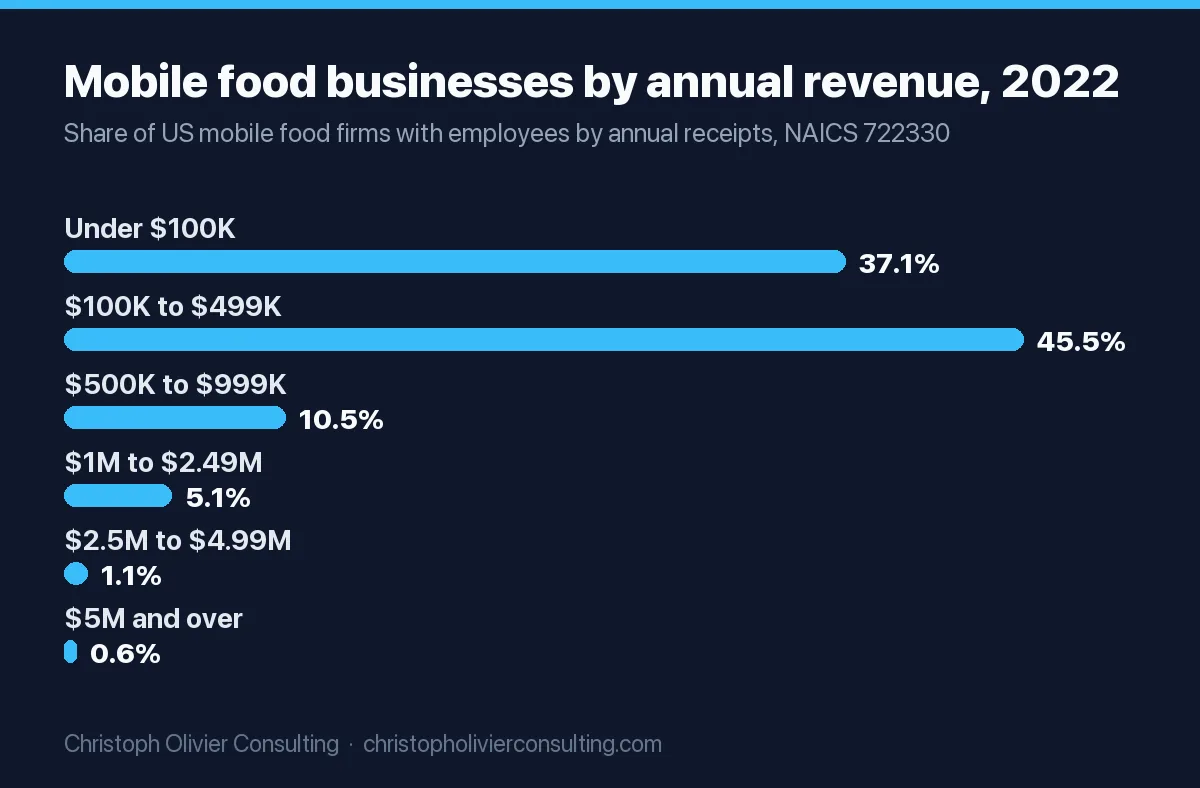
| Annual receipts (enterprise size) | Firms | Share of firms | Average receipts per firm |
|---|---|---|---|
| Under $100,000 | 4,274 | 37.1% | $41,877 |
| $100,000 to $499,999 | 5,238 | 45.5% | $240,110 |
| $500,000 to $999,999 | 1,213 | 10.5% | $686,559 |
| $1 million to $2.49 million | 591 | 5.1% | $1,424,369 |
| $2.5 million to $4.99 million | 132 | 1.1% | $3,132,318 |
| $5 million and over | 68 | 0.6% | Not shown (some cells suppressed) |
Source: Census SUSB 2022, NAICS 722330. Shares and averages are my calculation. Employer firms only.
Mobile food revenue by state
Where you park matters. Among the eight states with the most mobile food employer firms, receipts per establishment ranged from $297,006 in Pennsylvania to $514,029 in California in 2022 (Census SUSB state file, my calculation). California had 1,212 firms, Texas 1,108 and Florida 1,036. Higher receipts in a state usually come with higher wages and fees, so do not read the state figure as profit.
Food truck owner salary: owner pay is salary plus profit
When people ask what a food truck owner makes, they usually mean everything the business leaves for the owner. That is two separate things:
- A wage for the work you do. If you cook and run the window 9 hours a day, that labor is worth roughly the $39,650 median for a cook in special food services. If you also run the schedule, buying, staffing and bookings, the comparison is a food service manager in the same industry at $78,910 (BLS, May 2025).
- Profit on the money and risk you put in. What is left after you pay yourself that market wage. This is what a buyer would pay for, and what you lose if the truck sits.
On a sole proprietorship or single-member LLC, both parts arrive together as Schedule C net income, which is why the IRS line above looks the way it does. If you elect S corporation status, the IRS says the company must pay reasonable compensation to a shareholder who works in the business before non-wage distributions. My view: book your own labor as a cost at the market rate in your monthly P&L, even if you never cut yourself a paycheck. If the profit line after that is zero or negative, you have bought yourself a job, and a cook’s job pays the same without the loan. The same split is how I break down pay in the restaurant owner salary and coffee shop owner salary analyses.
Worked P&L: what a part-time, full-time and two-truck owner makes
This is my own calculation, not a survey result. Every input is either published or labeled as an assumption, so you can replace each line with your own numbers.
| Line (own calculation) | A. Part-time: owner + 1 helper, 150 days | B. Full-time: owner + cook + window, 240 days | C. Two trucks: owner + 3 cooks + 2 window staff, 240 days |
|---|---|---|---|
| Tickets per truck per day × average check | 80 × $14.00 | 100 × $14.50 | 100 × $14.50 per truck |
| Sales per service day | $1,120 | $1,450 | $2,900 |
| Annual revenue | $168,000 | $348,000 | $696,000 |
| Food, beverage and packaging (29.6%) | $49,728 | $103,008 | $206,016 |
| Staff wages × 1.25 load | $24,882 | $96,276 | $244,039 |
| Commissary, parking and event fees (5.2%) | $8,736 | $18,096 | $36,192 |
| Fuel, propane, card fees, POS, maintenance, insurance, marketing (14.7%) | $24,696 | $51,156 | $102,312 |
| Texas Type III license + pre-licensing inspection | $1,376 | $1,376 | $2,752 |
| Truck loan payments ($50,000 per truck, 10.5%, 7 years) | $10,116 | $10,116 | $20,233 |
| Owner pay (salary + profit, pre-tax) | $48,465 | $67,972 | $84,456 |
| Owner pay as share of revenue | 28.8% | 19.5% | 12.1% |
| Owner pay minus a $78,910 manager wage (true profit) | Not comparable (part-time) | −$10,938 | $5,546 |
| Census receipts band | $100K to $499K (median band) | $100K to $499K | $500K to $999K |
Assumptions and where each comes from:
- Food, beverage and packaging at 29.6% of sales. Chipotle’s 2025 ratio (10-K). A national chain buys cheaper than you, so treat this as a floor for a well-run menu, not a typical truck.
- Staff wages: BLS May 2025 medians in special food services: cooks $19.06 an hour, fast food and counter workers $16.58 an hour (BLS OEWS). Each staff member works 9 hours per service day (8 in model A). Model C adds a second truck with two cooks and one window worker.
- 1.25 load for payroll tax and benefits: private employers paid $25.20 an hour in total compensation for $20.15 in wages for part-time workers in June 2026 (BLS Employer Costs for Employee Compensation, my ratio).
- Commissary, parking and event fees at 5.2%, other operating costs at 14.7%. Chipotle’s 2025 occupancy ratio ($624.9 million) and other operating costs ratio ($1,755.8 million of $11,925.6 million revenue), which include marketing, card processing, utilities, technology and maintenance. I use them as proxies; a truck has no lease, but commissaries and many events charge a flat fee or a share of sales. Check your own contracts.
- Licensing: Texas DSHS charges a Type III mobile food vendor (one that cooks and serves from the vehicle) an $876 application fee and a $500 pre-licensing inspection, with a license that runs one year (Texas DSHS). City fire inspections, food handler cards and event permits are extra.
- Truck loan: $50,000 is the SBA microloan maximum, and SBA says microloan rates generally run 8% to 13% with a 7-year maximum term (SBA). I used 10.5%, the midpoint. Your truck may cost more or less, and you may finance it differently.
- Not included: owner’s health insurance and retirement, depreciation, income and self-employment tax, and slow months. The first season will usually be lower while you find profitable stops.
The two-truck result is the one most owners do not expect. Doubling revenue to $696,000 adds only about $16,000 to owner pay, because the second truck needs a full paid crew while the first truck uses the owner’s free labor. A second truck pays when the owner stops cooking and the crews still hit the ticket count.
How tickets per day and average check change owner pay
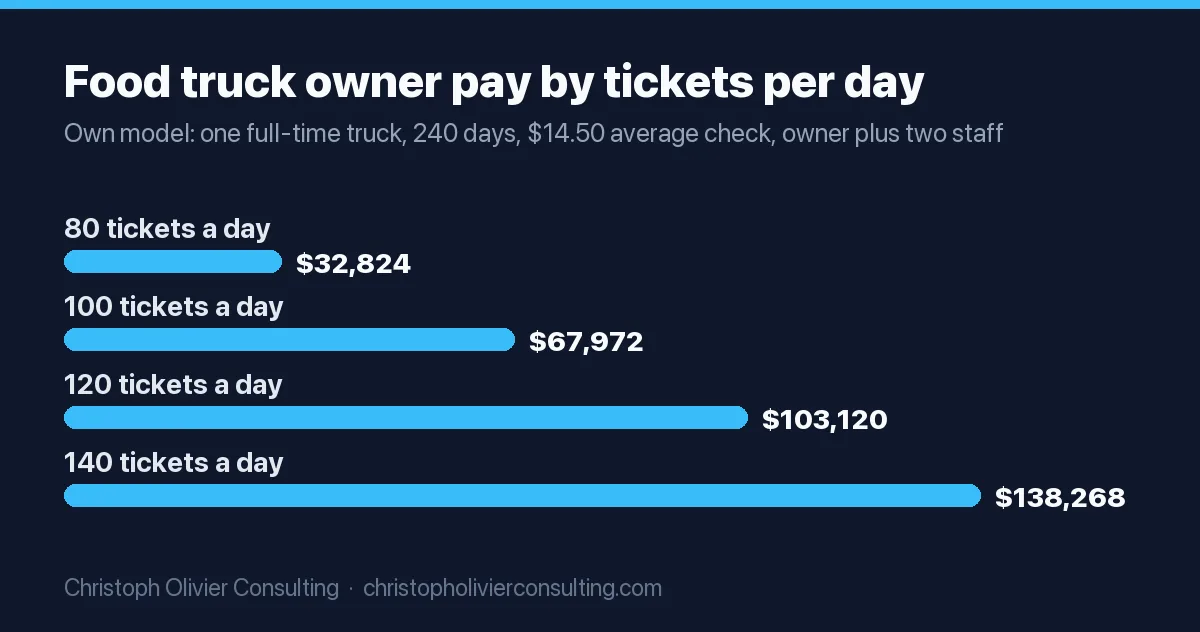
Same model as truck B (one full-time truck, 240 days, owner plus two staff). Only tickets per day and average check change. The $12 and $17 checks are scenarios, not reported figures.
| Tickets per day | $12.00 average check | $14.50 average check | $17.00 average check |
|---|---|---|---|
| 60 | −$20,504 | −$2,324 | $15,856 |
| 80 | $8,584 | $32,824 | $57,064 |
| 100 | $37,672 | $67,972 | $98,272 |
| 120 | $66,760 | $103,120 | $139,480 |
| 140 | $95,848 | $138,268 | $180,688 |
Break-even points for truck B at a $14.50 check (my calculation): about 61 tickets a day to cover all costs with nothing left for the owner, about 84 a day to pay the owner the $39,650 cook median, and about 106 a day to pay the $78,910 manager median. Each extra ticket per day is worth about $1,750 a year to the owner at that check.
Food truck profit margin
Margin numbers for food trucks vary so much online because people mix three different margins:
- Gross margin after food cost: 70.4% if food and packaging run 29.6% of sales, as at Chipotle in 2025. This is the number behind claims of “60% to 70% margins.” It ignores labor.
- Owner pay margin: what the owner keeps including their own labor. In my model this is 19.5% for a full-time single truck and 28.8% for a part-time truck where the owner does most of the work.
- True profit margin: after paying the owner a market wage. For truck B it is negative (−3.1%) when the owner’s labor is valued at the manager median. For the IRS restaurant and bar line it was 3.4% of receipts across all Schedule C filers in 2023, before any owner salary.
Big restaurant chains report margins after all staff are paid, which is why they are the honest comparison for the true profit margin. Industry-wide margin benchmarks for food service are in my profit margin by industry table. Treat any food truck margin quoted without a definition as unusable.
Is owning a food truck profitable in 2026?
It can be, but survival data says plan for a lean start. BLS tracks every private establishment that opens. Of the accommodation and food services establishments that opened in the year to March 2020, 85.5% were still open a year later and 59.3% were still open in March 2025, five years on (BLS Business Employment Dynamics). Of the 2015 cohort, 41.6% were open after ten years. These figures cover all restaurants, bars and hotels, not trucks alone, and only establishments with employees.
For 2026, two rule changes affect costs. Texas moved mobile food vendor licensing to the state: from July 1, 2026, every mobile food vendor in Texas must hold a DSHS license (Texas DSHS), and Austin Public Health’s page now points vendors to the state permit (Austin Public Health). Los Angeles County moved trucks into low, moderate and high risk permit tiers in March 2024, which cut the annual permit for a high-risk truck such as a taco or BBQ truck from $905 to $761 (LA County Environmental Health).
What food trucks make the most money?
No public dataset ranks food truck concepts by profit, so be wary of any list that does. The model shows what to look for instead: a higher average check, a food cost below 30%, and a menu simple enough for two people to push 100 or more tickets in a service. Permit tiers also matter: in Los Angeles County a moderate-risk truck that handles only precooked meats pays $598 a year against $761 for a high-risk truck handling raw meat, and its plan check costs $544 against $741 (LA County). Booked private events and catering are the other lever, because a guaranteed minimum removes the slow-day risk the sensitivity table shows.
Food truck startup costs: what the public sources cover
No government source publishes a price for food trucks, so any total startup figure you see online is an estimate. Here is what can be priced from official sources, and what you need quotes for.
| Cost item | Published figure | Source |
|---|---|---|
| Texas mobile food vendor license, Type III (cooking truck) | $876 application + $500 pre-licensing inspection; routine inspections $500 | Texas DSHS, 2026 |
| LA County mobile food facility annual permit | $325 low risk, $598 moderate risk, $761 high risk | LA County, effective March 6, 2024 |
| LA County plan check for a new truck | $544 low or moderate risk, $741 high risk | Same |
| LA County mobile support unit or dependent food operator approval | $313 / $309 | Same |
| Card reader (Square Terminal) | $299 | Square, 2026 |
| Card processing (Square Free plan, in person) | 2.6% + 15¢ per transaction | Square pricing, 2026 |
| SBA microloan | Up to $50,000; average about $13,000; rates generally 8% to 13%; up to 7 years | SBA |
| Truck or trailer, build-out, generator, insurance, commissary deposit | Not published by any public source | Get three written quotes |
Is $50k enough to start a food truck business?
Run this test before you sign for a truck. In model B, the fixed costs that do not shrink on a slow day (staff, loan payment, license) come to about $107,768 a year, or roughly $8,980 a month (my calculation). Holding three months of those as working capital takes about $27,000. That leaves about $23,000 of a $50,000 budget for the truck, equipment, plan check and first inventory. That works for a used trailer or a truck you staff yourself at first; it does not cover a new custom build with paid staff from day one. If your quotes for the truck exceed what is left after working capital, the budget fails.
Food truck owner pay worksheet: run your own numbers
Copy this into a spreadsheet. Each line has a pass/fail check taken from the model and sources above.
| Step | Formula | Pass if |
|---|---|---|
| 1. Tickets per service day | POS transactions ÷ service days (last 8 weeks) | 85 or more at a $14.50 check (covers costs plus a cook wage for you) |
| 2. Average check | Net sales ÷ transactions | Rising or flat after each menu price change |
| 3. Food and packaging cost | Purchases adjusted for inventory ÷ net sales | 32% or lower (Chipotle 2025: 29.6%) |
| 4. Staff cost | Wages × 1.25 ÷ net sales | Under 30%; model B runs 27.7% |
| 5. Fixed costs per month | Staff + loan + license + commissary flat fee | Covered by 3 months of cash in the bank |
| 6. Your market wage | Your hours ÷ 2,080 × $39,650 (cook) or $78,910 (manager) | Booked as a cost before profit |
| 7. True profit | Revenue minus all costs including step 6 | Above zero; if not, the truck pays you less than a job |
| 8. Second truck test | Second truck’s sales × 50.5% minus its full crew cost | Positive by more than its loan payment |
The 50.5% in step 8 is what is left of each sales dollar after food (29.6%), commissary and fees (5.2%) and other operating costs (14.7%) in the model. If step 1 fails, adding a truck multiplies the problem: fix your stops, hours and event calendar first. Marketing that fills a calendar of booked events is usually where the ticket count is won, and the restaurant marketing strategies ranked by what you keep apply to trucks too. If you want an outside view of where your numbers break, you can book a consultation.
Ready to scale your revenue?
Book a free 30-min consultation. We’ll diagnose your growth bottleneck and map out the 3 highest-leverage moves for your business.
Frequently asked questions
How much does a food truck owner make?
No government survey reports food truck owner income. In a model built from Census, BLS and 10-K data, an owner earns about $48,000 pre-tax running a truck 150 days a year, about $68,000 running one truck full time at 100 tickets a day and a $14.50 check, and about $84,000 with two trucks. At 60 tickets a day the full-time owner earns roughly nothing.
How much do food truck owners make per year on average?
There is no published average for trucks alone. The closest IRS line, restaurants and drinking places filed on Schedule C, averaged $3,995 of net income per return in tax year 2023, and $21,282 among the 57.6% of filers that made a profit. Employer mobile food firms averaged $344,672 in revenue in 2022, per Census SUSB.
How much does a food truck make a day?
Census does not count service days, so there is no official daily figure. Spreading the 2022 Census average of $344,672 per employer mobile food firm over 240 service days gives about $1,436 a day. A practical way to estimate your own day: tickets times average check, for example 100 tickets at $14.50 is $1,450.
What is a good food truck profit margin?
Define the margin first. Gross margin after food cost is about 70% if food and packaging run near Chipotle's 29.6% of sales. Owner pay, including the owner's own labor, was 19.5% of revenue for a full-time truck in my model. After paying the owner a market manager wage, that same truck's true profit margin was slightly negative.
Is 50k enough to start a food truck business?
Only for a lean start. In the full-time model, staff, loan and license costs run about $8,980 a month, so three months of working capital takes about $27,000. That leaves about $23,000 for the truck, equipment, plan check and first inventory, which fits a used trailer or an owner-staffed truck, not a new custom build with paid crew.
What is the failure rate of a food truck?
BLS does not track food trucks separately. For all accommodation and food services establishments that opened in the year to March 2020, 85.5% were still open one year later and 59.3% after five years, per BLS Business Employment Dynamics. That means about 4 in 10 had closed within five years. The data covers only establishments with employees.
Are food trucks profitable in 2026?
They can be, with enough volume. In the model, a single full-time truck covers all costs at about 61 tickets a day and pays the owner a $39,650 cook median at about 84 tickets. Costs also moved: Texas requires a state DSHS license for every mobile food vendor from July 1, 2026, at $876 plus a $500 inspection for a cooking truck.
Small business owner income