
A gas station owner who runs one store and works as its manager usually takes home somewhere between a store manager’s wage and a few hundred thousand dollars a year, pre-tax. The amount depends on two numbers: how many gallons the station sells and how much it sells inside the store. The IRS counted 8,157 gas station sole proprietorships for tax year 2023. On average they reported $33,236 of net profit, and the 57% that made money averaged $84,203 (IRS SOI Table 1, 2023, my calculation). By comparison, general and operations managers employed at gas stations had a median wage of $61,360 in May 2025 (BLS OEWS).
Short answer: In my worked model built from public data, an owner-operator earns about $71,000 a year from a small station selling 40,000 gallons a month, about $240,000 from a typical 76,000-gallon station with a busy store, and about $578,000 from a 150,000-gallon site. These are pre-tax amounts before depreciation and loan payments, and they include the manager’s salary the owner would otherwise pay. If the fuel margin drops from 38 to 25 cents a gallon, the small station falls to roughly break-even. No government survey publishes gas station owner income directly.
Below are the figures that do exist. They cover Census revenue for every U.S. gas station firm, IRS profit for sole owners, BLS wages and the fuel and in-store margins disclosed in the 10-K filings of Casey’s, Murphy USA and ARKO. After that, I turn them into a P&L you can rerun with your own gallons.
Gas station owner salary: what the data actually measures
Salary sites list “gas station owner” pay, but those numbers come from job postings for managers, not from owners’ tax returns. Each source below counts a different slice of the business. Read the “what it measures” column before you compare numbers.
| Source and year | What it measures | Figure | How it was calculated |
|---|---|---|---|
| IRS SOI, tax year 2023 | Net profit per gas station sole proprietorship, winners and losers combined | $33,236 | $271.1 million net income less deficit ÷ 8,157 returns (my calculation) |
| IRS SOI, tax year 2023 | Net profit per sole proprietorship that made money | $84,203 | $394.0 million ÷ 4,679 returns; average receipts $2.24 million, so profit was 3.8% of sales (my calculation) |
| Census SUSB 2022, NAICS 447110 | Revenue per gas station with a convenience store, employer businesses | $5.54 million | $534.3 billion receipts ÷ 96,486 establishments (my calculation) |
| Census Nonemployer Statistics 2022, NAICS 4571 | Revenue per gas station with no paid employees | $416,604 | $2.87 billion ÷ 6,897 businesses (my calculation) |
| BLS OEWS, May 2025, NAICS 457100 | Median wage of general and operations managers employed by gas stations | $61,360 | Published. First-line retail supervisors: $43,150. Cashiers: $30,530 ($14.68 an hour) |
| NACS, March 2026 | Retail fuel margin before and after store expenses | 38 cents gross, about 15 cents pre-tax per gallon | Published five-year average gross margin; expenses “typically over 20 cents per gallon” |
What to take from this table:
- The IRS figures are the only direct read on owner profit, and they skew small. The table covers only owners who file a Schedule C. Owners who run their station through an S corporation, partnership or C corporation are not in it, and the IRS does not publish a gas station owner profit figure for those entities.
- Losses are common. 3,478 of the 8,157 sole proprietor returns, or 42.6%, did not show a profit for 2023 (my calculation).
- Revenue is not income. A $2 million station can still pay its owner less than a cashier earns, because fuel turns over at thin margins and part of the pump price is tax.
How much revenue a gas station brings in, by size
The $5.54 million average is pulled up by chains. Census also groups firms by annual revenue. Here is the breakdown for gas stations with convenience stores, the format that sells most U.S. fuel.
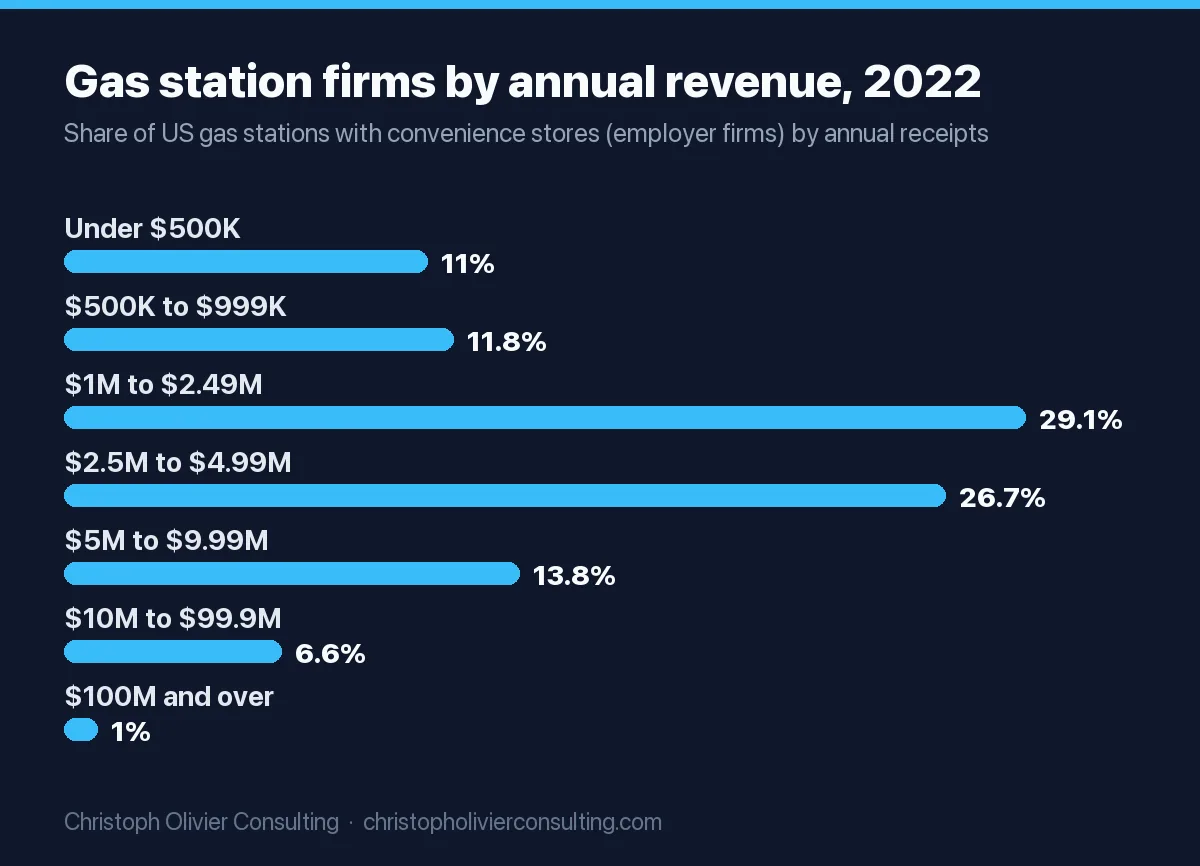
| Firm’s annual receipts | Firms | Share of firms | Cumulative share | Average receipts per station | Employees per station | Payroll as share of receipts |
|---|---|---|---|---|---|---|
| Under $500,000 | 5,805 | 11.0% | 11.0% | $266,305 | 1.8 | 11.8% |
| $500,000 to $999,999 | 6,256 | 11.8% | 22.8% | $736,684 | 3.0 | 8.3% |
| $1 million to $2.49 million | 15,377 | 29.1% | 51.9% | $1,691,347 | 4.6 | 5.7% |
| $2.5 million to $4.99 million | 14,135 | 26.7% | 78.6% | $3,454,708 | 6.2 | 4.2% |
| $5 million to $9.99 million | 7,282 | 13.8% | 92.4% | $6,169,357 | 8.9 | 3.9% |
| $10 million to $99.9 million | 3,515 | 6.6% | 99.0% | $7,907,425 | 11.3 | 4.0% |
| $100 million and over | 522 | 1.0% | 100% | $8,854,490 | 12.5 | 3.9% |
Source: U.S. Census Bureau, SUSB 2022, U.S. 6-digit NAICS by enterprise receipts size, NAICS 447110 (gasoline stations with convenience stores; renumbered 457110 in NAICS 2022), released April 10, 2025. Employer firms only. Receipts include fuel sold at pump prices. Combined bands, shares and per-station averages are my calculations.
What the table tells you:
- The median gas station firm takes in $1 million to $2.49 million a year. 51.9% of firms are at or below that band, and almost every firm in it runs a single station with 4.6 employees.
- The chains own the volume. The 522 firms with $100 million or more in receipts operate 38,137 stations and collect 63.2% of the industry’s revenue.
- Payroll is a small share of revenue, but not of profit. Payroll is 4% to 6% of receipts for most stations. That sounds small until you remember the whole store may keep only 3% to 6% of receipts before the owner is paid.
Stations without a store (NAICS 447190, which includes truck stops) are fewer and bigger: 12,757 locations averaging $13.4 million each in 2022. Ownership is also concentrated at the top among convenience stores. NACS counted 151,975 U.S. convenience stores at the end of 2025, 122,620 of them selling fuel. 63% belong to companies with 10 or fewer stores.
Gas station profit margin: cents per gallon vs inside the store
Gas station margins are quoted two ways. Fuel is measured in cents per gallon, because the pump price moves every day. The store is measured as a percentage of sales. The three largest public operators with U.S.-only stores disclose both in their 10-K filings.
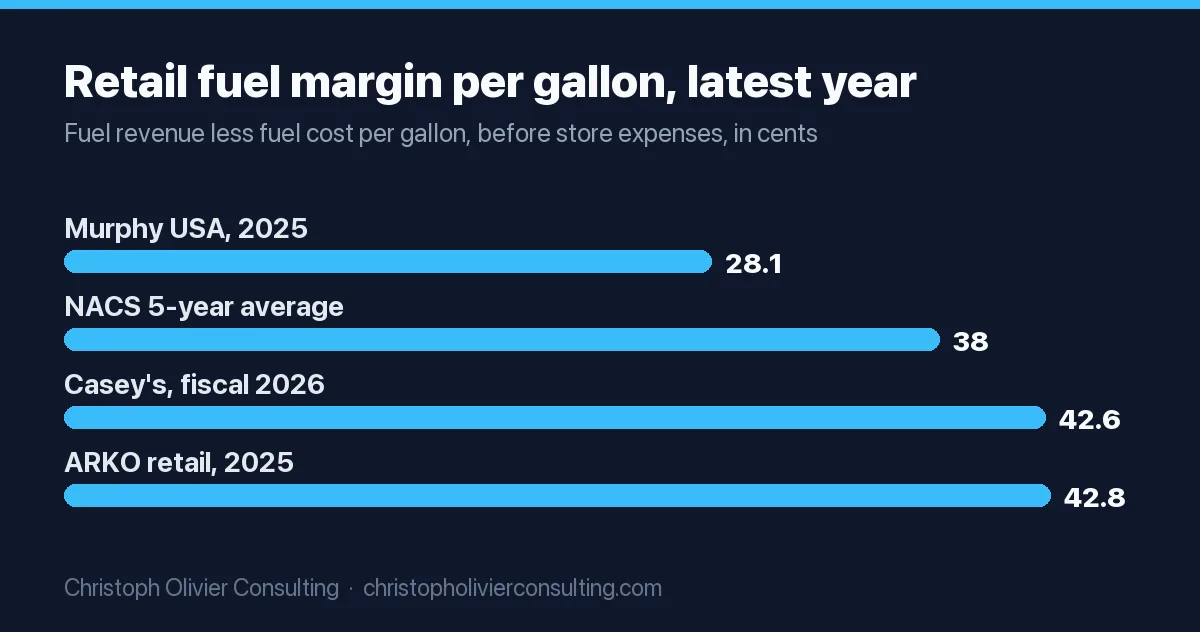
| Measure | Casey’s, fiscal 2026 | Murphy USA, 2025 | ARKO retail segment, 2025 |
|---|---|---|---|
| Stores | 2,944 | 1,800 | 1,118 |
| Retail fuel margin, cents per gallon | 42.6 | 28.1 | 42.8 |
| Gallons per store | 1.217 million a year (about 101,000 a month) | 235,800 a month | Not comparable (256 stores converted to dealers during the year) |
| Inside (merchandise) gross margin | 42.2% (my calculation: prepared food 58.6%, grocery and general merchandise 35.8%) | 20.2% | 33.7% |
| Inside share of gross profit | 61.9% (my calculation) | 36.9% (my calculation) | 55.9% (my calculation) |
| Net income as share of total revenue | 4.1% (my calculation) | 2.4% (my calculation) | 0.3% company-wide, including wholesale (my calculation) |
Sources: Casey’s General Stores Form 10-K for the year ended April 30, 2026; Murphy USA Form 10-K for 2025; ARKO Corp. Form 10-K for 2025. Fuel margins are revenue less fuel cost per gallon, before store expenses. Murphy’s figure is its retail margin only; its total fuel contribution including supply and RINs was 30.7 cents.
Three patterns stand out:
- Fuel brings people in, and the store makes the money. Casey’s sells pizza and prepared food at a 58.6% margin, and its stores earned 61.9% of their gross profit inside. Murphy runs small stores next to Walmart and sells mostly tobacco and drinks. It earns a 20.2% inside margin and depends on fuel for 63% of gross profit. Industry-wide, fuel was 65.0% of convenience store sales but only 38.8% of gross profit dollars in 2025 (NACS, April 2026).
- Net margins are thin even at scale. Casey’s, one of the most profitable chains, kept 4.1% of revenue as net income. That is close to the 3.8% that profitable IRS sole proprietors kept before income tax.
- The volume leader has the lowest margin. Murphy prices low to sell 235,800 gallons per store each month, more than twice Casey’s per-store volume, and takes 14.5 cents less per gallon.
Gas station gross margin on fuel: where the cents go
Most of the pump price never reaches the owner. EIA reports an average 2025 retail price of $3.22 a gallon for all grades and formulations (EIA). That price includes 18.40 cents of federal tax and, as of January 2026, an average of 33.55 cents of state taxes and fees (EIA, Factors affecting gasoline prices). The station’s gross margin is what is left after it pays for the delivered fuel, taxes included.
Card fees then come out of that margin. U.S. convenience retailers paid a record $21.3 billion in card fees in 2025 on $817.5 billion of sales (NACS), or 2.6%. At $3.22 a gallon, that works out to about 8.4 cents per gallon (my calculation). Casey’s, with chain-level bargaining power, reported $279 million in card fees for fiscal 2026, or 1.6% of revenue. A single-store owner will usually pay closer to the industry rate. On a 38-cent gross margin, the card companies take more than a fifth before rent, payroll or the electric bill.
Owner pay is salary plus profit
“Owner salary” mixes two paychecks. Keep them separate when you read your own books:
- The manager wage. What it would cost to hire someone to run the station day to day. The BLS median for general and operations managers at gas stations is $61,360 (May 2025). A first-line supervisor costs a median $43,150.
- The owner return. What is left after every employee, the card companies, rent, repairs, insurance and environmental compliance are paid, with a market manager wage counted as a cost. That is your return on the capital and the risk, including the risk of a fuel leak.
The test: if your total take is close to $61,360, you own a job, not a business. You could earn about the same running someone else’s station without signing for the tanks. Under federal rules, owners of petroleum underground storage tanks at a marketing facility must carry $1 million of financial responsibility per leak occurrence (40 CFR 280.93). That liability is part of what the owner return pays for.
Worked P&L: what a small, typical and high-volume station owner makes
This is my own calculation, not a survey result. Each input is sourced or labeled as an assumption, so you can replace it with your own numbers. In all three cases the owner works as the general manager and is not paid separately.
| Line (own calculation, per year) | Small: 40,000 gal/month, $50,000 inside sales/month | Typical: 76,000 gal/month, $120,000 inside/month | High-volume: 150,000 gal/month, $250,000 inside/month |
|---|---|---|---|
| Fuel sales at $3.224/gal | $1,547,520 | $2,940,288 | $5,803,200 |
| Inside sales | $600,000 | $1,440,000 | $3,000,000 |
| Total revenue | $2,147,520 | $4,380,288 | $8,803,200 |
| Fuel gross profit (38 cents/gal) | $182,400 | $346,560 | $684,000 |
| Inside gross profit (30%) | $180,000 | $432,000 | $900,000 |
| Total gross profit | $362,400 | $778,560 | $1,584,000 |
| Card fees (2.6% of revenue) | $55,954 | $114,129 | $229,368 |
| Hired payroll, loaded (Census payroll ratio × 1.307, minus the manager the owner replaces) | $79,797 | $160,266 | $368,556 |
| Rent or ground lease (assumption) | $60,000 | $96,000 | $144,000 |
| Utilities, repairs, insurance, tank compliance, POS, shrink, accounting (assumption) | $96,000 | $168,000 | $264,000 |
| Owner pay (salary + profit, pre-tax) | $70,650 | $240,165 | $578,077 |
| Owner pay as share of revenue | 3.3% | 5.5% | 6.6% |
| Owner pay above a hired manager’s $61,360 | $9,290 | $178,805 | $516,717 |
| Inside share of gross profit | 49.7% | 55.5% | 56.8% |
| Census revenue band | $1M to $2.49M (median band) | $2.5M to $4.99M | $5M to $9.99M |
Assumptions and where each comes from:
- Gallons. NACS says the average U.S. fueling location sells about 2,500 gallons a day, roughly 76,000 a month (NACS, June 2026). That is the typical case. The small case is about half of that. The high-volume case falls between Casey’s 101,000 and Murphy’s 235,800 gallons a month.
- Fuel price and margin. $3.224 is EIA’s 2025 average for all grades. The 38-cent margin is the NACS five-year average. It sits between Murphy’s 28.1 cents and Casey’s 42.6 cents.
- Inside sales and margin. U.S. convenience stores sold $341.2 billion inside in 2025 (NACS). Spread over 151,975 stores, that is about $187,000 a store each month (my calculation), and Murphy reports $203,700. The 30% inside margin is an assumption between Murphy’s 20.2% and ARKO’s 33.7%. A store with a real food program can do better, as Casey’s 42.2% shows.
- Payroll. I used the Census 2022 payroll share of receipts for each station’s revenue band: 5.7%, 4.2% and 3.9%. I loaded it by 1.307 for payroll taxes and benefits, the ratio of total compensation ($27.07) to wages ($20.71) per hour for retail trade in June 2026 (BLS Employer Costs for Employee Compensation). Then I subtracted one loaded general manager at $61,360, because the owner does that job.
- Rent and other operating costs are assumptions. No public source breaks these out for small stations. If you own the land, rent drops out, but then you count the mortgage. Repairs to dispensers, tanks and canopies vary widely by the age of the site.
- Not included: depreciation, loan payments, income tax, lottery and ATM commissions, car wash income and fuel supplier incentive payments. Supply agreements differ on these terms, so read yours.
Cross-check: the small station’s owner pay of $70,650 on $2.15 million of revenue is 3.3% of sales. That lands just under the 3.8% that profitable gas station sole proprietors reported to the IRS for 2023 on average receipts of $2.24 million.
How fuel margin and inside margin change owner pay
Same model, varying only the fuel margin and the inside margin. Each cell shows small / typical / high-volume owner pay, rounded to the nearest $100. The 25-cent and 45-cent margins are scenarios, not reported averages.
| Inside gross margin | Fuel margin 25 cents/gal | 38 cents/gal (NACS 5-year average) | 45 cents/gal |
|---|---|---|---|
| 25% | −$21,800 / $49,600 / $194,100 | $40,600 / $168,200 / $428,100 | $74,200 / $232,000 / $554,100 |
| 30% | $8,200 / $121,600 / $344,100 | $70,600 / $240,200 / $578,100 | $104,200 / $304,000 / $704,100 |
| 35% | $38,200 / $193,600 / $494,100 | $100,600 / $312,200 / $728,100 | $134,200 / $376,000 / $854,100 |
The left column matters most. A 13-cent drop in fuel margin costs the small station $62,400 a year, nearly all of its profit. A five-point gain in inside margin is worth $30,000. If you are small, your fuel margin is set by the station across the street, but your inside margin is set by your own shelves and food counter. That is why I think marketing dollars at a gas station belong inside the store: loyalty offers, food and the items that bring people in from the pump. The tactics in this retail marketing plan for independent stores fit a station as well as a shop.
How much do gas station owners make off of gas?
On a gross basis, about 38 cents a gallon over the past five years by the NACS count. After store expenses, which NACS puts at over 20 cents a gallon, roughly 15 cents is left as pre-tax profit. On 76,000 gallons a month, that is about $137,000 a year of fuel profit before income tax (my calculation). Margins swing a lot from year to year. Casey’s earned 38.7 cents in fiscal 2025 and 42.6 cents in fiscal 2026. Casey’s said the last quarter of fiscal 2026 brought “historically higher than average” fuel margins.
How much of that margin a station owner keeps depends on the supply deal. ARKO’s 10-K shows the split in a large dealer network. At its 1,801 “fuel supply” sites, dealers buy fuel from ARKO at a price that reflects ARKO’s fuel cost plus a fee, and ARKO’s wholesale margin was 6.3 cents a gallon in 2025. The rest of the pump margin belongs to the dealer. At its 298 “consignment” sites, ARKO owns the fuel until the customer buys it, and its reported fuel margin was 27.5 cents a gallon. The dealer there receives either a percentage of the fuel gross profit or a fixed fee per gallon, under the terms of each agreement.
How much do gas station franchise owners make?
Most branded gas stations are not franchises in the restaurant sense. The brand on the canopy usually comes with a fuel supply agreement, and the owner’s income depends on which of three setups they are in:
| Setup | Who owns the fuel | Owner’s income | Who carries the property |
|---|---|---|---|
| Open dealer (owns or controls the site, buys branded or unbranded fuel) | Dealer buys it | Full fuel margin plus inside profit, minus all costs | Dealer |
| Lessee dealer (leases the station from a fuel distributor) | Dealer buys it from the landlord distributor | Fuel margin plus inside profit, minus rent paid to the distributor | Distributor owns; dealer pays rent |
| Consignment dealer | Distributor owns the fuel until sale | A percentage of fuel gross profit or a fixed fee per gallon, plus inside profit | Varies by agreement |
Categories as described in the ARKO Corp. 2025 10-K. ARKO supplied 2,099 dealer locations at year end 2025 and converted 256 company-run stores to dealer locations during the year, which shows that for some sites a large operator earns more from fuel supply and rent than from running the store itself.
There is no published average income for branded dealers. If someone quotes one, ask whether it is after rent to the distributor and after card fees.
Pass/fail worksheet: does this station pay its owner?
Use this before you buy a station or sign a supply agreement. Each line has a pass mark based on the figures above. More than two fails means the deal mostly buys you a job.
| Check | How to calculate it | Pass | Why that mark |
|---|---|---|---|
| 1. Fuel margin after card fees | (Fuel gross profit − fuel card fees) ÷ gallons, trailing 12 months | Above 20 cents | NACS puts store expenses at over 20 cents a gallon; below that, fuel does not cover its share of costs |
| 2. Inside share of gross profit | Inside gross profit ÷ total gross profit | 50% or more | The industry gets 61.2% of gross profit inside (NACS 2025); the small model station needs about 50% to pay its owner |
| 3. Inside gross margin | Inside gross profit ÷ inside sales | 30% or more | Below 25%, the small model station loses money if fuel margins fall to 25 cents |
| 4. Owner take vs a hired manager | Pre-tax profit before your own pay − $61,360 | Positive by $50,000+ | Below that, the return does not pay for the tank liability and capital at risk |
| 5. 25-cent stress test | Rerun the P&L at 25 cents a gallon | Still positive | Murphy USA, the volume leader, earned 28.1 cents in 2025; margins can fall that far |
| 6. Card fee rate | Total card fees ÷ total revenue | 2.6% or lower | The 2025 industry rate (NACS); Casey’s paid 1.6% |
| 7. Volume check | Gallons per month | Above 76,000 or a strong store | The NACS average fueling site sells about 2,500 gallons a day |
| 8. Supply contract terms | Read minimum volume, term, rebranding and image repayment clauses | No penalty that exceeds one year of owner profit | Owner pay at the small station is about $70,000 a year; one bad clause can erase it |
Is owning a gas station a good investment?
It can be, but the numbers favor size and a real store. At the median Census band ($1 million to $2.49 million of revenue), my model pays an owner-manager only about $9,000 more than a hired manager’s salary. That is before loan payments on a purchase. At the typical 76,000-gallon station with $120,000 a month of inside sales, owner pay is about $240,000. The gap is almost entirely inside sales and gallons. A good station is not one with a higher pump price. It is one where people stop, then walk in.
Profit margin data puts this in context. A store keeping 3% to 6% of revenue looks thin next to most businesses on the profit margin by industry benchmarks, but the volume is high. Owners in nearby retail formats run on similar math, as the liquor store owner income breakdown and the car wash owner salary analysis show. A car wash is also the most common add-on at a fuel site. If you are buying a station or a small group, the small business succession data explains why so many independent stores are changing hands now.
How much does it cost to open a gas station?
No government source publishes an average cost to build or buy a gas station, and the figures quoted online are not sourced. What is set by rule is the liability you take on. A station selling petroleum from underground tanks must show $1 million of financial responsibility per occurrence and $1 million in annual aggregate for 1 to 100 tanks (40 CFR 280.93). Owners usually meet that through tank insurance or a state fund. Land, tanks, dispensers, canopy, store build-out, permits and opening inventory make up the rest, and each varies by state and site. Get quotes for your site. If you are buying an existing station, ask for three years of fuel gallons and inside sales from the books, not the seller’s summary.
If the worksheet shows the store side failing, the fix is usually a marketing and merchandising problem more than a fuel problem. If you want a second pair of eyes on the numbers, you can book a consultation.
Ready to scale your revenue?
Book a free 30-min consultation. We’ll diagnose your growth bottleneck and map out the 3 highest-leverage moves for your business.
Frequently asked questions
How much does a gas station owner make a year?
No government survey reports it directly. Gas station sole proprietors reported average net profit of $33,236 for 2023, and the 57% that were profitable averaged $84,203 (IRS SOI). In a model built from Census, BLS, NACS and 10-K data, an owner-manager earns about $71,000 at a 40,000-gallon station, $240,000 at a typical 76,000-gallon site and $578,000 at 150,000 gallons, pre-tax.
Do gas station owners make good money?
Owners of high-volume stations with strong inside sales do. At the median Census revenue band of $1 million to $2.49 million, a modeled owner-manager earns only about $9,000 more than the $61,360 median wage of a hired gas station manager (BLS, May 2025). And 42.6% of gas station sole proprietors showed no profit for 2023 on IRS returns.
What is a typical gas station profit margin?
Net margins are thin. Casey's kept 4.1% of revenue as net income in fiscal 2026 and Murphy USA kept 2.4% in 2025. Profitable gas station sole proprietors kept 3.8% of receipts for 2023 before income tax (IRS SOI). On fuel, NACS puts the five-year average gross margin at about 38 cents a gallon and pre-tax profit at about 15 cents.
What is the gas station gross margin on fuel?
Gross fuel margins were 42.6 cents a gallon at Casey's in fiscal 2026, 28.1 cents at Murphy USA and 42.8 cents in ARKO's retail segment in 2025, per their 10-Ks. NACS reports a five-year average of about 38 cents. Card fees take roughly 8.4 cents of that at the 2025 industry rate of 2.6% and a $3.22 average pump price.
What makes the most money in a gas station?
The store, not the pump. Fuel was 65.0% of U.S. convenience store sales but 38.8% of gross profit in 2025 (NACS). Casey's earned 58.6% gross margin on prepared food and dispensed beverages and 35.8% on grocery and general merchandise in fiscal 2026, against about 14% of fuel revenue.
How much do gas station franchise owners make?
There is no published average. Most branded stations run on fuel supply agreements, not classic franchises. Open dealers keep the full fuel margin, lessee dealers pay rent to the distributor and consignment dealers get a share of fuel gross profit or a fixed fee per gallon, as ARKO's 2025 10-K describes. Ask any seller for income after rent and card fees.
How much does it cost to open a gas station?
No government source publishes an average build or purchase cost, and online figures are unsourced. The fixed rule is liability: owners of petroleum tanks at a marketing facility must show $1 million of financial responsibility per occurrence under 40 CFR 280.93. Land, tanks, dispensers, canopy, store build-out and permits vary by state and site, so get site-specific quotes.
Small business owner income