

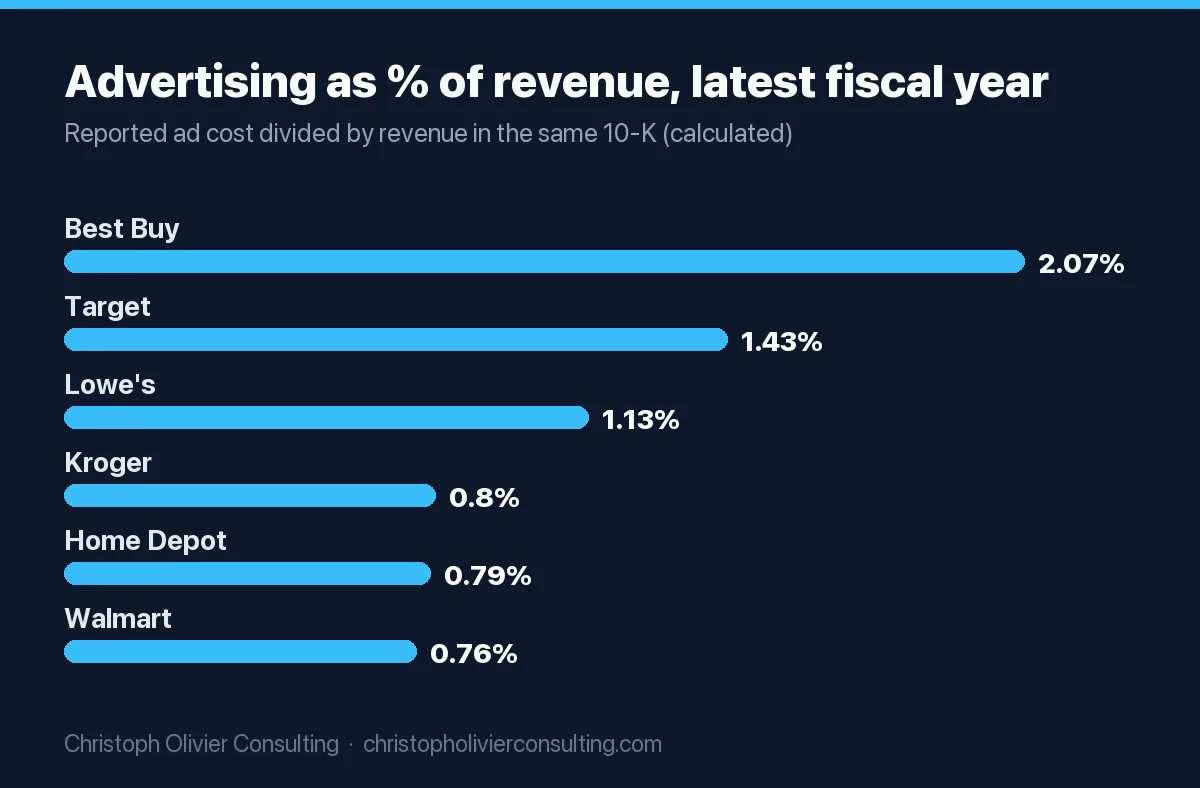
Walmart spent $5.4 billion on advertising in fiscal 2026 (the year ended January 31, 2026), the most of any store-based US retailer. Home Depot spent $1.3 billion, Target $1.5 billion, Kroger $1.18 billion, Lowe’s $978 million and Best Buy $861 million in their latest fiscal years. Costco publishes no advertising figure at all. Every number here is the advertising line from the company’s own 10-K on SEC EDGAR, and as a share of revenue none of them reaches 2.1%.
Short answer: Walmart: $5.4 billion (fiscal 2026, 0.76% of revenue). Target: $1.5 billion, net of vendor reimbursements (2025, 1.43%). Home Depot: $1.3 billion, net of co-op allowances (fiscal 2025, 0.79%). Lowe’s: $978 million (2025, 1.13%). Costco: not disclosed. The twist: Walmart’s own advertising business brought in nearly $6.4 billion in the same year, more than it spent on ads.
Each row keeps the company’s own fiscal-year label, because retailers name their years differently. Walmart and Best Buy call the year that ended in late January 2026 “fiscal 2026”. Target, Home Depot, Lowe’s and Kroger call the same period “2025” or “fiscal 2025”. Costco’s year ends in late August, so its latest year is fiscal 2026, ended August 30, 2026.
Retail advertising spend compared: Walmart, Target, Costco, Home Depot, Lowe’s
Spend and revenue in each row come from the same 10-K. The percentage column is my calculation, with one formula for every company: advertising as % of revenue = reported advertising cost ÷ total revenue (or net sales) × 100. Worked example, Walmart fiscal 2026: $5,400 million ÷ $713,163 million × 100 = 0.76%.
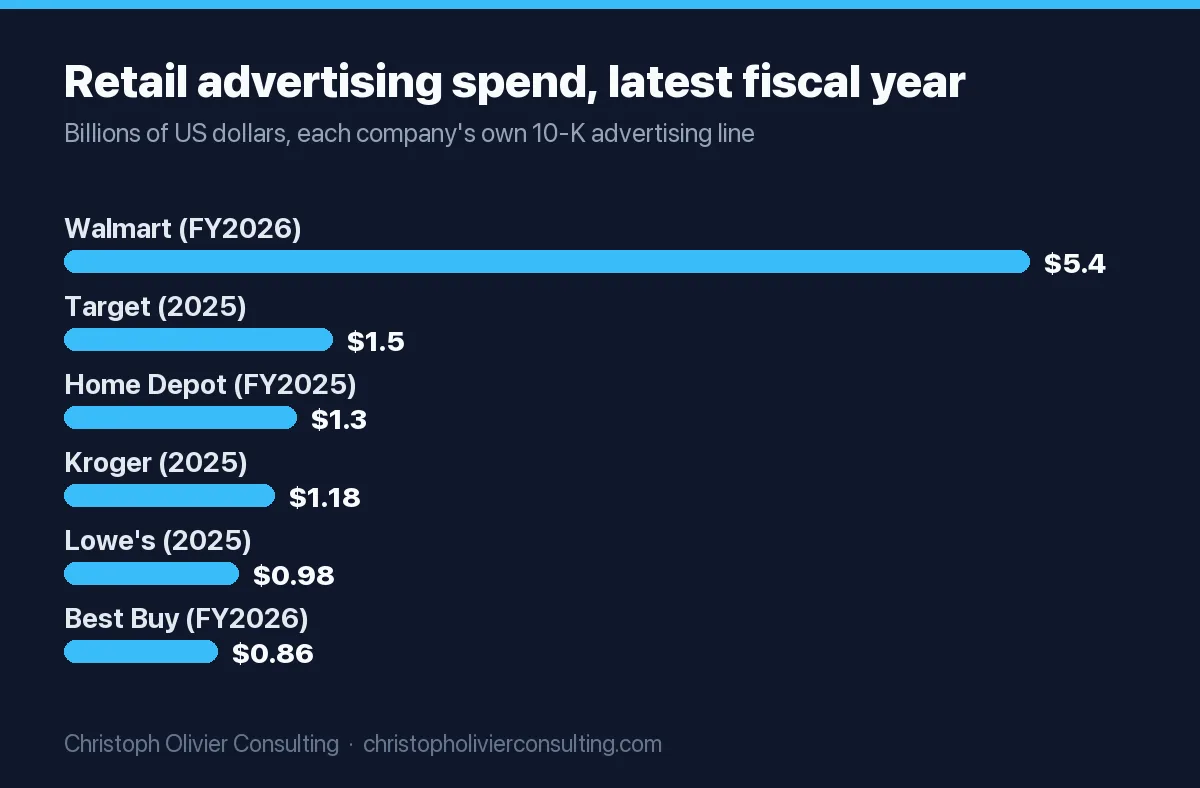
| Retailer | Exact line in the 10-K | Fiscal year (company label, end date) | Advertising (reported) | Revenue (same filing) | % of revenue (calculated) | Source |
|---|---|---|---|---|---|---|
| Walmart | “Advertising costs”, in operating, selling, general and administrative expenses | Fiscal 2026, Jan 31, 2026 | $5.4 billion | $713,163 million total revenues | 0.76% | Walmart 10-K |
| Target | “Advertising costs, net of vendor reimbursements”, in SG&A | 2025, Jan 31, 2026 | $1.5 billion | $104,780 million net sales | 1.43% | Target 10-K |
| Home Depot | “Net advertising expense”, in SG&A, after co-op allowances | Fiscal 2025, Feb 1, 2026 | $1.3 billion | $164,683 million net sales | 0.79% | Home Depot 10-K |
| Kroger | “Advertising costs”, inside merchandise costs | 2025, Jan 31, 2026 | $1,180 million | $147,642 million sales | 0.80% | Kroger 10-K |
| Lowe’s | “Advertising expenses”, in SG&A | 2025, Jan 30, 2026 | $978 million | $86,286 million net sales | 1.13% | Lowe’s 10-K |
| Best Buy | “Advertising costs”, in SG&A | Fiscal 2026, Jan 31, 2026 | $861 million | $41,691 million revenue | 2.07% | Best Buy 10-K |
| Costco | No advertising line in the 10-K | 2026, Aug 30, 2026 | Not disclosed | $303,154 million total revenue | n/a | Costco 10-K |
Two reading notes. Walmart, Target and Home Depot round to the nearest $0.1 billion, so their percentages can move by a few hundredths of a point. “Not disclosed” for Costco means the annual report contains no dollar figure for advertising, not that Costco spends nothing.
Why retail ad budgets are under 2.1% of revenue
Retail ad budgets look tiny next to consumer brands such as Coca-Cola and Nike, whose filings are compared on our big brand marketing budgets page. The filings point to four reasons the retailers sit so much lower.
- Revenue is huge relative to margin. Walmart’s cost of sales was $535,395 million in fiscal 2026, about 75% of its $713,163 million in total revenues (my calculation from the 10-K). A 10% ad ratio would wipe out the profit on that kind of margin.
- Suppliers pay part of the bill. Target reports its figure “net of vendor reimbursements”. Home Depot records “co-op advertising allowances that are reimbursements of specific, incremental, and identifiable costs” as an offset against advertising expense. Walmart says supplier payments for “certain advertising arrangements” reduce cost of sales. The number in the filing is what the retailer kept on its own books, not the total value of advertising that ran.
- Stores do much of the work. A retailer with thousands of locations gets foot traffic and visibility that a brand has to buy.
- Some costs sit in other lines. Kroger books advertising inside “merchandise costs”, not in operating expenses, which makes it easy to miss when you scan the income statement.
How much does Walmart spend on advertising? $5.4 billion (fiscal 2026)
Walmart’s fiscal 2026 10-K says: “Advertising costs were $5.4 billion, $5.1 billion and $4.4 billion for fiscal 2026, 2025 and 2024, respectively.” The costs “consist primarily of digital, television and print advertisements” and are expensed as incurred. That is about $0.76 of advertising for every $100 of revenue.
The Walmart advertising budget grew faster than the business. From fiscal 2024 to fiscal 2026, ad spend rose 22.7% ($4.4 billion to $5.4 billion) while total revenues rose 10.0% ($648,125 million to $713,163 million). Both percentages are my calculations from the same filing.
Walmart’s ad business: nearly $6.4 billion in ad revenue
Walmart now sells more advertising than it buys. Its fourth-quarter fiscal 2026 earnings release says the “Global advertising business grew 46% to nearly $6.4 billion, including VIZIO”. In the fourth quarter alone, Walmart Connect in the US grew 41%. Walmart notes that this ad revenue “is recorded in either net sales or as a reduction to cost of sales, depending on the nature of the advertising arrangement”, so you will not find a single “advertising revenue” line in the 10-K.
What is Walmart’s largest expense?
Cost of sales: $535,395 million in fiscal 2026, the cost of the merchandise Walmart sells. The second biggest line is operating, selling, general and administrative expenses at $147,943 million, which covers wages, stores and the $5.4 billion of advertising. Advertising is about 3.6% of that line (my calculation).
Walmart CEO pay and celebrity ad fees
People who search the Walmart ad budget also ask about the people in and behind the ads. Walmart’s 2026 proxy statement reports total fiscal 2026 compensation of $29,240,930 for Doug McMillon, who retired as President and CEO effective January 31, 2026. John Furner became President and CEO on February 1, 2026; his fiscal 2026 total, earned while he ran Walmart U.S., was $27,343,149. What Walmart pays individual actors for its commercials, including Walton Goggins, is not disclosed in its filings, and no number for it appears in the 10-K.
How much does Target spend on advertising? $1.5 billion (2025)
Target’s 2025 10-K says advertising costs, net of vendor reimbursements, “were $1.5 billion in both 2025 and 2024 and $1.4 billion in 2023.” The costs “consist primarily of digital advertisements and media broadcast”. Digital ads are expensed when the consumer clicks or views; broadcast is expensed at first showing. On $104,780 million of net sales, Target’s advertising budget is 1.43% of sales (my calculation), almost double Walmart’s ratio.
Roundel: $915 million of advertising revenue
Target also runs Roundel, which its 10-K calls “our in-house retail media network”. Note 2 of the filing breaks out “Advertising revenue” of $915 million in 2025, up from $649 million in 2024 and $522 million in 2023. Target sold ads worth about 61% of what it spent on its own advertising (my calculation: $915 million ÷ $1,500 million).
Costco marketing budget: not disclosed
Costco is the outlier. Its fiscal 2026 10-K has no advertising cost note and no advertising figure. The word “advertised” appears only in a description of a lawsuit about promotional email subject lines. Total selling, general and administrative expenses were $27,190 million, 9.15% of net sales, and Costco does not say how much of that is marketing.
Costco described its approach in older filings. The fiscal 2013 10-K said: “Marketing and promotional activities generally relate to new warehouse openings, occasional direct mail to prospective new members, and regular direct marketing programs (such as The Costco Connection, a magazine we publish for our members, coupon mailers, emails from costco.com, costco.ca, and costco.co.uk, and handouts) to existing members promoting selected merchandise.” In other words, Costco markets mostly to people who already pay for a membership. Any number you see for the Costco marketing budget is an outside estimate, not a company figure.
Home Depot advertising budget: $1.3 billion (fiscal 2025)
Home Depot’s fiscal 2025 10-K reports: “Net advertising expense included in SG&A was $1.3 billion, $1.2 billion, and $1.1 billion for fiscal 2025, 2024, and 2023, respectively.” That covers “digital, television, radio and print”, expensed when the ad first appears. The word “net” matters: co-op allowances from vendors that reimburse specific ad costs are subtracted first. On $164,683 million of net sales, the Home Depot advertising budget is 0.79% of sales (my calculation). Fiscal 2024 had 53 weeks; fiscal 2025 had 52.
How much does Lowe’s spend on advertising? $978 million (2025)
Lowe’s 2025 10-K says: “Advertising expenses were $978 million, $921 million, and $831 million in 2025, 2024, and 2023, respectively.” Costs go to SG&A as incurred. Lowe’s spends 1.13% of its $86,286 million in net sales (my calculation), a higher ratio than Home Depot even though its dollar budget is about $322 million smaller. Lowe’s records its vendor funds as a reduction to the cost of inventory, not against advertising, because the 10-K says they “generally” do not reimburse specific, identifiable costs.
Best Buy and Kroger: $861 million and $1.18 billion
Best Buy reported advertising costs of $861 million in fiscal 2026, $846 million in fiscal 2025 and $794 million in fiscal 2024, per its 10-K. The costs “primarily consist of digital advertisements”. At 2.07% of $41,691 million revenue (my calculation), Best Buy has the highest ratio in this group. Best Buy also runs its own retail media network, Best Buy Ads, but does not report its revenue separately.
Kroger reported advertising costs of $1,180 million in 2025, $1,171 million in 2024 and $1,089 million in 2023 in its 10-K, booked in merchandise costs. That is 0.80% of $147,642 million in sales (my calculation). Kroger’s retail media arm, Kroger Precision Marketing, is described as “a key contributor” to its alternative profit strategy, but the filing gives no revenue figure for it.
Three-year trend: who is spending more on ads
All three years for each company come from its latest 10-K, which restates the prior two years. The change column is my calculation from the rounded figures.
| Retailer | Two years earlier | Prior year | Latest year | Change over two years |
|---|---|---|---|---|
| Walmart (fiscal 2024, 2025, 2026) | $4.4B | $5.1B | $5.4B | +22.7% |
| Home Depot (fiscal 2023, 2024, 2025) | $1.1B | $1.2B | $1.3B | +18.2% |
| Lowe’s (2023, 2024, 2025) | $831M | $921M | $978M | +17.7% |
| Kroger (2023, 2024, 2025) | $1,089M | $1,171M | $1,180M | +8.4% |
| Best Buy (fiscal 2024, 2025, 2026) | $794M | $846M | $861M | +8.4% |
| Target (2023, 2024, 2025) | $1.4B | $1.5B | $1.5B | +7.1% (rounded figures) |
| Costco | Not disclosed in any of the three years | n/a | ||
Target’s 2023 and Home Depot’s fiscal 2024 were 53-week years, so a small part of those years’ spend reflects the extra week.
Retailers now sell more ads than they buy
The biggest retailers are now ad sellers too. Among the store-based chains on this page, Walmart and Target disclose the number; Amazon is included for scale. For the wider market picture, see our retail media statistics.
| Retailer | Own advertising spend | Advertising revenue it reports | Ad revenue ÷ ad spend (calculated) | Source |
|---|---|---|---|---|
| Amazon (2025) | $23.5 billion | $68,635 million (advertising services) | 2.9x | Amazon 10-K |
| Walmart (fiscal 2026) | $5.4 billion | Nearly $6.4 billion (global ad business, incl. VIZIO) | About 1.2x | Earnings release |
| Target (2025) | $1.5 billion | $915 million | 0.6x | Target 10-K |
| Kroger, Best Buy | $1,180M; $861M | Not disclosed (Kroger Precision Marketing, Best Buy Ads) | n/a | Company 10-Ks |
| Home Depot, Lowe’s, Costco | $1.3B; $978M; not disclosed | No ad revenue figure in the 10-K | n/a | Company 10-Ks |
Which company spends the most on advertising?
Among retailers, Amazon. Its 2025 10-K reports “advertising and other promotional costs” of $23.5 billion, up from $21.4 billion in 2024 and $20.3 billion in 2023. That is 3.3% of its $716,924 million in net sales (my calculation) and more than four times Walmart’s $5.4 billion. Rankings of the top 10 advertisers across all industries are compiled by trade publications from estimates; the filings above are the reported figures for the companies they cover.
What an independent retailer can take from these numbers
The big chains are not a budget template for a single store. They have thousands of locations, supplier money and their own media networks. What they do show is how disciplined retailers fund and frame advertising. I would take three lessons, and one worksheet.
- Ask suppliers to share the cost. Target and Home Depot report ad spend after vendor reimbursements and co-op allowances. If you carry branded products, ask each supplier in writing whether it offers co-op funds, what proof of advertising it requires and when claims are due.
- Market hardest to people who already buy. Costco built a $303 billion business without disclosing any advertising line, and its own description of marketing is direct mail, a member magazine, coupon mailers and email to existing members. Your customer list is the cheapest channel you have.
- Treat your audience as an asset. Walmart, Target, Kroger and Best Buy all sell access to their shoppers. At small scale, that means paid featured placement for local brands in your store, email or social channels, on clear written terms.
Worksheet: a first ad budget from retail ratios
Use the reported ratios as a floor, not a target. A smaller store without national foot traffic usually needs to spend a larger share to be found. Our advertising-to-sales ratio by industry guide covers wider benchmarks, and how to set a marketing budget walks through the full process. The example below is a hypothetical store with $3,000,000 in annual sales.
| Step | Formula | Low case (Walmart ratio) | Middle case (Lowe’s ratio) | High case (Best Buy ratio) |
|---|---|---|---|---|
| 1. Annual sales | From your books | $3,000,000 | $3,000,000 | $3,000,000 |
| 2. Reference ratio | From the 10-K table above | 0.76% | 1.13% | 2.07% |
| 3. Base ad budget | Step 1 × Step 2 | $22,800 | $33,900 | $62,100 |
| 4. Monthly amount | Step 3 ÷ 12 | $1,900 | $2,825 | $5,175 |
| 5. Add supplier co-op | Confirmed co-op dollars from vendor agreements | Add only amounts a supplier has confirmed in writing | ||
| 6. Pass/fail check | Base budget ÷ gross profit | If the budget is a large share of gross profit, test a smaller channel first and measure sales per dollar before scaling | ||
If you want a second opinion on where those dollars should go, book a consultation. For channel ideas that fit a single location or a small chain, our retail marketing strategy guide is the next read.
How to check any retailer’s ad spend on EDGAR
- Go to SEC EDGAR full-text search and open the company’s latest 10-K (for Walmart, Target, Home Depot, Lowe’s, Best Buy and Kroger, filed in March of each year; for Costco, in October).
- Search the document for “advertising costs”, “advertising expense” or “net advertising”.
- Read the whole note: check whether the figure is net of vendor money and which income statement line holds it.
- Take total revenue or net sales from the income statement of the same filing, and divide.
- For ad revenue, check the revenue note (Target’s Note 2) and the fourth-quarter earnings release filed as an 8-K exhibit (Walmart).
Ready to scale your revenue?
Book a free 30-min consultation. We’ll diagnose your growth bottleneck and map out the 3 highest-leverage moves for your business.
Frequently asked questions
How much does Walmart spend on advertising?
Walmart's 10-K reports advertising costs of $5.4 billion for fiscal 2026, the year ended January 31, 2026, up from $5.1 billion in fiscal 2025 and $4.4 billion in fiscal 2024. The costs are mainly digital, television and print ads. On $713.2 billion of total revenues that is about 0.76%. Walmart's own ad business brought in nearly $6.4 billion in the same year.
What is Target's advertising budget?
Target's 2025 10-K reports advertising costs, net of vendor reimbursements, of $1.5 billion in both 2025 and 2024 and $1.4 billion in 2023. Most of it is digital advertising and media broadcast. That is about 1.43% of Target's $104.8 billion in net sales. Target also earned $915 million of advertising revenue in 2025, mostly through its Roundel retail media network.
What is Costco's marketing budget?
Costco does not disclose one. Its fiscal 2026 10-K has no advertising note or figure, and SG&A of $27.2 billion is not broken down. Older Costco 10-Ks described marketing as new warehouse openings, occasional direct mail to prospective members, and direct marketing to existing members such as The Costco Connection magazine, coupon mailers and email. Any dollar figure you see elsewhere is an outside estimate.
What is Home Depot's advertising budget?
Home Depot reports net advertising expense of $1.3 billion for fiscal 2025, the year ended February 1, 2026, after $1.2 billion in fiscal 2024 and $1.1 billion in fiscal 2023. The figure is net of vendor co-op allowances that reimburse specific ad costs, and covers digital, television, radio and print. That is about 0.79% of $164.7 billion in net sales.
How much does Lowe's spend on advertising?
Lowe's reported advertising expenses of $978 million in fiscal 2025, the year ended January 30, 2026, up from $921 million in 2024 and $831 million in 2023, according to its 10-K. That is about 1.13% of its $86.3 billion in net sales, a higher share of sales than Home Depot even though Home Depot's dollar budget is larger.
What company spends the most on advertising?
Among retailers, Amazon. Its 2025 10-K reports advertising and other promotional costs of $23.5 billion, more than four times Walmart's $5.4 billion. That is about 3.3% of Amazon's $716.9 billion in net sales. Amazon also reported $68.6 billion of advertising services revenue in 2025, so it sells far more advertising than it buys.
What big companies spend on marketing