
An interim CMO is a senior marketing executive who sits in the chief marketing officer seat for a fixed term, usually 3 to 9 months, to cover a vacancy, a leave or a transition, and then hands over to a permanent leader. A fractional CMO does the same leadership job part time, on an ongoing retainer, because the company does not need or cannot yet afford a full-time CMO. “Interim” describes why and how long. “Fractional” describes how many hours. That distinction drives the price: published 2026 rates put a fractional CMO at about $3,000 to $15,000 a month, a part-time interim CMO at $8,000 to $15,000 a month, and a full-time interim C-level executive at $2,500 to $5,000 or more per day.
Short answer: Hire an interim CMO when the seat is empty and you need someone with full authority, often full time, until a permanent CMO starts. Hire a fractional CMO when you need senior marketing leadership indefinitely but only 5 to 20 hours a week. A six-month full-time interim at the published floor of $2,500 a day costs about $315,000; six months of fractional leadership with team oversight costs $42,000 to $72,000.
Below: what each term means in practice (vendors define “interim” differently, which is where most confusion starts), every published rate with its source and date, a six-month cost model for covering a CMO gap, a fit table that includes the cases where you should hire neither, the first 90 days for each, and a copy-ready scope worksheet for the contract.
Interim CMO meaning: it describes the reason, not the hours
The industry does not agree on whether an interim CMO works full time. That matters, because the same title can be quoted at $8,000 a month or more than $50,000 a month.
- Chief Outsiders’ interim CMO page (2026) defines the split by purpose: “An interim CMO fills a defined leadership gap during a transition,” while “A fractional CMO provides ongoing executive marketing leadership on a flexible basis when a full-time CMO isn’t needed.” Engagement length for interim is “Defined by the transition.”
- Frontline Source Group (updated November 16, 2026) defines an interim CMO as “A full-time CMO for 3 to 9 months to cover a vacancy, lead a rebrand or major launch,” at about 160 hours a month, quoted weekly.
- MarketerHire’s interim marketing guide (June 17, 2026) prices an interim CMO or VP at 15 to 25 hours a week, which is part time, with most interim engagements lasting 3 to 6 months.
- Korn Ferry’s fiscal 2026 annual report (year ended April 30, 2026) states that “Interim roles are short-term in duration, generally less than 12 months.”
So the working definition: an interim CMO is time-boxed and holds the full authority of the role, including the budget, the team and the board or owner relationship, until a named end point. A fractional CMO is open-ended and holds the strategy, budget and accountability for a share of the week. A fractional CMO can serve as an interim CMO, and many do. The reverse is rare, because full-time interims are priced and staffed for short, intense stints.
Why the gap appears at all: in Spencer Stuart’s January 2026 CMO tenure study of 346 S&P 500 CMOs, average tenure was 4.1 years against 5.0 years for all C-suite roles, and 38% of CMOs were hired from outside. Short tenures and outside searches mean the seat is empty for a while more often than in most C-suite roles.
| Question | Interim CMO | Fractional CMO |
|---|---|---|
| Why you hire one | The CMO left, is on leave, or a merger, launch or rebrand needs a leader now | You need CMO-level decisions but not 40 hours a week of them |
| Hours | Full time (about 160 hours a month per Frontline) or part time (15 to 25 hours a week per MarketerHire) | 5 to 20 hours a week (MarketerHire, April 2026) |
| Length | 3 to 9 months (Frontline); generally under 12 months (Korn Ferry) | Ongoing; reviewed quarterly |
| Authority | The full seat: budget, team, hiring, board or owner reporting | Strategy, budget split and accountability; the team executes |
| How it ends | A permanent CMO starts and receives a handover | You outgrow it and hire full time, or you keep it |
| Success test | No lost momentum during the gap, clean handover, search supported | Marketing hits the numbers it committed to, quarter by quarter |
| Typical buyer | Company that already had, and will again have, a full-time CMO | Company that has never had a CMO, or cannot justify a full-time salary yet |
Interim CMO cost vs fractional CMO cost: published 2026 rates
All of these figures come from firms that sell executive talent. None is an independent survey of invoices. Use them as asking-price benchmarks, and always ask for the hours behind a monthly quote.
| Engagement | Published rate | Hours | Source and date |
|---|---|---|---|
| Fractional CMO, strategy only | $3,000 to $6,000 a month | 5 to 10 a week | MarketerHire, April 15, 2026 |
| Fractional CMO, strategy plus execution oversight | $7,000 to $12,000 a month | 15 to 20 a week | MarketerHire, April 15, 2026 |
| Fractional CMO, hourly | $150 to $350 an hour | 5 to 15 a week | MarketerHire, April 15, 2026 |
| Fractional CMO, tiered retainers | $5,000 to $8,000 (20 to 30 hrs/month); $9,000 to $14,000 (40 to 60); $15,000 to $20,000 (80+) | 20 to 80+ a month | Frontline Source Group, November 16, 2026 |
| Interim CMO or VP, part time | $8,000 to $15,000 a month | 15 to 25 a week | MarketerHire, June 17, 2026 |
| Interim CMO, full time | “Quoted weekly,” no figure published | About 160 a month | Frontline Source Group, November 16, 2026 |
| Interim C-level executive (CEO, CFO, CTO, CMO, CPO), full time | $2,500 to $5,000+ a day (firm’s projection) | 20 to 22 working days a month | JRG Partners, July 2026 |
| Professional-level interim talent (finance, IT, HR, operations; not executive) | $145 an hour average bill rate | Not stated | Korn Ferry 10-K, fiscal 2026 |
| Executives-as-a-service firm, retainer | $1,500 to over $30,000 a month; $300 to $500 an hour | Not stated | Chief Outsiders, October 26, 2026 |
Three things in that table are worth reading twice. First, the part-time interim and the oversight-level fractional CMO cost about the same per month; with those two, you are paying for the time box and the authority, not a different hourly rate. Second, the full-time interim is in a different price class: JRG’s floor of $2,500 a day is $312.50 an hour on an 8-hour day, and 21 days of it is $52,500 a month. JRG adds that monthly retainers “often represent a 10-15% reduction in the equivalent daily rate for engagements exceeding three months,” which would bring that floor to roughly $44,600 to $47,300 a month. Third, Korn Ferry’s $145 average is for professional-level interims, not executives, so treat it as a floor an interim CMO will sit well above.
Outside the US the market is often quoted in day rates; the UK-focused Fractional Quest guide lists interim CMO day rates of £700 to £2,000 and cites an Institute of Interim Management average assignment of 10.0 months across all interim roles.
If you already have an interim or fractional proposal on the table, put its hours, authority and end date next to these rows before you compare the fee. If you want a second opinion on whether the scope matches the price, you can book a consultation and go through it line by line.
What a six-month CMO gap costs under each option
The realistic comparison is not interim against fractional in the abstract. It is: your CMO has left, a search will take months, what do you spend while the seat is empty? The model below prices a six-month gap. It is our own calculation from the published figures above, using the low end of each range unless stated, with every assumption shown.
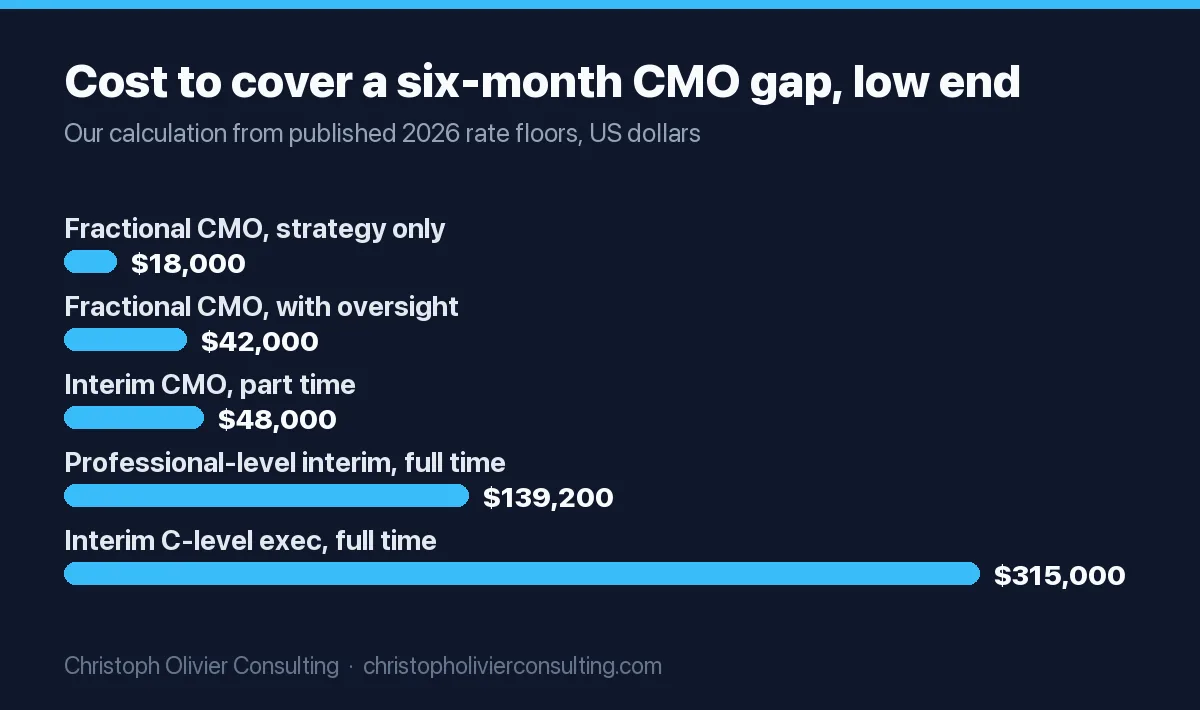
Assumptions: 21 working days a month (the midpoint of JRG’s 20 to 22); a 52-week year; the permanent hire’s cost uses the BLS median wage for marketing managers, $166,790 in May 2025, loaded for benefits with the BLS Employer Costs for Employee Compensation for private-industry management, business and financial jobs in June 2026 ($20.31 of other benefits and supplemental pay on $68.32 of wages plus paid leave, a 1.297 multiplier). The BLS median is a director-level number; a CMO at a larger company costs more, so the full-time rows are conservative. Korn Ferry’s 10-K says its search fee is “generally one-third of the estimated first-year cash compensation of the placed candidate.”
| Option for the six-month gap | Math (our calculation) | Six-month cost | What you get |
|---|---|---|---|
| Fractional CMO, strategy only | $3,000 to $6,000 x 6 | $18,000 to $36,000 | Direction and priorities; the team keeps running |
| Fractional CMO, strategy plus oversight | $7,000 to $12,000 x 6 | $42,000 to $72,000 | A weekly leader for the team and agencies, 15 to 20 hours a week |
| Interim CMO, part time | $8,000 to $15,000 x 6 | $48,000 to $90,000 | The seat’s authority for 15 to 25 hours a week, with a defined end |
| Professional-level interim at Korn Ferry’s average bill rate (below CMO level) | $145 x 160 hours x 6 | $139,200 | A full-time marketing manager or director stand-in, not an executive |
| Interim C-level executive, full time | $2,500 to $5,000 a day x 21 x 6 | $315,000 to $630,000 before any retainer discount | A full-time executive in the seat, often on site |
| Permanent hire at the BLS median, for comparison | $166,790 x 1.297 / 2 | $108,186 for six months of employment | Only available once the search ends |
| Retained search fee for that hire (paid on top of any option above) | One-third of $178,728 first-year cash (salary plus 7.16% supplemental pay) | $59,576 | The search itself |
Read the table this way: the search fee and the permanent salary are coming regardless, so the real decision is the cover row. A full-time interim at the published floor costs more for six months than a full year of a median permanent hire, $216,373 with benefits. That premium buys speed and full authority. It is worth paying when the gap itself is expensive, for example a launch, an acquisition integration or a board-visible plan that cannot stall. It is not worth paying to keep weekly reporting running.
The payback test is the same for both: six-month cost divided by gross margin is the added gross profit the cover has to protect or produce. At a 50% gross margin, $72,000 of fractional oversight has to protect $144,000 of revenue; $315,000 of full-time interim has to protect $630,000.
Which one fits: interim, fractional, or neither
Most comparison pages assume you should hire one of the two. Often you should not. This table includes the situations where a cheaper option, or doing it yourself, is the right answer.
| Your situation | Best fit | Why |
|---|---|---|
| CMO resigned, team of 10+, big launch or board plan in the next two quarters | Interim CMO, full time | The gap is costly and the team needs a daily decision-maker with the seat’s authority |
| CMO left, team is senior and the plan for the year is already set | Fractional or part-time interim, 15 to 20 hours a week | You need decisions and accountability, not 160 hours of leadership |
| Never had a CMO; real marketing spend but no senior owner | Fractional CMO | Open-ended part-time leadership; an interim implies a permanent CMO is coming |
| Acquisition or merger: two brands, two teams, one plan needed | Interim CMO with a written end date | A defined project with a clear finish suits a time-boxed mandate |
| A strong internal marketing director is six to twelve months from ready | Fractional CMO as coach and backstop, not interim | An interim takes the seat; a fractional leader can build your successor and step back |
| Small company where the founder does the marketing and the whole budget is a few thousand dollars a month | Neither. A specialist, a one-off strategy project, or doing it yourself | Even the $3,000 a month floor is $36,000 a year, money that may do more as ad spend or a specialist |
| The work you need is execution: ads, content, email, design | Neither. A specialist, freelancer or agency | Paying CMO rates for campaign work is the most common mismatch; a marketing director or a fractional CMO covers different jobs |
| Permanent CMO already signed and starts within 4 to 6 weeks | Neither. Have the CEO hold priorities and freeze big commitments | Our rule of thumb: an interim would barely finish onboarding before the handover |
Decision checklist: score your situation
Answer yes or no. This is our own rubric, not an industry standard.
- Did you have a full-time CMO in the last 12 months, and do you plan to hire another?
- Is there a dated event in the next 6 months (launch, rebrand, merger, fundraise) that marketing must lead?
- Do more than 10 people, or more than one agency, report into the marketing seat? (MarketerHire names a team past 10 people as one sign the full-time path may justify its cost.)
- Does the board or owner expect a named marketing executive in leadership meetings every week?
- Is the marketing plan for the next two quarters unwritten or no longer valid?
Four or five yes answers: a full-time interim CMO is defensible. Two or three: part-time interim or fractional at 15 to 20 hours a week. Zero or one, with question 1 a no: fractional, or one of the “neither” rows above. If you are not sure whether you are ready for any outside leader, our guide on when to hire a fractional CMO lists the readiness signals in more detail.
Interim, fractional or neither? Get a straight answer
Bring your checklist score, team size and any proposals you have. In a free consultation we will look at which row of the fit table you are actually in, including whether you need outside leadership at all.
What each one should own in the first 90 days
The first 90 days look different because the end state is different. An interim is preparing the seat for someone else. A fractional CMO is building a system they will keep running.
| Period | Interim CMO | Fractional CMO |
|---|---|---|
| Weeks 1 to 2 | Take over the budget, approvals and team one-to-ones; list every open commitment the last CMO left | Audit channels, funnel, tracking and spend; agree the target the role will be judged on |
| Weeks 3 to 6 | Keep the in-flight plan moving; make the decisions that cannot wait for the new hire; support the search brief | Positioning, budget split by channel with stop rules, and a quarterly roadmap |
| Weeks 7 to 12 | Fix what blocks the next CMO (vacant roles, broken reporting, unclear agency scopes); interview finalists with the CEO if asked | Launch the priority programs and report weekly against the agreed numbers |
| Exit or month 4 | Written handover and 2 to 4 weeks of overlap with the permanent CMO | Quarterly review: continue, expand hours, or plan the move to a full-time hire |
A trap with interims: big strategic moves made in month two that the permanent CMO inherits but did not choose. Agree in writing which decisions the interim may make alone (spend under a cap, vendor renewals, hiring for open roles) and which wait for the permanent leader (rebrand, agency replacement, reorganization), unless the board decides otherwise.
Scope worksheet: what to put in either contract
Copy this into your statement of work and fill in each line. A proposal that leaves a line blank is the first thing to question. A detailed clause-by-clause version is in our fractional CMO contract template.
- Title and reporting line: Interim CMO or Fractional CMO, reporting to ____. Attends ____ meetings.
- Term: Start date ____. Interim: ends on ____ or two weeks after the permanent CMO starts, whichever is first. Fractional: rolling, with ____ days’ notice and a review every quarter.
- Time: ____ hours a week or ____ days a month, on site ____ days. Hours above the cap need written approval.
- Fee: ____ per month, day or hour. Expenses and travel billed ____ (JRG notes that most interim contracts bill travel separately).
- Decision rights: May approve spend up to ____ per item; may hire or end contracts for roles up to ____; needs CEO sign-off for ____.
- Deliverables with dates: 30-day audit by ____; plan and budget by ____; weekly report every ____.
- Handover (interim) or transition (fractional): written handover covering budget status, open contracts, team assessments and the next 90 days; ____ weeks of overlap.
- Conversion and non-solicit: fee, if any, if you hire the interim or fractional leader permanently: ____.
- Worker status: independent contractor or employee, decided before signing.
Line 9 is not a formality. Heidrick & Struggles’ 2024 annual report says it classifies its interim talent “primarily as independent contractors” and lists misclassification as a risk to itself and its clients. The IRS test looks at behavioral control, financial control and the type of relationship. A full-time interim who works on site, manages your staff and uses your tools for nine months looks more like an employee than a part-time fractional leader does, so ask your accountant or employment lawyer before you sign.
Questions to ask an interim or fractional candidate
- How many interim or fractional engagements have you finished, and how did each one end: handover, conversion, or termination?
- What will you have decided by day 30, and what will you leave for the permanent CMO?
- Of your hours, how many go to leadership and how many to hands-on work? Who does the execution?
- Can you show a redacted handover document from a past engagement?
- How many other clients will you have during our engagement, and what is your response time?
- If we wanted to hire you permanently, would you consider it, and what fee applies?
For the prices behind each fractional tier and how to compare quotes by effective hourly rate, see the fractional CMO cost guide. For what a full-time CMO earns if you are weighing the permanent hire, see the CMO salary guide, and for a plain definition of the role itself, what a fractional CMO is and does.
Where CO Consulting fits
To be plain about what we offer: CO Consulting provides fractional CMO leadership, not full-time interim placement. Our fractional CMO services run as a monthly retainer of 20 to 40 hours a month with a 3 to 6 month minimum, as a fixed project, or as a few hours a week of advisory work. The fractional CMO owns direction and accountability (assessment, strategy, leadership of your staff and agencies, and measurement) and directs, rather than performs, day-to-day content, ad building and design. Engagements can run until an internal leader is ready to take over, which makes it a fit for the “CMO left, team is senior” and “successor six to twelve months from ready” rows above. If you need someone in the seat five days a week, a full-time interim firm is the better route, and we will tell you so. Either way, book a consultation and bring your situation and any quotes you have.
Ready to scale your revenue?
Book a free 30-min consultation. We’ll diagnose your growth bottleneck and map out the 3 highest-leverage moves for your business.
Frequently asked questions
What is the difference between a fractional CMO and an interim CMO?
An interim CMO fills the CMO seat for a fixed term, usually 3 to 9 months, to cover a vacancy or transition, then hands over to a permanent hire. A fractional CMO provides ongoing part-time leadership, typically 5 to 20 hours a week, because the company does not need a full-time CMO. Interim describes the time box; fractional describes the hours. A fractional CMO can also serve as an interim.
What does interim CMO mean?
Interim CMO means a temporary chief marketing officer who holds the full authority of the role, including budget, team and reporting to the CEO or board, for a defined period. Frontline Source Group describes it as a full-time CMO for 3 to 9 months, while MarketerHire prices part-time interim CMOs at 15 to 25 hours a week. Korn Ferry's 10-K says interim roles generally last under 12 months.
How much does an interim CMO cost?
Published 2026 figures: a part-time interim CMO or VP costs $8,000 to $15,000 a month for 15 to 25 hours a week (MarketerHire, June 2026). Full-time interim C-level executives are projected at $2,500 to $5,000 or more per day (JRG Partners, July 2026), which is about $52,500 a month or more at 21 days. Both are seller-published estimates, not survey data.
How long does an interim CMO engagement last?
Usually 3 to 9 months, per Frontline Source Group, and MarketerHire says most interim marketing engagements run 3 to 6 months. Korn Ferry's fiscal 2026 annual report describes interim roles as generally under 12 months. The engagement should end with a written handover and a short overlap once the permanent CMO starts.
What does a fractional CMO actually do?
A fractional CMO owns marketing decisions part time: the target marketing commits to, positioning, the budget split by channel, which channels to start or cut, measurement definitions, and agency and hiring decisions. Your staff, freelancers or agencies do the execution. MarketerHire separates strategy-only engagements (5 to 10 hours a week) from strategy plus execution oversight (15 to 20 hours a week).
Fractional CMO: cost, fit and industries