
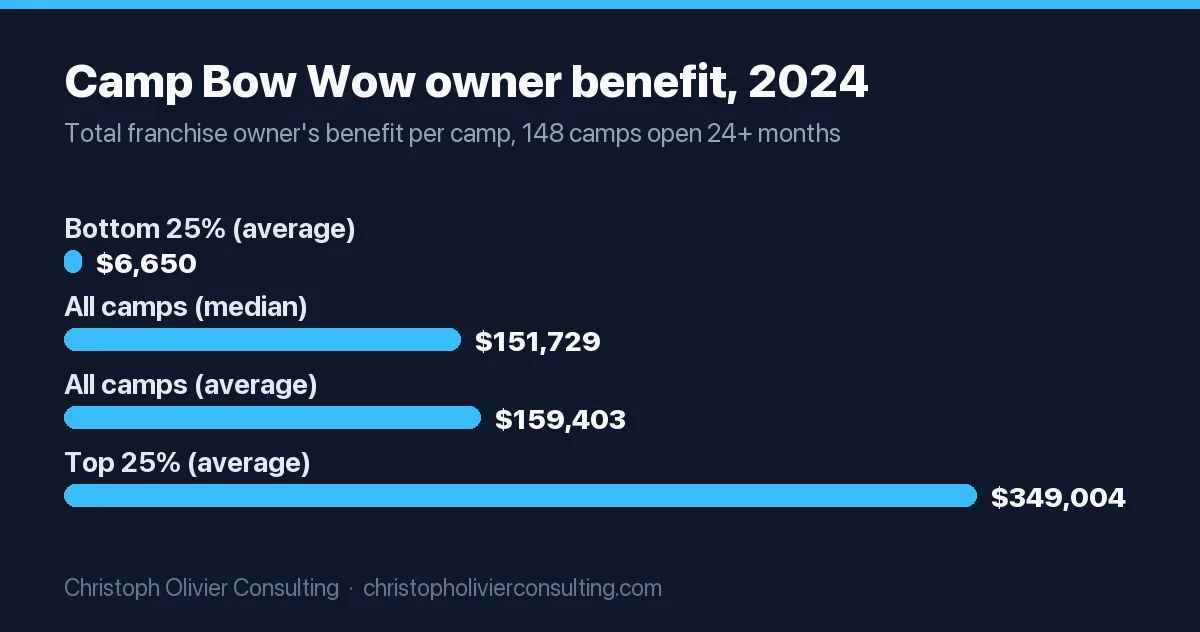
A dog daycare owner who runs one facility usually takes home somewhere between nothing and about $350,000 a year before tax, and the middle of that range sits around $150,000. The best public evidence is the 2024 franchise data for Camp Bow Wow: across 148 established locations, the median owner benefit (profit before interest, depreciation and tax, plus any salary the owner booked) was $151,729. The bottom quarter averaged $6,650 and the top quarter $349,004 (Camp Bow Wow 2025 FDD, Item 19).
Short answer: In my worked model built from franchise disclosure documents and BLS wages, an owner who works the floor full time makes about $96,000 pre-tax with 20 daycare dogs a day, about $128,000 with 40 and about $205,000 with 70, before loan payments. Franchise data shows the same spread: owner benefit of $6,650 for the weakest quarter of Camp Bow Wow locations and $349,004 for the strongest. No government survey publishes dog daycare owner income directly.
Below are the numbers that do exist: Census revenue counts for pet care businesses, BLS wages for the attendants you would hire, the Colorado staffing rule that sets your labor bill, and the audited-format Item 19 tables in three dog daycare franchise disclosure documents (FDDs) filed with Minnesota’s franchise registry. Then I turn them into a labeled P&L you can rerun with your own dog count and price.
Dog daycare owner salary: what each source actually measures
No dataset reports “dog daycare owner salary.” BLS wage surveys exclude the self-employed. The IRS sole proprietorship tables stop at the sector level (“personal and laundry services”), so pet care is not broken out. What you can measure is revenue per business, the wage you would pay instead of working yourself, and what established franchise locations keep. Read the “what it measures” column before comparing any two numbers.
| Source and year | What it measures | Figure | How it was calculated |
|---|---|---|---|
| Census SUSB 2022, NAICS 812910 | Revenue per pet care firm with employees (daycare, boarding, grooming, training, sitting combined) | $415,944 | $9,852,047,000 receipts ÷ 23,686 firms (my calculation) |
| Census Nonemployer Statistics 2022, NAICS 81291 | Revenue per pet care business with no paid employees (mostly walkers, sitters, solo groomers) | $25,176 | $3,306,283,000 ÷ 131,327 businesses (my calculation) |
| BLS Occupational Outlook Handbook, May 2025 | Median wage of employed animal caretakers in “other personal services,” the industry that holds daycares and kennels | $35,190 | Published. All animal caretakers: $35,360 |
| Camp Bow Wow FDD, 2024 results | Median “Total Franchise Owner’s Benefit” (EBITDA plus owner salary on the P&L), 148 locations open 24+ months | $151,729 | Published. Average: $159,403 |
| Hounds Town USA FDD, 2025 results | Average net operating income before owner pay, interest, depreciation and tax, 29 locations open 3+ years | $152,070 | Published. 21% of $722,816 average revenue; median $155,404 |
| Dogtopia FDD, 2025 results | Average net operating margin before owner distributions, 134 centers that sent full P&Ls | 19.2% | Published. Median 18.9%; range minus 39.4% to 51.4% |
Three things to take from this table:
- The Census code is broader than daycare. NAICS 812910 also counts groomers, trainers, pet sitters and dog walkers. It is still the only federal revenue count that includes dog daycares.
- The $25,176 nonemployer average is not a daycare owner’s income. 95.8% of those 131,327 businesses are sole proprietors (my calculation), and a facility with a play floor cannot legally run with one person once more than 15 dogs mix in a state that follows Colorado’s rule (more on that below). That figure describes side work and solo services.
- The three franchise figures land close together. Camp Bow Wow, Hounds Town and Dogtopia measure profit slightly differently, but all three put an established location’s pre-owner-pay profit at roughly $150,000 to $180,000. That is the most reliable anchor on the internet for this question.
How much does a dog daycare make? Revenue by size
The average pet care firm with employees took in $415,944 in 2022, but the typical one took in far less. Census publishes firms by annual revenue band. I added the shares and per-firm averages.
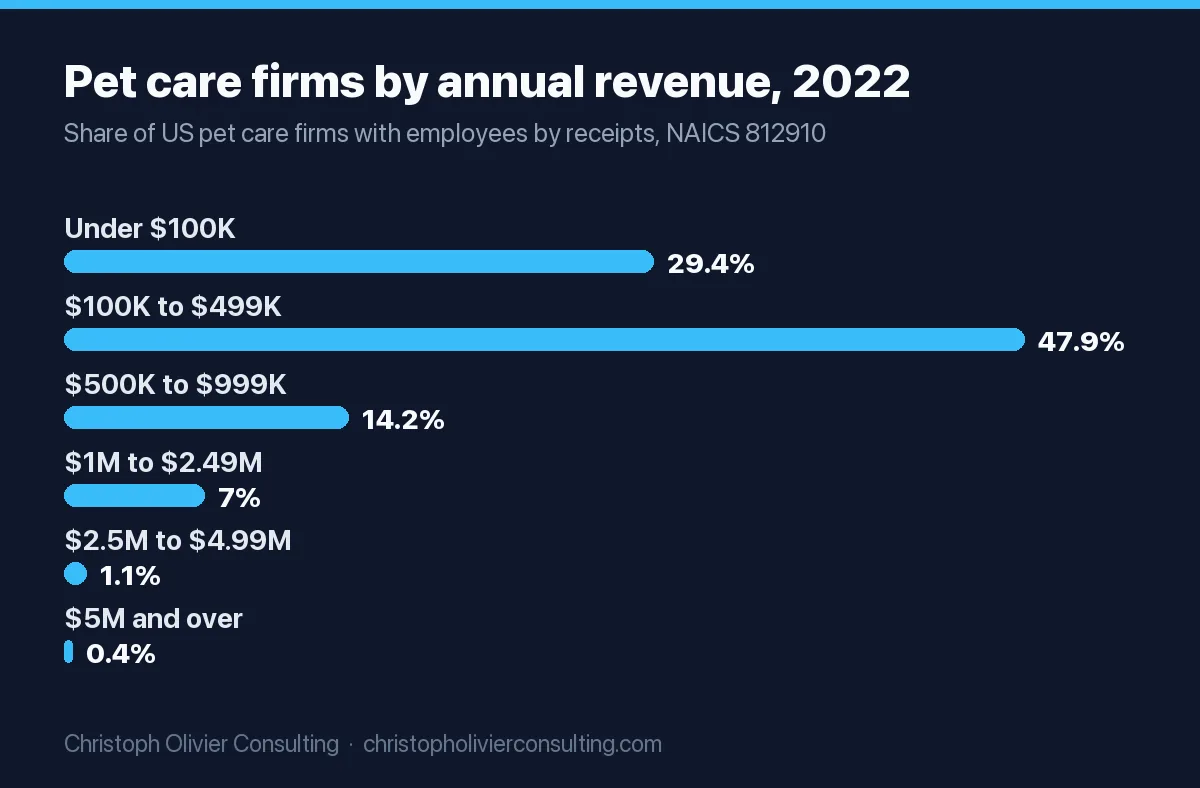
| Annual receipts of the firm | Firms | Share of firms | Cumulative share | Average receipts per firm | Employees per firm | Share of all revenue |
|---|---|---|---|---|---|---|
| Under $100,000 | 6,965 | 29.4% | 29.4% | $45,995 | 1.4 | 3.3% |
| $100,000 to $499,999 | 11,357 | 47.9% | 77.4% | $246,321 | 4.4 | 28.4% |
| $500,000 to $999,999 | 3,358 | 14.2% | 91.5% | $697,184 | 11.8 | 23.8% |
| $1 million to $2.49 million | 1,653 | 7.0% | 98.5% | $1,441,533 | 21.9 | 24.2% |
| $2.5 million to $4.99 million | 249 | 1.1% | 99.6% | $3,161,663 | 41.5 | 8.0% |
| $5 million and over | 102 | 0.4% | 100% | $11,287,637 | 114.0 | 11.7% |
Source: U.S. Census Bureau, SUSB 2022, U.S. 6-digit NAICS by enterprise receipts size, NAICS 812910 Pet Care (except Veterinary) Services, released April 10, 2025. Employer firms only. The $5 million and over row combines the published bands above $5 million. Averages, shares and cumulative shares are my calculations.
What the table tells you:
- The median pet care firm takes in between $100,000 and $499,999. 77.4% of employer firms are under $500,000. That band fits a grooming salon or a small kennel better than a purpose-built daycare.
- Purpose-built daycares sit in the top 23%. The franchise locations below report $520,000 to $993,000 in average revenue, which places a typical established daycare in the $500,000 to $999,999 band or higher.
- Payroll is the biggest cost. Industry payroll was 43.6% of receipts in 2022 ($4.30 billion of $9.85 billion, my calculation), across 158,246 employees. That is wages only, before payroll taxes and benefits.
Revenue for established franchise daycares
| Brand and year | Locations counted | Average revenue | Median revenue | Low to high |
|---|---|---|---|---|
| Dogtopia, 2025 | 202 centers open 24+ months | $935,548 | $921,160 | $295,287 to $2,153,303 |
| Camp Bow Wow, 2024 | 148 camps open 24+ months, under 9,000 sq ft | $993,149 | $960,150 | $381,269 to $1,977,249 |
| Hounds Town USA, 2025 | 73 franchised locations open 12+ months | $520,855 (my calculation) | $485,743 (my calculation) | $92,602 to $1,359,016 |
Sources: Dogtopia 2026 FDD Item 19 Table 7; Camp Bow Wow 2025 FDD Item 19 Table 1; Hounds Town USA 2026 FDD Item 19 Table 4, my totals across all 73 rows. All three are franchisee-reported and unaudited. Filed with the Minnesota Department of Commerce.
Revenue climbs with age. Hounds Town’s 2025 average was $313,632 for locations open one to two years, $420,811 at two to three years, $609,310 at three to five years and $842,716 at five or more years. Dogtopia’s centers open 24 to 36 months averaged $843,049, against $950,433 for older centers. Plan for two to three lean years, not one.
Where the money comes from: daycare vs boarding
Hounds Town is the only franchisor of the three that splits revenue by service. I totaled all 73 franchised locations in its 2025 Table 4:
| Revenue line, 2025 | Share of revenue | Units per location (average) | Revenue per unit |
|---|---|---|---|
| Daycare | 37.6% | 6,470 daycare visits | $30.27 per visit |
| Boarding | 51.7% | 5,252 boarding nights | $51.24 per night |
| Spa (bathing, grooming) | 7.9% | Not reported | Not reported |
| Other | 2.8% | Not reported | Not reported |
Source: Hounds Town USA 2026 FDD, Item 19 Table 4. Shares, averages and per-unit revenue are my calculations (category revenue ÷ category occupancy, as the FDD defines “average check”).
Two things follow. First, a “dog daycare” earns most of its money at night: boarding brought in more than daycare at these locations. Second, 6,470 daycare visits a year works out to about 25 dogs per weekday if spread across 255 weekdays (my calculation). Many owners plan around 50 or 60 dogs a day. The franchise data says the average established location runs at half that.
How much should I charge for doggy daycare?
Hounds Town franchisees collected a median of $29 per daycare visit and $51 per boarding night in 2025 (my calculation from Table 4), after package discounts. By location age, the average daycare check ran from $27 for one to two year old locations to $32 for those open five years or more (Table 7). Posted prices at Army-run pet care centers show the same band: Fort Belvoir charges $32 for a single day, $300 for a 10-day card and $525 for unlimited monthly daycare, with basic boarding at $60. Fort Meade lists $28 a day, $245 for 10 days and boarding from $40 to $55 a night by dog weight.
Notice the gap between list price and collected price. Fort Belvoir’s 10-day card is $30 a visit, 6% under its single-day price. Monthly unlimited at $525 drops to $25 a visit for a dog that comes 21 days. Your effective price per visit is set by your package mix, not your price board.
The staffing rule that sets your labor cost
Labor is the line that decides owner pay, and in many states it is set partly by regulation. Colorado’s Pet Animal Care and Facilities Act rules, 8 CCR 1202-15, Part 14 (effective July 15, 2025), allow boarding and training facilities to commingle dogs from different households only “under constant and direct supervision,” and require:
- At least one human supervisor, 16 or older, present at all times (14.11.1).
- At least one supervisor for every 15 dogs in each common area: 2 to 15 dogs need one, 16 to 30 need two, 31 to 45 need three (14.11.2).
- No more than 60 dogs in any enclosure or common area at once (14.11.3).
Rules differ by state, and many states set none. Even so, 1 to 15 is a useful planning ratio, and it creates a staffing step: the 16th, 31st and 46th dog on the floor each force another attendant for the whole shift. At the BLS median of $35,190 for caretakers in personal services ($16.92 an hour) and a 1.43 cost load for payroll taxes and benefits, an 11-hour weekday shift costs about $266 a day. That is the price of the 16th dog unless you can add enough dogs to fill the new attendant’s group.
Dog daycare owner pay is salary plus profit
“Owner salary” mixes two paychecks. Keep them apart, or you will misread your own books:
- The work wage. What it would cost to hire someone to do the hours you work. If you run the floor, that is roughly the BLS caretaker median, $35,190 a year (May 2025). The highest 10% of animal caretakers earned more than $50,060.
- The owner return. What is left after every employee, rent, insurance and franchise fee, before loan payments and tax. This is the return on the $570,000 or more you put at risk (see startup costs below).
The franchise numbers handle this differently, so check before you compare. Dogtopia’s wage line “excludes distributions and personal payments made to the business owner.” Hounds Town’s net operating income is before “owners’ draw, or owners’ compensation.” Camp Bow Wow adds booked owner salary back into “Total Franchise Owner’s Benefit,” but its FDD notes that some owners take a draw through the balance sheet instead, which is not captured. In all three, the reported profit is roughly what the owner takes home before interest, depreciation and income tax.
What franchise owners actually kept
| Camp Bow Wow, 2024 | Bottom 25% (37 camps) | All 148 camps, median | All 148 camps, average | Top 25% (37 camps) |
|---|---|---|---|---|
| Gross sales | $811,783 (avg) | $960,150 | $993,149 | $1,294,862 (avg) |
| Labor, share of sales | 52.9% | 39.0% | 46.0% | 42.6% |
| Rent and facilities | 19.7% | 15.1% | 15.0% | 11.7% |
| Other operating expenses | 19.5% | 15.6% | 18.6% | 16.1% |
| EBITDA | minus $13,174 | $92,384 | $116,327 | $276,946 |
| Total owner benefit | $6,650 | $151,729 | $159,403 | $349,004 |
Source: Camp Bow Wow 2025 FDD, Item 19 Tables 1 to 3. Quartiles are ranked on owner benefit. COGS (not shown) includes royalties. Franchisee-reported, unaudited. Medians are computed line by line, so they do not sum.
The bottom quarter did not fail on sales. Its camps averaged $811,783, more than the Census median band by a wide margin. They failed on cost: labor took 52.9% of sales and rent 19.7%, against 42.6% and 11.7% in the top quarter. The same pattern shows up at Dogtopia, where centers under $900,000 in revenue averaged a 6.5% net operating margin and paid 20.7% of revenue in rent, while centers at $1 million to $1.5 million averaged 22.9% and paid 13.8%.
Worked P&L: what an independent owner makes at 20, 40 and 70 dogs a day
This is my own calculation, not a survey result. It models an independent daycare (no franchise fees) where the owner works 2,080 hours a year on the floor. Every input is sourced or labeled as an assumption.
| Line (own calculation) | Small: 20 daycare dogs, 8 boarders | Mid: 40 daycare dogs, 18 boarders | Large: 70 daycare dogs, 30 boarders |
|---|---|---|---|
| Daycare revenue (dogs × 255 weekdays × $30.27) | $154,377 | $308,754 | $540,320 |
| Boarding revenue (nightly boarders × 365 × $51.24) | $149,621 | $336,647 | $561,078 |
| Spa and other (10.7% of total revenue) | $36,654 | $77,818 | $132,800 |
| Total revenue | $340,652 | $723,219 | $1,234,197 |
| Floor attendants on weekdays (1 per 15 dogs) | 2 | 4 | 7 |
| Paid staff hours after owner’s 2,080 | 4,410 | 14,585 | 26,685 |
| Staff cost ($16.92 × 1.429 load) | $106,595 | $352,536 | $645,008 |
| Rent (assumption, within Dogtopia’s disclosed range) | $72,000 | $102,000 | $144,000 |
| Supplies and retail cost (4%) | $13,626 | $28,929 | $49,368 |
| Local marketing (4%) | $13,626 | $28,929 | $49,368 |
| Insurance, software, card fees, licenses, accounting (7%) | $23,846 | $50,625 | $86,394 |
| Utilities (3%) and repairs (1.5%) | $15,330 | $32,545 | $55,539 |
| Owner pay (work wage + profit, pre-tax, before loan payments) | $95,630 | $127,655 | $204,521 |
| Owner pay as share of revenue | 28.1% | 17.7% | 16.6% |
| Owner pay above a caretaker’s $35,190 | $60,440 | $92,465 | $169,331 |
| Census revenue band | $100K to $499K (median band) | $500K to $999K | $1M to $2.49M |
Assumptions and where each comes from:
- Prices: $30.27 per daycare visit and $51.24 per boarding night. Hounds Town franchised locations, 2025 (my calculation from Table 4). Spa and other revenue at 10.7% of the total is that same group’s share.
- Volume: daycare 255 weekdays a year, boarding 365 nights. Assumptions. Boarders join daycare groups on weekdays. On 110 weekend and holiday days, one attendant (two in mid and large) covers boarders for 8 hours. Daycare hours are 11 a day, matching Fort Belvoir’s posted 7 a.m. to 6 p.m.
- Staffing: one attendant per 15 dogs on the floor. Colorado’s 8 CCR 1202-15 ratio. Mid and large add one and two front desk staff for the full schedule. No paid overnight staff is included; check your state and insurer.
- Wages: $16.92 an hour, the BLS May 2025 median for animal caretakers in other personal services ($35,190 ÷ 2,080 hours). Load: 1.429, from private employers’ total compensation of $46.89 an hour against $32.82 in wages in June 2026 (BLS Employer Costs for Employee Compensation, my ratio). Many small daycares pay fewer benefits, so this is conservative.
- Rent: Dogtopia expects 4,000 to 6,000 square foot centers to pay $4,600 to $16,150 a month (2026 FDD, Item 7 note 8). My $6,000, $8,500 and $12,000 a month are assumptions inside that range.
- Other costs: percentages from the Hounds Town Table 9 averages (COGS 4%, marketing 4%, direct operating expenses 7%, utilities 3%, repairs 1%, rounded up to 1.5% for an older building). Royalty and brand fund (8% there) are removed because this is an independent.
- Not included: loan payments on build-out, depreciation, owner health insurance and income tax.
Check against the franchise data: the mid model’s $723,219 revenue matches Hounds Town’s Table 9 average of $722,816 almost exactly. Its $127,655 owner pay is below Hounds Town’s $152,070 even without franchise fees, mainly because my labor load includes benefits that the FDD’s “wages and payroll tax” line leaves out. Expect your real number between the two.
How dog count and price change owner pay
Mid-size model, 18 nightly boarders, changing only weekday daycare dogs and price per visit. The $25 and $40 prices are scenarios, not reported figures.
| Daycare dogs per weekday | $25 per visit | $30.27 per visit (Hounds Town 2025) | $40 per visit |
|---|---|---|---|
| 27 (45 dogs on floor, 3 attendants) | $104,938 at $30.27 | ||
| 28 (46 dogs on floor, 4 attendants) | $44,100 at $30.27 | ||
| 30 | $21,659 | $58,026 | $125,171 |
| 40 | $79,166 | $127,655 | $217,181 |
| 50 (5 attendants) | $68,872 | $129,484 | $241,391 |
The first two rows are the point of this page. One extra dog, the 46th on the floor, triggers a fourth attendant and cuts owner pay by about $60,800 a year. It takes about nine more daily dogs to earn that back. At $25 a visit, going from 40 to 50 dogs lowers owner pay, because the 10 extra dogs bring in less than the fifth attendant costs. Price and group fill matter more than headcount. In my view this is also how a daycare should judge marketing: by full groups of 15, not by sign-ups. The work-it-backward lead math shows how to set that target.
Dog boarding owner salary
Boarding is where the margin is. A boarding night collected $51.24 at Hounds Town locations against $30.27 for a daycare visit, and boarders who join the daytime group add no extra attendant until they push the floor past the next 15-dog step. That is why the large franchise prototypes are built around kennel count: Camp Bow Wow’s current design opens with 50 dog cabins and fits up to 80 in about 6,000 square feet, and Hounds Town plans 35 boarding enclosures in 4,000 to 6,000 square feet.
No source reports income for boarding-only kennel owners separately. The BLS does report what you would pay a kennel attendant: the same $35,190 median for caretakers in personal services. A boarding-heavy operation in my model earns more per dog, but it also carries the 365-day, weekend and holiday staffing cost, which daycare-only operators avoid.
Dog daycare startup costs
Franchise Item 7 tables are the best public cost breakdowns for a purpose-built facility. All three assume a leased building of roughly 4,000 to 6,000 square feet.
| Cost line | Dogtopia, 2026 FDD | Camp Bow Wow, 2025 FDD | Hounds Town USA, 2026 FDD |
|---|---|---|---|
| Total initial investment | $664,355 to $1,478,820 | $943,606 to $1,199,536 | $667,610 to $1,122,153 |
| Leasehold improvements (build-out) | $541,700 to $856,200 (average $738,807), before landlord contributions | $516,735 to $663,917, net of landlord contributions | $450,000 to $700,000 |
| Initial franchise fee | $40,095 to $49,500 | $50,000 | $49,000 plus $30,000 launch fee |
| Equipment, furniture, supplies | $19,800 to $28,640 furniture and equipment; $24,060 to $31,530 supplies | $136,799 equipment and supplies; $76,750 cabins and fencing | $30,500 to $50,000 |
| Camera system | Not broken out ($14,600 to $20,700 for all technology systems) | $23,639 to $29,000 webcam system | $10,000 to $20,000 |
| Working capital for first 3 months | $30,000 to $60,000 | $80,000 | $30,375 to $100,000 |
| Ongoing royalty and brand fund | 7% plus 2% of gross sales | 3.5% in year one, then 7%, plus 1% advertising | 6% plus 2% |
Sources: Item 7 and Item 6 of the Dogtopia, Camp Bow Wow and Hounds Town USA disclosure documents on the Minnesota CARDS registry.
What an independent can strip out: Hounds Town says $97,506 to $103,224 of its total goes to the franchisor or its affiliates. Remove that and the same building costs $570,104 to $1,018,929 (my calculation). You still need most of the launch marketing those fees cover, so do not count all of it as savings. Build-out is more than half of every budget (55% to 82% at the low end of the three ranges, my calculation), which is why converting an existing building, or negotiating a large landlord contribution, moves your payback more than any equipment choice.
Payback at the model’s owner pay: a $570,104 build would take about 2.8 years of the large model’s $204,521, or 3.8 years of the Camp Bow Wow median $151,729, if you lived on nothing and paid no interest (my calculation). Most owners finance it, so the real question is whether owner pay covers your loan payment and your living costs at the same time.
Is owning a doggy daycare profitable?
Usually, once it is established, but not reliably. Of the 134 Dogtopia centers that sent full 2025 P&Ls, the median net operating margin was 18.9%, the best was 51.4% and the worst was minus 39.4%. A quarter of Camp Bow Wow’s established camps averaged $6,650 in owner benefit in 2024. Those are locations that survived at least two years; the FDDs exclude newer and closed ones. If you want to compare dog daycare to other small service businesses, the profit margin benchmarks for 94 industries put these margins in context.
How much does a doggie daycare worker make?
Animal caretakers working in other personal services, the industry that includes daycares and kennels, earned a median $35,190 in May 2025. All animal care and service workers earned a median $17.08 an hour. Animal trainers in the same industry earned a median $39,990. BLS projects 12% employment growth for caretakers from 2025 to 2035 (BLS OOH).
Two related questions often come up. If you are weighing grooming as a revenue line or a separate business, the dog grooming business owner salary breakdown covers it. If you searched “daycare owner” and meant child care, see what a child daycare owner makes.
Owner pay worksheet: run your own numbers
Copy this into a spreadsheet. Each line has a pass/fail check taken from the benchmarks above.
| Step | Formula | Pass if |
|---|---|---|
| 1. Daycare visits per weekday | Annual daycare visits ÷ days open | 25 or more (Hounds Town 2025 average, my calculation) |
| 2. Collected price per visit | Daycare revenue ÷ visits, after packages | $30 or more (Hounds Town 2025: $30.27) |
| 3. Boarding nights per year | Nights sold | 5,250 or more (Hounds Town 2025 average: 5,252) |
| 4. Group fill | Dogs on floor ÷ (attendants × 15) | 80% or more. A 16th, 31st or 46th dog adds an attendant |
| 5. Labor share | All staff cost ÷ revenue | At or under 45% (Dogtopia franchised 44.5%, Camp Bow Wow 46.0%); 52.9% is the Camp Bow Wow bottom quarter |
| 6. Rent share | Rent and facilities ÷ revenue | At or under 15%; 19.7% to 20.7% marks the weakest groups |
| 7. Owner pay | Revenue minus all costs except your own pay | Above $35,190 by enough to cover your loan payment and risk |
If step 1 or step 2 fails, opening a second location multiplies the problem. Fix fill rate and package pricing first, and use local search before paid ads: a daycare sells to people within a short drive, which makes the small-business Google Ads budget split worth reading before you spend. If you want an outside view of where your daycare’s numbers break, you can book a consultation.
Ready to scale your revenue?
Book a free 30-min consultation. We’ll diagnose your growth bottleneck and map out the 3 highest-leverage moves for your business.
Frequently asked questions
How much does a dog daycare owner make a year?
No government survey reports it. The best public figure is Camp Bow Wow's 2024 franchise data: across 148 established camps, median owner benefit was $151,729 before interest, depreciation and tax. The bottom quarter averaged $6,650 and the top quarter $349,004. In a worked model for an independent owner who works the floor, owner pay is about $96,000 at 20 daycare dogs a day and $205,000 at 70.
How much does a dog daycare make in revenue?
The average US pet care firm with employees took in $415,944 in 2022 (Census SUSB, NAICS 812910), and 77.4% took in under $500,000. Purpose-built franchise daycares earn more once established: Dogtopia centers open 24+ months averaged $935,548 in 2025, Camp Bow Wow camps $993,149 in 2024 and Hounds Town franchised locations about $520,855 in 2025.
Is owning a doggy daycare profitable?
Usually once established, but results vary widely. Of 134 Dogtopia centers reporting full 2025 P&Ls, the median net operating margin before owner pay was 18.9%, ranging from minus 39.4% to 51.4%. Camp Bow Wow's weakest quarter of established camps had negative EBITDA in 2024, mainly because labor took 52.9% of sales and rent 19.7%.
What are dog daycare startup costs?
Franchise disclosure documents put a leased 4,000 to 6,000 square foot facility at $664,355 to $1,478,820 for Dogtopia, $943,606 to $1,199,536 for Camp Bow Wow and $667,610 to $1,122,153 for Hounds Town USA. Build-out is the largest line, $450,000 to $856,200. Without franchise fees, the Hounds Town budget falls to about $570,104 to $1,018,929.
How much does a doggie daycare worker make?
Animal caretakers in other personal services, the industry that includes dog daycares and kennels, earned a median $35,190 a year in May 2025, according to the BLS Occupational Outlook Handbook. All animal care and service workers earned a median $17.08 an hour. Animal trainers in the same industry earned a median $39,990.
How much should I charge for doggy daycare?
Hounds Town franchisees collected about $30.27 per daycare visit and $51.24 per boarding night in 2025 after discounts. Army-run centers post similar prices: Fort Belvoir charges $32 a day, $300 for 10 days and $525 a month unlimited; Fort Meade charges $28 a day. Your collected price depends on package mix, so track revenue per visit, not list price.
How much does a dog boarding owner make?
No source reports boarding-only owner income separately. Boarding is the bigger revenue line at daycare-boarding facilities: 51.7% of 2025 revenue at Hounds Town franchised locations, at $51.24 per night versus $30.27 per daycare visit. Boarders who join daytime play groups add no staff until the floor passes the next 15-dog step, which is why boarding carries the margin.
Small business owner income