
An ecommerce marketing strategy is a plan for spending across acquisition and retention channels so that the lifetime value of each customer clears what you paid to acquire them. The right sequence is: get one channel profitable, prove an LTV:CAC ratio near or above 3:1, then reinvest that margin into the next channel. Most guides hand you a list of 20 tactics. This one gives you the order to run them in and the single number that tells you whether to keep spending.
Last reviewed: October 2026

What is an ecommerce marketing strategy, really?
An ecommerce marketing strategy is the deliberate mix of paid and organic channels that move a shopper from first click to repeat purchase, governed by unit economics rather than by channel trends. It answers three questions in order: which customers are worth acquiring, what each channel costs to acquire them, and how much they are worth over their lifetime. If those three do not connect, you have a tactics list, not a strategy.
The distinction matters because ecommerce fails quietly. A store can post rising revenue while every new order loses money on ad spend and discounts. A real strategy makes the loss visible early by forcing every channel to report its own cost per acquired customer. For the wider frame this sits inside, see our sales and marketing strategy hub.
The one metric your strategy runs on: LTV:CAC
LTV:CAC is the ratio of a customer’s lifetime value to the cost of acquiring them, and it is the single number that decides whether a channel scales or gets cut. Customer acquisition cost (CAC) is total sales and marketing spend divided by new customers won in the same window. Lifetime value (LTV) is the gross margin a customer produces across all their orders. Most operators target a blended ratio near 3:1.
Read the ratio as a signal, not a scoreboard. Below 1:1 you lose money on every customer and must fix margin, retention, or targeting before scaling. Near 3:1 the model is healthy and can absorb more spend. Well above 5:1 you are usually underinvesting and leaving growth on the table, because you could spend more to acquire faster and still profit.
| LTV:CAC ratio | What it signals | Action |
|---|---|---|
| Below 1:1 | Losing money per customer | Pause scaling; fix margin, offer, or targeting |
| 1:1 to 3:1 | Marginal to healthy | Improve retention and AOV before adding spend |
| Around 3:1 | Sustainable growth zone | Reinvest margin into the next channel |
| Above 5:1 | Likely underinvesting | Spend more to acquire faster |
Calculate CAC per channel, not just blended. A blended 3:1 can hide a paid social channel bleeding at 1:1 and an email program running at 15:1. Channel-level CAC is what tells you where to move the next dollar.
How do you choose the right channel mix?
Choose channels by matching their strength to a funnel stage, not by copying competitors. Paid search and shopping capture existing demand; paid social and influencers create it; SEO and content compound it for free over time; email and SMS retain and monetize it. A strong ecommerce marketing strategy runs at least one demand-capture channel and one owned retention channel from day one, then layers demand creation once the economics hold.
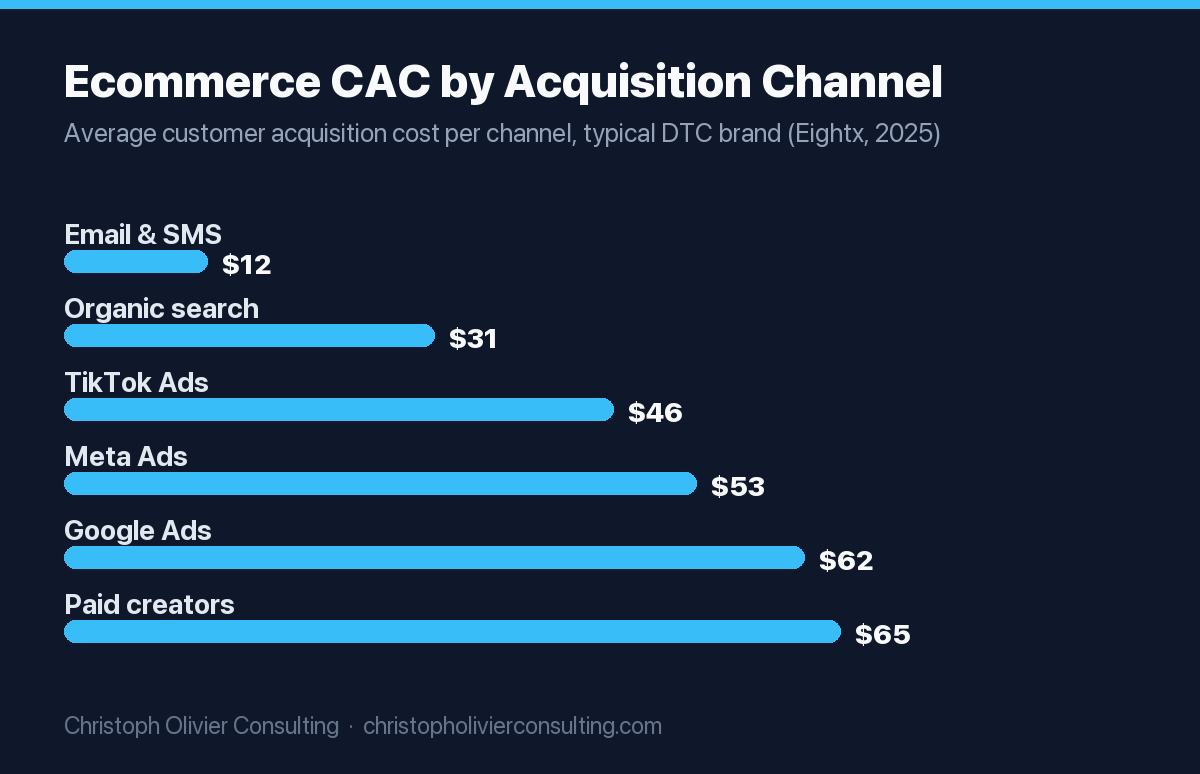
The table below maps the main ecommerce channels to their job, a typical cost signal, and the funnel stage they serve best. Treat the cost ranges as directional; they vary by category, margin, and competition.
| Channel | Primary job | Typical cost signal | Best funnel stage |
|---|---|---|---|
| SEO / content | Compounding organic demand | Time and content cost; low marginal CAC | Awareness and consideration |
| Paid search / Google Shopping | Capture existing demand | Pay per click; scales with intent volume | Consideration and conversion |
| Paid social (Meta, TikTok) | Create demand at scale | Higher CAC; needs strong creative | Awareness and conversion |
| Email and SMS | Retention and repeat revenue | Low cost per send; highest ROI channel | Activation and repeat |
| Marketplaces (Amazon, etc.) | Reach ready buyers | Referral fees plus ad spend; thin margin | Conversion |
| Influencer / affiliate | Trust and net-new reach | Commission or flat fee; variable CAC | Awareness and consideration |
Email and SMS almost always show the strongest return because you own the audience and pay only to send. That is why owned channels anchor the mix: they raise LTV, which in turn lets you afford higher acquisition CAC elsewhere. Our guide to SEO for lead generation covers the organic side, and social media lead generation covers demand creation.
The acquisition-to-retention funnel, stage by stage
The ecommerce funnel is one connected system with five stages: traffic, engagement, conversion, activation, and repeat purchase. Acquisition efficiency only improves when all five move together, because cutting CAC at the top is pointless if activation and repeat rates are weak. Map each channel and offer to the stage it serves, then measure the handoff between stages.
Traffic and engagement (top)
The top of the funnel earns attention and a first click, measured by qualified sessions and cost per visit rather than immediate sales. SEO, content, paid social, and influencers live here. The goal is not volume but relevance: traffic that matches your product and margin. Cheap irrelevant traffic inflates the top and starves conversion. Our playbook for optimizing ecommerce content shows how buying guides and blog posts earn traffic that actually buys.
Conversion and activation (middle)
The middle turns visitors into first-time buyers and then into activated customers who came back once. Conversion rate optimization, product page quality, reviews, and a clear first-purchase offer drive this stage. Activation, the all-important second purchase, is where LTV starts to build, so a post-purchase email flow and a reorder or complement offer belong here.
Retention and repeat (bottom)
The bottom converts one-time buyers into repeat customers, the stage that actually funds acquisition. Email and SMS lifecycle flows, loyalty, subscriptions, and reactivation campaigns raise purchase frequency and LTV. A store that lifts repeat rate can afford to outbid rivals on paid channels, because higher LTV widens the CAC ceiling.
How do you sequence spend by stage of the business?
Sequence spend by proving unit economics on one channel before adding the next, rather than launching everything at once. Early stores should validate demand capture and owned retention first, because those have the lowest CAC and the clearest signal. Demand creation and marketplace expansion come after the core loop is profitable. Follow this order.
- Instrument the basics. Set up analytics, conversion tracking, and a way to measure CAC per channel and LTV per cohort. Without measurement, every later decision is a guess.
- Launch one demand-capture channel. Start with paid search or Google Shopping to meet buyers already searching for your product. Drive it to a strong product page and measure CAC honestly.
- Stand up owned retention immediately. Build welcome, abandoned-cart, and post-purchase email and SMS flows on day one. These recover lost sales and lift LTV before you spend more on acquisition.
- Prove LTV:CAC near 3:1. Hold spend until the combined loop clears roughly 3:1 on a cohort basis. If it does not, fix offer, margin, or targeting rather than scaling the leak.
- Add demand creation. Once the loop is profitable, layer paid social, influencers, or content to create new demand, accepting a higher CAC that your retention now supports.
- Expand channels and geographies. Add marketplaces, affiliates, or new markets last, each held to its own channel-level CAC and margin test.
DTC versus marketplace: which model changes the strategy?
Direct-to-consumer (DTC) and marketplace selling demand different strategies because they trade control for reach. DTC gives you customer data, higher margin, and full ownership of the retention loop, but you fund all the traffic yourself. Marketplaces like Amazon supply ready buyers and trust, yet they take fees, own the customer relationship, and limit your ability to build LTV.
| Factor | DTC store | Marketplace |
|---|---|---|
| Customer data | You own it | Largely hidden |
| Margin | Higher, you keep it | Reduced by fees |
| Traffic burden | You buy all of it | Built-in demand |
| Retention / LTV | Full control | Very limited |
| Best used for | Brand and repeat revenue | Discovery and volume |
Most durable brands run both: a marketplace presence for discovery and a DTC store for margin and retention. The strategic rule is to use marketplaces to complement, not replace, your direct channel, and to move buyers into owned email and SMS wherever the platform allows.
A worked example: a $40 average order value DTC brand
Consider a DTC brand with a $40 average order value, a 60 percent gross margin, and customers who buy twice a year for two years. That is 4 orders at $24 gross margin each, so LTV is about $96. To hit a 3:1 ratio, CAC must stay under roughly $32. This one calculation reframes every channel decision.
At that ceiling, a paid social channel acquiring customers at $45 is unprofitable on the first order and only works if retention lifts LTV. The fix is not to kill paid social outright but to strengthen the email and SMS flows that turn two purchases into four, raising LTV to $192 and lifting the CAC ceiling to $64. Retention, not a new ad platform, is what makes acquisition affordable. This is the kind of unit-economics modeling a fractional CMO builds before touching ad budgets; see our consulting services.
Common mistakes that break the strategy
The most common failure is scaling acquisition spend before the retention loop works, which multiplies losses instead of growth. Other frequent errors: judging channels on blended ROAS instead of channel-level CAC, discounting so heavily that margin cannot support LTV, and treating email as a newsletter rather than a lifecycle revenue engine.
- Vanity traffic: chasing sessions and impressions that never match product or margin.
- Discount dependence: training customers to wait for promotions, which erodes the margin that funds acquisition.
- Ignored second purchase: no activation flow, so LTV never builds and CAC never becomes affordable.
- One-channel fragility: depending on a single platform whose CAC can double overnight with an algorithm change.
Putting the strategy together
A working ecommerce marketing strategy is a loop, not a list: capture demand cheaply, retain aggressively to raise LTV, then reinvest that margin to create new demand. Anchor every decision to channel-level LTV:CAC, sequence spend so each channel proves out before the next, and keep owned email and SMS as the engine that makes paid acquisition affordable. Start with one profitable loop and widen it deliberately.
Frequently asked questions
What is a good LTV:CAC ratio for ecommerce?
A commonly used target is around 3:1, meaning a customer is worth about three times what you paid to acquire them. Below 1:1 you lose money per customer and should pause scaling. Above 5:1 often signals underinvestment, since you could likely spend more to grow faster while still staying profitable. Calculate it per channel, not just blended.
Which marketing channel is best for ecommerce?
There is no single best channel; the strongest mix pairs a demand-capture channel like Google Shopping or paid search with an owned retention channel like email and SMS. Email and SMS typically show the highest return because you own the audience and pay only to send. Owned channels raise LTV, which lets you afford higher acquisition costs elsewhere.
How much should a new ecommerce store spend on marketing?
Rather than fixing a percentage, cap spend by your CAC ceiling: acquire customers below the cost your LTV can support at roughly a 3:1 ratio. New stores should validate one demand-capture channel and one retention channel first, hold spend until that loop is profitable on a cohort basis, then reinvest the margin into additional channels.
How do I sequence my marketing spend as a small store?
Instrument tracking first, then launch one demand-capture channel such as paid search, and stand up email and SMS flows on day one. Prove the combined loop reaches near 3:1 LTV:CAC before adding demand-creation channels like paid social or influencers. Expand to marketplaces and new markets last, each held to its own channel-level CAC test.
Should I sell on my own store or on marketplaces like Amazon?
Most durable brands do both. A direct-to-consumer store gives you customer data, higher margin, and control of retention, but you fund all the traffic. Marketplaces supply ready buyers and trust while taking fees and hiding the customer relationship. Use marketplaces for discovery and volume, and your own store for margin and building lifetime value.
Why is my ecommerce store growing revenue but losing money?
Usually because acquisition CAC exceeds customer LTV while heavy discounting hides the gap. Revenue rises but each order loses money after ad spend and promotions. Fix it by calculating CAC per channel, cutting channels below your LTV-supported ceiling, and strengthening retention flows that raise LTV so acquisition becomes affordable before you scale spend again.
More Growth, Strategy & Sales guides
- Healthcare Marketing: How Practices Attract and Keep Patients
- How to Measure Marketing Effectiveness
- Nonprofit Marketing: A Small-Budget Playbook That Wins Donors
- How to Write a Positioning Statement (Template + Examples)
- The 4 Ps of Marketing: Product, Price, Place, Promotion
- How to Do a Competitive Analysis (Marketing Guide + Template)