
An AI marketing agent is autonomous or semi-autonomous software that takes a marketing goal, breaks it into steps, connects to your live tools, and runs the work with limited human input. It plans, acts, checks the result, and adjusts. That reasoning loop is what separates it from a chatbot that only answers and from rule-based automation that only fires the steps you pre-built.
Last reviewed: September 2026
The term gets stretched to cover any AI in a marketing stack, which muddies buying decisions. This guide draws a hard line around the agentic version, shows how it differs from the tools you already run, and gives you a safe way to deploy one. For the broader category of AI writing and creative tools, see our overview of generative AI for marketing.
What is an AI marketing agent?
An AI marketing agent is a goal-oriented system that plans and executes multi-step marketing work across connected platforms. You give it an objective, such as improve return on a paid social budget, and it decomposes that into subtasks, reads and writes to real systems, and iterates on its own output within the guardrails you set.
Three traits define it. First, autonomy: it sequences and runs multi-step work without step-by-step prompting. Second, adaptability: it reads performance back from a platform, flags what is converting, and shapes the next action from that signal. Third, integration: it connects to real systems such as an ad manager, a CRM, analytics, or a commerce back end, and can take action there rather than only producing text.
Agents run on a spectrum. A semi-autonomous agent proposes actions and waits for a human to approve each consequential step. A more autonomous agent executes inside a permission boundary and reports back. Most teams should start toward the semi-autonomous end and widen the boundary only as trust and evidence build.
AI marketing agent vs chatbot vs marketing automation
The clean distinction is what owns the outcome. A chatbot answers a question you ask. Marketing automation runs the exact rules you configured. An AI marketing agent takes a goal and runs the plan-act-observe-adjust loop itself, choosing among allowed actions as conditions change. All three can coexist, and an agent often orchestrates the automation you already have.
| Capability | Chatbot | Marketing automation | AI marketing agent |
|---|---|---|---|
| Core behavior | Reactive: responds to a prompt | Rule-based: fires preset steps | Goal-driven: plans and runs multi-step work |
| Decision making | None beyond the reply | Only the branches you built | Chooses among allowed actions in context |
| Takes action in your tools | Rarely | Yes, on fixed triggers | Yes, and adapts based on results |
| Learns from its own output | No | No | Yes, within its guardrails |
| Best fit | Q&A, support, drafting | Drip email, lead scoring, workflows | Multi-step campaigns and optimization loops |
| Human role | Directs every turn | Builds and maintains rules | Sets goal and guardrails, reviews output |
If a tool waits for your next instruction, it is a chatbot. If it only does what you wired up in advance, it is automation. If it owns a goal and adjusts its own steps toward it, it is an agent. Agents are best used to coordinate the automation and content tools around them, not to replace them wholesale. For process-level orchestration, our business automation work covers the workflows an agent can sit on top of.
What AI marketing agents actually do
The strongest early use cases are repeating, well-governed workflows with clear data and low customer-facing risk. Weekly reporting is often the safest first deployment. From there, teams extend agents into segmentation, campaign execution, and analysis, keeping a human on any decision that reaches a customer.
- Reporting and insight-to-action. Pull performance data, write the narrative, and flag what changed and what to do next.
- Audience segmentation. Cluster customers by lifetime value or churn risk and refresh the segments as behavior shifts.
- Campaign execution. Build variants, launch, read results from the ad platform, and iterate toward the goal within a budget cap.
- Content operations. Draft SEO briefs and refreshes, repurpose one asset across channels, then route to a human for approval.
- Lead qualification. Enrich, score, and route inbound leads so sales sees the ready ones first.
Search visibility is increasingly its own workstream, since AI answer engines now sit between your content and the buyer. If that is your priority, see how we help brands rank on AI search surfaces.
What does an AI marketing agent cost?
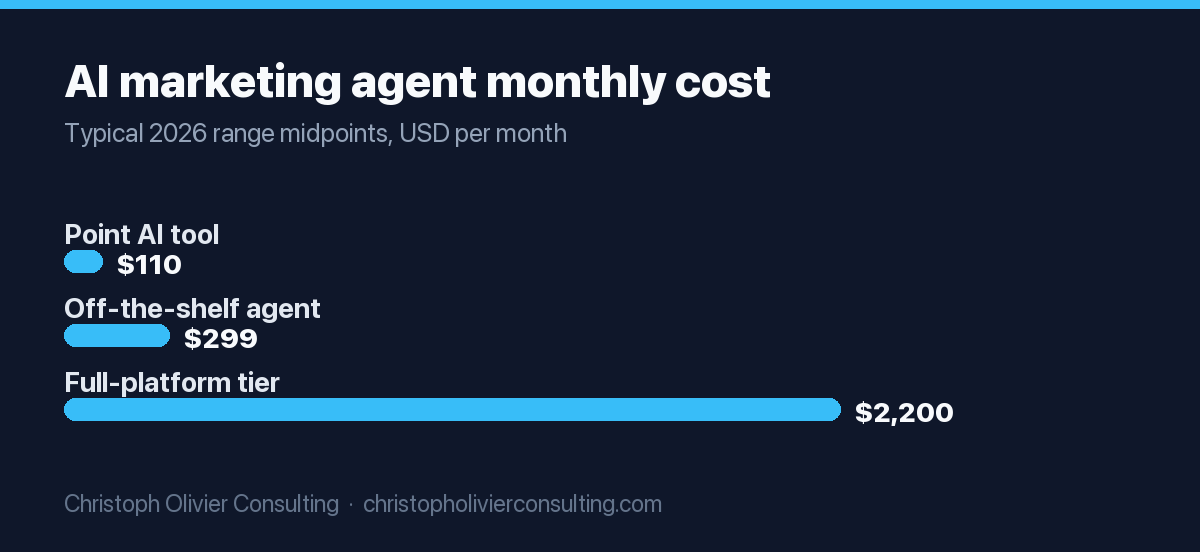
Costs vary by whether you buy a point tool, adopt an agent feature inside a full platform, or commission a custom build. As a 2026 reference, a single-purpose AI tool commonly runs about $20 to $200 a month, off-the-shelf task or voice agents about $99 to $499 a month, and the automation tier of a full platform about $800 to $3,600 a month. Custom-built agents are typically a one-time $3,000 to $20,000 or more.
| Option | Typical monthly range (2026) | Notes |
|---|---|---|
| Point AI tool (single task) | $20 to $200 | Narrow scope; light integration |
| Off-the-shelf task or voice agent | $99 to $499 | Prebuilt; limited customization |
| Full-platform automation tier | $800 to $3,600 | Broader features; deeper integration |
Watch the pricing model, not just the sticker. Usage-based billing tied to tokens, API calls, and agent runs can swing roughly 30 to 50 percent month over month with campaign volume. Many platforms also add a one-time implementation fee that can raise a first-year total by about 15 to 25 percent, plus per-channel add-ons. Budget for the variable layer, not only the base plan.
Where AI marketing agents fall short today
Agentic AI is early, and the failure rate is real. Gartner predicted in June 2025 that over 40 percent of agentic AI projects will be canceled by the end of 2027, citing escalating costs, unclear business value, and inadequate risk controls. Most current projects are still experiments, so treat vendor autonomy claims with caution.
The practical limits cluster in a few places. Without guardrails, an agent can overspend a budget, misread a signal, or ship messaging that drifts from brand voice. Biased or incomplete data produces flawed optimization, since the agent trusts the numbers it is given. Consumer-facing decisions carry far higher brand and reputational risk than back-office tasks, which is why customer-facing autonomy should be earned, not assumed.
Adoption reflects this caution. Broad AI use in marketing is near-universal, but agentic AI specifically sits in the low teens of marketers by 2026 Salesforce data, with a larger share still evaluating. The gap between using AI and proving its return is where most programs stall, so tie any agent to a measurable business result from the start.
How to deploy an AI marketing agent safely
Start with one repeating workflow, a defined result, tight permissions, and a human approval gate. Prove value on a low-risk task before you widen scope. The goal in the first 90 days is a working loop you trust, not a fully autonomous marketing function.
- Pick one monthly workflow. Choose something repetitive with clean data and low customer-facing risk, such as weekly reporting.
- Define the business result. Name the metric the agent should move, so return is measurable rather than assumed.
- Write the guardrails. Set brand, audience, budget, and compliance limits in writing before the agent runs.
- Grant least-privilege access. Give one agent role only the permissions its task needs, and no production write access on day one.
- Test in a sandbox. Use a sandbox instance or throwaway assets; never let a first run touch live campaigns.
- Keep a human in the loop. A person reviews output and makes the final call before anything reaches a customer.
- Review and widen slowly. Check performance against the metric, then expand scope only where the evidence supports it.
Deployed this way, an AI marketing agent behaves less like a black box and more like a junior operator on a leash you control. If you want help scoping the first workflow and the guardrails around it, our fractional CMO services cover strategy, implementation, and the governance that keeps agents accountable.
Frequently asked questions
What is an AI marketing agent in simple terms?
It is software that takes a marketing goal, plans the steps to reach it, connects to your live tools, acts, checks the result, and adjusts within limits you set. Unlike a chatbot that only answers or automation that only fires preset rules, an agent owns the outcome and iterates on its own work under human oversight.
How is an AI marketing agent different from a chatbot?
A chatbot is reactive: you ask, it answers, one step at a time. An AI marketing agent is goal-driven: you set an objective and guardrails, and it plans and runs multi-step work across connected systems, adjusting as results come back. A chatbot answers questions, while an agent builds and optimizes campaigns.
Is an AI marketing agent the same as marketing automation?
No. Marketing automation runs the exact rules you configure, such as a drip email or a lead-scoring branch. An AI marketing agent interprets context and chooses among allowed actions to reach a goal, and often orchestrates the automation you already run. Automation follows your rules; an agent pursues your outcome within guardrails.
How much does an AI marketing agent cost in 2026?
As a rough reference, a single-purpose AI tool runs about $20 to $200 a month, off-the-shelf task or voice agents about $99 to $499 a month, and a full-platform automation tier about $800 to $3,600 a month. Custom builds are often a one-time $3,000 to $20,000 or more, plus variable usage-based charges.
Are AI marketing agents safe to use?
They can be, with guardrails. Give one agent role least-privilege access, define budget and brand limits in writing, test in a sandbox, and keep a human approving anything customer-facing. Gartner expects over 40 percent of agentic AI projects to be canceled by end of 2027, so start small, measure return, and widen scope only on evidence.
What is the best first use case for an AI marketing agent?
Weekly or monthly reporting is often the safest starting point because the data is clean, the steps repeat, and the customer-facing risk is low. Once the agent reliably pulls data, writes the narrative, and flags what to do next, you can extend it into segmentation, campaign execution, and lead qualification with the same guardrails.
More marketing guides for rank on ai: get cited by ai search
- Client Database Software: How to Store and Segment Client Records
- The Best Client Management Apps for Service Businesses (2026)
- Customer Relationships: Stages, Strategy, and How to Build Them
- How to Create Instagram Stories Ads: A Step-by-Step Guide
- How to Rank Higher on Google: A Prioritized 2026 Playbook
- The Best HubSpot Alternatives in 2026 (by Use Case)
- Rank on AI: Get Cited by AI Search