
Most US small businesses spend between $1,000 and $15,000 a month on digital marketing in 2026, with a rough average near $2,083 a month. What you pay depends on your revenue, how competitive your market is, which channels you run, and whether you hire a freelancer, an agency, or build a team in house. Roughly half of small businesses (about 52%) still spend under $1,000 a month across all channels combined.
Last reviewed: September 2026
How much does digital marketing cost in 2026?
Digital marketing costs a typical small business $1,000 to $15,000 a month in 2026, with the average landing around $2,083. Very small local operators often run $500 to $2,000 a month on one or two channels, while businesses chasing fast growth commit far more. Your number is driven by channel mix, market competitiveness, and who does the work.
Think of the figure as a monthly operating cost, not a one time fee. Digital marketing compounds: SEO and content build equity over months, while paid channels stop the moment you stop funding them. A budget that looks small on paper often underperforms because it is spread too thin across too many channels at once.
Digital marketing cost by channel
Channel costs vary widely: SEO retainers run $1,500 to $7,500 or more a month, PPC management runs a $1,000 to $3,000 base plus 10% to 20% of ad spend, social media management runs $750 to $2,500, content marketing runs $1,000 to $10,000 or more, and email platforms start at $20 to $100. Media budget (the money paid to ad platforms) sits on top of any management fee.
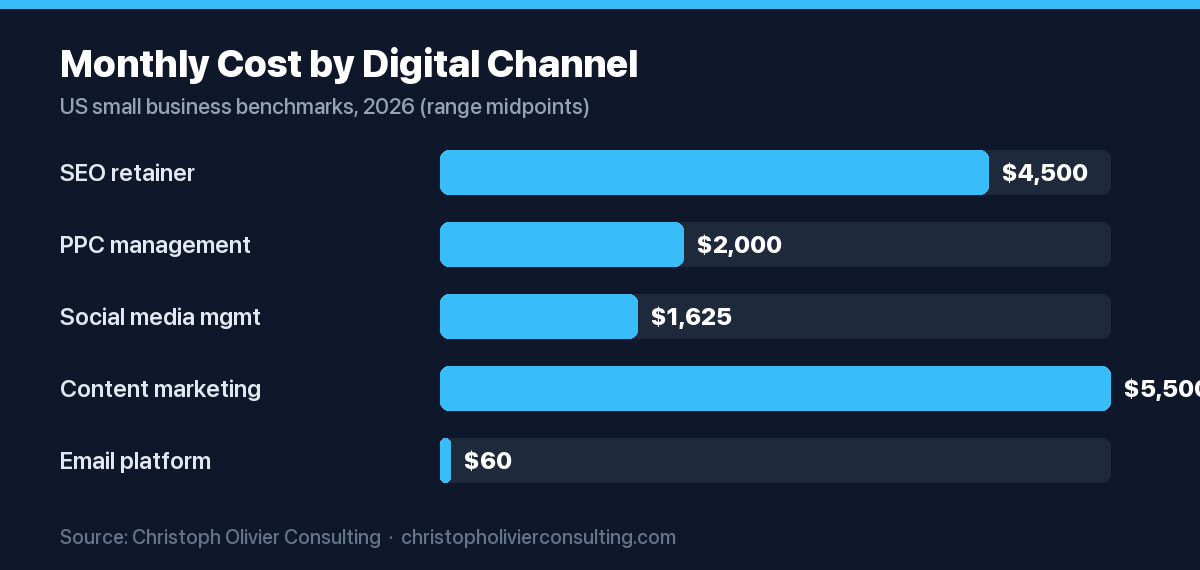
The table below separates the fee you pay a provider from the media spend you pay directly to Google, Meta, or an email tool. Confusing the two is the most common budgeting mistake, and it makes cheap quotes look better than they are.
| Channel | Typical monthly range (US, 2026) | What it covers |
|---|---|---|
| SEO retainer | $1,500 to $7,500+ | Strategy, on-page and technical work, content, links |
| PPC management | $1,000 to $3,000 base + 10% to 20% of ad spend | Campaign build and management (excludes the ad budget itself) |
| Paid media budget | $300 to $500+ for a local test | Money paid to Google or Meta for clicks and impressions |
| Social media management | $750 to $2,500 | Content creation, posting, community replies |
| Content marketing | $1,000 to $10,000+ | Articles, video, design, editing |
| Email marketing | $20 to $100 platform + labor | Platform plus setup, automation, and sends |
For most local and professional service businesses, SEO and paid search together tend to produce the clearest return, which is why the SEO for lead generation approach usually anchors the plan before newer channels get funded.
Agency vs in-house vs freelancer: what each costs
A freelancer typically runs $1,000 to $3,000 a month and is 40% to 60% cheaper than an agency for comparable deliverables, though you manage coordination yourself. A small agency runs $3,000 to $10,000 a month, a mid-size full-service agency $10,000 to $30,000. Building an in-house team costs more than an agency for most businesses under $30M in revenue, because you carry salary, benefits, tools, and management overhead.
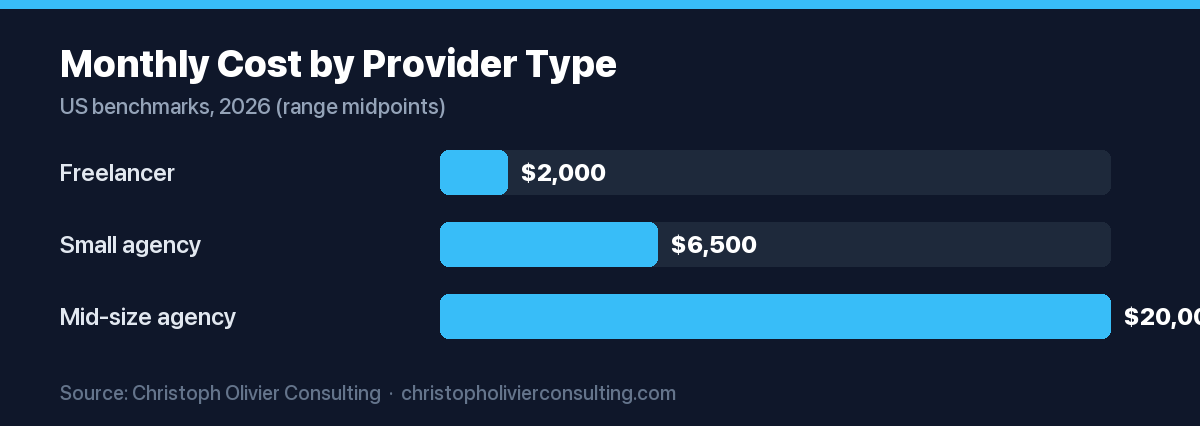
The right choice follows the volume of work. In-house makes sense once you need 40 or more hours a week of consistent marketing. Below that, a freelancer or agency gives better flexibility per dollar. Many owners start with a freelancer or a fractional operator, then add specialists as revenue justifies it.
| Model | Typical monthly cost | Best fit |
|---|---|---|
| Freelancer or specialist | $1,000 to $3,000 | One or two channels, tight budget, hands-on owner |
| Small agency | $3,000 to $10,000 | Multi-channel execution without a full team |
| Mid-size agency | $10,000 to $30,000 | Aggressive growth, several channels at once |
| In-house team | Salaries + tools + overhead | 40+ hours a week of steady work |
A fractional model sits between these options and is worth comparing against the full menu on the services page before you commit to a fixed retainer.
What percentage of revenue should you spend on marketing?
A common benchmark is 7% to 8% of revenue for steady businesses, rising above 20% for companies pushing hard for growth (some firms in the $10M to $25M range invest over 21%). Newer businesses building awareness usually sit at the higher end, while established firms defending market share sit lower.
Percentage of revenue is a sanity check, not a rule. A business with strong margins and a fast payback per lead can justify more; one with thin margins should spend less and prove return before scaling. Tie the percentage to a target cost per lead and payback period rather than copying an industry average, which is the core of any sound sales and marketing strategy.
What a realistic monthly budget buys
At $1,000 a month you can run one channel well, usually local SEO or a small paid search test, but not both. At $3,000 to $5,000 you can pair SEO with paid search and light content. At $8,000 or more you can run several channels together with dedicated management and reporting. Spreading a small budget across five channels is the fastest way to see no result anywhere.
Use the tiers below as a planning guide, then match them to how quickly a customer pays back your acquisition cost.
- $500 to $1,500 a month: one focused channel, foundational SEO or a small local ads test, done consistently.
- $2,000 to $5,000 a month: SEO plus paid search, basic content, and email automation with real reporting.
- $6,000 to $10,000 a month: multi-channel execution, dedicated management, testing budget for new channels.
- $10,000+ a month: full funnel across search, social, content, and email with weekly optimization.
How to set your digital marketing budget
Set your budget from goals and unit economics, not from a competitor’s spend. Start with the revenue you want, work back to the leads and customers required, then fund the channels most likely to deliver them. A disciplined method keeps you from over-committing to channels that cannot pay back inside your cash cycle.
- Define a revenue goal and the number of new customers it requires.
- Estimate your cost per lead and close rate per channel from past data or realistic benchmarks.
- Fund one or two channels fully before adding a third.
- Reserve about 10% for testing new channels once the core is working.
- Review cost per acquisition monthly and reallocate toward what pays back fastest.
The step by step version of this, with worksheets, lives in the how to set a marketing budget guide.
How to judge value versus price
Judge digital marketing by cost per acquired customer and payback period, not by the monthly fee alone. A $5,000 retainer that returns $20,000 in tracked revenue is cheaper, in the only sense that matters, than a $1,500 retainer that returns nothing. Ask any provider how they measure and report results before you compare quotes.
Watch for two warning signs: quotes that hide media spend inside the management fee, and promises of specific rankings or lead counts, which no honest provider can guarantee. Results depend on your market, offer, and follow-up, so treat firm outcome claims with caution and ask for tracked, attributable numbers instead.
Frequently asked questions
How much does digital marketing cost per month for a small business?
Most US small businesses spend $1,000 to $15,000 a month in 2026, with an average near $2,083. Very small local operators often run $500 to $2,000 on one or two channels. About 52% of small businesses still spend under $1,000 a month across all channels combined. Your figure depends on revenue, market competitiveness, and channel mix.
Is it cheaper to hire a freelancer or an agency?
A freelancer is usually 40% to 60% cheaper than an agency for comparable work, typically $1,000 to $3,000 a month versus $3,000 to $10,000 for a small agency. The tradeoff is coordination and quality control, which you manage yourself with a freelancer. Agencies cost more but bundle strategy, execution, and reporting across several channels under one roof.
What percentage of revenue should go to digital marketing?
A common benchmark is 7% to 8% of revenue for steady businesses, rising above 20% for companies pushing hard for growth. Newer businesses building awareness sit higher; established firms defending share sit lower. Treat the percentage as a sanity check and tie it to a target cost per lead and payback period rather than copying an industry average.
Why does PPC pricing show a fee plus a percentage?
PPC has two costs: the management fee you pay a provider and the media budget you pay platforms like Google or Meta. Management often runs a $1,000 to $3,000 base plus 10% to 20% of ad spend. So a $2,000 ad budget with a $1,500 base and 15% fee costs about $3,800 a month all in. Always confirm which figure a quote includes.
What can I get for a $1,000 monthly marketing budget?
At $1,000 a month you can run one channel well, usually local SEO or a small paid search test, but not both at once. Spreading that budget across several channels almost always produces no measurable result anywhere. Fund one channel fully, prove it returns, then add a second as revenue grows rather than starting everything at once on a thin budget.
More marketing guides for rank on ai: get cited by ai search
- How Much Does SEO Cost in 2026?
- Junk Removal Marketing: A Channel-by-Channel Booking System
- Landscaping Marketing in 2026: Cost Per Booked Job by Channel
- Martial Arts School Marketing: A Playbook to Fill Mats and Keep Students
- Pressure Washing Marketing: The Channels That Book Jobs in 2026
- Tree Service Marketing: Cost and ROI by Channel (2026)
- Rank on AI: Get Cited by AI Search