
Last reviewed: September 2026
To generate more leads, you increase volume and quality at the same time: fix conversion on the traffic you already have, then add the two or three channels with the lowest cost per lead for your business. Most teams do the reverse, buying more clicks before the site converts, and pay for it. The 12 tactics below are ordered by how fast they move the number, with a prioritization framework so you work the highest-return ones first.
The lead generation prioritization framework
Before you add tactics, score them. The fastest way to generate more leads is usually not a new channel, it is removing friction on the demand you already attract. Score every idea on three factors and start at the top.
- Impact: how many extra qualified leads per month if it works.
- Confidence: how sure you are, based on your own data or a close benchmark.
- Effort: hours and budget to ship it, lower is better.
Multiply impact by confidence, divide by effort, and rank. Conversion-rate fixes and owned channels tend to win this math because they compound and carry a low cost per lead. Paid tactics score well only when your offer and follow-up are already tight. For the bigger picture on how demand generation feeds pipeline, see our sales and marketing strategy guide.
12 tactics to generate more leads
These 12 tactics cover owned, earned, and paid sources so you are not dependent on one channel. Owned tactics carry the lowest cost per lead and compound over time; earned builds trust fast; paid buys speed. Run three at once, measure cost per lead on each, and cut the losers.
Owned channels (lowest cost per lead)
Owned channels are assets you control: your site, your email list, your content. They take longer to ramp but produce the cheapest, best-fit leads once they do.
- Turn your best pages into lead capture. Add a relevant offer and a clear next step to the pages that already get traffic. A stronger button and headline often lift form fills more than a redesign. Study proven patterns in these call to action examples.
- Publish decision-stage content. Comparison, pricing, and “how to choose” pages attract people close to buying, not just browsers. This is where organic search produces qualified leads at low cost.
- Win AI search and answer engines. Buyers now ask ChatGPT and Google AI Overviews before they click. Structure content to be quoted by machines, with clear answers, tables, and FAQs. Our guide on how to rank on AI covers the mechanics.
- Build a lead magnet worth an email. A template, checklist, calculator, or short guide converts anonymous traffic into named contacts you can nurture.
- Run an email nurture sequence. Most leads are not ready on day one. A five to seven email sequence with proof and a soft ask recovers demand you already paid to attract.
Earned channels (trust and referrals)
Earned channels turn other people’s audiences and your happy customers into new leads. They convert well because they arrive with built-in trust.
- Ask for referrals systematically. Referrals are the top-cited lead source for small businesses and convert far better than cold prospects. Make the ask a step in your delivery process, not an afterthought.
- Optimize your local and profile listings. A complete Google Business Profile lets buyers find, trust, and contact you directly from the map.
- Show up where your buyers already gather. Answer questions in the communities, podcasts, and events your market follows, then point back to a useful resource, not a hard pitch.
Paid channels (speed, at a price)
Paid channels buy immediate volume. Use them once your offer converts, because paid amplifies whatever your funnel already does, good or bad.
- Run intent-based search ads. Bid on terms where the searcher wants a solution now. Send clicks to a matched landing page, never the homepage.
- Retarget site visitors. Retargeting recovers people who left without converting and carries one of the lowest paid costs per lead.
- Test one high-intent social channel. LinkedIn produces expensive but high-quality B2B leads; a single well-targeted campaign beats spreading budget thin.
- Use content syndication or webinars for volume. These fill the top of the funnel cheaply, but qualify hard, because the intent is lower than search.
Cost per lead by channel: where to invest first
Cost per lead varies widely by channel, and the cheapest source is not always the best fit. Owned channels such as SEO and email carry the lowest cost per lead; paid social and trade shows carry the highest. The table below shows typical 2026 B2B midpoints alongside ramp time and intent so you can weigh speed against price.
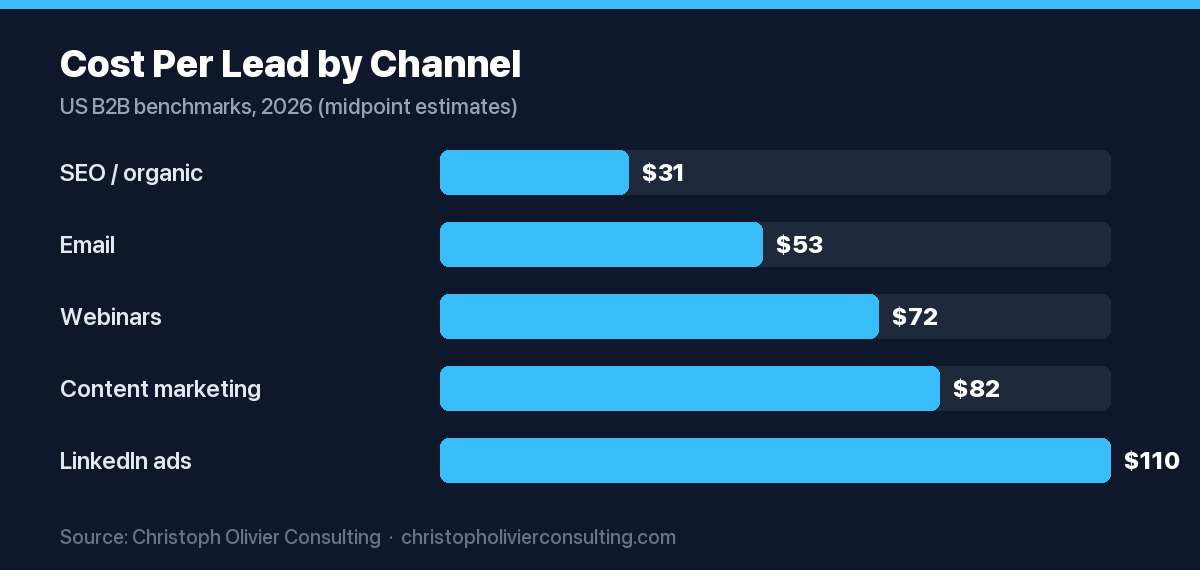
| Channel | Typical CPL (2026 B2B midpoint) | Ramp time | Intent / quality |
|---|---|---|---|
| SEO / organic search | ~$31 | Slow (months) | High |
| Email marketing | ~$53 | Medium | Medium to high |
| Webinars | ~$72 | Medium | Medium |
| Content marketing | ~$82 | Slow | Medium to high |
| LinkedIn ads | ~$110+ | Fast | High |
Ranges are wide, so treat these as starting points and measure your own numbers. For deeper benchmarks by sector, see our data on average cost per lead by industry. A practical read: start with the low-cost owned channels for durable volume, and layer paid on top only when you need speed and your offer already converts.
How to increase lead quality, not just volume
Generating more leads only helps if sales can close them. Quality comes from matching your message to intent and filtering early, so reps spend time on real buyers. More raw leads with worse fit can slow revenue, not grow it.
- Define what a qualified lead is with sales, in writing, before you scale any channel.
- Ask one or two qualifying questions on the form to filter fit without killing conversion.
- Route and follow up fast. Speed to first contact is one of the strongest predictors of whether a lead converts.
- Track cost per qualified lead, not just cost per lead, so a cheap channel full of poor fits does not look like a winner.
A 30-day plan to generate more leads
You can move the number in a month without a new budget line. This plan front-loads conversion fixes, which are the fastest, highest-confidence wins, then adds one paid test for speed.
- Week 1: Audit your top five traffic pages and add a clear offer and call to action to each.
- Week 2: Ship one lead magnet and a short email nurture sequence behind it.
- Week 3: Build a referral ask into your delivery process and update your Google Business Profile.
- Week 4: Launch one retargeting or intent-based search campaign to a matched landing page, and set up cost-per-qualified-lead tracking.
Measure every week, keep what beats your target cost per lead, and cut what does not. Compounding a few working channels beats chasing a new tactic each month.
Frequently asked questions
What is the fastest way to generate more leads?
The fastest way is usually not a new channel, it is capturing more of the traffic you already have. Add a relevant offer and a clear call to action to your highest-traffic pages, then put a lead magnet behind an email form. These conversion fixes take days, cost little, and often lift form fills more than buying additional clicks would.
How can a small business generate leads for free?
Free lead sources include SEO-focused pages that answer buyer questions, a complete Google Business Profile, systematic referral requests, and answering questions in the communities your market follows. None cost ad budget, though they cost time and take weeks to ramp. Referrals are the most-cited lead source for small businesses and convert far better than cold prospects.
What is a good cost per lead?
It depends on your channel and deal size. In 2026, blended B2B cost per lead commonly lands between roughly $40 and $300 or more. Owned channels such as SEO (about $31) and email (about $53) sit lowest; paid social and trade shows sit highest. Judge a channel by cost per qualified lead, not raw cost per lead, so poor-fit volume does not mislead you.
Which channel generates the highest-quality leads?
For B2B, search and referrals tend to produce the best-fit leads because the buyer is actively looking or arrives pre-trusted. LinkedIn ads produce high-quality leads at a higher price. The cheapest channel rarely produces the best-fit leads, so weigh intent and quality against cost per lead rather than chasing the lowest price alone.
How many leads should I expect per month?
There is no universal number; it depends on traffic, conversion rate, and budget. A more useful target is a monthly lead goal derived from your revenue target, average deal size, and close rate, worked backward through your funnel. Set that goal, then measure cost per qualified lead by channel so you know which sources to scale.
Should I focus on more leads or better leads?
Both, but sequence them. First define what a qualified lead is with sales, then increase volume through channels that match that definition. More raw leads with poor fit can slow revenue by burning rep time. Track cost per qualified lead so a cheap, low-intent channel does not look like a winner when it is not.
More marketing guides for rank on ai: get cited by ai search
- How to Make a Sales Call: Structure, Questions, and Openers
- Internet Advertising: Channels, Pricing Models, and How to Choose
- What Is a Marketing Consultancy? Services, Fees, and How to Choose
- The 7 Sales Process Steps (and How to Run Each One)
- Customer Engagement Platform: What It Is and How to Choose
- Customer Success Software: Categories, Features, and Pricing
- Rank on AI: Get Cited by AI Search