
Last reviewed: September 2026
Learning how to make a sales call is less about a clever pitch and more about a repeatable structure you can run on every dial. A good call opens with permission, spends most of its minutes on the buyer, and ends with one agreed next step. This guide gives you the structure, the openers, and the discovery questions to run it, whether the call is cold, a booked discovery slot, or a follow-up.
The bar is set by the numbers. Only 3 to 12 percent of B2B cold dials reach a live person on generic data, and the average call books a meeting roughly 2 to 3 percent of the time while skilled reps hit 6 to 10 percent. The difference is rarely the script. It is preparation, questions, and a disciplined close.
What makes a sales call work
A sales call works when the buyer does most of the talking and leaves with a clear next step. Analysis of B2B calls shows top performers talk about 43 percent of the time on discovery calls, while calls that end in a lost deal average around 64 percent rep talk time. Less pitching and more listening is the single most consistent signal.
Three things separate a call that advances from one that stalls: you earned the time with a clear reason for calling, you diagnosed a real problem instead of presenting features, and you named the next step before hanging up. Everything below serves those three outcomes. If you want the wider context of where a live call sits in your pipeline, see our guide to the sales process steps.
How to prepare before you dial
Preparation is five to ten minutes of research that changes the entire call. Before you dial, know who you are calling, why they might care right now, and what a realistic first ask is. Walking in cold with no context is the fastest way to get screened out in the first 15 seconds.
Run a short pre-call checklist so every dial starts from the same footing.
| Prep item | What to find | Why it matters |
|---|---|---|
| The person | Role, tenure, what they own | Frames who has the pain and the budget |
| The trigger | Recent hire, launch, funding, review cycle | Gives a reason to call now |
| The likely pain | Two or three problems their role usually faces | Lets you ask sharper questions |
| Your ask | The single next step you want | Keeps the call from drifting |
| The timing | Tuesday to Thursday, late morning | Connect rates peak midweek, 10am to 12pm |
Timing is a small edge that compounds. Reported data puts Tuesday as the strongest day and late morning (10am to noon) as the highest-connect window, with Fridays the weakest. You will not win a deal on timing alone, but you will reach more live people.
A sales call structure that works
A reliable sales call follows six stages in order: open, set the agenda, diagnose, connect the problem to a solution, handle concerns, and confirm the next step. Keeping the stages in sequence stops the common failure of pitching before you understand the problem. Use this numbered structure as your default frame.
- Open with a reason (30 to 45 seconds). State who you are, why you are calling this person, and ask for permission to continue.
- Set the agenda and check time. Confirm how long they have and what you both want out of the call, so there are no surprises.
- Diagnose with questions (10 to 15 minutes). Spend the bulk of the call here. Understand the current situation, the problem, and the cost of leaving it unsolved.
- Connect problem to solution. Only after you understand the pain, show the one or two ways you address it. Tie every point to something they said.
- Handle concerns. Treat objections as questions, not rejections. Acknowledge, clarify, respond, confirm.
- Confirm the next step. Propose a specific next action with a date and get a clear yes.
The proportions matter as much as the order. Discovery should be the longest stage by far, and the pitch should be the shortest. If your solution stage is running longer than your diagnosis, you are talking too much.
Sales call openers that earn the next 30 seconds
A strong opener names the person, gives a reason for the call, and asks permission before you continue. The goal of the first 30 seconds is not to sell. It is to earn the next two minutes. Direct, honest openers outperform disguised pitches because buyers can tell the difference instantly.
These openers work across cold and warm calls. Adapt the wording to your voice.
| Situation | Opener you can adapt |
|---|---|
| Cold call, permission-based | “Hi [name], this is [you] from [company]. I know I am calling out of the blue. Can I take 30 seconds to say why, and you can tell me if it is worth continuing?” |
| Cold call, trigger-based | “I saw you just [trigger event], which usually means [likely challenge] lands on your desk. Is that on your radar right now?” |
| Booked discovery call | “Thanks for making the time. We have 30 minutes. I would like to understand [their goal] and see if we are a fit. Does that work?” |
| Follow-up call | “Last time you mentioned [specific point]. I have been thinking about it and have one idea and one question. Good moment?” |
Notice that each opener ends with a question. Handing control back to the buyer early builds the two-way rhythm that predicts a good call. If you want a framework for structuring the message itself, the AIDA model maps cleanly onto how an opener should move from attention to interest.
Discovery questions to ask on a sales call
Good discovery questions are open-ended and move from the current situation to the problem to its impact. Avoid yes or no questions, which end conversations instead of opening them. Group your questions so the call flows naturally from context to consequence rather than jumping around.
Use these categories as a bank, not a script. Ask fewer questions and listen harder.
- Situation: “Walk me through how you handle [area] today.” “Who else is involved in that?”
- Problem: “Where does that process break down?” “What have you already tried?”
- Impact: “What does that cost you in time or revenue?” “What happens if nothing changes this year?”
- Priority: “Where does fixing this sit against your other priorities?” “Is there a deadline driving it?”
- Decision: “If we found a fit, what would the next steps look like on your side?”
Strong discovery does double duty. It qualifies the lead and it prevents objections later, because you have already surfaced the concerns and the cost of inaction. Popular qualification frameworks such as BANT, SPIN, and MEDDIC are just organized ways to cover situation, problem, impact, and decision.
How to handle objections without pushing
Handle objections by pausing, understanding the real concern, and responding to that rather than the surface words. Most objections trace back to thin discovery, so the best objection handling happens earlier in the call. When one does land, resist the urge to defend or pitch on reflex.
A simple four-step pattern keeps you calm and credible.
- Acknowledge. “That is fair, and a lot of people raise that.”
- Clarify. “So I answer the right thing, is it the price itself or the timing?”
- Respond with value. Address the actual concern and tie it back to what they told you.
- Confirm. “Does that put the concern to rest, or is there more to it?”
Objections are buying signals more often than rejections. A prospect who pushes back on price or timing is usually still thinking about doing it. Silence is a tool here: ask, then stop talking and let them fill the space.
How to lock in a clear next step
End every sales call by proposing one specific next step with a date and getting an explicit yes. A call with no agreed action is a call you will chase for weeks. The next step should be proportional to where you are: a second call, a scoped proposal, a demo, or an introduction to another stakeholder.
Be concrete. “I will send a short summary and two times for a working session next week. Does Wednesday or Thursday suit better?” beats “I will follow up soon.” Naming the action and the calendar slot removes the ambiguity that kills momentum. For how these calls feed a larger plan, see our view on building a coherent sales and marketing strategy.
Sales call benchmarks worth tracking
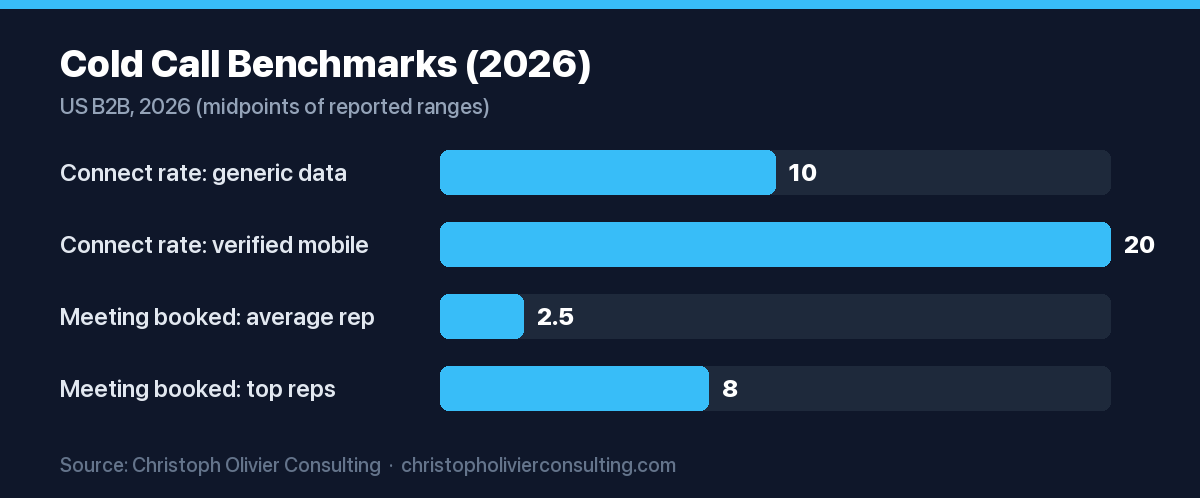
Track connect rate, meeting-booked rate, and talk-to-listen ratio to know whether your calls are improving. These three numbers explain most of the gap between average and top performers. The benchmarks below are midpoints of ranges reported across 2026 B2B call studies, so treat them as targets rather than guarantees.
| Metric | Typical range (2026) | What good looks like |
|---|---|---|
| Connect rate, generic data | 8 to 12 percent | Reach more live people midweek, late morning |
| Connect rate, verified mobile | 18 to 22 percent | Cleaner data roughly doubles connects |
| Meeting-booked rate, average | 2 to 3 percent | Baseline for most teams |
| Meeting-booked rate, top reps | 6 to 10 percent | Driven by prep, questions, and a firm close |
| Rep talk time on winning calls | ~43 percent | Buyer does most of the talking |
If you are also thinking about how buyers and AI assistants find and cite your business before a call ever happens, our guide to how to rank on AI covers the visibility side of the same funnel.
Frequently asked questions
How do you start a sales call?
Start by naming the person, giving a clear reason for the call, and asking permission to continue. A cold opener can be as simple as: “I know I am calling out of the blue, can I take 30 seconds to explain why?” Ending your opener with a question hands control back to the buyer and earns you the next two minutes.
How long should a sales call be?
It depends on the type. Cold prospecting calls that succeed often run around 90 seconds to two minutes because the goal is only to book time. A booked discovery call typically runs 20 to 30 minutes, with roughly 10 to 15 minutes spent on questions. Let the buyer, not a clock, set the real length once the conversation is flowing.
What questions should I ask on a sales call?
Ask open-ended questions that move from situation to problem to impact. Start with how they handle the area today, then where it breaks down, then what that costs them in time or money. Finish with priority and decision questions such as whether a deadline is driving the project. Avoid yes or no questions, which shut conversations down.
How do you handle objections on a sales call?
Pause, understand the real concern, then respond to that rather than the surface words. A reliable pattern is acknowledge, clarify, respond with value, and confirm. Most objections come from thin discovery, so strong questions earlier in the call prevent many of them. Treat pushback as a buying signal rather than a rejection, and use short silences to let the buyer explain.
What is a good talk-to-listen ratio on a sales call?
On discovery calls, top-performing reps talk roughly 43 percent of the time and let the buyer talk the rest. Calls that end in lost deals average closer to 64 percent rep talk time. The practical rule is to ask a question, then stop talking. If you are talking more than the prospect during discovery, you are pitching too early.
What is the best time to make a sales call?
Reported 2026 data points to Tuesday through Thursday, with late morning between 10am and noon producing the highest connect rates. Fridays tend to be the weakest. Timing gives you more live conversations but will not fix a weak call, so treat it as a small edge on top of good preparation and questions rather than a strategy on its own.
More marketing guides for rank on ai: get cited by ai search
- Internet Advertising: Channels, Pricing Models, and How to Choose
- What Is a Marketing Consultancy? Services, Fees, and How to Choose
- The 7 Sales Process Steps (and How to Run Each One)
- Customer Engagement Platform: What It Is and How to Choose
- Customer Success Software: Categories, Features, and Pricing
- What Is Fractional Marketing? Model, Cost, and When to Use It
- Rank on AI: Get Cited by AI Search