
The seven sales process steps are prospect, qualify, connect, discover, present, handle objections, and close or nurture. Each step has one job and one exit test, so you always know whether a deal is ready to move forward or is stuck. Run them in order and you stop guessing where revenue leaks.
Last reviewed: September 2026
Most guides for these sales process steps assume a B2B software team with a full modern stack. This one does not. It is channel agnostic, so an owner selling by phone, a founder closing over email, and a two-person sales team all use the same seven steps. If you sell a longer, tool-heavy deal, pair this with our sales and marketing strategy guidance for the modern-stack version.
What a sales process actually is
A sales process is the repeatable set of steps a seller takes to move a person from stranger to customer. It describes what you do at each stage and the exit test that lets a deal advance. It is not the same as a sales funnel, which measures how many buyers survive each stage, or a pipeline, which is your live list of open deals.
Keeping these three ideas separate matters because they answer different questions. The process tells a rep what to do next. The funnel tells a manager where conversion drops. The pipeline tells the business what revenue is in play right now.
| Concept | What it describes | Question it answers |
|---|---|---|
| Sales process | The actions a seller takes, step by step | What do I do next? |
| Sales funnel | Conversion rates between stages | Where do deals fall out? |
| Sales pipeline | The current set of open deals by stage | What revenue is in play now? |
The 7 sales process steps
Below are the seven steps in order. Each one lists the job to do and the exit test that says the deal can advance. Treat the exit test as a gate. If a deal cannot pass it, the step is not finished, no matter how good the call felt.
- Prospect. Build a list of people who plausibly have the problem you solve. Use referrals, your existing customer base, inbound signups, events, and targeted outreach. This is also where AI search visibility earns its keep, because buyers now shortlist vendors through AI answers before a rep is ever involved; see how to rank on AI. Exit test: the contact fits your ideal-customer profile and has a reason to hear from you.
- Qualify. Confirm the prospect has a real need, a rough budget, and the authority or influence to act. Disqualify fast. A short list of fitting prospects beats a long list of maybes. Exit test: need, budget, and decision path are all confirmed as plausible.
- Connect. Make first contact and earn a real conversation, not a brush-off. Speed decides this step: prospects contacted within an hour are far more likely to engage than those left for a day. Exit test: the prospect agrees to a discovery call or a defined next step.
- Discover. Ask questions until you understand the problem, its cost, and what a good outcome looks like. Most weak deals trace back to a shallow discovery. Listen more than you pitch. Exit test: you can restate the prospect’s problem and success criteria in their own words.
- Present. Show how your offer solves the specific problem you uncovered, not a generic feature tour. Tie every point to something they told you in discovery. Structuring the pitch around attention, interest, desire, and action helps; see the AIDA model. Exit test: the prospect agrees your offer fits their problem.
- Handle objections. Treat objections as requests for information, not rejection. Confirm you understand the concern, answer it plainly, and check whether anything else stands in the way. Exit test: every stated concern has a clear answer and no new one is hiding behind it.
- Close or nurture. Ask for the decision directly and make the next step easy. Roughly four in five opportunities will not buy on this round, so route a clear no or not-yet into a nurture track with a set follow-up date. For deals that close, a smooth handoff to a customer success manager protects renewals and referrals. Exit test: you have a signed yes, a scheduled follow-up, or a clean no.
What good conversion looks like at each stage
Honest benchmarks help you spot the leaking step instead of guessing. Across US business-to-business teams, qualified leads convert to opportunities at roughly 50 to 62 percent, and opportunities convert to closed deals at roughly 15 to 30 percent. Reported 2025 win rates sat near 19 percent on average, down from prior years, so a below-average close rate is common, not a personal failing.
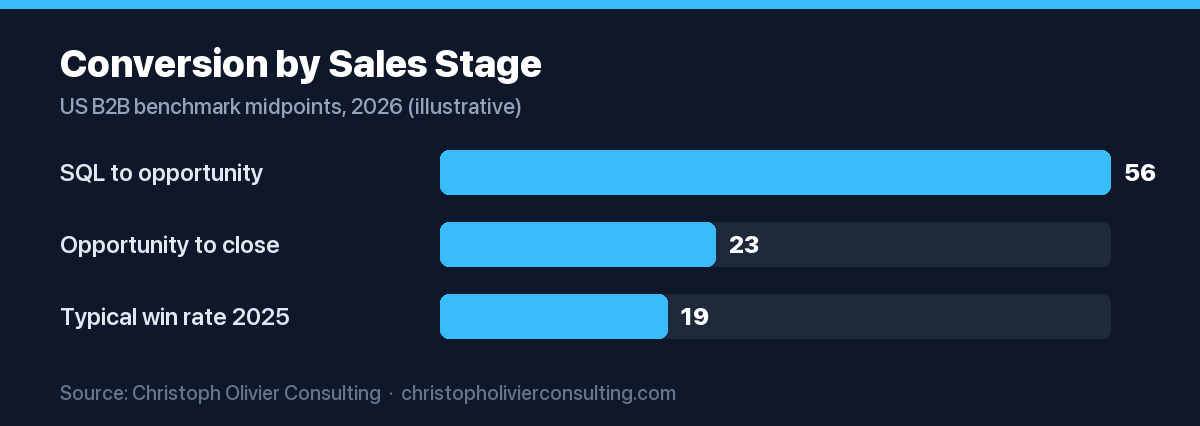
Use the ranges as a diagnostic. If your qualify-to-opportunity rate is healthy but closing is weak, the problem is usually late in the process. If few qualified leads ever become opportunities, look at connect and discover first.
| Stage transition | Typical range | Watch for |
|---|---|---|
| Qualified lead to opportunity | 50 to 62% | Below 30% means leads enter under-qualified |
| Opportunity to closed deal | 15 to 30% | Below 15% points to pipeline quality, not effort |
| Overall win rate (2025) | ~19% average | SMB deals tend to close higher than enterprise |
These are illustrative midpoints of published ranges, not a promise for your numbers. Track your own rates for a quarter, then compare.
How to run each sales process step in a small business
Small teams win by making the steps concrete and light, not by copying enterprise tooling. Write one exit test per step, put it where reps can see it, and review deals against those tests weekly. That single habit does more for close rates than any new software.
Keep discovery notes in one place so the present step can reference exact quotes. Set a standing rule for connect speed, such as first contact within one business hour for any inbound request. Give every not-yet a real follow-up date rather than a vague someday, because the nurture path is where most SMB revenue is quietly lost.
Common mistakes that stall the process
The most frequent failure is skipping the exit test and letting hopeful deals drift forward. A close call built on a thin discovery collapses under the first objection. Chasing volume over fit fills the pipeline with prospects who were never going to buy.
The second failure is treating the process as a script instead of a checklist. Buyers do not move in a straight line, so you will loop back from present to discover, or from objections to qualify. That is normal. The steps are the order you check, not a cage.
Frequently asked questions
What are the 7 steps of the sales process?
The seven steps are prospect, qualify, connect, discover, present, handle objections, and close or nurture. Prospecting builds a list of likely buyers, qualifying confirms fit, connecting earns a conversation, discovery uncovers the real problem, presenting maps your offer to it, objection handling answers concerns, and closing asks for the decision while nurturing the deals that are not ready yet.
What is the difference between a sales process and a sales funnel?
A sales process describes the actions a seller takes at each stage, so it answers what to do next. A sales funnel measures conversion rates between stages, so it answers where deals fall out. A pipeline is the live list of open deals by stage. You use the process to run a deal and the funnel to find the step that is leaking.
How many steps should a sales process have?
There is no fixed number, but seven is a practical default for most small and mid-sized sellers. Simpler funnels collapse to three stages of awareness, consideration, and decision, while complex enterprise deals may add stages for procurement or security review. Start with the seven steps here, then split or merge a step only when a real gate in your buyer’s journey demands it.
Which sales process step is most important?
Discovery is usually the highest-impact step because everything after it depends on understanding the buyer’s real problem and success criteria. A shallow discovery produces a generic pitch and weak objection handling, which shows up as a low close rate. That said, the connect step often decides whether discovery happens at all, since slow first contact loses prospects before a conversation starts.
What is a good conversion rate at each stage?
Across US business-to-business teams, qualified leads convert to opportunities at roughly 50 to 62 percent, and opportunities convert to closed deals at roughly 15 to 30 percent. Reported 2025 win rates averaged near 19 percent. Treat these as illustrative ranges, not targets. Track your own rates for a quarter, then compare stage by stage to find where deals leak.
How do you build a sales process for a small business?
Start with the seven steps, then write one plain exit test for each so reps know when a deal can advance. Review open deals against those tests weekly, set a connect-speed rule such as first contact within an hour, and give every not-yet a dated follow-up. Keep tooling light. A shared checklist beats complex software for most small teams.
More marketing guides for rank on ai: get cited by ai search
- Customer Engagement Platform: What It Is and How to Choose
- Customer Success Software: Categories, Features, and Pricing
- What Is Fractional Marketing? Model, Cost, and When to Use It
- 31 Free Marketing Tools Worth Using in 2026
- How to Brand Yourself: A Step-by-Step Playbook for 2026
- How to Generate More Leads: 12 Tactics That Actually Work
- Rank on AI: Get Cited by AI Search